Most applicants mess up backup specialties not in their rank list, but in their personal statements.
You can fix that. And you should, because contradictory statements are one of the fastest ways to get quietly filtered out by programs that might actually rank you.
You want to apply to a competitive specialty plus a backup. You keep hearing: “Write separate personal statements.” Fine. But nobody tells you how to make sure those two essays do not contradict each other, do not make you look fake, and do not tank you in both fields.
Here is exactly how to do it.
Step 1: Get One Story Straight Before You Split It
Most people start wrong: they try to write two different identities. One for EM, one for IM. One for Derm, one for FM. That is how you end up with contradictions.
You are one person. Start there.
Build a single core narrative first
Before you write anything specialty-specific, answer these questions in one place (I recommend a single 1–2 page scratch document):
Why medicine, not another career?
One paragraph, max. What actually pushed you toward medicine in the first place? A real story, not “I like science and helping people.”What kind of physician do you want to be, regardless of specialty?
Think traits, not titles:- Do you gravitate toward longitudinal relationships?
- Crisis management and fast decisions?
- Complex diagnostics and puzzles?
- Procedures and tangible results?
- Systems improvement and workflow design?
What are 3–4 consistent themes in your experiences?
Look at your actual CV / ERAS:- Leadership positions
- Research topics
- QI or systems projects
- Teaching / mentoring
- Community or underserved work
- ICU, ED, clinic, OR time that meant something
Circle the patterns. That is your backbone.
What do you value in your day-to-day work?
Be concrete:- Fast-paced vs measured
- Team-based vs independent
- Predictable schedule vs variable
- Depth with a few patients vs breadth across many
You are not writing prose yet. You are building the “single version of you” that both specialties will see.
If your two personal statements do not grow out of this shared document, you are likely to contradict yourself.
Step 2: Decide What Absolutely Must Stay the Same
Two personal statements. One identity.
There are elements that should be nearly identical or at least fully consistent between them. Programs read in context. PDs talk. Your ERAS is one file, not two.
Lock these components across both statements
These should either be the same or obviously compatible:
Overall professional identity
Example identity:
“I am someone who likes complex, multi-problem patients, values team-based care, and is motivated by system-level improvements and teaching.”That can fit IM + Neuro, or EM + CCM, or FM + Psych.
It does not work if one statement claims you need continuity above all else and the other claims you hate longitudinal care.Core values and traits
Pick 3–4 traits and stick with them in both essays:- Curious, methodical, collaborative, calm under pressure, patient-centered, systems thinker, etc.
If you say “I am meticulous and thrive with detailed follow-up” in one and “I prefer quick decisions and moving on” in the other, PDs will smell the inconsistency instantly.
Origin story tone and content
You can use:- The same “why medicine” anecdote, or
- Two different anecdotes that are clearly part of the same life arc
What you cannot do is have:
- One story about a long-term relationship inspiring you to pursue continuity
- Another story about loving one-time high-intensity interventions and disliking ongoing follow-up
You can emphasize different angles. You cannot invent two different people.
Long-term goals structure
Your exact job can differ (academic vs community EM, for example), but the high-level goals should fit together:- Teaching vs not teaching
- Research vs not
- Underserved vs affluent
- Systems/QI vs pure clinical
If your long-term goals in Statement A are fundamentally incompatible with Statement B, you look inauthentic.
Step 3: Use a Shared Skeleton, Then Customize
Stop trying to reinvent the wheel twice. Use one architecture.
Here is a simple template that works for most specialties and makes “non-contradiction” much easier:
- Opening story / hook (shared or parallel)
- Core motivations and values
- Experience section #1: Clinical experiences
- Experience section #2: Non-clinical strengths (research, teaching, leadership, QI)
- What you are looking for in residency + long-term goals
- Closing line that ties back to your opening
Write this skeleton for your primary specialty first. Then copy it into a separate document and do surgery on the content, not the structure.
Example: Same skeleton, different emphasis
Primary specialty: Emergency Medicine
Backup: Internal Medicine
Opening Story
- EM statement: Nights in the ED, managing a multi-trauma activation where you realized you thrive on rapid triage and stabilizing undifferentiated patients.
- IM statement: Same patient, but your focus is how the complex comorbidities, medication reconciliation, and diagnostic thinking impacted his long-term trajectory once admitted.
Same event. Different angle. No contradiction.
Core motivations and values
- Both: You like complex patients, team-based work, and thinking under uncertainty.
- EM statement: Emphasize acute stabilization, breadth, and decisiveness.
- IM statement: Emphasize longitudinal reasoning, multi-morbidity, and systems.
Clinical experience
- EM statement: Highlight your EM elective, trauma shift, prehospital EMS ride-along, code response.
- IM statement: Highlight ward months, ICU, complex clinic panels, consult services.
Non-clinical strengths
- Use the same projects, but describe them in specialty-specific language.
- EM lens: “Through my ED throughput QI project, I learned how workflow and protocols impact time-sensitive care.”
- IM lens: “Through the same QI project, I saw how admission criteria and handoff quality affect patient outcomes after leaving the emergency department.”
What you seek in residency
- Both: Strong teaching, broad pathology, supportive feedback.
- EM: Emphasize critical care exposure, ultrasound, varied settings.
- IM: Emphasize subspecialty exposure, continuity clinic, research/academic focus.
Same person. Two coherent, non-conflicting public faces.
Step 4: Define a “Do Not Contradict” List
You will be tempted to tailor too hard. That is when people lie or stretch the truth.
I recommend you literally create a list at the top of each draft file called:
“Non-Negotiables – Do Not Contradict Across Statements”
Fill it with bullet points like:
- I value team-based care and collaboration.
- I am comfortable with high-acuity patients but also value ongoing learning and reflection.
- My long-term goal: academic practice with teaching and some systems/QI work.
- I like complex patients with multiple medical and social factors.
Then check every paragraph of both PSs against this list. If a sentence directly fights one of your non-negotiables, you cut or rephrase it.
This is how you avoid:
- “I cannot imagine not doing procedures every day” in one
and - “I value taking the time to sit and talk rather than always doing procedures” in the other.
Both might be partly true, but written bluntly, they clash.
Step 5: Handle Common Primary–Backup Combinations (Without Lying)
Let me walk you through specific pairings and the traps that blow people up.
Competitive surgical + IM (e.g., Ortho + IM, ENT + IM)
Problem:
Ortho/ENT PS says: “I must operate, work with my hands, and see immediate results.”
IM PS says: “I want long-term relationships and appreciate non-procedural medicine.”
How to fix:
Shared identity: You like:
- Complex pathophysiology
- Multi-disciplinary teams
- Guiding patients through major health events
Ortho PS angle:
- Highlight the satisfaction of operative intervention.
- Emphasize pre-op optimization, operative strategy, post-op management.
IM PS angle:
- Highlight perioperative medicine, managing comorbidities, risk stratification.
- Emphasize that you enjoy being the physician who stabilizes and optimizes patients before and after surgery.
You are not “a different person.” You just lean into different parts of the same interest in complex medical decision-making.
EM + IM
Trap statement in EM: “I prefer one-time, focused encounters instead of longitudinal care.”
Trap statement in IM: “Long-term relationships are the core of my interest in medicine.”
Pick one: do you actually hate continuity, or are you just leaning?
Non-contradicting approach:
- Shared:
- You like caring for adults with complex medical issues.
- You work well under uncertainty.
- EM PS:
- Emphasize acute stabilization and broad differential diagnosis in minutes.
- IM PS:
- Emphasize diagnostic refinement over days, nuanced management, and follow-up.
Phrase it like this (example):
- EM: “I am drawn to the front line of care, where I can rapidly stabilize patients and initiate management plans that set the stage for definitive inpatient or outpatient care.”
- IM: “I am drawn to the inpatient and clinic settings where I can refine diagnoses over time, adjust treatment plans, and follow patients through the consequences of acute events and chronic disease.”
They complement. They do not contradict.
Derm + IM or FM
Big contradiction risk: lifestyle talk and “I must have procedures” vs “I must have continuity.”
How to thread it:
- Shared:
- You care about chronic disease, quality of life, and visual diagnosis.
- Derm PS:
- Emphasize skin as a window to systemic disease, procedures, and complex medical dermatology if true.
- IM/FM PS:
- Emphasize total-patient care including dermatologic manifestations, chronic conditions, prevention.
Do not write in Derm: “I prefer not to manage broad chronic disease”
and in FM: “I am passionate about managing all aspects of chronic disease.”
You can be honest:
- Derm: “I enjoy the intersection of systemic disease and cutaneous manifestations and am drawn to the opportunity to focus my practice on this area.”
- FM: “I value longitudinal care in the outpatient setting, where I can manage chronic conditions, including dermatologic disease, in the context of patients’ lives and communities.”
Same interest. Different scope.
Step 6: Align Your Personal Statements With ERAS and LoRs
Two perfectly consistent personal statements mean nothing if your application contradicts them.
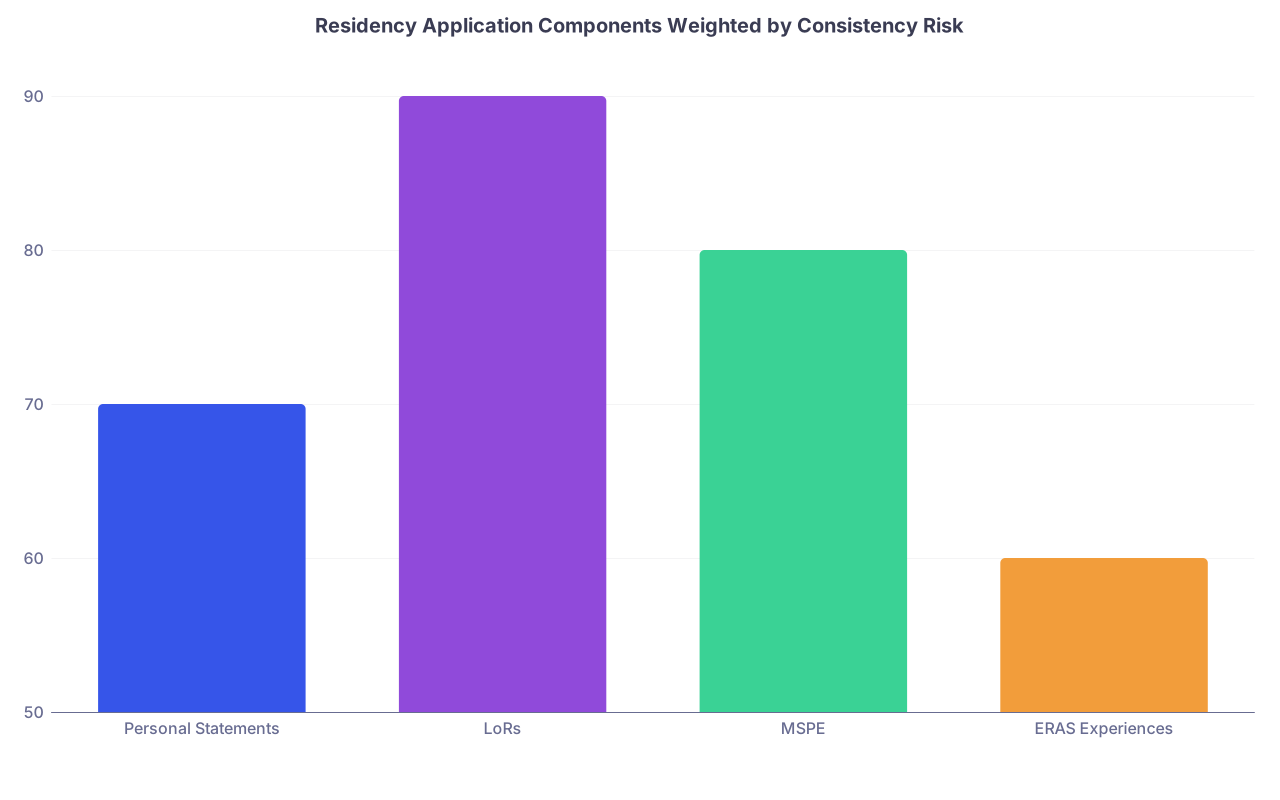
Programs do not read your PS in isolation. They read:
- ERAS experiences and descriptions
- Your MSPE
- Your LoRs
- Your personal statement
All side by side.
| Category | Value |
|---|---|
| Personal Statements | 70 |
| LoRs | 90 |
| MSPE | 80 |
| ERAS Experiences | 60 |
Interpretation: letters and MSPE carry heavy “truth value.” If they contradict your PS, your PS loses.
Concrete checks to run
-
- If a big-name EM letter says: “She is committed to EM as a career; I have no doubt she will be an excellent emergency physician,” and your IM PS says you have always known you wanted IM and do not mention EM at all, that looks suspect.
- You can fix this by:
- Acknowledging genuine exploration.
- Not overstating “I have always only wanted X and nothing else.”
Experience descriptions
- If your ERAS entries scream EM (tons of EM electives, EM interest group leadership, EM research, EM volunteering), but your IM PS claims you have been focused on IM all along, that is a mismatch.
- You can instead say:
- “My clinical experiences in both EM and IM have shown me complementary aspects of complex adult care…”
MSPE comments
- If your dean’s letter already calls out a heavy interest in one specialty, do not pretend that never existed in your PS for another. Acknowledge honest evolution.
You do not have to explain your entire decision tree in the PS. But you cannot pretend documented history doesn’t exist.
Step 7: Use This Side‑By‑Side Contradiction Test
After both drafts exist, stop tweaking in isolation. Compare them.
Print them or split-screen. Then do a fast but brutal test.
| Item to Check | Question to Ask Yourself |
|---|---|
| Core motivation | Do they claim the same main reasons for medicine? |
| Key traits | Are 3–4 core traits consistent in both? |
| View of patients | Do I treat patients the same way in both? |
| Work style preferences | Do I clearly contradict myself on pace/setting? |
| Long-term goals | Are career goals different but compatible? |
If you answer “no” or “they fight each other” for any row, mark the offending lines in both statements.
Then fix by:
- Softening absolute language:
- Change “I could not imagine…” to “I am particularly drawn to…”
- Replacing mutually exclusive claims:
- Instead of: “I do not want X,” describe why Y fits you better.
Do not sanitize everything into vague mush. Just strip out direct contradictions.
Step 8: Write Honestly About Backup Status (Or Do Not Mention It)
Programs know people apply to backups. PDs are not stupid. The real issue is how you handle it, if you handle it at all.
When to NOT mention backup status
Most of the time, in the backup specialty PS, you do not need to say “This is my backup.”
Just write a sincere, robust statement:
- Grounded in your real experiences in that field
- Showing clear understanding of the specialty
- Showing how your traits fit
If you cannot write an honest, genuinely interested statement for your backup, you probably picked the wrong backup.
When a brief acknowledgment can work
Rare scenario: You did 90% of your visible work in one specialty and are now pivoting or dual-applying.
Then a tight, mature sentence or two can help.
Example for IM PS when you have a huge EM footprint:
“Much of my early clinical exposure focused on emergency care, where I learned to manage undifferentiated patients and acute presentations. As I progressed in my training, I found myself increasingly drawn to the longitudinal diagnostic reasoning, multi-morbidity management, and sustained patient relationships that define internal medicine.”
You admit reality. You do not say “IM is my second choice.” You show evolution, not desperation.
Do not grovel with:
- “I know I may not match EM, so I am applying to IM.”
- “IM is a great field even though my first choice is EM.”
That is fatal.
Step 9: Use a Tight Review Protocol (Not a Committee)
Too many cooks wreck personal statements. You do not need fifteen opinions. You need two things:
- Someone in each specialty who can say “this sounds sincere and aligned with our field”
- One person (you) responsible for consistency
Simple review sequence

| Step | Description |
|---|---|
| Step 1 | Draft Core Narrative |
| Step 2 | Write Primary Specialty PS |
| Step 3 | Clone and Adapt for Backup PS |
| Step 4 | Run Contradiction Checklist |
| Step 5 | Specialty Reviewer 1 - Primary |
| Step 6 | Specialty Reviewer 2 - Backup |
| Step 7 | Revise Both Statements |
| Step 8 | Final Personal Consistency Check |
Key rules:
Give each reviewer only the statement for their specialty.
They should judge:- Fit with specialty culture
- Clarity of interest
- Red flags or clichés
You hold both and protect the shared identity and non-contradiction.
Do not let one reviewer rewrite you into a totally different person “for our field.” That is how contradictions slip in.
Step 10: Two Quick Templates You Can Steal
You probably want something concrete. Here you go.
Template 1: Primary Specialty (e.g., EM)
- Hook
- 3–5 sentences; specific clinical moment that shows how you think and work.
- What that moment showed you about yourself
- 1 paragraph; 2–3 traits + tie to your broader motivations.
- Key clinical experiences in the specialty
- 1–2 paragraphs; pick 2–3 concrete experiences. Show reflection, not a list.
- Non-clinical strengths relevant to this specialty
- Brief paragraph: QI, leadership, teaching, research.
- What you seek in residency + long-term goals
- 1 paragraph: training environment preferences, career direction.
- Closing
- 2–3 sentences; circle back to opening; restate fit.
Template 2: Backup Specialty (e.g., IM)
Same structure. Differences:
- Hook can be:
- Same patient/event with a different focus, or
- Another experience that is clearly part of the same story arc.
- Clinical experiences:
- Choose rotations/electives clearly in that specialty.
- Long-term goals:
- Keep consistent traits but adjust setting or scope.
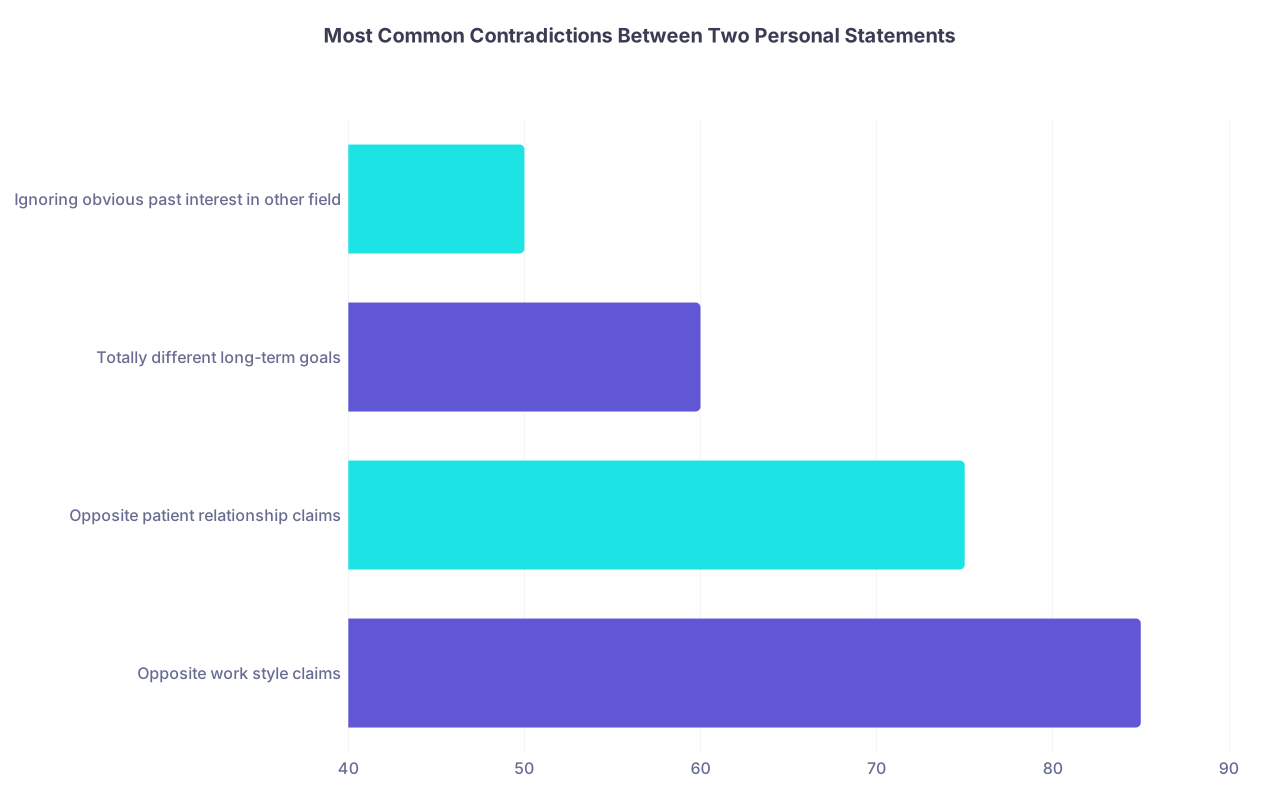
Step 11: Common Mistakes That Make You Look Contradictory
You can avoid 80% of problems simply by not doing these:
| Category | Value |
|---|---|
| Opposite work style claims | 85 |
| Opposite patient relationship claims | 75 |
| Totally different long-term goals | 60 |
| Ignoring obvious past interest in other field | 50 |
Total personality flip
- “I am detail-oriented and deliberate” vs “I thrive on constant rapid decisions and dislike detailed follow-up.”
- Pick the real you. Describe how that fits both fields differently.
Pretending you never liked the other specialty
- PDs know you did 3 EM sub-Is and then applied IM.
- Do not gaslight your own application.
Lifestyle-heavy reasoning
- “I want a controllable schedule” in Derm PS and “I am drawn to intense, variable schedules” in EM PS.
- Avoid lifestyle talk as a core motivator. It is always risky.
Copy-paste with lazy find-and-replace
- Changing “emergency medicine” to “internal medicine” and leaving the rest intact. It always reads wrong and often literally contradicts the specialty realities.
Overstating absolute certainty
- “I can imagine myself in no other field” — then you apply broadly to another field.
- Do not write this if you are dual applying. Simple.
Step 12: A 30‑Minute Audit You Can Do Tonight
You probably already have at least one draft lying around.
Do this:
- Open both personal statement drafts (or your primary PS plus a blank doc).
- At the top of each, write your Non-Negotiables – Do Not Contradict list.
- Highlight:
- In each PS, any sentence that:
- Talks about motivation
- Describes your personality or work style
- States long-term goals
- In each PS, any sentence that:
- For each highlighted sentence, ask:
- “Would this make sense if a PD saw it side by side with the other statement?”
- If the answer is “no” or even “this would raise an eyebrow,” rewrite it now.
You do not need perfection. You need coherence and sincerity.