
You are sitting at your desk in September, ERAS window open, cursor blinking on “Edit Experiences.”
Your preferred specialty tab is done: Personal Statement #1 polished, programs selected, letters assigned.
Then you flip to your backup specialty.
The story falls apart.
Different personal statement. Different experiences. Different letters. You can feel the incoherence. You can also hear the PDs in your head:
- “So… are you actually interested in us, or are we just your backup?”
- “If you could do anything, what would it be?”
- “Tell me how you decided on this specialty.”
If you do this wrong, you do not just look “flexible.” You look unfocused. Or worse—desperate.
Let me walk you through how to fix that. Step by step.
This is how you build a coherent ERAS story across multiple backup fields without tanking your credibility in any of them.
Step 1: Decide If You Actually Need Backup Specialties
First problem: many people back up when they should not, and others refuse to back up when they clearly should.
You decide this before you start story-building, otherwise you waste hours writing personal statements for specialties you will never apply to or, worse, scatter-shoot applications with no clear plan.
A. Brutal risk assessment
Use this as a starting point. Not feelings. Numbers.
| Profile Factor | Likely Safe | Borderline | High Risk |
|---|---|---|---|
| Step 2 score | ≥ specialty mean | 5–10 below mean | >10 below mean |
| Class rank | Top 1/3 | Middle 1/3 | Bottom 1/3 |
| Home program in your desired field | Yes | No but strong away | None and no away |
| Research in target specialty | ≥2 projects with output | 1 project, minimal output | None |
If you are “High Risk” in 2 or more boxes for a very competitive specialty (derm, ortho, plastics, ENT, neurosurgery, urology, ophtho, IR, rad onc):
- You need a backup.
- And you need it early, not in November when interviews are silent.
If you are mid-tier applying to IM or FM with solid scores and no professionalism flags:
- You probably do not need a different specialty backup.
- You might need geographic / program-type backups within the same specialty.
B. Choosing what type of backup you are doing
There are three main backup patterns that actually work:
Adjacent specialty, same “core identity”
Examples:- EM ↔ IM with critical care interest
- Ortho ↔ General Surgery
- Derm ↔ IM with allergy/immunology interest
Step-down in competitiveness, same organ system / patient type
Examples:- ENT → General Surgery or IM with pulm/CC
- Ortho → PM&R with MSK focus
- Anesthesia → IM with CC interest
True rebrand: from hyper-competitive to broad specialty
Examples:- Derm → IM or FM
- Plastics → General Surgery or IM
- Ortho → FM with sports medicine
Pattern #1 is easiest to make coherent. Pattern #3 is the hardest but still fixable if you are disciplined.
If your chosen backup does not fit any of those patterns, you are probably creating chaos for yourself. Rethink.
Step 2: Define a Single Core Professional Identity
Here is the key move everyone skips.
You do not build totally separate stories for each specialty. You build one underlying professional identity, then you express it in specialty-specific language.
That identity should be something like:
- “I am a procedural, team-based acute care doctor.”
- “I am a longitudinal, relationship-focused primary care doctor.”
- “I am a systems + data person who optimizes complex care.”
- “I am a hands-on, anatomy-driven proceduralist.”
You want something that:
- Feels true. You can walk into an interview and talk like you mean it.
- Fits both your primary and backup fields.
- Is visible in your actual experiences.
Here is how you extract that identity from your CV:
- List your top 8–10 experiences (research, leadership, jobs, major volunteering).
- Next to each, jot the real motivation or satisfaction you got from it. Concrete, not fluffy.
- “Working nights in the ED, being the first to stabilize someone”
- “Following the same panel in clinic for 2 years”
- “Building an order set to reduce errors”
- Look for themes:
- Acute vs longitudinal
- Hands-on vs diagnostic thinking
- Individual patient vs system/process focus
- Adults vs kids vs mixed
- Procedures vs counseling vs data/analysis
Once you see the dominant pattern, distill it into one sentence. That sentence becomes your “core identity statement.”
Example that works for EM and IM:
“I am a physician who thrives managing undifferentiated, high-acuity illness and then building systems to make that care more reliable.”
You can sell that to EM. You can also sell it to IM (hospitalist, CC). Coherent.
Write your version down. You are going to reuse it everywhere.
Step 3: Map Each Specialty to the Same Core Identity
Now you translate that identity into specialty-specific language without sounding copy-paste.
Do this on paper first before you touch ERAS.
A. Side-by-side mapping
Take a blank page, draw a line down the middle.
Left: Primary specialty.
Right: Backup specialty.
At the top, write your core identity statement for both.
Under each column, answer the same four questions, but tailored:
- What parts of my core identity show up naturally in this specialty’s work?
- What rotations or experiences reinforce this angle?
- Where could a PD question my fit, based on my CV?
- How do I preempt that concern in my narrative?
Example: Ortho primary → PM&R backup, core identity = “MSK-focused, function-restoring doctor.”
Left (Ortho):
- Identity expression: “Surgical restoration of function after trauma/degeneration”
- Evidence: 2 ortho sub-Is, ortho research, sports med volunteering
- PD concern: Is this person going to leave for fellowship immediately? Too surgically fixated?
- Narrative: Emphasize team rehab, long-term outcomes, not only OR time.
Right (PM&R):
- Identity expression: “Non-operative restoration of function, rehab, MSK medicine”
- Evidence: Spine clinic, sports clinic, PT collaboration, PM&R elective
- PD concern: Are we clearly the backup? Why not ortho?
- Narrative: Emphasize satisfaction in longitudinal rehab, interdisciplinary teams, outpatient function.
You are not pretending the specialties are identical. You are showing they are two legitimate paths to the same core aim.
That is coherence.
Step 4: Build a Controlled, Consistent ERAS Application Spine
Think of your ERAS app as having a “spine” that must be consistent regardless of specialty:
- Personal facts and values
- Major experiences and what you learned
- Core professional identity
- Trajectory (how you got here, what you want next)
You are not going to reinvent that spine for each backup field. That is how people sound fake.
A. Experiences section: same facts, different emphasis
You will usually use the same experiences for all specialties, but:
- You change which 3 you mark as “most meaningful.”
- You tweak a few descriptions (subtly) if you are pushing in different directions.
For each major experience, answer:
- What skill or value does this show that both specialties care about?
- Is there a specialty-specific phrase I can use that still feels true?
Example: ED research assistant.
- For EM: Emphasize undifferentiated patients, rapid decision-making, resuscitation exposure.
- For IM: Emphasize sepsis protocols, reducing time to antibiotics, improving hospital outcomes.
Do not say totally different things. Same core story, slightly different angles.
B. Activities you should not hide
Do not scrub out evidence of your primary specialty from your backup app. That looks worse.
If you did an ortho sub-I and you are also applying PM&R, keep it. You just frame it.
Example line in your PM&R personal statement or interview:
“My orthopaedic sub-internship confirmed how much I care about musculoskeletal function. I enjoyed the OR, but I found myself most engaged when patients returned to clinic months later and we discussed their rehab, their gait, their return to sport. That is why I am pursuing PM&R—because I want to own that functional arc more fully.”
Own the earlier interest. Show the pivot as purposeful, not a panic move.
Step 5: Write Personal Statements That Align But Do Not Copy
Personal statements are where applicants torch coherence. They write:
- One “this has always been my dream” essay for the primary.
- And a limp, generic, “I like variety and procedures” for the backup.
You need both statements to:
- Share the same origin and core values.
- Diverge in how those values led you to each specialty.
A. Use a shared origin, then branch
Structure I recommend:
Opening anecdote / early influence
Same story or theme can appear in both. Acute event, longitudinal relationship, system failure you want to fix.How it shaped your identity as a physician
Exact same values language is fine here.Branch point: why this led you specifically to [specialty]
This is where the two statements differ.Evidence: rotations, work, research that fit that specialty
Overlaps allowed, but the interpretation shifts.Future direction that sounds realistic for that field
Different for each specialty but still rooted in your identity.
Example: Core identity = “complex chronic disease + relationships.”
- IM PS: Focus on clinic continuity, inpatient complexity, maybe heme/onc or rheum as long-term aim.
- FM PS: Focus on full-spectrum, cradle-to-grave care, community context, behavioral + social drivers.
Same origin, different expressions. Coherent.
B. Avoid these two fatal lines
In your backup personal statement, never write:
- “Although my original interest was in [primary specialty]…”
- “Because [backup specialty] is less competitive…”
Yes, people actually write some version of that. No, you cannot do it.
You can say:
“My early exposure was heavily oriented around surgical care, and I valued that experience. Over time though, I realized my favorite part of that work was following patients through rehab and seeing their function return. That shift in what I found most meaningful is what drew me toward PM&R.”
That is honest, mature, and plausible.
Step 6: Align Letters of Recommendation Without Looking Two-Faced
Letters can absolutely blow your coherence if you are careless. PDs will forgive a bit of “trying on” if they feel you are acting in good faith. They do not forgive obvious double-booking.
A. Decide your letter strategy upfront
There are three sane patterns:
Pure split
- 3 letters for primary specialty
- 3 letters for backup specialty
- You assign appropriately in ERAS.
Shared generalist letters + specialty-specific letters
- 1–2 departmental letters in each specialty
- 1–2 general “this is a strong future physician” letters from IM, peds, surgery, etc.
- You mix and match.
All in one basket (if backup is closely related and you are late)
- All letters in one field but used for both (e.g., IM letters used for IM and FM).
- Only works if the fields are adjacent enough that the letter still makes sense.
If you are backing up derm with FM, do not use 3 derm letters for FM. One might be okay. Three screams “this person will leave the second they match derm fellowship.”
B. Tell your letter writers the truth—but with a frame
What you actually say:
- “I am applying primarily to orthopaedics, but I will also be applying to PM&R as a related field because of my interest in MSK and function. I would value a letter that comments on my clinical performance and my fit for musculoskeletal-focused care. I will be assigning your letter to [these specialties].”
Most attendings respect that. They see this every year.
Do not hide from them which specialties you are applying to. The risk of them mentioning the “wrong” field is high if you do.
Step 7: Program List Strategy That Matches Your Story
A coherent story that you send to an incoherent list of programs still looks bad.
You want your rank lists of programs (within each specialty) to “make sense” for who you say you are.
A. Build targeted, not random, backup lists
Within the backup field, prioritize programs that:
Naturally align with your stated interests
(e.g., strong MSK/rehab at a PM&R program if you are coming from ortho; strong sports med FM programs if you were originally EM/ortho).Have a track record of people with backgrounds like yours
You can spot this from:- Resident bios mentioning prior careers / reorientation
- Chief bios showing EM-to-IM, surgery-to-anes type stories
Are not hyper-competitive if you are already stretching with your primary field
Your backup list should contain a higher proportion of community and mid-tier programs.
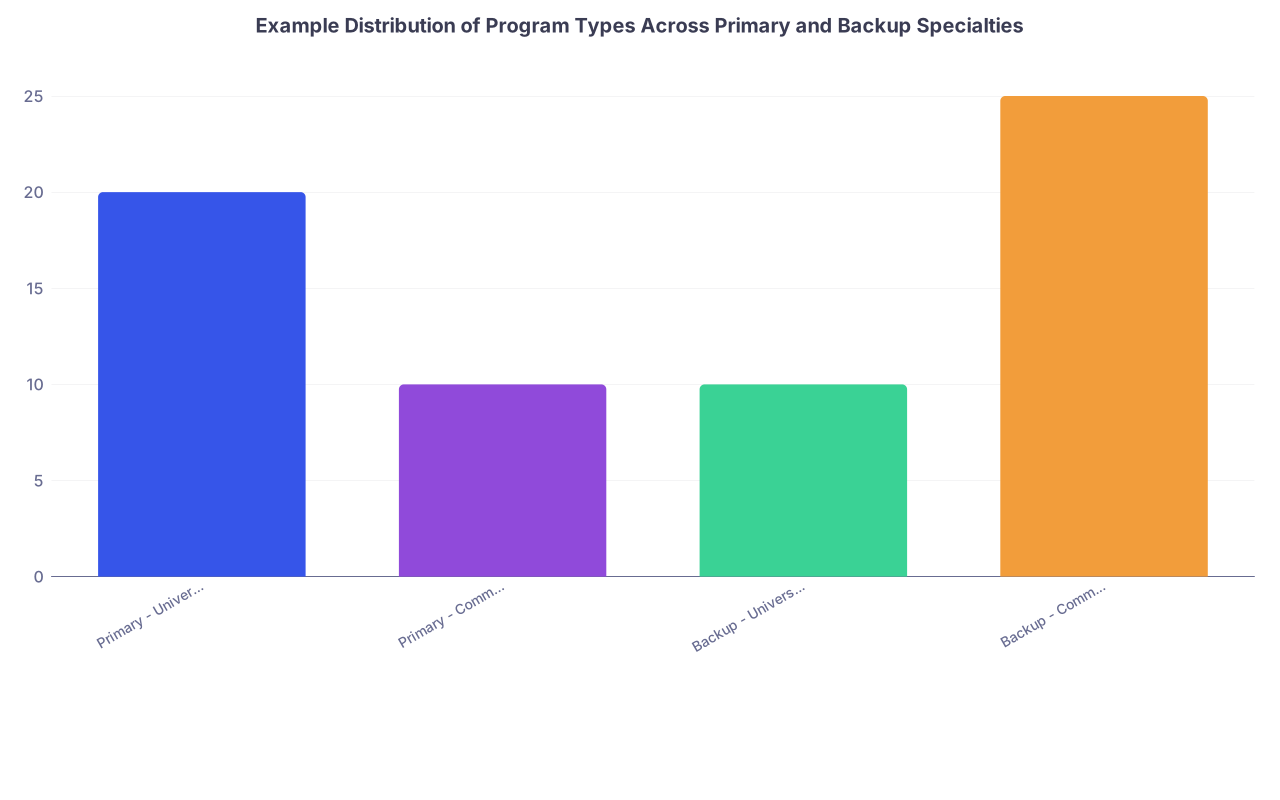
| Category | Value |
|---|---|
| Primary - University | 20 |
| Primary - Community | 10 |
| Backup - University | 10 |
| Backup - Community | 25 |
You do not need to show this chart to anyone, but if your internal bar for “community vs university” looks like that, you are thinking correctly.
B. Geographical coherence
If your primary specialty list is all coasts and big cities and your backup is entirely rural Midwest, you invite “are we just the safety net?” questions.
Whenever possible:
- Overlap at least some regions between primary and backup.
- Be ready with an honest explanation if there is a geographic gap.
Step 8: Pre-Write Unified Answers to the Obvious Interview Questions
The real coherence test is not ERAS. It is your mouth on interview day.
If you stumble on these questions, you are done:
- “What other specialties did you consider?”
- “If you matched here and also at [other specialty], how would you choose?”
- “Tell me about how you landed on [specialty] specifically.”
You need tight, rehearsed, honest answers that:
- Do not lie about the existence of other applications.
- Do not make the interviewer feel like they are your second choice.
- Anchor back to your core identity.
A. Script your core answer pattern
Here is a template that actually works:
“I considered both [primary] and [backup] seriously because they each let me pursue [core identity: e.g., complex acute care and critical decision-making].
Over time, I found that what I valued most was [specific aspect that differentiates this field]. For example, in [experience], I really enjoyed [X]. That is why I am focusing my applications on [this specialty now / this kind of work].
If I had the chance to do [this specialty] in a program that supports [your specific goals here], that would be my top choice.”
Then, for the backup field version:
“I applied to a small number of programs in [other specialty] because they also address my interest in [core identity], but in a different way. What appeals to me about your program and this field is [field-specific feature]. If I matched here, I would be very satisfied, because it still lets me do [core identity outcome] that I care about.”
Key move: you never say “I only applied here because I needed a backup.” You also never say “I would definitely rank [other specialty] above you.” You keep it focused on fit with your identity and their program.
Write this out for yourself. Edit until you can say it without flinching.
Step 9: Make the Timeline Work For You, Not Against You
Backing up across fields is not just a narrative problem. It is a logistics and timing one. If you mishandle the timing, your story looks like a last-minute scramble.
Here is a sane project plan.
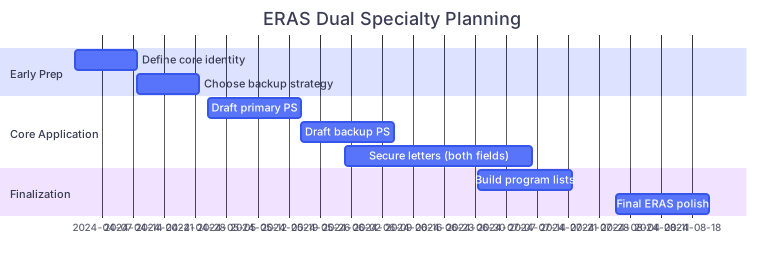
| Task | Details |
|---|---|
| Early Prep: Define core identity | a1, 2024-04, 2w |
| Early Prep: Choose backup strategy | a2, after a1, 2w |
| Core Application: Draft primary PS | b1, 2024-05, 3w |
| Core Application: Draft backup PS | b2, after b1, 3w |
| Core Application: Secure letters (both fields) | b3, 2024-06, 6w |
| Finalization: Build program lists | c1, 2024-07, 3w |
| Finalization: Final ERAS polish | c2, 2024-08, 3w |
If you are already in September reading this, compress the work, but do not skip the identity step. That is what keeps the whole structure from falling apart.
Step 10: Fixing Messes You Already Made
Some of you already submitted ERAS or at least drafted everything and now realize:
- Your backup PS reads like a panic move.
- Your experiences are labeled in a way that screams “derm or bust.”
- Your letters are lopsided.
You can still salvage.
A. If ERAS is not submitted yet
- Rewrite only what conflicts with your core identity.
Do not rebuild from scratch.
Fix the worst inconsistencies:- Backup PS: Add coherent explanation of interest.
- Experiences: Adjust which are “most meaningful” for each specialty.
- Reassign letters where you can.
Make sure each specialty has at least one letter that makes sense in that field.
B. If ERAS is already submitted
Focus on interview performance and post-submission communication:
- On interview day, proactively tell the coherent version of your story.
- In second looks / emails, emphasize your genuine interest in that specialty’s version of your core identity.
- If you get more interviews in one field than the other, lean into that field when signaling enthusiasm. That is your market speaking.
You cannot retroactively change ERAS, but you can change how PDs interpret it.
Concrete Example Walkthrough
Let me give you a compact, real-style scenario so you can see all of this tied together.
Student:
Step 2: 233. Middle of the class.
Primary interest: Emergency Medicine.
Backup: Internal Medicine hospitalist track.
Core identity statement:
“I am a physician who enjoys undifferentiated acute illness, stabilizing patients, and then optimizing inpatient systems to deliver that care reliably.”
Experiences:
- 2 ED rotations, ED research on sepsis protocols
- IM rotation with strong evals, QI project on readmissions
- Volunteer: community clinic triage, night shifts
EM personal statement:
- Origin: Overnight ED shift where a septic patient came in crashing.
- Identity: Thrives in acute undifferentiated presentations, rapid coordination.
- Evidence: ED rotations, leadership as senior med student in codes.
- Future: Academic EM with focus on ED sepsis workflow QI.
IM personal statement:
- Same origin story, but with a different focus: “I admitted this patient to medicine and followed them over the next 4 days.”
- Identity: Enjoys understanding and managing the full trajectory of acute illness in the inpatient setting.
- Evidence: Medicine rotation, QI in readmissions, research on sepsis bundles affecting inpatient mortality.
- Future: Hospitalist with involvement in sepsis QI and maybe future CC fellowship.
Same spine. Two coherent specialties.
If asked in an IM interview: “Did you consider EM?”
Answer:
“Yes. Most of my early exposure was in the ED, and I appreciated that environment. Over time, though, I realized I was most fulfilled when I followed those patients on the medicine floors—managing their organ dysfunction day by day, coordinating with consultants, and working on the systems that keep them safe during their stay. That is why all my applications are focused on Internal Medicine programs with strong inpatient training.”
Simple. Honest. Coherent.
Your Next Move Today
Do not start by rewriting your personal statements. That is how you lose another night to editing without fixing the underlying problem.
Do this instead:
- Grab a blank page.
- Write your core professional identity statement in one sentence.
- Under it, make two columns: primary specialty and backup specialty.
- For each, jot 3–4 ways that specialty is a legitimate path to express that identity—using examples from your actual rotations and experiences.
If you cannot do step 4 convincingly for the backup field, you do not have a coherence problem. You have a backup specialty problem.
Fix that choice first. Then build the story.