
It’s mid-September. You’re sitting with your ERAS open, one tab on your dream specialty, one tab on something “safer.” Your mentor just said the line everyone hates: “You should probably have a backup.”
But no one can give you a straight answer: which backup specialty actually helps you, and which one quietly tanks how both specialties see you?
Let me tell you what really happens on the other side of that portal. In the selection committee room. In the email threads you never see. In the side comments when your name comes up:
“He’s applying IM and neuro. Honestly? Makes sense.”
“She’s doing ortho, gen surg, EM? Feels scattered. Hard pass.”
Same Step score. Same research. Different backup strategy. Very different fate.
Let’s dissect why.
How Program Directors Actually Read Your “Dual” Application
When your name comes up in a rank meeting, nobody says, “Her personal statement was so heartfelt.” They say:
“Where else did she apply?” “Is she serious about us or just hedging?” “Does her story track with that?”
And yes, they do look.
Some programs outright ask in interviews: “What other specialties did you apply to?” That’s not small talk. That’s a calibration question. They’re deciding if you’re:
- A realistic planner who made a smart, coherent backup choice
or - A panicked applicant spraying ERAS everywhere and hoping for the best
The dirty little secret: certain specialty pairings actually increase your credibility with both sides. You look like someone who understands your strengths, understands the system, and is wanted by multiple departments. Other combinations scream, “I panicked on September 27th.”
The goal here is simple: pick a backup that:
- Makes narrative sense with your primary choice
- Uses a shared skills/reputation base
- Does not look like a last-minute, random pivot
You do that right, and a surprising thing happens. Committees start saying, “If we don’t grab this one, IM/Psych/Neuro will. Let’s not lose them.”
That’s what you want.
The Combos That Quietly Impress (And Why)
I’m going to walk through the combinations that, behind closed doors, usually get nods of approval rather than eye rolls. Are these universal? No. But I’ve watched these conversations at big-name and community programs, and patterns repeat.
1. Internal Medicine + Neurology
This is one of the “cleanest” combos. It rarely raises red flags.
Why PDs like it:
- Shared core: both are brain-heavy, exam-heavy, complex inpatients, a lot of overlap in pathophys and pharmacology.
- The logic is obvious: “I love complex diagnostic puzzles; I’m happiest on the medicine floor but really enjoy neuro-heavy cases.”
- You can frame either as the “backup” and still look coherent.
What PDs actually say:
“I’m not mad at IM + Neuro. Shows they like thinking specialties. They’ll be fine on our service.”
This combo becomes impressive when your story is consistent: neuro electives, IM sub-I, stroke research, maybe some epilepsy clinic time. Not random neurology slapped on in August to look “broad.”
2. Internal Medicine + Psychiatry
This is more common than applicants realize, and when done right, it’s respected.
Why it works:
- You’re signaling interest in complex, longitudinal care: medically and psychosocially complex patients.
- Academically, combined Med-Psych programs exist. So the IM/psych overlap is already “normalized” in academic minds.
- Both fields appreciate good communicators who can sit in ambiguity.
What PDs mutter:
“If they’re applying IM and Psych, they’re probably not going to hate our sick, complicated patients with depression and substance use. That’s a plus.”
The catch: if all your experience is surgically heavy and suddenly you’re applying Psych + IM with zero continuity clinic or mental health exposure, it looks less like a thoughtful pairing and more like you gave up on surgical scores late.
3. Pediatrics + Child Neurology / Peds Neuro / Peds Psych
Anyone who’s sat on a pediatrics rank committee has seen this: peds applicants also applying child neuro or triple-boarding adjacent fields.
Why it’s seen positively:
- Shows commitment to kids, not indecision. You’re not wavering between “kids or adults,” you’re wavering between “kids in general” and “kids with more specific neuro/mental health needs.”
- Peds PDs often feel robbed by child neuro programs. They know they’re fishing in the same pool. When they see “Peds + Child Neuro,” the reaction is usually, “This is the kind of resident we want even if they subspecialize later.”
For child neuro or peds psych, seeing straight peds applications alongside theirs feels like a natural spectrum, not betrayal.
You look like someone with a centered identity: “I’m a pediatrician at heart; I’m just choosing how specialized.”
4. Emergency Medicine + Anesthesiology (when framed correctly)
This one surprises students, but on the inside, EM + Anesthesia can look mature. Or chaotic. Depends how you sell it.
Why it can impress:
- Both are acute-care, airway-heavy, physiology-driven fields.
- Strong overlap in skill set: resuscitation, lines, airway, hemodynamics.
- The anesthesia PD knows: “If they like ED resuscitation, they’ll like trauma cases, critical care, OR resuscitations.”
The key is narrative discipline. If your materials for both scream “I hate long-term follow-up, I love physiology and procedures, I like shifts and intense bursts,” that tracks. Do not write one statement talking about loving continuity of care and another about hating clinic. They will catch that.
When this combo looks bad: when you’ve also applied to IM, FM, and maybe radiology. Now you’re just throwing darts.
5. General Surgery + Vascular / Integrated but Safer Fields
Not quite a “backup specialty” in the traditional sense, but there are surgical applicants who apply both categorical general surgery and specialties like vascular or even integrated fields while simultaneously ranking prelim gen surg widely.
What impresses PDs:
- Clear surgical identity. You’re not leaving surgery. You’re just open to which path.
- Programs know the surgical match is vicious. So seeing a candidate with a wide net in surgery but not a simultaneous “I’ll just go do FM if this fails” can read as commitment, not recklessness—especially if they’ve hedged with preliminary years.
Gen Surg PD perspective:
“They applied vascular and some straight categorical. Fine. They’re a surgery person. If they end up in our program, they’ll still work their ass off here.”
The danger is when your “backup” is so non-surgical (like EM or FM) that it makes them question your resilience in a surgical lifestyle. That’s where gen surg committees sometimes sour.
6. Internal Medicine + Radiation Oncology (for late pivots)
In the last few years, with rad onc match volatility, there’s a subset of applicants doing IM + Rad Onc.
Done poorly, this looks like a confused applicant chasing prestige.
Done well, it can actually impress both sides.
Why:
- IM PDs see a sharp, research-heavy candidate who might end up doing oncology anyway.
- Rad Onc PDs see someone who understands systemic disease, wants to stay close to cancer care, and isn’t naïve about the job market, so they smartly kept a solid IM option.
The phrase I’ve literally heard in a meeting:
“Honestly, if we don’t take them, IM will, and they’ll probably become a heme/onc doc anyway.”
That underlying respect—“someone else will want them”—is leverage for you.
7. Family Medicine + Psychiatry or Pediatrics
Family medicine PDs are more used to seeing dual-interest people than any other specialty. They’re more philosophical about it.
FM + Psych:
Looks good when you clearly value behavioral health, rural or underserved care, and longitudinal patient relationships. Many FM programs pride themselves on strong psychiatry training; you basically validate their identity.
FM + Peds:
Again, this can read as “I just want to care for kids but I’m open to full-spectrum if needed.” FM PDs know some people discover they love adult medicine during residency. They’re not offended.
These combinations respect FM as a real, intentional choice, not as “whatever’s left.” That distinction matters enormously.
The Combos That Quietly Hurt You (Even If No One Says It)
Now the ugly part. No one writes this down, but everyone talks about it.
Some combos make you look like you don’t know who you are. Or like you haven’t really understood what these jobs feel like.
Let’s be blunt.
Surgical + Completely Non-Procedural Primary Care (with no story)
Example: Ortho + FM. Gen Surg + FM. ENT + FM. With no clear explanation.
This sets off alarms:
- Lifestyle and personality mismatch. It makes people wonder if you actually understand what surgery entails.
- Looks like a safety parachute thrown in late September, not a planned backup.
- FM PDs sometimes think: “We’ll end up being their consolation prize. They’ll be miserable here.”
Can this be done respectfully? Rarely. You’d need a compelling, consistent narrative (small town upbringing, deep FM exposure, plus genuine love of surgery as a skill set but an understanding you’d also be happy in FM). Most people don’t have that, and PDs can tell.
Triple or Quadruple Specialty Shopping
EM + IM + Anesthesia + FM.
Ortho + Radiology + Anesthesia + PM&R.
When this comes up in a room, someone inevitably says:
“They don’t know what they want. That’s risky.”
From their perspective, residency is not a “try before you buy.” It’s a 3–7 year commitment where they will invest enormous faculty time, money, and energy in you. They want people who might change subspecialties later, yes, but not people who still can’t decide what kind of physician they are.
If you’re in this boat mentally, fine. But you can’t afford to show that level of diffusion to every program.
EM + Radiology (or other “lifestyle-chasing” vibes)
This combo can read poorly if you’re not careful. On paper it’s: acute mind vs slow, analytical imaging mind. Very different clinical feel.
If all your statements talk about “lifestyle,” “shifts,” “flexibility,” “more time outside the hospital,” PDs see it immediately: you’re shopping for a job, not a calling.
Radiology PD comment I’ve heard:
“EM + Rads tells me they want high pay, control over schedule, and no longitudinal care. They’ll burn out fast if they don’t actually love imaging.”
Could you make EM + Rads make sense? Barely. Maybe if you’re obsessed with ED imaging, protocoling, or want IR eventually. But even then, you’re swimming upstream.
Why Some Backup Choices Actually Make You More Attractive
Here’s the twisted thing. The right backup doesn’t just protect you; it can elevate your stock.
When PDs see:
- Strong board scores
- Solid letters
- A coherent primary specialty choice
- And a smart, adjacent backup
they make a very human leap:
“If we do not jump on this person, someone else will. They are wanted.”
Loss aversion kicks in. Nobody wants to be the program who passed on the resident that became a star across the hall in neuro or down the street in IM.
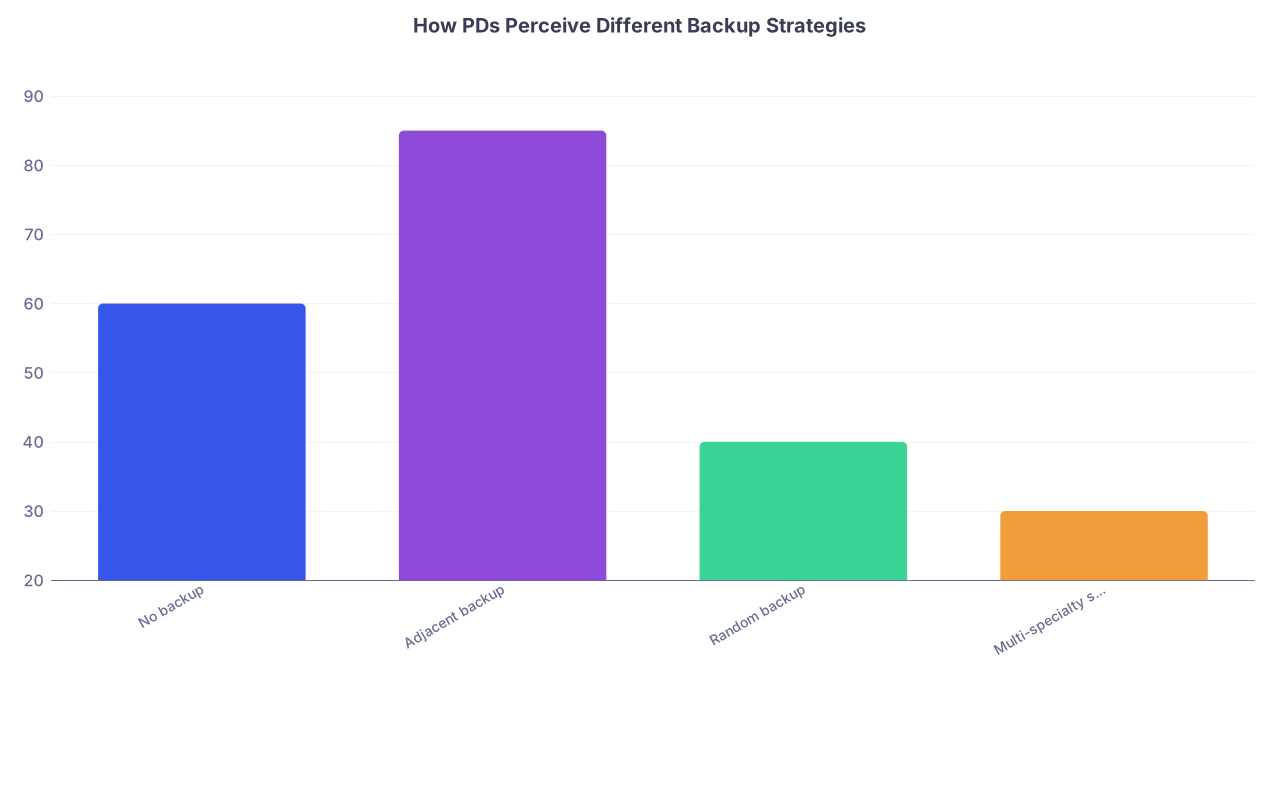
| Category | Value |
|---|---|
| No backup | 60 |
| Adjacent backup | 85 |
| Random backup | 40 |
| Multi-specialty shopping | 30 |
That chart sums up countless conversations I’ve heard. “Adjacent backup” applicants are often seen as deliberate, self-aware, realistic. Honestly, they feel safer to rank highly than the “all eggs in one basket” person who will collapse if they do not match their single dream.
How To Make Your Backup Combo Look Strategic, Not Desperate
Let’s get practical. You’re not just picking specialties. You’re building a story that has to survive being read by time-crunched people who’ve seen thousands of these.
1. Decide what kind of physician you are at your core
Forget labels for a second. Are you:
- Acute resuscitation and quick decision-making?
- Slow, longitudinal relationships?
- Systems/diagnostic puzzles?
- Procedural addict?
- Kids vs adults?
Once you answer that, your backup should be in the same psychological neighborhood.
EM + Anesthesia fits the “acute physiologist” profile.
IM + Neuro fits “complex inpatient/comorbidity brain.”
FM + Psych fits “whole-person, longitudinal, biopsychosocial.”
If you cross neighborhoods—like Ortho + Psychiatry—people will question your self-knowledge. You might have a rare life story that explains that. Most people do not.
2. Align your experiences and letters for both choices
Program directors absolutely pay attention to letters. They know which attendings write generic fluff versus meaningful comparisons.
If you’re applying IM + Neuro, a dream letter looks like this:
“This student functioned at the level of an intern on our stroke service. I could easily see them excelling in either neurology or internal medicine.”
Notice: the attending is validating both paths.
Same idea for EM + Anesthesia:
“They were outstanding in the ED, and their grasp of airway and hemodynamics would make them an asset in any acute care specialty, including anesthesia.”
You get statements like that by talking to your letter writers openly:
“I’m applying to both EM and Anesthesia. The common thread for me is acute care, airways, and resuscitation. If you feel comfortable, I’d appreciate you highlighting that.”
That kind of honesty does not hurt you. It makes you look like a grown adult.
3. Tailor your personal statements so they rhyme, not contradict
If PDs compare your statements—and yes, some do—you cannot sound like two different humans.
Bad version:
- EM PS: “I dislike longitudinal clinic and prefer episodic care without following patients long term.”
- FM PS (backup): “Continuity of care has always been my deepest passion.”
You’re lying to someone. They know.
Better version (for IM + Neuro, as an example):
- IM PS: Emphasize love of complex, multisystem disease, long admissions, team-based inpatient problem solving.
- Neuro PS: Emphasize how your fascination with the nervous system grew out of caring for neurologically complex inpatients on medicine.
Same core identity. Different zoom level.

| Step | Description |
|---|---|
| Step 1 | Core Identity |
| Step 2 | Primary Specialty Story |
| Step 3 | Backup Specialty Story |
| Step 4 | Shared Skills |
| Step 5 | Coherent Application |
4. Be honest but smart when asked about your backup in interviews
The nightmare scenario in applicants’ heads: “If I admit I have a backup, they won’t rank me highly.”
Reality: most PDs know you have at least considered one. Some respect you more if you’ve thought things through.
Here’s the version of the answer that tends to land well:
“I focused my applications on [Primary Specialty], but I did also apply to [Backup] at a smaller number of programs that share my emphasis on [common thread – e.g., complex inpatient care/acute care/child health]. Regardless of where I match, I see myself caring for [type of patients] and using [shared skills]. This program is at the top of my list because [specific reasons].”
You’re:
- Not denying reality
- Showing there’s a through-line
- Reassuring them they’re not a generic checkbox
What bombs is: “Well, I applied EM, Anesthesia, IM, and FM because I just like everything.” That’s exactly what PDs don’t want to hear.
A Few Backup Combos That Often Work Well (And Why)
Here’s a quick look at some combos that frequently get a nod rather than a wince:
| Primary | Backup | Why It Works Briefly |
|---|---|---|
| Neurology | Internal Med | Shared inpatient, complex pathophys |
| Internal Med | Psychiatry | Med-psych overlap, longitudinal care |
| Pediatrics | Child Neuro | Clear kid-focused identity |
| Emergency Med | Anesthesia | Acute care, airway, resuscitation |
| Family Med | Psychiatry | Behavioral health, holistic care |
These aren’t the only ones, but they’re patterns I’ve seen repeatedly across institutions.
When Your Dream Specialty Is Hyper-Competitive
Let’s talk about the people trying to match Derm, Ortho, ENT, Plastics, Neurosurg, or Rad Onc. The “backup” conversation is different here.
Behind closed doors, PDs know three truths:
- Many of you statistically will not match your dream.
- Many of you are planning a pivot but are afraid to admit it.
- Some of you would be outstanding in other specialties if you got over the prestige hangup.
If you’re in that cohort, the backup specialty that impresses is one that respects your core strengths rather than pretending you suddenly became someone else.
Examples:
- Derm → IM (heme/onc, rheum, allergy down the line). Narrative: complex systemic disease, immunology, chronic care.
- Ortho → PM&R. Narrative: MSK, function, rehab, procedures, sports.
- ENT → Anesthesia or Radiology. Narrative: head & neck anatomy, procedures, OR-based work.
- Rad Onc → IM. Narrative: longitudinal oncology care, complex cancer patients.
What does not impress is pretending in October that you’ve “always dreamed of being a rural FM doc” when everything in your CV screams ultra-academic microspecialist.
Be honest with yourself, then build a story the committee can believe.
The Bottom Line
Some backup specialty combinations quietly boost how programs see you. Others whisper that you’re lost. The committees won’t email you and say, “Your combo hurt you.” They will just move your name down a few spots. Or off the list.
Your job is to:
- Pick a backup in the same psychological neighborhood as your primary.
- Align your experiences so both specialties feel rooted in who you are.
- Write and speak in a way that makes the combo look like insight, not panic.
Years from now, you will not remember the exact wording of your backup personal statement. You will remember whether you were honest about who you are—and whether you had the courage to choose specialties that actually fit you, not just impress other people.