
The idea of a “lifestyle” backup specialty has wrecked more careers than a low Step score.
Not because lifestyle is bad. Because people pick backups based on vibes, gossip, and Reddit threads without any serious understanding of what they are trading away—or walking into.
You are not just choosing a shift schedule. You are choosing your patient population, your day-to-day cognitive tasks, your physical workload, your long‑term earnings ceiling, your geographic flexibility, and your risk of burning out in a field you never really wanted.
Let me walk you through the mistakes that quietly destroy options.
The Myth of the “Lifestyle Backup”
The biggest lie floating around medical schools right now is this: “If my competitive specialty does not work out, I will just do a lifestyle specialty like radiology, anesthesiology, EM, or maybe psych. It will be fine.”
No. It might be fine. It might also feel like slow suffocation five years in.
The mistake is simple: treating “lifestyle” as a single category and assuming any of those specialties are interchangeable with your dream field, just with better hours. They are not.
You need to understand three things:
- These specialties are not personality-neutral.
- Their “lifestyle” advantages are highly context‑dependent.
- Once you lock into one, switching out is nontrivial and sometimes nearly impossible.
What students think “lifestyle specialty” means
When I ask MS3s what they mean by lifestyle, they usually give me some version of:
- Predictable hours
- Less overnight call
- Good pay
- “I want to see my family”
- “I do not want to be miserable like the surgery residents”
So they throw anesthesiology, radiology, dermatology, EM, PM&R, pathology, and psychiatry into one mental bucket.
Reality: those fields have radically different work environments, job markets, risk profiles, and personalities. Choosing “anesthesia as a backup to ortho because lifestyle” is like saying, “If I do not get into architecture, I will just do accounting. They both use math.”
On paper, maybe. In your actual brain? Completely different job.
Tradeoff #1: Personality and Cognitive Style Mismatch
If you pick a lifestyle backup without understanding your own cognitive style, you are volunteering for long‑term dissatisfaction.
Radiology and anesthesia are not generic “doctor lite” jobs
I have lost count of how many students said, “I will probably just do rads if derm does not work out. Still good money, chill lifestyle.” Then they rotate and discover:
- Radiology is hours of sustained visual attention, pattern recognition, and decision‑making in uncertainty with minimal social interaction. You live in a dark room. Your “patient contact” is mostly pixels and phone calls with annoyed clinicians.
- Anesthesiology is high‑acuity physiology in real time. Short, intense relationships with patients, constant vigilance, and high consequence errors. Blocks of boredom with spikes of terror. You must be comfortable making rapid decisions with imperfect data, again and again.
If your favorite time in med school was sitting with a family for 40 minutes explaining prognosis, you will be miserable reading CTs all day. If you love longitudinal relationships and continuity, EM and anesthesia will likely feel empty over time.
The personality trap
Here is the quiet disaster: many students pick “lifestyle” fields that directly conflict with what they actually enjoy.
Common bad patterns I have seen:
- Extroverted, relationship‑driven students backing up into radiology because it “pays well and is chill”
- Longitudinal-care lovers backing up into EM because “no clinic, good schedule”
- Hands‑on, procedural people backing into psychiatry because “no notes overhead and telehealth is flexible”
Those students often do fine in residency. You can grind through most things for 3–4 years. The problem appears in year 5–10 of practice when the mismatch really sinks in.
If you are going to pick a backup, make sure:
- You have actually done a rotation that reflects the real job, not just a curated student experience.
- You pay attention to what your brain feels like at 3 p.m. in that specialty. Drained or energized?
- You ask practicing attendings, “Who is unhappy in this field? Why?”
The mistake is assuming that any “lifestyle” field is a safe generic landing spot. It is not. It must fit your temperament just as much as your primary choice.
Tradeoff #2: Lifestyle Is Highly Dependent on Practice Setting
The “lifestyle” you think you are buying may not exist in your market.
Plenty of students have said, “I want radiology because 8–5, no call.” Then they end up in a private practice group doing:
- Early start reads
- Evening shifts
- Weekend coverage
- Telerads nights to maintain income
Same goes for EM: “12 shifts a month, life is good.” That was 2005. Now you are looking at:
- Shift creep
- Charting load
- Boarding crisis
- Decreasing reimbursement and consolidation
Or anesthesia: “Good hours, great pay.” Then the group sells to a large management company, staffing is tight, and you are doing later cases and more add‑ons than you were promised.
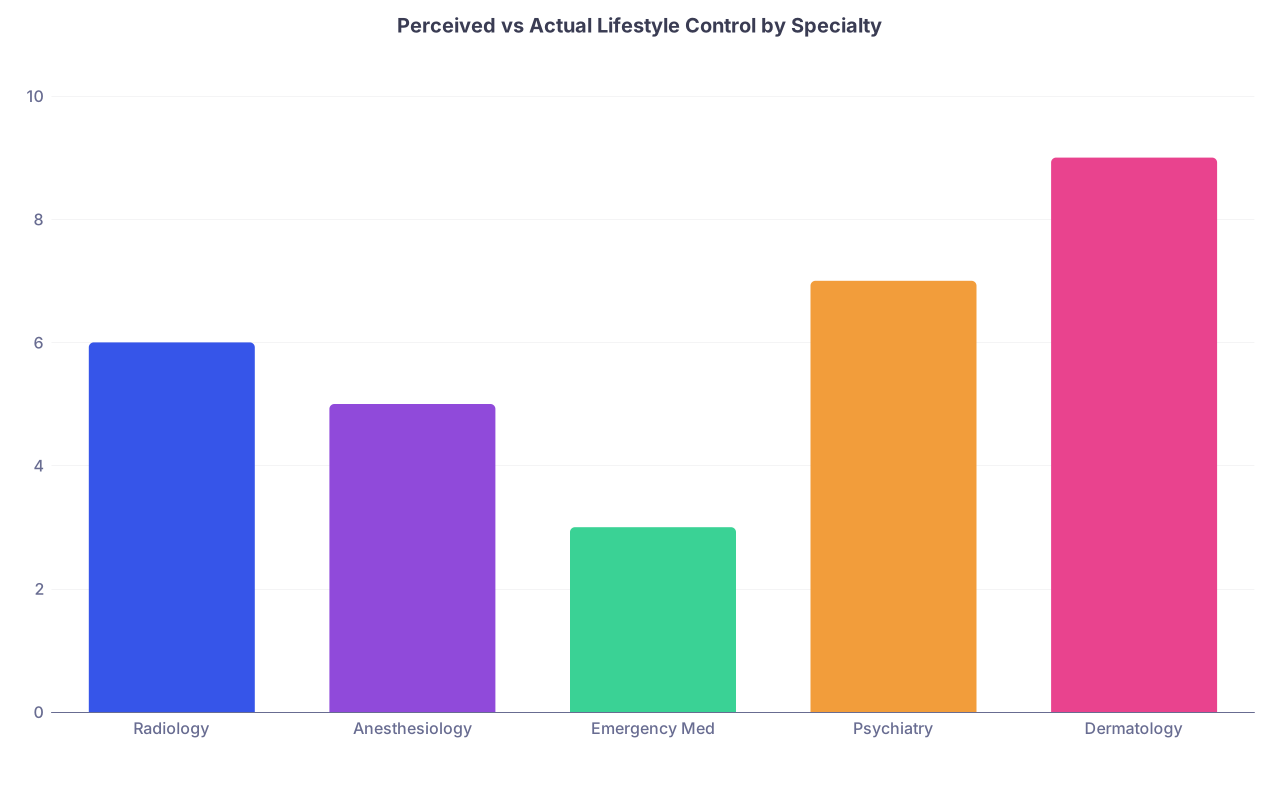
| Category | Value |
|---|---|
| Radiology | 6 |
| Anesthesiology | 5 |
| Emergency Med | 3 |
| Psychiatry | 7 |
| Dermatology | 9 |
(Scale 1–10, based on how much real control you generally have over hours and work environment. This is not scientific, but it is closer to the truth than the marketing.)
Geography and job control
Another nasty tradeoff: some “lifestyle” specialties have terrible geographic flexibility if you care about specific cities or regions.
- Dermatology: fewer jobs, highly desirable locations fill fast, may need to sacrifice location or accept lower pay.
- Academic radiology: often clustered in major cities, with big pay cuts compared to private practice.
- EM: oversupplied in some markets, jobs drying up or offering questionable terms.
- PM&R: niche markets; you may find fantastic jobs or very sparse options depending on region.
If you pick a backup simply because the “day in the life” looks good on YouTube and ignore the long‑term job market, you may trap yourself in a narrow set of locations or practice structures.
Ask bluntly:
- Where are graduates of this specialty actually working 5 years out?
- What compromises are they making on location, schedule, or income?
- What happens in a recession or policy change to this field?
Do not assume your residency “vibe” is the lifestyle you will have in practice. Residents have a distorted view of lifestyle fields because they are shielded from some market realities.
Tradeoff #3: Competitiveness, Signaling, and Burning Bridges
One of the worst mistakes I see every cycle: people apply to a “lifestyle backup” without fully committing either way. They try to hold onto their dream specialty while half‑heartedly “keeping options open.”
Programs see right through this.
The dual‑apply disaster
Here is a pattern that blows up applications:
- Student wants ortho but is nervous. Decides to “dual apply” to anesthesia or radiology as a lifestyle backup.
- Does barely adequate ortho research, a couple of ortho letters, but also tries to get anesthesia or rads letters last minute.
- Personal statements are generic: “I love working with teams, I enjoy procedures, I value work‑life balance.”
- Neither side is convinced. Competitive field thinks they are not fully in. Lifestyle backup thinks they are a dumping ground.
End result: lots of applications, few interviews, no match or a very limited set of backup interviews in locations they dislike.
Programs want people who actually want their field. Especially in anesthesiology, radiology, and EM, where they know they are often treated as Plan B or C. They look for red flags like:
- Hidden or late interest (no early elective, no meaningful exposure)
- Letters from unrelated specialties
- Personal statements that scream “I wanted something else first”
If you choose a lifestyle backup, you must understand the tradeoff: you probably need to spend meaningful time signaling you are serious. That may weaken your primary application.
You cannot max out everything at once. Pick your risk tolerance deliberately.
| Strategy | Primary Specialty Strength | Backup Specialty Strength | Match Risk |
|---|---|---|---|
| All‑in on primary | High | Very low | High |
| Balanced dual‑apply | Moderate | Moderate | Moderate |
| Backup‑heavy dual‑apply | Low | High | Low–Moderate |
The mistake is pretending you can behave like an “all‑in” applicant for your competitive specialty while casually sprinkling in a lifestyle backup with no consequences. You cannot.
Tradeoff #4: Financial Reality vs Lifestyle Narrative
A lot of “lifestyle” talk conveniently ignores money. You should not base your specialty purely on income. But you are lying to yourself if you pretend long‑term earnings and job stability do not matter.
Some lifestyle fields can absolutely provide excellent income and balance. Others carry more risk than students realize.
Income is not the only number that matters
Think about:
- Time to independent practice (fellowships add years of lower income)
- Typical hours needed to reach that income
- Burnout and attrition risk
- Future policy and reimbursement vulnerabilities
EM is the classic cautionary tale. Fifteen years ago, it was sold as:
- High hourly wage
- Flexible shifts
- Great lifestyle
Now you have:
- Increasing burnout
- Job market saturation in some regions
- Corporate control of many ED contracts
- Constant system pressure due to boarding and under‑resourced hospitals
Psychiatry, on the other hand, has quietly become one of the more flexible, durable “lifestyle” fields, but only if:
- You are willing to consider outpatient/telehealth models
- You can manage the emotional load and documentation
- You accept that “easy” patient days do not exist, just different kinds of hard
Do not pick or avoid a backup solely based on average salary tables. Look at:
- How wide the income spread is between practice types
- How many years before you can design your own lifestyle
- How many people in that field are stuck in jobs they hate because the market is too tight
Tradeoff #5: Switching Later Is Harder Than You Think
The fantasy: “I will match into a lifestyle backup. If I hate it, I can always switch later.”
You might. Many do not.
Switching specialties after residency starts requires:
- Open positions (rare)
- Program directors willing to take a risk on a transfer
- Usually starting over at PGY‑1 or PGY‑2
- Taking a significant financial and time hit
And that is the “easy” part. The harder part is emotional:
- You may feel trapped by sunk costs and loans.
- You may feel guilty leaving co‑residents or a program that invested in you.
- You may be in a city with a partner, kids, mortgage. Moving again is not trivial.
I have seen residents stay in fields they actively dislike because the alternative feels too disruptive or risky. It is not that switching is impossible. It is that students routinely underestimate the friction.
Your backup needs to be something you can tolerate as a long‑term career, not just a parachute you assume you will abandon once you land.
Ask yourself bluntly: “If I get stuck here, could I build a decent life?” If the honest answer is “probably not,” it is not a safe backup. It is a trap.
How to Evaluate a Lifestyle Backup Without Sabotaging Yourself
Let us talk about doing this correctly. Because “never pick a lifestyle backup” is also bad advice. Many people are genuinely happier in their backup than they would have been in their original choice.
The key is deliberate evaluation, not panic‑driven hedging.
Step 1: Map your non‑negotiables
Before you chase any specialty, list the things you are not willing to sacrifice. Examples:
- Must have some degree of schedule predictability
- Cannot tolerate frequent high‑stakes acute crises
- Need longitudinal relationships vs prefer episodic care
- Need more team interaction vs comfortable with solo work
Then line up your primary and backup against that list.

| Step | Description |
|---|---|
| Step 1 | List non negotiables |
| Step 2 | Assess primary fit |
| Step 3 | Assess backup fit |
| Step 4 | Proceed with dual apply |
| Step 5 | Find different backup |
| Step 6 | Backup meets 70 percent or more? |
If your backup fails most of your core needs, stop there. You are courting long‑term regret.
Step 2: Get ugly, unfiltered information
Do not trust:
- Promo videos
- Perfectly curated “day in the life” clips
- Residents who are talking in front of their PD
You want:
- Off‑the‑record conversations with attendings 5–15 years in
- Residents on night float when people are honest
- Alumni from your school who ended up in those fields
Ask questions like:
- “What surprised you negatively about this specialty?”
- “Who do you see burning out or leaving, and why?”
- “If your kid wanted to do this, what would you warn them about?”
Ignore any field where people cannot give you specific downsides. That means you are not getting the full picture.
Step 3: Decide your risk posture consciously
There is no risk‑free path:
- All‑in on a hyper‑competitive field with no backup can mean SOAP or prelim misery.
- Heavy backup focus can mean giving up a realistic shot at your dream.
Both are valid choices if you make them eyes open.
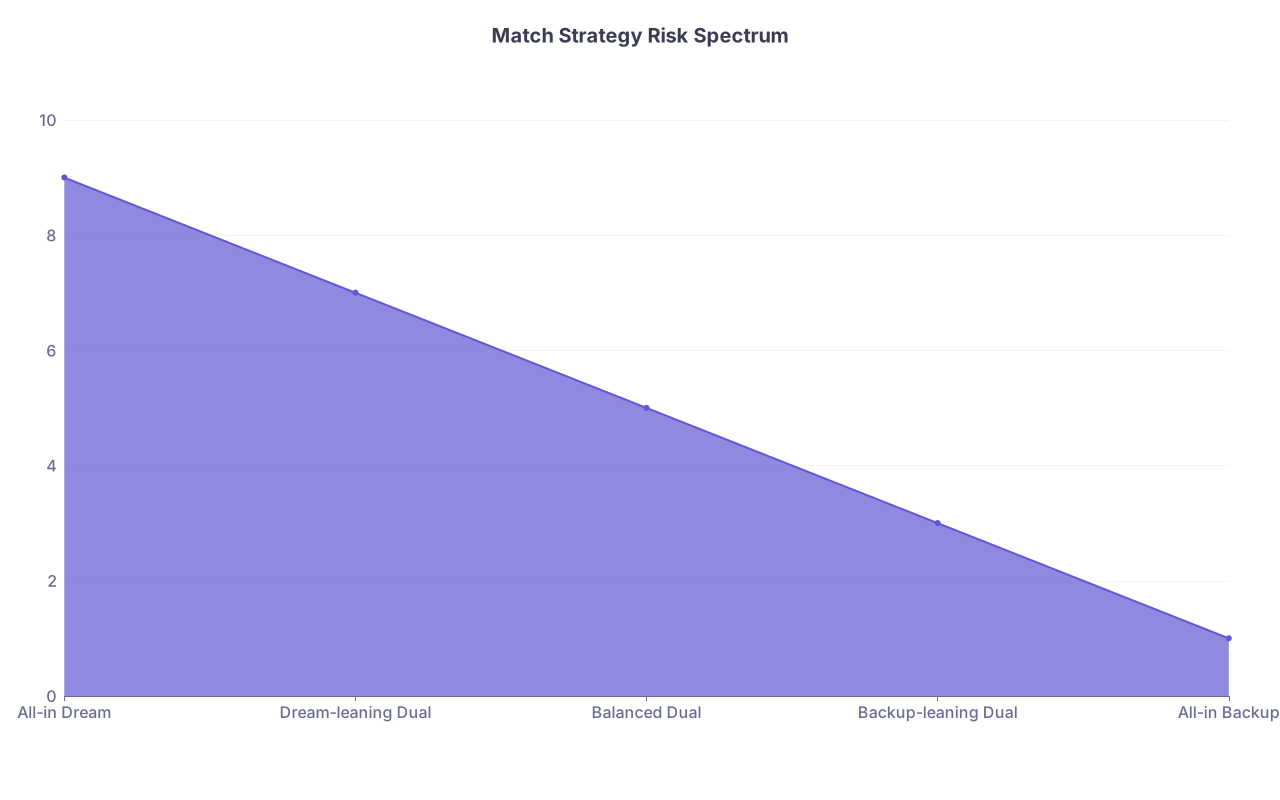
| Category | Value |
|---|---|
| All-in Dream | 9 |
| Dream-leaning Dual | 7 |
| Balanced Dual | 5 |
| Backup-leaning Dual | 3 |
| All-in Backup | 1 |
The mistake is pretending you are taking low risk by casually adding a backup. You are not. You are shifting the kind of risk: away from unmatched and toward matching into something you might not actually like.
Own that tradeoff.
Step 4: Build a coherent narrative for both fields
If you dual apply, you cannot send the same bland story to everyone.
You need:
- Specialty‑specific experiences that actually make sense
- At least one strong letter in each field (not five, one good one)
- Personal statements that do not contradict but emphasize different themes
Example:
- For surgery: emphasize love of procedures, team‑based acute care, complex decision‑making, and operating‑room culture.
- For anesthesia backup: emphasize physiology, perioperative medicine, acute care, interface with surgery, and detail‑oriented vigilance.
Those can both be true. But if your surgery statement says you “cannot imagine a career without operating” and your anesthesia one says you “have always wanted to manage patients across the perioperative spectrum,” it sounds hollow.
You are allowed to admit evolution: “I initially explored X, but through Y experiences I discovered I am better aligned with Z.” Programs prefer coherent evolution to obvious dishonesty.
Tradeoff #6: The Emotional Fallout of “Settling”
The last thing people underestimate is how it feels to match into your backup.
You may:
- Grieve your original dream specialty
- Feel embarrassed in front of peers who matched “higher”
- Question your ability and worth
None of that means you picked wrong. It just means you are human.
Where people make the real mistake is staying stuck in “bitter backup” mode for years. They never fully invest in their new field. They keep one foot in “the life I should have had” and coast through residency.
That is a guaranteed path to burnout, mediocre performance, and terrible job options at the end. Programs can tell who is half‑in. So can future employers.
If you match into your backup:
- Give yourself a fixed period to mourn privately—months, not years.
- Then commit to going all‑in and seeing what the best version of that specialty looks like for you.
- If, after genuinely trying, you still hate it, revisit the question of switching with real data, not nostalgia.
The real danger is not having a backup. The real danger is sleepwalking into one, then refusing to engage with it honestly.
Final Warnings: What Not To Do
Let me be blunt about a few specific traps.
Do not:
- Pick EM as a lifestyle backup because “it is chill and shift‑based” without understanding current job market and burnout data.
- Pick radiology because “you do not like talking to patients” if you have never actually spent a week in a dark room reading studies all day.
- Pick anesthesia as a generic “procedural but not surgical” backup if you hate acute pressure and continuous monitoring.
- Pick psychiatry because it seems “easy on the body” if you have low tolerance for chronic, complex psychosocial problems and systems frustration.
- Copy classmates’ backup strategies because “everyone is dual applying to X this year.” Herd behavior in specialty choice is a disaster.
Backups are not harmless. They shape your life.
The Bottom Line
Three things you should not forget:
- “Lifestyle” is not a single category; every so‑called lifestyle specialty carries its own personality demands, job market realities, and long‑term risks.
- Dual applying always trades one kind of risk (not matching) for another (matching into something that does not truly fit you); pretending otherwise is how people trap themselves.
- A viable backup is not something you half‑understand and hope you never need; it is a specialty you could live with long‑term if the match locks you there. Choose it like it might be your actual life—because it might.