
What if your “safety” specialty match becomes the job you resent for the next 30 years?
That’s the move people do not talk about enough: backing into a field you never wanted, telling yourself “I’ll switch later,” and waking up locked into a career you quietly hate.
Let’s walk through how that happens, why it’s so dangerous, and how to protect yourself before ERAS and your rank list back you into a corner.
1. The Quiet Lie: “I’ll Just Do This For a Few Years”
You know this script. I’ve heard it in workrooms every cycle.
“I’ll apply broadly. If I match my backup, I can always lateral into my dream field later, right?”
Usually said by:
- The borderline Step 2 candidate shooting for derm but “also applying IM just in case”
- The person who hated their psych rotation but is “throwing in psych apps” because it’s “less competitive”
- The M4 convinced anesthesia is “fine” even though they never once enjoyed the OR
Here’s the mistake: they treat a residency specialty like a one-year job, not a structural career decision that locks in your training, your CV, your network, and your identity.
You think you’re buying flexibility.
You’re actually trading away leverage.
Once you match:
- Your day-to-day life is that specialty. Full stop.
- Your references, mentors, and research shift into that field.
- Your identity to programs becomes: “He’s an anesthesiology resident.” “She’s a psych resident.” Not “future dermatologist” or “future ortho.”
You can absolutely try to change. People do. But it’s harder, uglier, and more constrained than anyone tells you when you’re panicking over NRMP data and Reddit posts.
2. The Long-Term Costs You’re Underestimating
Let me be blunt: matching into a specialty you secretly hate is not “better than not matching” in every case. Sometimes, it’s just a different kind of disaster.
Here’s what people underestimate.
Emotional and psychological wear
You might survive a year or two doing work you dislike. It’s residency; everyone is tired.
But hate is different from “this is hard.”
If you dislike:
- The patient population
- The core tasks (e.g., clinic all day, OR all day, endless notes)
- The culture of the field
…that friction does not fade. It compounds.
It becomes:
- Chronic resentment toward your schedule and your co-residents
- Avoidance behavior: calling in sick more, dreading rotations
- Cynicism toward patients and colleagues
This is exactly how burnout looks when it starts early: not just exhausted, but misaligned.
Career trajectory lock-in
Residency isn’t just a job. It’s a specialized funnel.
Your:
- Research
- Procedural skills
- Letters of recommendation
- Leadership roles
- Networking
…all point in one direction: deeper into that specialty.
That’s great when you love it.
It’s a trap when you don’t.
By PGY-3 in a field you dislike, your CV screams:
- “Committed [insert specialty] resident”
- “No recent work in other fields”
- “Short track record in desired specialty” (if you try to switch)
Programs in other specialties see:
- Risk
- Questionable fit
- Minimal proof you’ll actually stay
Not impossible to overcome. But you’re pushing a boulder uphill you didn’t need to create.
Financial inertia
You’re not just picking a specialty. You’re picking:
- A training length (3 vs 5 vs 7+ years)
- A salary arc
- When you can moonlight
- When loans get paid down
If you match a backup specialty you dislike:
- You may finish it “because you’re already this far”
- Then maybe do another residency or fellowship to escape
- That’s years of extra training, lost attending income, and more deferred financial stability
You could end up:
- Finishing a backup residency
- Being too drained or tied down (family, mortgage, geography) to start over
- Stuck in attending-level misery because pivoting feels impossible financially
3. The Common Backup Strategy Mistakes
Let’s call out the usual bad patterns so you can recognize them in yourself.
Mistake 1: Backing up into something you actively disliked on rotation
If you left a rotation thinking:
- “I would never want to do this every day”
- “I hated the workflow/patients/tasks”
…that is not a reasonable backup.
That’s denial disguised as pragmatism.
You can compromise on prestige, pay, or competitiveness.
You cannot safely compromise on “I actually hate this work.”
Mistake 2: Choosing a backup only because it’s “less competitive”
I’ve seen this exact phrase too many times:
“I’m applying to [field X] as a backup because it’s easier and has a good lifestyle.”
Translation:
“I don’t care about the actual work, but I heard the match rate and hours are nice.”
Red flag combination:
- No real excitement about the clinical work
- No research or experiences in the field
- No specific reason you like the patient population
- But you keep saying “lifestyle” and “less competitive”
You’re treating your career like a board exam scoring game, not decades of daily reality.
Mistake 3: Ignoring the culture mismatch
Every specialty has a culture. You felt it:
- ICU: intensity, rapid decisions, data-heavy
- Psych: talking, nuance, gray zones
- Surgery: hierarchy, procedures, blunt communication
- FM: breadth, outpatient, continuity
Backing up into a field where the people felt like “not my tribe” is asking for chronic friction.
If you hated:
- The way attendings talked to patients
- The priorities in sign-out
- The vibe of conferences and rounds
…do not tell yourself you’ll magically feel at home there later.
Mistake 4: Believing “I’ll just subspecialize to escape”
The rationalization goes like this:
“Yeah, I don’t love general [IM/peds/whatever], but I’ll just do fellowship in [subspecialty I think I like]. That’ll fix it.”
Maybe. But you’re gambling on:
- Matching fellowship (which is another competitive funnel)
- Actually liking that subspecialty long-term
- Surviving years of core specialty work you dislike until then
If your entire career happiness hangs on a future subspecialty you haven’t actually experienced deeply, that’s shaky ground.
4. How Hard Is It Really To Switch Specialties?
People love to toss around “you can always switch later.”
Let’s put some structure around that instead of relying on hallway myth.
| Scenario | Relative Difficulty |
|---|---|
| Switching after prelim year | Moderate |
| Switching after PGY-1 categorical | Hard |
| Switching after PGY-2+ with no prior experience in new field | Very hard |
| Switching into more competitive field (derm, plastics, ortho) | Extremely hard |
| Switching into same competitiveness or less with prior exposure | Moderate-Hard |
What actually needs to happen to switch
You don’t just email a PD and teleport.
You usually need:
- A PD who’s willing to support your switch (and not sabotage it)
- New letters from attendings in the target specialty
- Rotations/electives in the desired field (hard once you’re locked into a different schedule)
- Open PGY-2+ positions in that specialty (which are rare and unpredictable)
- A compelling narrative that doesn’t sound flaky or impulsive
And you’ll often be:
- Competing against new grads applying directly into that specialty
- Requesting time off or schedule reshuffling to rotate in the new field
- Doing this while working 60–80 hours/week in a job you already dislike
Can it work? Yes. I’ve seen transitions:
- Surgery → Anesthesia
- IM → Rad Onc
- Peds → Psych (child psych later)
But every single one came with:
- Delays
- Extra years
- Pay cuts or lost income
- Significant personal stress
Don’t build your entire strategy on “future me will have the energy to do all that while exhausted.”
5. Smart Backup Strategy: What a Non-Disastrous Backup Looks Like
You shouldn’t go “all or nothing” on an ultra-competitive dream field with no realistic plan B.
But your backup needs to be something you can tolerate long-term without hating your life.
Here’s how to sanity-check your backup choices.
1. Screen for “neutral to positive,” not “I hate this”
You don’t need to love your backup as much as your dream field. But the bar is not zero.
Bare minimum:
- You did not dread going to that rotation
- You can name specific parts you actually liked (patient population, procedures, continuity, team culture)
- You can imagine a version of yourself as an attending in that field and not feel sick
If your real reaction is “God, I hope I never end up doing that,” it’s not a backup. It’s a landmine.
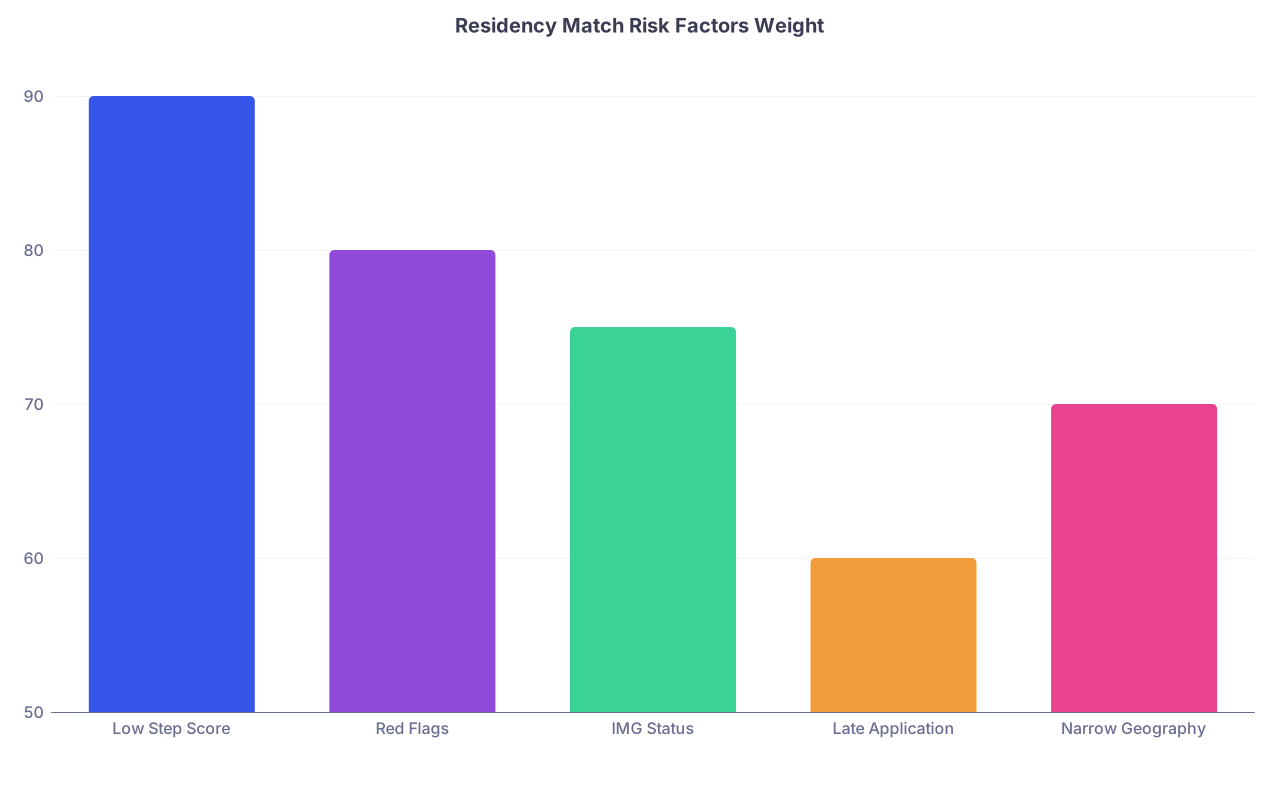
2. Be honest about your risk profile
You have to match your backup aggressiveness to your actual risk factors:
| Category | Value |
|---|---|
| Low Step Score | 90 |
| Red Flags | 80 |
| IMG Status | 75 |
| Late Application | 60 |
| Narrow Geography | 70 |
High-risk profile (multiple issues: low scores, failed exams, IMG, narrow geography)?
You may truly need a more conservative primary choice and a backup within that field (community vs academic, different regions), not an entirely different specialty you hate.
Moderate risk (borderline scores, average app)?
You can stretch for a tougher field, but your backup must still be something you’d accept living with.
Strong candidate?
You can go harder for your dream field without panicking yourself into a miserable backup.
3. Use elective time strategically
If you’re considering a backup, do this before ERAS locks:
- Schedule at least 1–2 serious rotations in that potential backup field
- Treat them like auditions: see how the work feels when you’re fully engaged
- Ask attendings and residents candid questions about long-term satisfaction
Do not label a specialty a “backup” if you’ve spent a grand total of 2 days there.
6. Red Flags You’re About to Back Into the Wrong Field
Here are the warning signs I’d tell you to slam the brakes for.
Red flag #1: You never talk about the actual work, only the match stats
You say:
- “High match rate”
- “Solid lifestyle”
- “Good money”
And you never say:
- “I really like taking care of [these patients]”
- “I enjoy doing [these tasks/procedures/skills]”
- “I respect how [this specialty] thinks”
That’s a problem. You’re optimizing the spreadsheet, not your life.
Red flag #2: You’re hiding your true feelings from mentors
If you find yourself:
- Telling your advisor, “Yeah, I liked [backup field], it seems fine,”
- But telling your partner, “I’d be miserable if I ended up in that,”
…that split is exactly how people end up matched somewhere they quietly despise.
Any specialty you rank needs to be something you can admit—out loud—to someone you trust:
“If I end up there, I can make a decent life.”
Red flag #3: Your rank list is driven by fear, not preference
If your rank list thoughts sound like:
- “Well, I’m scared I won’t match X, so I’ll just shove this thing above it even though I hate it.”
- “My advisor said to go safe, so I put this sure thing at #1 though it makes me depressed.”
You’re letting fear rewrite your future.
You should be scared of matching into something you hate.
Not just scared of the word “unmatched.”
7. How to Build a Safer Backup Plan (Without Ruining Your Life)
Let’s be practical. What can you actually do?
Step 1: Make three honest lists
Sit down and write:
- Specialties I’d be genuinely happy in
- Specialties I could tolerate but don’t love
- Specialties I actively disliked or would hate doing daily
If your backup is pulling from list #3, that’s your warning.
Step 2: Separate “prestige” from actual enjoyment
Look at your top and backup choices and ask:
- If all these specialties paid the same and had similar hours, would I still rank them this way?
If your ranking collapses when prestige/lifestyle equalize, you’re not choosing based on real fit.
Step 3: Consider intra-specialty backups before cross-specialty
Before you jump from, say, neurosurgery to “I guess psych,” ask:
Could I:
- Apply to a wider range of programs within my target field?
- Include community or less-prestigious programs?
- Open up geography?
- Consider a preliminary year with a reapplication plan, with eyes wide open?
Sometimes your real backup should be “less shiny program in the same field,” not “totally different specialty I dislike.”
Step 4: Have an unfiltered conversation with someone who knows you
Not someone who just knows your scores. Someone who knows you.
Ask them:
- “If I matched [backup field], do you honestly think I’d be happy?”
- “Have you ever heard me say I was excited about this specialty?”
- “Do I sound like I’m talking myself into this out of fear?”
If they hesitate? Pay attention.
8. The Uncomfortable Truth About “Unmatched” vs “Mis-Matched”
Here’s the part people don’t like to hear.
Being unmatched for a cycle:
- Is brutal.
- Is humiliating.
- Forces you to face gaps in your application.
- Costs you a year.
Being mis-matched into a specialty you hate:
- Is also brutal.
- Lasts longer.
- Sinks years of your life into training you may not want.
- Makes switching harder because you’re busier and more entangled.
Sometimes the less catastrophic path is:
- Taking an extra year for research
- Strengthening your application
- Reapplying in a field you actually care about
- Or recalibrating to a different, but still acceptable, specialty you don’t hate
I’m not saying “go unmatched, it’s fine.” It’s not fine.
I’m saying: don’t automatically assume any match is better than no match.
A bad match is not a clean win. It’s a different kind of loss.
9. A Simple Decision Flow Before You Add a Backup Specialty
Use this as a mental checklist before you commit.

| Step | Description |
|---|---|
| Step 1 | Considering backup specialty |
| Step 2 | Do not use as backup |
| Step 3 | Schedule honest talk |
| Step 4 | Re evaluate rank list |
| Step 5 | Reasonable backup option |
| Step 6 | Did you dislike the rotation? |
| Step 7 | Can you imagine being an attending in this field? |
| Step 8 | Have you talked to mentor honestly? |
| Step 9 | Is fear main reason for ranking it higher? |
If you fail at any of those steps and still push ahead “because NRMP data freaks me out,” you’re knowingly walking into risk.
10. What To Do If You’re Already Halfway Down the Path
Some of you are reading this with ERAS already submitted. Or interviews booked. Or a backup specialty already on your list.
You’re not doomed. But don’t double down on mistakes.
If you haven’t ranked yet:
Revisit your list. Pull anything you’d truly hate out of the top positions, even if it feels risky.If you’re in interviews:
Use them to reality-check. Ask current residents what they don’t like. Imagine being them in 5 years.If you’re already matched somewhere you don’t like:
Start documenting what parts of the work you dislike and what you’re drawn to instead. Seek out rotations in your areas of interest if you’re contemplating switching. Have a frank talk with your PD before you’re too deep in to move.
| Category | Value |
|---|---|
| Specialty Fit | 40 |
| Work Environment | 30 |
| Schedule | 20 |
| Compensation | 10 |
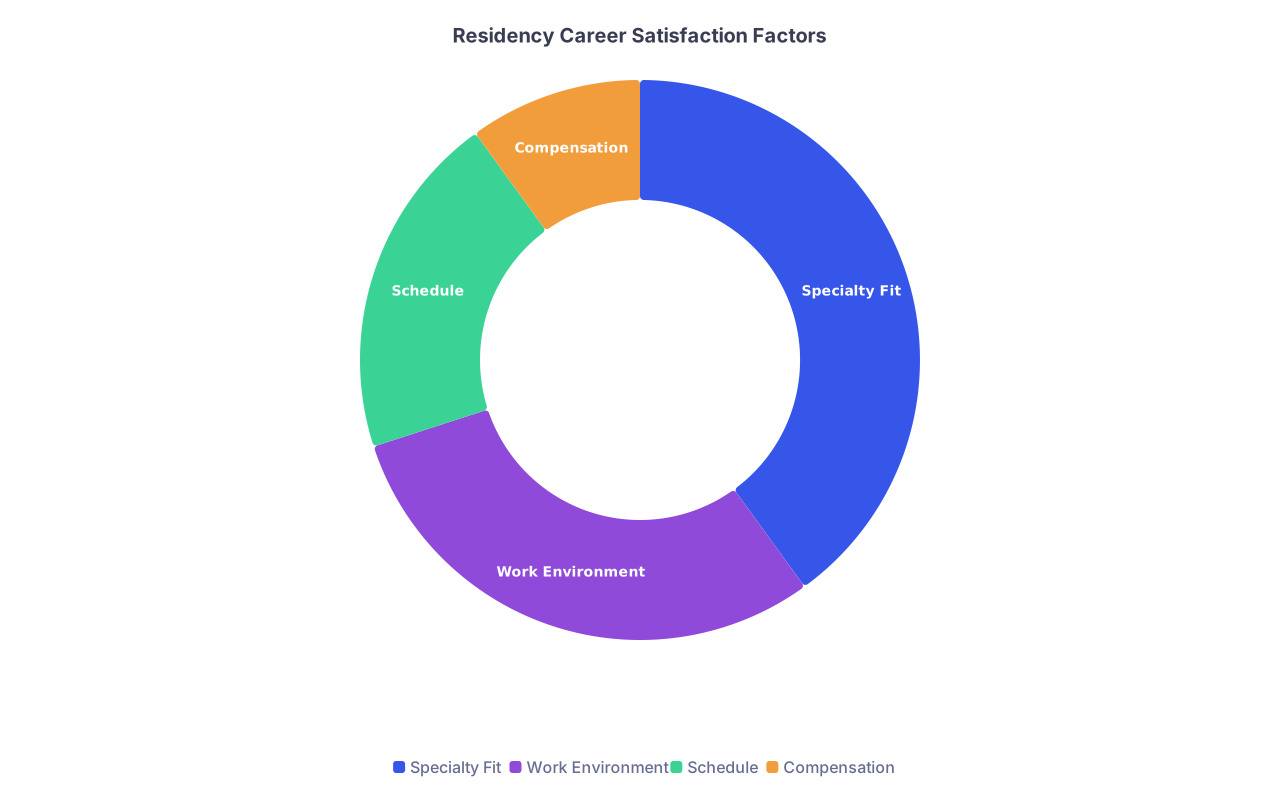
Specialty fit isn’t everything. But it’s the biggest slice. Do not treat it like a throwaway decision.
FAQ: Backing Up Into a Field You Secretly Hate
1. Is it ever reasonable to rank a specialty I don’t love just to avoid going unmatched?
Yes, but only if you’re in the “I could live with this” zone, not the “I actively hate this” zone. If you genuinely could see yourself building a decent life in that specialty—even if it’s not your top choice—then ranking it lower on your list is reasonable. Ranking something you dread above something you actually want purely out of fear is where people wreck their long-term happiness.
2. What if my school advisor is strongly pushing me toward a backup I don’t like?
Advisors are often risk-averse and focused on match statistics. They don’t have to live your life. Respect their perspective, but do not outsource your career choice. Tell them clearly: “I understand the risk, but I know I’d be unhappy in that field.” Ask them to help you build a within-specialty backup plan (broader programs, locations) or consider a different but genuinely acceptable specialty, not one you already know you dislike.
3. Couldn’t I just finish the backup residency and work in a non-clinical job?
You could. People do that—go into admin, industry, consulting, informatics. But you’d still have to slog through several brutal years of training in a field you dislike, just to end up leaving clinical practice anyway. If your real goal is non-clinical work, there may be more direct routes than enduring a miserable residency that doesn’t align with your interests.
4. How can I tell if I “hate” a specialty versus just being uncomfortable because it’s hard?
Ask yourself: on that rotation, did you dislike the difficulty or the core activities? Hard is fine if you still felt engaged by the work—interesting cases, satisfying procedures, curious about the subject. Hate feels like: watching the clock, feeling drained specifically by the nature of the work, and thinking “I cannot imagine doing this for 20 years.” If you felt consistently disengaged even when things weren’t stressful, that’s closer to hate.
5. What’s one concrete step I can take right now to avoid this mistake?
Open a blank page and list every specialty you’re considering or already applied to. Next to each, write three things: “Loved,” “Tolerated,” or “Hated” based on your actual experiences, not what you’ve told advisors. Then circle every “Hated.” Those should not be on your backup list. If they are, your next step is to schedule a blunt, honest conversation with a mentor this week and re-evaluate your plan before your rank list locks.
Open that list of specialties right now and label each with “Loved,” “Tolerated,” or “Hated.” If anything in the “Hated” column is on your backup list, that’s your signal to stop, rethink, and protect your future self before you lock in your rank order.