
What if listing two different specialties actually makes every PD think, “This kid doesn’t know what they’re doing”?
That’s the fear, right?
Not just not matching.
But matching nowhere because every program director assumes you’re half‑in on their field and half‑in on something else.
You’re sitting there thinking:
“If I apply to both EM and IM… or Anesthesiology and Radiology… will they all just blacklist me as ‘undecided’ or ‘not committed’?”
Let’s walk through this like two nervous people staring at ERAS together.
First brutal truth: most PDs already know people apply to backup specialties
They’re not stupid.
They’ve seen this 10, 15, 20 years in a row.
Is there bias against applicants who look “undecided”? Sometimes, yes.
But is applying to more than one specialty automatically a death sentence? No.
Here’s the really unspoken thing: the context matters way more than the fact that you applied to two fields.
PDs care about:
- Are you clearly a bad fit who panicked and sprayed applications?
- Or are you a borderline but reasonable applicant who strategically applied to a closely related backup with a coherent story?
If you look like the first group, yeah, they’ll write you off.
If you look like the second, most of them shrug and move on.
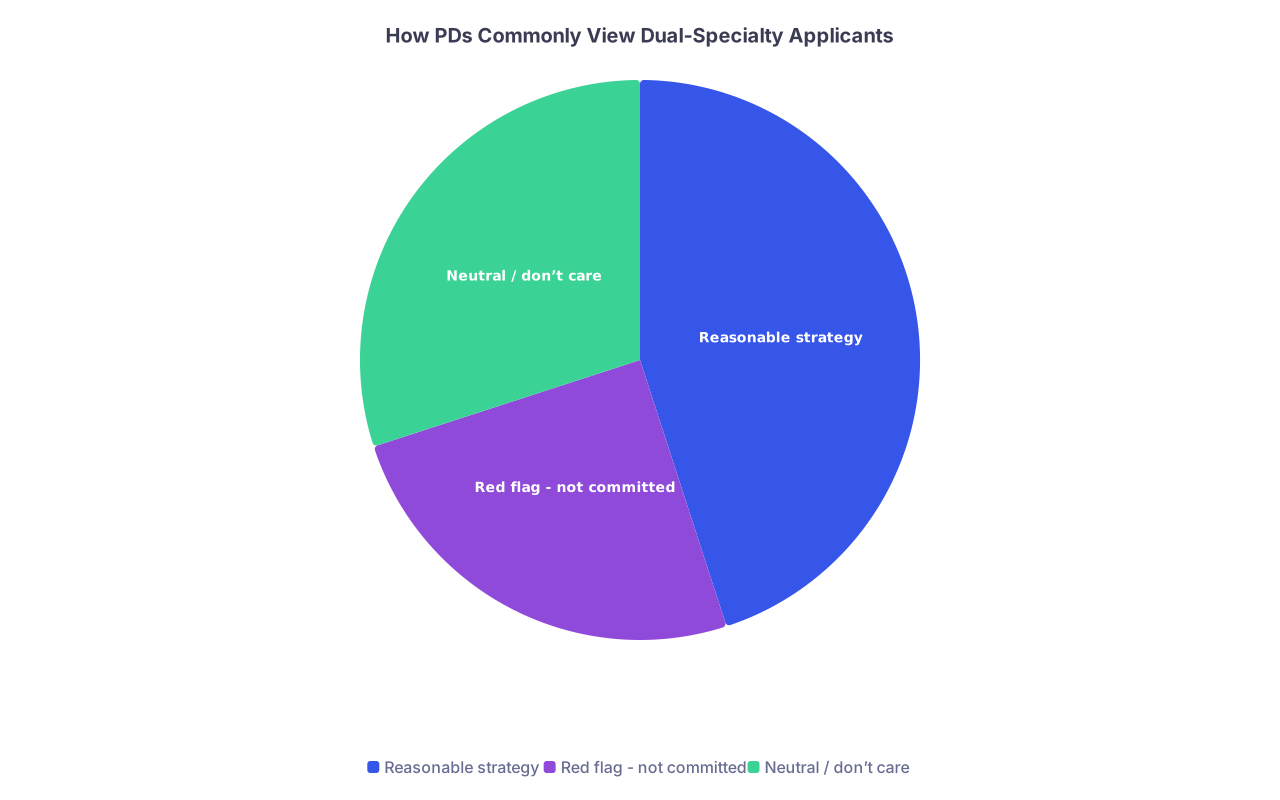
| Category | Value |
|---|---|
| Reasonable strategy | 45 |
| Red flag - not committed | 25 |
| Neutral / don’t care | 30 |
Is that exact data? No. But that’s roughly how it feels talking to faculty and residents over and over.
What kills you isn’t doing a backup.
It’s doing it sloppily and obviously.
The real nightmare: when your application screams “I’ll be happy anywhere”
The thing PDs hate isn’t: “This person considered multiple fields.”
They hate: “This person would do literally anything that pays.”
You worry they’ll see:
- IM letter, EM letter, Anes letter
- One random psych elective
- A personal statement that could apply to any specialty: “I love continuity of care but also acute resuscitation but also procedures but also clinic.”
And then they’ll think: “So… who are you actually?”
I’ve seen apps like this. The vibe is: “Please just give me a job.” And programs pick up on that.
What makes PDs think you aren’t serious about anything?
- Generic personal statements reused or lazily tweaked
- Letters from totally random people not clearly in your supposed field
- No real pattern in rotations, electives, or activities
- Saying different things in different places (e.g., “I’ve always known I was meant for surgery” in one PS and “I’ve always known I was meant for radiology” in another… and then both letters talk about psych)
It’s not that you like more than one field. Plenty of people do.
It’s that your application looks like a personality test with “strongly agree” on every answer.
How to pick a backup without looking like you’re faking everything
Let’s say your primary and backup are:
- EM + IM
- Or Gen Surg + IM
- Or Anes + IM
- Or Neuro + Psych
Reasonable pairings. People do this all the time.
The key is to accept one thing: you cannot present yourself as 100% destined for both simultaneously. That’s impossible and yes, looks fake.
What you can do is:
- Have a primary narrative
- Have a believable secondary narrative
- Make sure each field sees what they need to see to believe you’ll show up and be invested for 3–7 years
Here’s how that looks in practice.
1. Separate personal statements that actually diverge
Not: save as → change specialty name → done.
Your IM PS and your EM PS shouldn’t just be clones with “emergency department” swapped to “inpatient wards.”
EM PS:
- Acute care
- Resuscitation
- Undifferentiated patients
- Shift work / fast decisions
- Example: a resus case, chaos, controlled crisis
IM PS:
- Longitudinal thinking
- Diagnostic problem-solving
- Team coordination over days, not minutes
- Example: puzzling multi-comorbidity case and following through
If your backup PS reads like a weak version of your primary one, you’ll feel like a tourist. And they’ll treat you like one.
2. Letters that pass the sniff test
You’re terrified that PDs will somehow “find out” you applied broadly.
Here’s the quieter reality: most don’t have time to investigate your entire ERAS portfolio like it’s a federal wire fraud case.
What they do see:
- Who wrote your letters
- How strong / specific they are
- Whether it fits what you’re claiming in your PS and CV
General rule:
- At least 2–3 letters in your primary field
- At least 2 solid letters for your backup if you’re seriously willing to go there
If you’re applying IM as a backup and your only IM letter is from a guy who barely remembers your name? Yeah, that looks bad. Not because you have a backup. Because your “backup” seems like “afterthought I don’t respect.”
What actually tips you into “not serious about anything” territory
Let’s be blunt. These are the mistakes that really burn people.
Doing away rotations in one field, but applying stronger to another with no explanation
If you did three Sub-I’s in ortho and then apply mostly to FM… and your FM PS says “I’ve always known I wanted broad primary care”… the cognitive dissonance is loud.
Using the same generic extracurriculars for everything
- “I love teaching”
- “I’m passionate about leadership”
- “I enjoy research”
with zero specialty‑specific connection. PDs are bored of this.
Letting your CV be random chaos
All your research is in cardiology.
Your aways: two in EM, one in CCU.
Then you apply Radiology with no imaging anything.
Will some places still interview you? Maybe. But it doesn’t scream committed.Telling interviewers two different life stories
This is the one that really haunts people.
EM interview: “I can’t imagine doing anything else. I’ve tried other things, but EM is my home.”
IM interview two days later (because panic): “Honestly, I’ve always been drawn to continuity of care.”
Guess what residents and faculty do after interview days? They talk. “Did you interview that student who said they were 100% meant for EM last week? They’re here for IM this week.”
Is that always fatal? No.
But if it gets back to a PD who already thinks you’re borderline? It doesn’t help.
So how do you structure your actual backup plan without tanking everything?
You need a plan that looks intentional rather than desperate.
| Aspect | Primary (EM) | Backup (IM) |
|---|---|---|
| PS | EM-specific, acute focus | IM-specific, longitudinal focus |
| Letters | 3 EM attendings | 2 IM attendings |
| Electives | 2 EM, 1 ICU | 1 ward month, 1 clinic |
| Programs Applied | EM: broad range, all tiers | IM: more regionally focused |
You don’t have to be perfect. You just have to be coherent.
Some practical rules:
- Choose a backup that you can genuinely see yourself doing. If IM is your backup, you should have actually enjoyed at least parts of inpatient and not just “it’s less competitive.”
- Make peace with the fact that your primary field might see some signs you have a backup. That’s normal. Saying “I ranked only your specialty” while clearly applying elsewhere just makes you look dishonest.
- If questioned directly (“Are you applying to other specialties?”), have a calm, non-guilty answer ready:
- “Yes, EM is my top choice and where I see the best fit, but I’ve also applied to a small number of IM programs where I have strong geographic/family ties. I’m committed to being a good resident wherever I match.”
That’s not betrayal. That’s called being an adult who understands the Match is brutal.
Will PDs think worse of me just for having a backup? The uncomfortable but honest answer.
Some will, yes.
Some are purists who want: “I only ever loved your field and nothing else and I wrote my first H&P in the womb.”
But a lot don’t live in that fantasy world. They know:
- Not everyone has a 260+ Step 2 score
- Not everyone can move across the country
- Visa issues exist
- Couples match exists
- People need jobs
So they focus less on “Did this person also apply somewhere else?” and more on:
- Do I believe this person would show up here and work hard?
- Are they running from something or toward something?
- Is there at least some believable connection between their history and my specialty?
If your whole vibe is: “I am terrified of not matching and would do anything,” that’s when “not serious about anything” sticks.
But if your vibe is: “I’d be thrilled with X, and also content and engaged with Y, and I’ve demonstrated effort toward both”? That’s reasonable.
How to reduce the anxiety spiral in your head
You’re probably doing the math:
“What if EM PDs assume I’m really IM, and IM PDs assume I’m really EM, and I fall straight between the two and match nowhere?”
That fear is real. I’ve watched people spiral on exactly that.
Here’s how to at least tilt the odds in your favor:
Make one field clearly primary in your head.
Not for guilt. For decision-making. It anchors everything else.Align your strongest letters and aways with that primary.
Backup still gets love, just not equal love.Don’t over-apply in your backup so it looks like you actually abandoned your primary.
If you apply to 40 EM and 120 IM, you’ve basically told the universe which one you really believe in.Be okay with some programs thinking whatever they’re going to think.
You can’t perfectly control how every PD interprets every signal. You can only control whether your application looks thought‑out or chaotic.

| Step | Description |
|---|---|
| Step 1 | Choose Primary Specialty |
| Step 2 | Assess Competitiveness |
| Step 3 | Apply Mostly Primary |
| Step 4 | Select Backup Specialty |
| Step 5 | Create Separate PS and Letters |
| Step 6 | Apply to Both With Clear Strategy |
| Step 7 | Realistic for primary only |
Last thing: you’re allowed to protect yourself
There’s this weird guilt in med culture that says:
“If you really loved the field, you’d risk going unmatched for it.”
No. Absolutely not. That’s romantic nonsense from people who already matched.
You’re allowed to:
- Want a job
- Want to avoid SOAP
- Want some control in a system that gives you almost none
- Want a life that’s more than “I martyr myself for the perfect specialty label”
Protecting yourself with a backup specialty doesn’t make you unserious.
Doing it thoughtlessly and dishonestly does.
If you can say, honestly:
- “I’d be happiest in X.”
- “I’d still be okay and engaged in Y.”
- “I’ve shown genuine effort and interest in both.”
…then you’re not the problem. The system is.

FAQ (Anxious Edition)
1. Do programs actually know if I applied to other specialties?
Usually not in any official, ERAS-dashboard way. They mainly infer from:
- Your letters (mix of specialties)
- Your PS content
- Your away rotations
- What you say in interviews
Some institutions with multiple departments that share applicants gossip internally. But there’s no big flashing banner that says “APPLIED TO FIVE SPECIALTIES.”
2. What if an interviewer point‑blank asks, “Are you applying elsewhere?”
Don’t lie. Lying is worse than having a backup.
Example answer:
“Yes, this is my top choice specialty and where I see the best fit, but I did apply to a smaller number of [backup] programs as well, mostly in locations where I have personal ties. I know I’d be fully committed wherever I match.”
Calm, straightforward, not apologetic.
3. Is having a backup worse than just going all‑in and risking SOAP?
If you’re truly competitive and advisors you trust say, “You don’t need a backup,” then maybe you go all‑in. But for borderline applicants, pretending “backup = weakness” is how people end up in SOAP crying in a call room. Matching into a solid backup is almost always better than gambling everything for pride.
4. What if my backup ends up being where I match and I feel like I faked it?
That happens. People match their backup and feel like impostors. Two things:
- If you built an honest, coherent story for that backup, you didn’t fake it—you just landed on path B instead of A.
- A huge number of residents grow to genuinely like (or love) fields they originally saw as backups. Your identity as a doctor is built more by your training environment and mentors than by what you wrote in one anxious personal statement at 2 a.m.
Key points:
- Applying to a backup specialty doesn’t automatically make PDs think you’re unserious; a messy, generic, or contradictory application does.
- Separate, genuine narratives and letters for each specialty make you look strategic, not desperate.
- You’re allowed to protect yourself from going unmatched. The goal is a coherent plan, not a martyr story.