
Interventional Radiology (IR) is one of the most competitive and rapidly evolving specialties in the United States. For a non-US citizen IMG or foreign national medical graduate, the IR match can be particularly challenging because of visa limitations, program preferences, and relatively few categorical IR spots nationwide. Thoughtful backup specialty planning is not optional—it is a critical part of a smart, resilient strategy.
This article will walk you through how to build a realistic, well-researched Plan B (and Plan C) while still presenting yourself as a strong, focused IR applicant. You’ll learn how dual applying works, which backup specialties make strategic sense for IR, and how to practically organize your applications, documents, and interviews as a non-US citizen IMG.
Why Backup Specialty Planning Is Essential for Non-US Citizen IMGs Targeting IR
Interventional Radiology is a relatively young, small specialty. The number of integrated IR residency positions is limited, and programs are highly selective. When you add the additional barriers faced by a non-US citizen IMG or foreign national medical graduate, the risk of going unmatched in IR alone increases substantially.
Key challenges for non-US citizen IMG IR applicants
Limited IR positions and high competition
- Small number of integrated IR positions (especially compared to Internal Medicine or Pediatrics).
- Many applicants are US MD seniors with strong home-institution support and IR exposure.
- IR programs often prioritize candidates with robust US clinical experience and strong letters from interventional radiologists.
Visa sponsorship barriers
- Not all programs sponsor visas (especially H-1B).
- Some IR programs accept only J-1; some avoid visa sponsorship entirely.
- Even among programs that do sponsor visas, there may be internal quotas for non-US citizen residents.
IMG bias and institutional preferences
- Some institutions prefer (or exclusively accept) US grads for highly procedural, competitive specialties.
- Lack of an affiliated IR department in your home school can limit exposure and letters.
Single-shot nature of the IR match
- If you only apply to integrated IR and do not match, you essentially lose a year unless you have a backup plan (such as preliminary year + independent IR later, or another specialty entirely).
Given these realities, a strategic backup specialty is not a sign of weakness. It is an intelligent risk management strategy that:
- Increases your chance of matching into a US residency.
- Keeps open viable pathways back to an IR-like career (for example via Diagnostic Radiology or Vascular Surgery).
- Reduces psychological stress; you are not “all or nothing” on a single, ultra-competitive pathway.
How to Think About Backup Specialties as an IR-Focused Non-US Citizen IMG
Backup specialty planning is not just “pick Internal Medicine and hope for the best.” You need a thoughtful framework that respects your IR passion while remaining realistic about your profile and the visa environment.
Core principles for choosing a Plan B specialty
Alignment with IR interests and skills
- IR involves imaging, procedures, acute care, oncology, vascular disease, and minimally invasive therapies.
- An ideal backup specialty:
- Utilizes similar cognitive skills (imaging, procedural planning).
- Offers procedural opportunities.
- Allows future sub-specialization that brings you close to IR (e.g., endovascular interventions, image-guided procedures).
Realistic competitiveness match
- Be honest about your Step scores, research, US experience, and visa needs.
- Your backup should be less competitive for someone with your profile than IR, not equally or more competitive.
Visa-friendliness
- Investigate which specialties and which programs:
- Commonly sponsor J-1 or H-1B.
- Have a history of matching non-US citizen IMGs.
- Some large Internal Medicine or Family Medicine programs, for example, have strong track records of sponsoring J-1 visas for IMGs.
- Investigate which specialties and which programs:
Long-term career satisfaction
- Ask yourself: If I never become an interventional radiologist, can I see myself being satisfied in this specialty?
- Your backup should not feel like a punishment—rather, a different but meaningful way to practice medicine.
Pathways back to an IR-adjacent career
- Some backups keep open the possibility of “coming back” to IR or at least doing procedures:
- Diagnostic Radiology (DR → Independent IR or IR-heavy fellowship).
- Vascular Surgery (endovascular focus).
- Interventional Cardiology (through Internal Medicine → Cardiology).
- Interventional Pain / Spine (via Anesthesiology, PM&R).
- Other backups may not directly lead back to IR but can still be highly fulfilling.
- Some backups keep open the possibility of “coming back” to IR or at least doing procedures:
Best Backup Specialty Options for IR Applicants: Pros, Cons, and Strategy
Below are common backup pathways for an IR-focused non-US citizen IMG, along with their benefits and drawbacks.
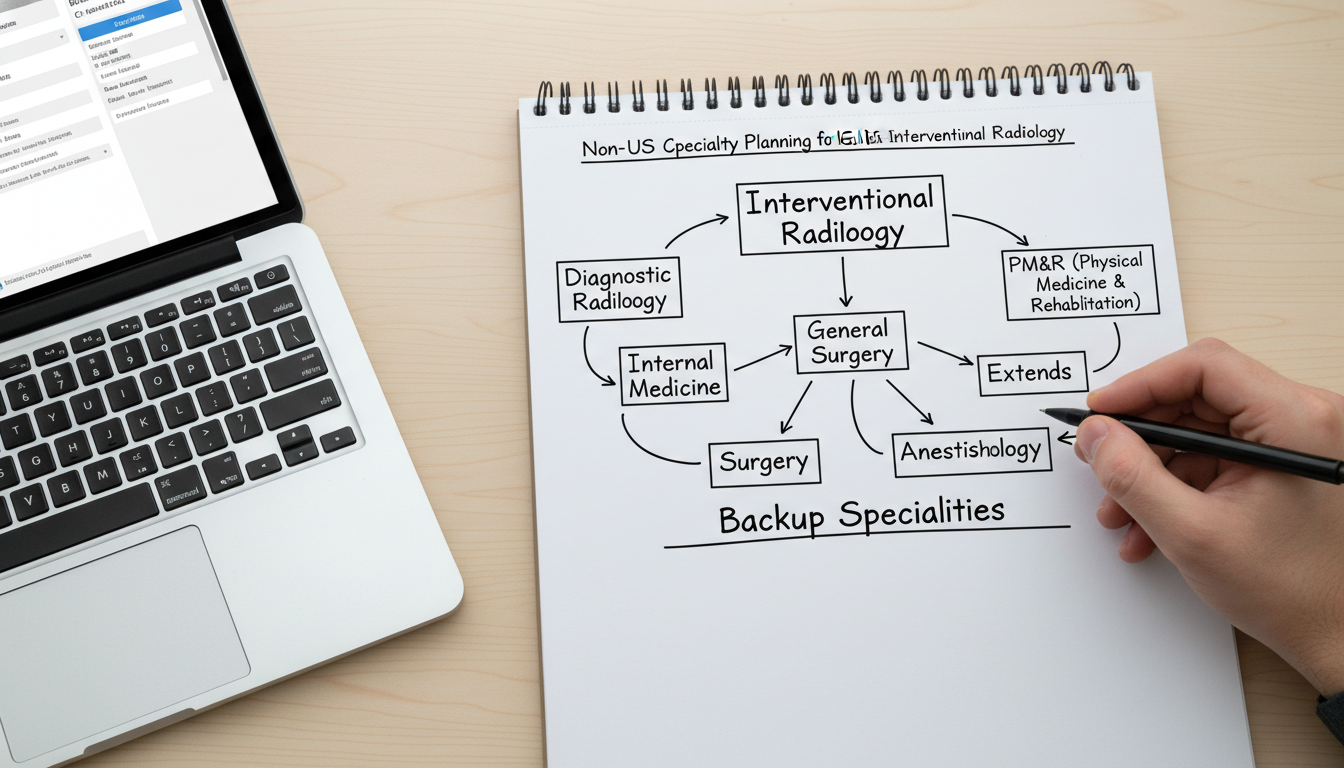
1. Diagnostic Radiology (DR) – The most direct IR-adjacent backup
Why it’s attractive:
- DR is the closest cognitive and technical relative to IR.
- Many residents in DR later pursue:
- Independent IR residency.
- IR/DR fellowships, or
- Other image-guided fellowships (neurointerventional, breast procedures, etc.).
- Strong imaging foundation, essential for any future IR work.
Pros:
- Direct pathway to independent IR after DR residency.
- You stay within the radiology department ecosystem.
- IR exposure during DR residency can still open doors to IR fellowships.
- Many DR programs recruit IMGs and sponsor J-1 visas.
Cons:
- DR is itself competitive—although generally less than IR.
- Your application still needs robust radiology interest (research, electives, letters).
- Visa policies may vary; not all DR programs are IMG-friendly.
Who should consider DR as backup:
- You have solid exam scores and strong radiology-related portfolio.
- You have IR or radiology research, or letters from radiologists.
- You’re comfortable that even if you end up staying in DR only, you would enjoy it.
Application strategy:
- If IR is your top priority, many applicants dual apply:
- Primary: IR (Integrated)
- Backup: DR
- Tailor your personal statement(s) to reflect:
- IR-focused for IR programs.
- More broadly imaging- and diagnostic-focused for DR programs.
- Emphasize your comfort with both diagnostic and procedural components.
2. Internal Medicine (IM) – Broad, visa-friendly, and flexible
Why it’s attractive:
- Internal Medicine is one of the most common matches for foreign national medical graduates.
- Many IM programs are familiar with J-1 sponsorship and match large numbers of non-US citizen IMGs each year.
- IM offers indirect paths toward procedural careers:
- Interventional Cardiology
- Endovascular medicine (in some vascular-focused cardiology or vascular medicine programs)
- Critical care procedures (lines, bronchoscopy in some settings)
Pros:
- Higher overall match probability compared with IR and DR.
- Widespread program availability geographically.
- Often more open to IMGs and visa sponsorship, particularly J-1.
- Numerous subspecialty options (Cardiology, GI, Pulm/CC, Hem/Onc).
Cons:
- It is not directly IR-adjacent; your imaging work will be limited compared with radiology.
- Becoming procedural often requires additional competitive fellowships (e.g., Interventional Cardiology, GI).
- Some IM subspecialties can be as competitive as IR.
Who should consider IM as backup:
- You have a balanced profile but not especially strong for radiology.
- You’re open to a broad clinical career with the possibility of a procedural fellowship.
- Your priority is maximizing chances of matching in the US with good visa prospects.
Application strategy:
- Explicitly mention your interest in procedural subspecialties (e.g., cardiology, ICU) without over-emphasizing IR.
- Highlight continuity of care, complex medical management, and interest in long-term patient relationships.
- Apply broadly and target IMG-friendly, visa-sponsoring programs (often community and university-affiliated hospitals).
3. General Surgery – A procedural route with vascular opportunities
Why it’s attractive:
- General Surgery offers abundant procedural exposure.
- Potential future specialties with overlap with IR:
- Vascular Surgery with endovascular training.
- Surgical oncology with intraoperative interventions.
Pros:
- Highly procedural from day one.
- Vascular Surgery and other surgical subspecialties increasingly use image-guided and endovascular techniques.
- Some non-US citizen IMGs have successfully entered surgery pathways, including J-1 sponsored positions.
Cons:
- General Surgery is physically demanding and culturally different from radiology.
- Matching into categorical surgery as a non-US citizen IMG can still be challenging.
- Lifestyle, call load, and training length may be more intense than other backups.
- Path from surgery to IR itself is not standard; you would more likely become a vascular surgeon rather than an interventional radiologist.
Who should consider Surgery as backup:
- You are strongly procedure-oriented and comfortable with long hours and OR culture.
- You are willing to commit to a surgery-based identity if IR does not work out.
- You value hands-on operative interventions more than image interpretation.
Application strategy:
- Build a surgery-focused portfolio: clerkship grades, letters from surgeons, surgical electives.
- Show commitment to the OR environment and surgical decision-making.
- Do not oversell IR; focus on surgery-specific motivations and long-term surgical goals (like vascular, oncology, or trauma).
4. Anesthesiology – A procedural and physiology-focused alternative
Why it’s attractive:
- Anesthesiology is procedural and physiology-heavy.
- Opportunities for advanced procedures and pain management:
- Regional anesthesia (nerve blocks, ultrasound-guided injections).
- Interventional Pain fellowships (spine procedures, injections, some fluoroscopy-guided work).
Pros:
- Strong emphasis on procedures and perioperative care.
- Some programs are IMG-friendly and sponsor J-1 visas.
- You still work closely with IR, surgery, and radiology teams in the hospital.
Cons:
- Not as clearly IR-adjacent as DR or Vascular Surgery.
- Some regions and top programs can be competitive.
- Interventional Pain is itself a competitive fellowship.
Who should consider Anesthesiology as backup:
- You enjoy physiology, acute care, and procedures.
- You’re comfortable with OR-based practice and critical care teams.
- You can see yourself satisfied in anesthesia or pain medicine if IR never happens.
Application strategy:
- Highlight your interest in acute care, airway management, and perioperative medicine.
- Secure strong letters from anesthesiologists where possible.
- Be explicit about your enthusiasm for anesthesia as a complete career, not just a stepping stone.
5. PM&R (Physical Medicine & Rehabilitation) – Less obvious but potentially procedural
Why it’s attractive:
- PM&R offers opportunities in:
- Interventional spine.
- Musculoskeletal ultrasound-guided procedures.
- Pain management pathways (some overlap with image-guided injections).
Pros:
- Some PM&R programs are more open to IMGs than IR or DR.
- You can still develop a procedural niche in musculoskeletal and spine interventions.
- Lifestyle can be more favorable than some surgical specialties.
Cons:
- Less direct connection to IR and vascular/interventional oncology.
- Fewer positions than IM or FM, although more than IR.
- Must be comfortable with long-term rehab care and disability medicine as a core aspect.
Who should consider PM&R as backup:
- You like musculoskeletal medicine, neurology, and functional recovery.
- You’re interested in interventional pain or spine procedures.
- You value a multidisciplinary, team-based environment (PT, OT, speech, etc.).
Application strategy:
- Gain PM&R exposure (electives, observerships) if possible.
- Emphasize functional outcomes, patient-centered care, and long-term rehab goals.
- Show insight into the day-to-day nature of PM&R, not only the interventional aspects.
Practical Strategy: How to Dual Apply Without Diluting Your IR Candidacy
Dual applying residency (or even triple applying) is common for applicants to highly competitive specialties. For the IR match, this can mean:
- IR + DR
- IR + DR + IM
- IR + Surgery
- IR + IM (if your IR competitiveness is relatively low)
The goal is to remain a compelling IR applicant while presenting as genuinely committed to your backup specialty for those programs.
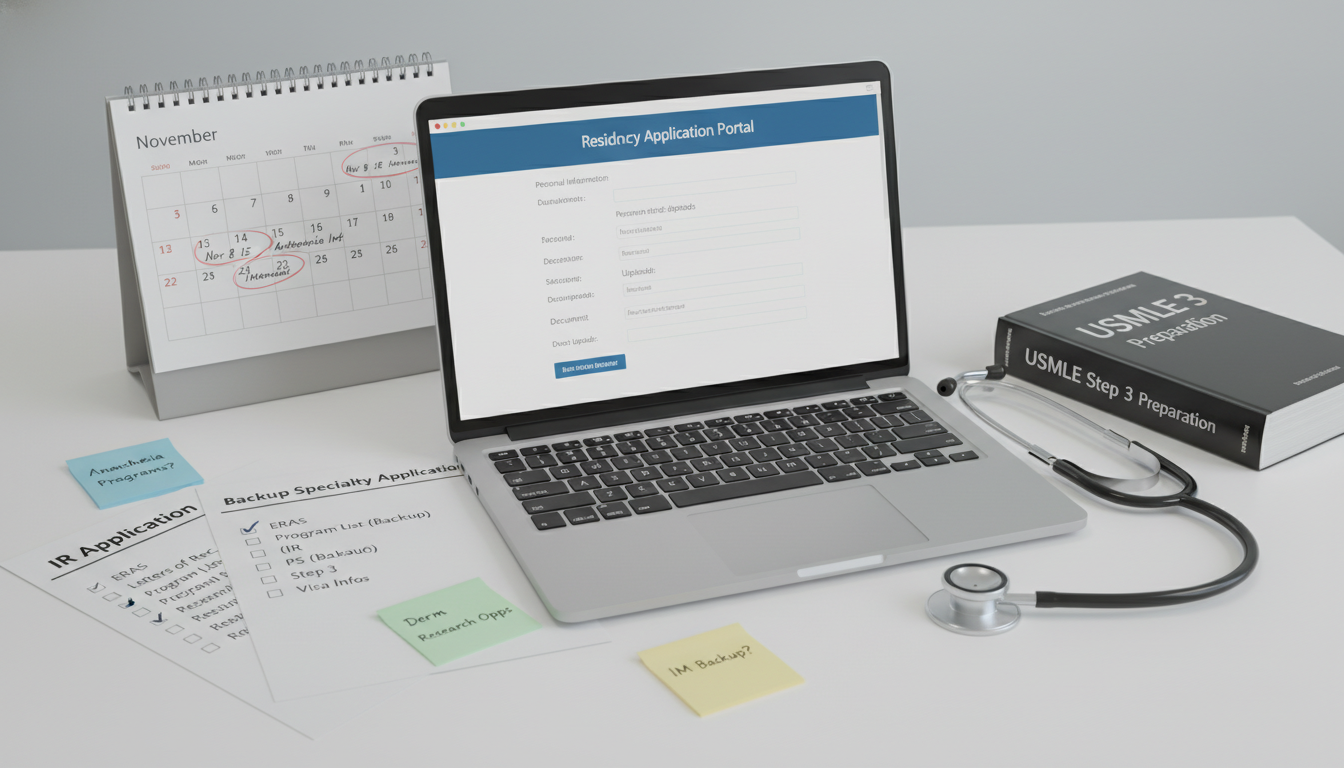
1. Separate but coherent narratives
You’ll likely need:
- One IR-focused personal statement.
- One (or more) backup specialty-specific statements (DR, IM, etc.).
Your IR statement:
- Emphasize your passion for image-guided procedures, minimally invasive care, and IR research/experiences.
- Show commitment to the full scope of IR (oncology, vascular interventions, trauma, etc.).
- Avoid language that suggests you see IR as interchangeable with other fields.
Your backup specialty statement:
- Emphasize the genuine aspects you like about that specialty (e.g., diagnostic reasoning in IM, operative care in Surgery).
- It’s okay to mention you enjoy procedures or imaging, but frame it within the backup specialty’s culture and values.
- Do not mention IR in your backup statement; it risks making you look unfocused.
2. Letters of recommendation balance
Try to secure:
- At least one strong IR or Radiology letter for IR/DR applications.
- One letter from a core specialty relevant to your backup (e.g., medicine letter for IM, surgery letter for Surgery).
When uploading:
- For IR and DR programs: prioritize radiology/IR letters plus a broad clinical letter (IM/Surgery).
- For IM programs: prioritize IM attendings, but you can include one radiology letter if it highlights general clinical abilities and teamwork, not only IR technique.
3. ERAS program signaling and list strategy
- Apply broadly to IR, but also realistically: focus on programs known to have matched IMGs or that sponsor visas.
- For your backup specialty:
- Use tools like FREIDA and program websites to identify:
- Visa policies (J-1 vs H-1B).
- Percentage of IMGs in current residents.
- Apply to more programs than you think you need; a non-US citizen IMG often needs a wide net (e.g., 80–120+ IM programs if IM is your major backup).
- Use tools like FREIDA and program websites to identify:
4. Handling interviews and questions about your interests
You may be asked: “Are you applying to other specialties?” How you answer depends on context.
For IR interviews:
- It’s usually better to emphasize your dedication to IR, unless specifically asked.
- If asked directly, be honest but strategic:
- “IR is my top choice and where I see myself long-term. Because IR is very competitive, I also applied to Diagnostic Radiology programs that would still allow me to pursue an IR-focused career.”
For backup specialty interviews:
- Focus on what genuinely attracts you to that specialty.
- Avoid making IR the center of your explanation:
- A poor answer: “I love IR but applied to IM as a backup.”
- Better answer: “I’m drawn to Internal Medicine for its complex diagnostic reasoning and longitudinal patient relationships, particularly in cardiology and critical care settings.”
5. Rank list strategy
When creating your rank list:
- Rank all IR programs you’d be genuinely happy to attend at the top.
- Then rank your primary backup specialty programs in the order of your true preference.
- Do not rank a program in any specialty that you would not be willing to attend.
Special Considerations for Non-US Citizen IMGs: Visas, Research, and Timelines
For a foreign national medical graduate, backup planning intersects closely with the visa and academic ecosystem.
1. Visa type realities
J-1 Visa:
- Most common for residency.
- Sponsored through ECFMG.
- Requires a 2-year home-country return at the end (unless you obtain a waiver).
- Many IMGs match on J-1; programs are generally familiar with the process.
H-1B Visa:
- Less common at the residency level; more paperwork and cost for the program.
- Some competitive specialties (including IR, DR) are less inclined to sponsor H-1B.
- Requires completion of all USMLE Steps (including Step 3) before H-1B filing in many cases.
Actionable advice:
- Consider J-1 more realistic as your primary path; don’t rule out H-1B, but do not rely on it.
- Target programs explicitly stating visa sponsorship on their websites or FREIDA.
2. Strengthening your application before applying
If you are still early in your timeline or planning a reapplication:
- Seek US clinical experience:
- Observerships or research electives in IR/radiology and in your backup specialty.
- Engage in research:
- IR-related projects if possible (case reports, chart reviews, QI).
- Backup specialty research can show genuine commitment there as well.
- Improve Step scores if you have not yet taken all exams:
- Even though Step 1 is pass/fail, Step 2 CK remains critical.
3. Considering a dedicated research or preliminary year
If you do not match:
- Use a gap year for:
- Research in IR or radiology at a US institution.
- A non-categorical or preliminary year position (IM or Surgery).
- This may:
- Strengthen your IR candidacy for next cycle.
- Provide an entry into a different specialty as a long-term home if IR remains out of reach.
Putting It All Together: A Sample Backup Strategy for a Non-US Citizen IMG Aiming at IR
Imagine a non-US citizen IMG with:
- Step 2 CK: 240s
- 1 IR observership + 1 radiology letter
- Limited US clinical experience in IM
- Needs J-1 visa sponsorship
A realistic dual applying residency strategy could be:
Primary focus:
- Apply to all IR programs that:
- Sponsor J-1.
- Have historically taken IMGs (based on current residents or forums).
- Use IR-focused personal statement and IR/radiology letters.
- Apply to all IR programs that:
Backup 1 (close to IR):
- Apply to a broad set of Diagnostic Radiology programs, including:
- University-affiliated community programs.
- Mid-tier academic centers.
- Use a slightly more DR-focused statement emphasizing diagnostic imaging, with subtle IR interest.
- Apply to a broad set of Diagnostic Radiology programs, including:
Backup 2 (higher match probability):
- Apply widely to Internal Medicine programs that:
- Are known to be IMG-friendly and sponsor J-1.
- Use IM-focused statement emphasizing diagnostic reasoning, longitudinal care, and interest in cardiology/critical care.
- Apply widely to Internal Medicine programs that:
During interviews:
- Present fully as an aspiring interventional radiologist in IR interviews.
- Present fully as a future internist (or radiologist) in backup interviews, without excessive IR talk.
Rank list:
- Rank all IR programs you interviewed at and genuinely like.
- Then rank DR programs.
- Then IM programs.
- Do not rank any program where you would not be willing to train.
This structure preserves your IR dream while drastically reducing the risk of going completely unmatched.
FAQs: Backup Specialty Planning for Non-US Citizen IMG in Interventional Radiology
1. As a non-US citizen IMG, is it realistic to match directly into an integrated IR program?
Yes, but it is challenging. A non-US citizen IMG can match into IR, especially if you have:
- Strong USMLE scores (especially Step 2 CK),
- Solid IR or radiology research,
- US-based IR or radiology rotations,
- Excellent letters from interventional radiologists or radiologists, and
- Targeted applications to programs known to take IMGs and sponsor visas.
However, due to the limited number of positions and additional visa barriers, having a backup specialty plan is strongly recommended.
2. Which backup specialty gives me the best chance to eventually work in an IR-like field?
Diagnostic Radiology is the most direct IR-adjacent backup. From DR, you can pursue independent IR residency or IR-heavy fellowships and maintain close involvement in imaging-based procedures. Vascular Surgery, Interventional Cardiology (via Internal Medicine), or Interventional Pain (via Anesthesiology/PM&R) can also provide procedural careers with some conceptual overlap, though they are distinct from IR.
3. Will dual applying to a backup specialty hurt my chances in the IR match?
Not if you manage your application strategy carefully. Program directors usually understand that highly competitive specialties like IR attract applicants who also apply more broadly. The key is to:
- Present a focused, credible IR narrative to IR programs.
- Use separate, specialty-specific personal statements.
- Avoid telling IR programs that your heart is elsewhere, or telling backup programs that IR is your only real interest.
Done carefully, dual applying can protect you without undermining your IR candidacy.
4. How many programs should I apply to in my backup specialty as a non-US citizen IMG?
The exact number depends on your overall competitiveness, but in general:
- For a non-US citizen IMG with moderate competitiveness, consider:
- IR: almost all programs that consider IMGs and sponsor your visa type.
- DR: 60–100 programs, prioritizing IMG-friendly and J-1 sponsoring institutions.
- IM: 80–150 programs if IM is your main backup, especially if your profile is average for IMGs.
Use tools like FREIDA, program websites, and IMG-focused match statistics to refine your list.
Thoughtful backup specialty planning won’t diminish your ambition to become an interventional radiologist. Instead, it ensures that, as a non-US citizen IMG or foreign national medical graduate, you maximize your odds of training and thriving in the US healthcare system—whether in IR, an IR-adjacent pathway, or another fulfilling specialty that matches your skills and values.