
The most common mistake applicants make with mentors is simple: they ask for encouragement when they actually need risk assessment.
If you want a realistic backup specialty, you must force the conversation out of “you’ll be fine” territory and into “here are the odds, here are the options, here is the plan.” That does not happen by accident. You have to engineer it.
This is exactly how to do it.
Step 1: Get Your Numbers Straight Before You Talk To Anyone
Walking into a mentor meeting without your data is like showing up to M&M without the chart. You will get vague reassurance and nothing actionable.
Before you schedule any “backup specialty” conversation, assemble a one-page snapshot of your application.
You need, at minimum:
- USMLE Step 1 status (Pass/Fail, with date)
- USMLE Step 2 CK score and test date (or planned date)
- COMLEX scores if applicable
- Class rank / quartile / decile or “no ranking” status
- Any AOA / Gold Humanism / other honors
- Number and type of publications (not “working on”; what is submitted/accepted/published)
- Specialty-specific signals:
- For competitive specialties: number of aways, specialty letters, sub-I comments
- For prelim / TY / IM / FM: clinical comments, leadership, any red flags (LOA, remediation)
- Red flags:
- Any failed exam
- LOA
- Course/clerkship failures
- Unexplained gaps
Put it into something like this:
| Category | Data Example |
|---|---|
| Step 1 | Pass (First attempt) |
| Step 2 CK | 228 (First attempt, 6/2025) |
| Class Standing | 3rd quartile, no AOA |
| Research | 1 pub (co-author), 1 poster |
| Target Specialty | Derm |
| Aways | 2 (Home + Regional academic) |
| Red Flags | None |
Print this. Or bring it up on your laptop. Do not make your mentor drag each piece of data out of you over 20 minutes.
Why this matters: realistic backup planning depends on risk category, not vibes. Your numbers place you into one of three groups whether you like it or not:
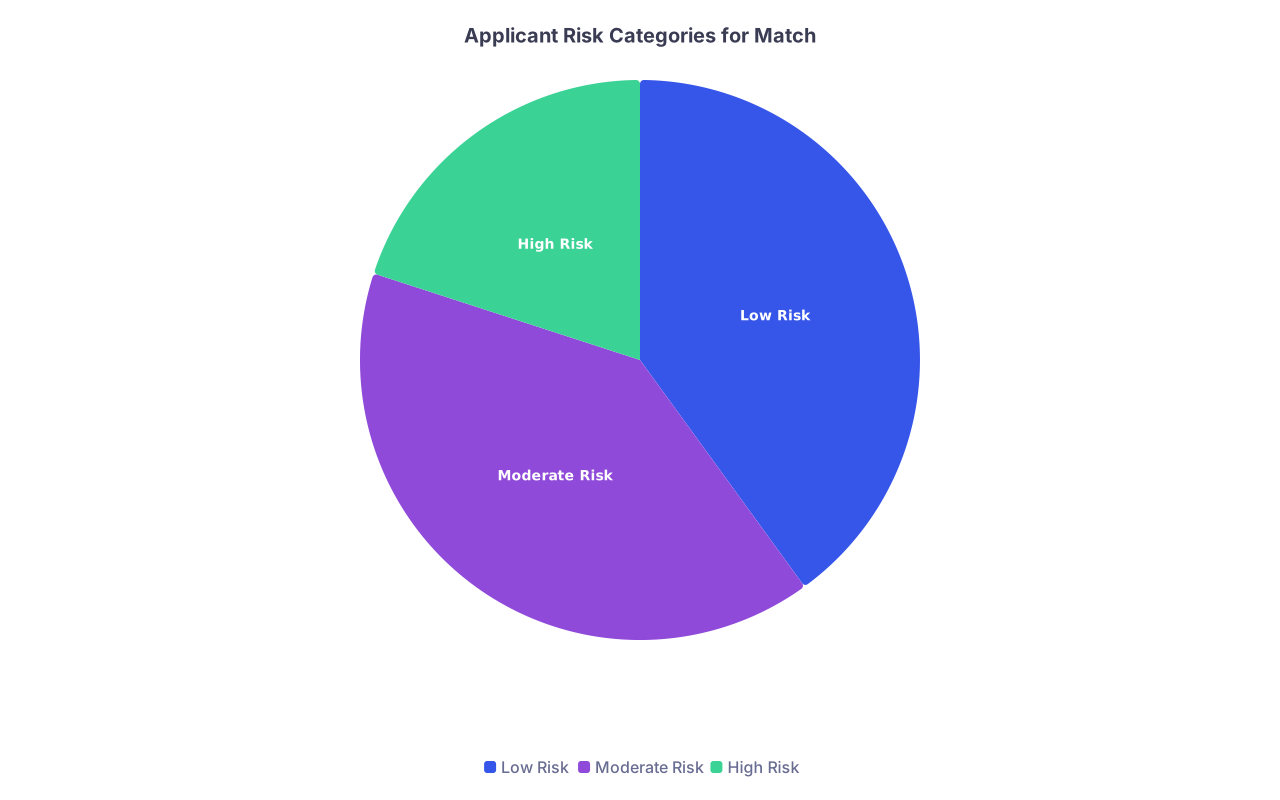
| Category | Value |
|---|---|
| Low Risk | 40 |
| Moderate Risk | 40 |
| High Risk | 20 |
Do this homework first, and your mentor can stop guessing and start advising.
Step 2: Set the Agenda Explicitly (Or You Will Get Useless Reassurance)
If you walk in saying, “I just wanted to get your thoughts,” expect generic encouragement.
You have to frame the purpose of the meeting before it starts. Send a short email like this:
Subject: Meeting re: main vs backup specialty strategies
Hi Dr. Patel,
I am planning to apply to orthopedics this cycle and want an honest assessment of my chances and help identifying realistic backup paths (e.g., prelim surgery, categorical IM, or another field).
I am not looking for reassurance so much as data-driven guidance and a concrete plan. I will bring a one-page overview of my application (scores, rank, research, etc.).
Could we meet for 20–30 minutes sometime next week?
Thank you,
[Name]
You are signaling three things:
- You want honesty.
- You want help choosing backup specialties, not just “how to be stronger.”
- You will be prepared.
This changes how your mentor comes into the room. They shift from cheerleader to consultant.
Step 3: Open the Conversation With a Direct, Structured Prompt
Do not waste the first 10 minutes on small talk and vague “What do you think of my chances?” Lead with a structured opener.
Sit down, pull up your one-pager, and say something close to this:
“I am planning to apply to [Target Specialty] as my primary choice. I know it is competitive and I want a blunt assessment of my risk category and what realistic backup specialties or structures I should build into my application.
Here is my snapshot. Based on your experience with recent applicants with similar profiles, where do you see me landing, and what backup strategy would you recommend?”
You have just:
- Stated your goal
- Framed you want “blunt” feedback
- Anchored the conversation to comparators (“recent applicants with similar profiles”)
- Asked for a strategy, not just a thumbs up/down
This is how you keep the meeting focused.
Step 4: Force Your Mentor To Give You a Risk Category
A surprising number of mentors avoid saying “high risk” out loud, even when everyone knows it. You have to pin this down.
Ask this exact sequence:
- “If you had to put me in a category for [target specialty]—low, moderate, or high risk to match—where would you put me?”
- “What makes you say that? Is it mainly score, research, letters, or something else?”
- “How did applicants like me do in the last 2–3 cycles?”
Push until you get a clear label. Not handwaving.
If they dodge, go sharper:
“If I were your own kid applying to [specialty] with this profile, how worried would you be about them not matching?”
That usually breaks the politeness barrier.
You are trying to get to something like:
- “Honestly, you are low risk for categorical IM and high risk for cards fellowship later if you do not build more research.”
- “For ortho, you are absolutely in the high-risk group. For prelim surgery, moderate. For categorical general surgery in community programs, low to moderate.”
- “For EM in the current market, you are moderate risk at best. I would treat that as an at-risk specialty and build in a categorical backup like IM or FM.”
Once you have your risk category, write it down in front of them. Forces clarity. And gives you something to plan around.
Step 5: Ask Targeted Questions About Specific Backup Paths
“Do I need a backup?” is useless.
Instead, you should ask:
- “For someone in my position, what are the 2–3 most realistic backup specialties or tracks?”
- “Between [list 2–3 tentatives you have in mind], which are realistic and which are fantasy?”
- “What backup strategy have you seen actually work for applicants like me?”
Common realistic backup structures:
- Competitive specialty → Categorical IM/Fam Med/Path/Psych as backup
- Competitive surgical field → Categorical general surgery or prelim surgery + parallel categorical applications
- At-risk mid-tier specialty (EM in some markets, OB-GYN for weaker applicants) → Parallel IM/FM with tailored personal statements
A mentor who has seen multiple cycles should be able to say something like:
- “With a 210 Step 2, plastics is essentially not salvageable. If you love the OR, general surgery or possibly ENT is more realistic if you had strong letters, but I would strongly suggest categorical general surgery + prelim programs.”
- “You are mid-pack for radiology. A strong backup would be categorical IM with a plan to pursue cards or heme/onc; those transitions happen and I have seen them.”
You want names. Concrete fields. Not just “Have a backup.”
Step 6: Get Them To Compare Probability, Not Just Possibility
A fatal trap: mentors saying “It is possible” and you hearing “It is likely.”
You need numbers. Crude ones are fine. Ask:
“If you had to put rough numbers on it for me this cycle:
- Chance to match [Target Specialty]
- Chance to match in a reasonable backup [Backup 1 or 2]
What would you say?”
Then sit in the silence. Let them think. Do not rescue them by changing the subject.
Sometimes you will hear:
- “Honestly, 30–40% for your target, 80–90% for family med.”
- “For ortho at your Step score and research level, maybe 20–30%. For general surgery categorical at reasonable programs, 60–70% if you apply smartly.”
You are not collecting perfect statistics. You are calibrating your own optimism.
If they absolutely refuse to give numbers, reframe:
“Would you be surprised if I did not match [Target Specialty]?”
“Would you be surprised if I did not match IM or FM with my current profile?”
“Surprised” is a useful word. It forces them to reveal their baseline expectation.
Step 7: Use Match Data During the Conversation (Not Later)
Do not slogan your way through this. Bring the numbers into the room.
Pull up the NRMP “Charting Outcomes” for your specialty and backup options. Have the PDFs ready on your laptop or tablet. Then say:
“Here’s where my Step 2 and research place me relative to matched vs unmatched applicants in [Target Specialty]. This looks borderline to me. How do you interpret this, given your experience?”
And then:
“Here is the same for IM and FM. It looks like I am well above the matched median. Does that match what you see for our students?”
You are forcing your mentor to anchor their advice to data, not memory of the one superstar or the one disaster.
If you want a quick visual of how this actually feels in reality, think of it this way:
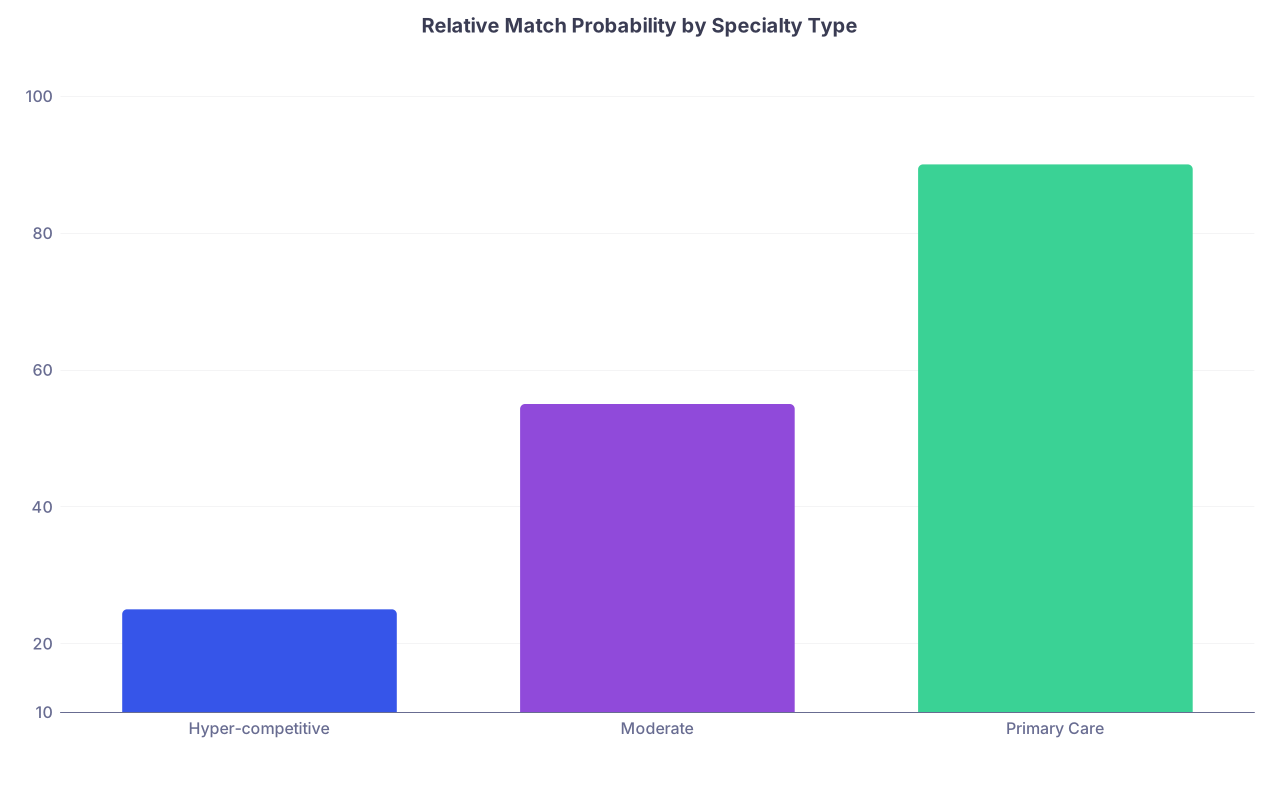
| Category | Value |
|---|---|
| Hyper-competitive | 25 |
| Moderate | 55 |
| Primary Care | 90 |
No, those numbers are not exact. But that is the shape of the risk curve.
Tie your conversation to where you fall in each bucket.
Step 8: Explicitly Discuss Parallel vs Tiered Application Strategies
You are not just picking a backup specialty. You are picking a structure for the entire application.
You need to ask this explicitly:
“Do you recommend a pure application to [Target Specialty], or a parallel application to [Backup Specialty], or a tiered strategy where I add programs in [Backup Specialty] if I do not get enough interviews?”
Then drill down on logistics.
Parallel application questions
If they say “parallel,” ask:
- “How many programs would you suggest for each specialty?”
- “Do I need completely separate personal statements, or can I adapt one?”
- “Will applying to [Backup Specialty] hurt me for [Target Specialty] at this institution?”
There are programs where applying broadly to FM or IM alongside a competitive field is normal and accepted. Others quietly see it as “lack of commitment.” You need local intelligence.
Tiered application questions
If they say “tiered,” ask:
- “What is the trigger point for switching? For example, if I have fewer than X interviews by [date], should I add [Backup Specialty]?”
- “How late is too late to add a second specialty and still have a fair shot?”
Use a timeline visual if it helps you (and them) see it:
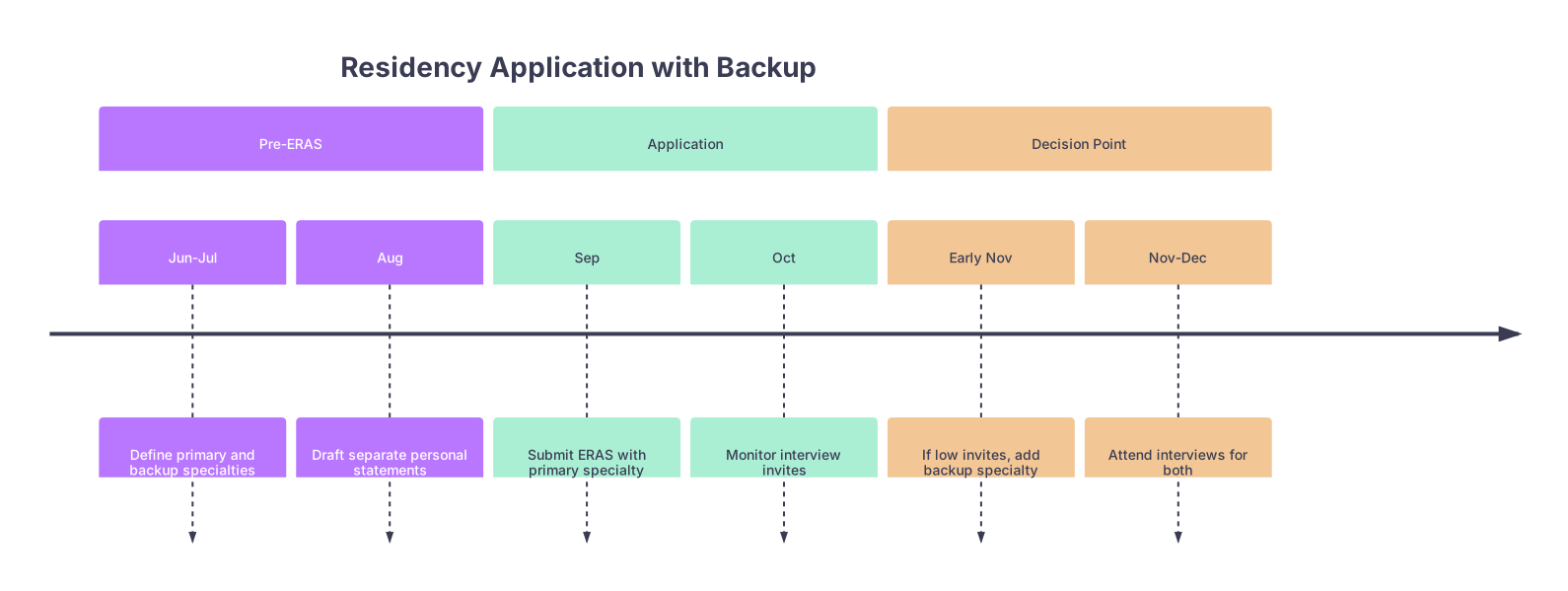
| Period | Event |
|---|---|
| Pre-ERAS - Jun-Jul | Define primary and backup specialties |
| Pre-ERAS - Aug | Draft separate personal statements |
| Application - Sep | Submit ERAS with primary specialty |
| Application - Oct | Monitor interview invites |
| Decision Point - Early Nov | If low invites, add backup specialty |
| Decision Point - Nov-Dec | Attend interviews for both |
Write down the trigger rules in your notes: “If < 5 interviews in ortho by November 1, start submitting categorical general surgery apps.” That is an actual plan, not hope.
Step 9: Ask For Specific Actions They Can Take To Support Plan A and Plan B
Mentors are often willing to help. They just default to helping with your main specialty. You need to explicitly enroll them in your backup strategy too.
Say something like:
“To make this plan work, I will need to strengthen both [Target Specialty] and [Backup Specialty].
For [Target Specialty]:
- Are there specific attendings who might write a stronger letter if I do another sub-I?
- Any research projects I can realistically complete or submit before ERAS?
For [Backup Specialty]:
- Who are the key faculty in [Backup Specialty] you would recommend I meet?
- Would you be comfortable reaching out to [Name] in that department to introduce me, or do you prefer I email them directly and mention your name?”
Make it extremely concrete:
- “Can I add a 2-week rotation with [Backup Specialty] team in August?”
- “Which PDs or APDs at this institution would you trust to give me blunt feedback about [Backup Specialty]?”
And then: ask for one specific, time-bound favor:
“If I draft two personal statements, one for [Target Specialty] and one for [Backup Specialty], would you be willing to read both and tell me if they are aligned with our plan?”
You are not begging. You are showing you have a plan and you want targeted input.
Step 10: Handle the Mentor Who Is Too Optimistic (Or Too Negative)
Not all mentors give balanced advice. You will meet two problem types:
- The cheerleader: “You’ll be fine, just go for it!”
- The nihilist: “Your score killed you. Nothing will help.”
You have to manage both.
If they are overly optimistic
Push them with counterfactuals.
“I appreciate your confidence. To stress-test this a bit:
- If I only get 3–4 interviews in [Target Specialty], what would you recommend then?
- Would you advise your own kid to only apply to [Target Specialty] in my situation?”
Then bring in data again:
“NRMP shows a sizable unmatched rate for applicants with my profile. How do you reconcile that with your sense that I will probably match?”
If they still brush it off, you need a second opinion. Preferably from someone involved in the match committee or PD-level.
If they are overly negative
Sometimes you are talking to someone who had a toxic fellowship or is just burned out.
If they shut down your target specialty entirely, respond this way:
“I hear your concern. Let me ask this:
- For the last 3 years, have any applicants from our school with my scores and research matched into [Target Specialty]?
- If the answer is no, what would I need to add or change to move from ‘almost no chance’ to ‘unlikely but possible’?”
You may learn there truly is no realistic path from your institution for that field with your profile. Or you may expose that their negativity is more emotional than data-driven.
Either way, then ask:
“Given that reality, what is the most competitive specialty you think is realistic for me, and what would it take to get there this cycle?”
This turns a demoralizing conversation into an actionable one.
Step 11: Know Exactly What To Say About Backup Specialties In Your Personal Statements and Interviews
Another anxiety point: “If I apply to a backup, how do I talk about it without sounding non-committal?”
You need to get mentor input on this phrasing. Ask them:
“Programs in [Backup Specialty] will see I also applied to [Target Specialty]. How do you recommend I frame that in my personal statement and if asked in interviews?”
You are aiming for something like:
For personal statements (backup specialty):
“During clinical rotations I was drawn strongly to both [Target Specialty] and [Backup Specialty] for different reasons.
After extensive discussion with mentors, I made the decision to apply to both fields. My primary goal is to train in a residency where I can develop strong [shared skill set: critical care exposure, procedural skills, continuity care, etc.]. I am fully committed to a career in [Backup Specialty] should I match into this field, and I see clear paths to a fulfilling, long-term career through [specific aspects of that specialty].”
For interviews:
“I explored both [Target Specialty] and [Backup Specialty] seriously. With my mentors I created a plan that balanced my interests with a realistic assessment of competitiveness. If I am fortunate enough to match in [Backup Specialty], I see that as a committed path, not a placeholder. The aspects of [Backup Specialty] that appeal to me specifically are [X, Y, Z].”
Run this language by your mentor in the meeting. They can tell you what sounds sincere vs fake.
Step 12: Finish The Meeting With a Written, Shared Plan
Do not leave your mentor’s office with “I’ll think about it.” You want a plan document by the time you stand up.
Pull out your notepad or laptop and say:
“Let me make sure I have our plan right. I am going to write it down and you can tell me if this sounds reasonable.”
Include:
- Risk assessment
- “[Target Specialty]: [Low/Moderate/High] risk”
- “[Backup Specialty 1]: [Low/Moderate/High] risk”
- Application structure
- “Primary: [X specialty], applying to ~[N] programs”
- “Backup: [Y specialty] parallel / tiered, ~[M] programs”
- Trigger point
- “If by [Date] I have fewer than [#] interviews in [Target Specialty], I will…”
- Action items
- “By [Date]: meet with [Faculty A] in backup field”
- “By [Date]: complete [sub-I/research/personal statements]”
- Mentor commitments
- “Dr. X will write letter for [Target Specialty] by [Date]”
- “Dr. X will email [Backup Specialty PD/Faculty] to introduce me”
Then say:
“Does this plan sound right to you? Anything here you would change before I move forward?”
When they nod, you have a mentor-endorsed backup strategy. Not just vague advice.
Step 13: Get a Second Opinion When The Stakes Are High
If you are applying to:
- Derm
- Plastics
- Ortho
- ENT
- Neurosurgery
- Urology
- Rad Onc
- Integrated vascular / CT / IR / etc.
…you cannot rely on a single mentor’s gut feeling. You need at least two data points.
Target:
- 1 mentor in your target specialty
- 1 mentor in your potential backup specialty (IM, FM, gen surg, etc.)
- Optional: 1 PD/APD or dean-level advisor who sees match lists across specialties
Ask each of them variations of the same structured questions you used above. Then compare answers.
If three people all say, “You are high risk for ortho; you are essentially guaranteed in FM,” believe them. And act accordingly.
The Bottom Line
You do not get realistic backup specialties by “hoping for the best.” You get them by forcing structured, sometimes uncomfortable conversations with mentors.
Keep three points in your head:
- Walk in with data and a clear ask. One-page snapshot. Explicit request for risk assessment and backup planning. No fishing for generic reassurance.
- Pin your mentor down to categories, numbers, and a written plan. Low/moderate/high risk, probable vs possible, clear parallel or tiered strategy, defined triggers and action items.
- Use your mentors as operators, not spectators. Ask for specific introductions, letters, rotations, and feedback on your dual-specialty narrative so your Plan B is actually matchable—not just theoretical.
Do this well, and your backup specialty stops being a panic move in November. It becomes a deliberate part of your strategy from day one.