
The way most applicants build backup plans is exactly how you make yourself look desperate in PD meetings.
Let me tell you what actually happens when your application hits that conference table and your “backup strategy” is hanging off it like a half-torn Post-it note.
What PDs Say Behind Closed Doors
Here’s the part nobody tells you honestly: program directors are not just evaluating you for their specialty. They’re evaluating whether you’ve already emotionally checked out to something else.
I’ve sat in those meetings. I’ve heard lines like:
- “This is clearly a derm reject trying to land somewhere.”
- “He wants ortho but threw us on the list. We’re not his people.”
- “Her story is anesthesia today, but she spent the last three years branding herself as ENT. Hard pass.”
Nobody writes that in your rejection email. But that is exactly the conversation.
The red flag isn’t just “backup specialty.” Everybody knows people hedge. The real red flag is when your backup plan looks lazy, last-minute, or blatantly transactional. That’s when PDs close the file.
Let’s walk through what actually sets off alarms.
The Pattern Every PD Recognizes
There’s a very specific desperation pattern that PDs talk about when they go through the stack of applications.
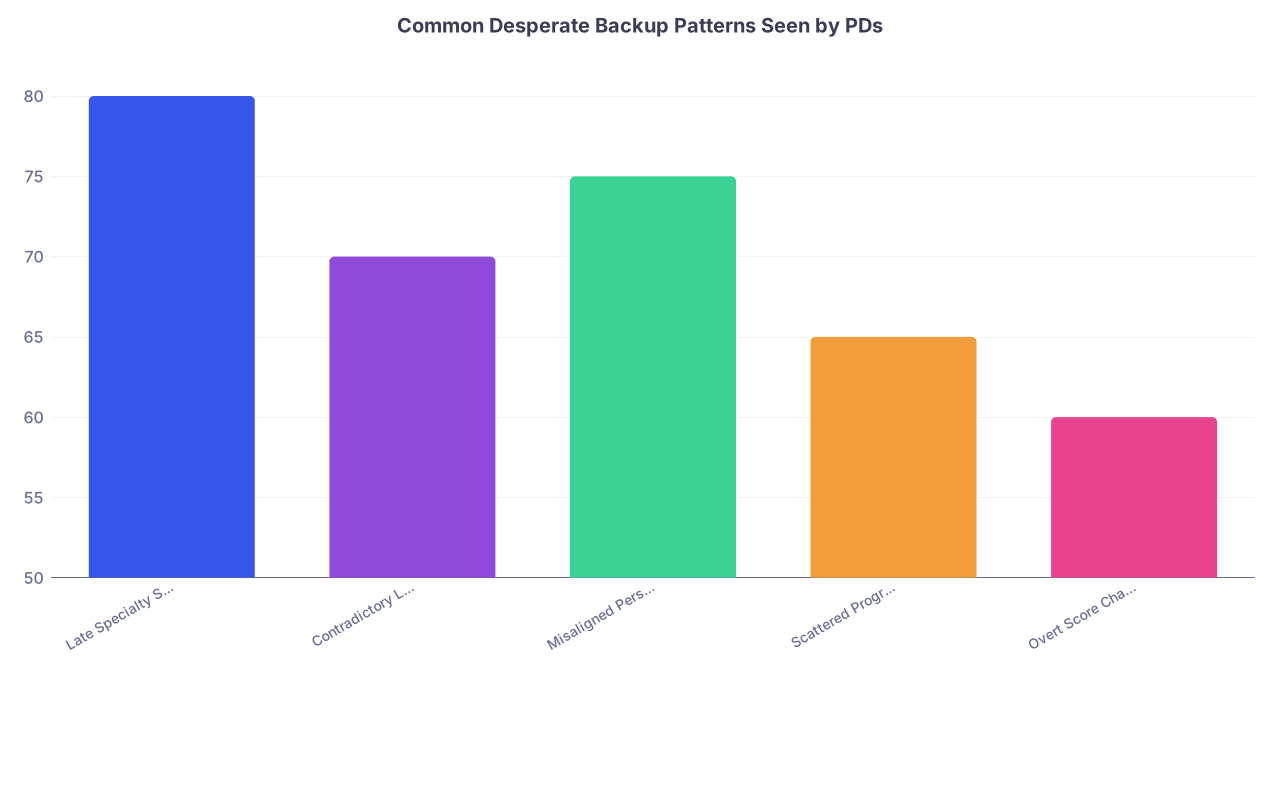
| Category | Value |
|---|---|
| Late Specialty Switch | 80 |
| Contradictory LORs | 70 |
| Misaligned Personal Statement | 75 |
| Scattered Program List | 65 |
| Overt Score Chasing | 60 |
Those numbers aren’t from a published paper. They’re the rough reality: these patterns show up again and again.
Let me break down what they look like on your ERAS page and how conversations actually sound in the room.
1. The Last-Minute Specialty Identity Crisis
You branded yourself for three years as one thing, then in August–September of application season, you “decide” you’re something else.
The application looks like this:
- Third-year narrative: two home rotations and an away in ortho
- Research: three posters in ortho, “interest group leader”
- Fourth year: one month of anesthesia in October, suddenly applying anesthesia
Then your personal statement opens with, “I have always been drawn to physiology and pharmacology…” and pretends the orthopedic chapter never existed.
PD reaction?
- “They’re here because ortho didn’t work out.”
- “If we rank them highly, they’ll just reapply ortho next year.”
- “We’re not going to be somebody’s gap-year Plan B.”
You think you’re being subtle by not mentioning your original dream specialty. You’re not. The timeline tells the story whether you write it or not.
2. The Personal Statement That Sells Too Hard
Desperate backup plans always oversell. You go from zero visible connection to a field… to claiming you’ve always known you belong there.
Anesthesia PD reading:
“Medicine has always been about being behind the scenes, working quietly in the background…”
Then sees:
- Two surgery aways
- A research year in neurosurgery
- Minimal anesthesia exposure and no longitudinal involvement
The word that comes up? Inauthentic.
I’ve heard PDs say: “If they just admitted they pivoted, I’d believe them more. This reads like fiction.”
The fix isn’t to hide your previous interest. The fix is to frame the pivot intelligently and coherently, so it looks mature, not panicked. I’ll get to that.
Letters That Betray Your Real Plan
If there’s one thing that kills the desperate backup applicant more than anything else, it’s mismatched letters. PDs don’t just skim these. They know exactly what to look for.
3. The “He’ll Make a Great Orthopedic Surgeon” Letter… in an IM Application
This is brutal but common.
You apply Internal Medicine as a “backup.” You send two IM letters and—because you liked the writer—a strong ortho letter where the attending gushes about your operative skills, your “future as an excellent orthopedic surgeon,” and your “clear passion for surgery.”
Internal Medicine PD, after reading the letter, leans back and says:
- “He’s not staying in IM. He’ll bolt the minute he can.”
- “We’re training someone else’s future surgeon.”
Those letters get remembered for the wrong reason.
If your letter even hints strongly that your true passion is somewhere else, PDs will assume:
- You’ll be miserable in their field.
- You’re more likely to underperform or leave.
They are not running a charity for applicants who couldn’t make their first choice.
4. Specialty-Specific Language in the Wrong Context
Even when the letter never says “derm” or “ortho,” the subtext is obvious.
- “She has a clear passion for procedural-based care and the OR environment.”
- “He has outstanding technical skills and hand-eye coordination.”
- “She talks often about her future in ENT.”
Now imagine that in a Pediatrics application. You won’t see a “this is why we rejected you” note. But in the meeting, the phrase is: “This is not a peds person.”
If you’re building a backup plan, you must control what goes into your letters. Not with scripts. With clarity:
- Tell letter writers what you’re actually applying to.
- If you pivot, update them.
- If they can’t write for that new field, don’t use the letter.
School Advisors vs. PD Reality
Your school advisor often gives you the “safe” advice. The kind that preserves their statistics, not necessarily your credibility.
Things like:
- “Just dual-apply, you can sort it out later.”
- “You can always switch after intern year.”
- “Apply medicine as a backup; you’re a strong candidate.”
Here’s what PDs actually say:
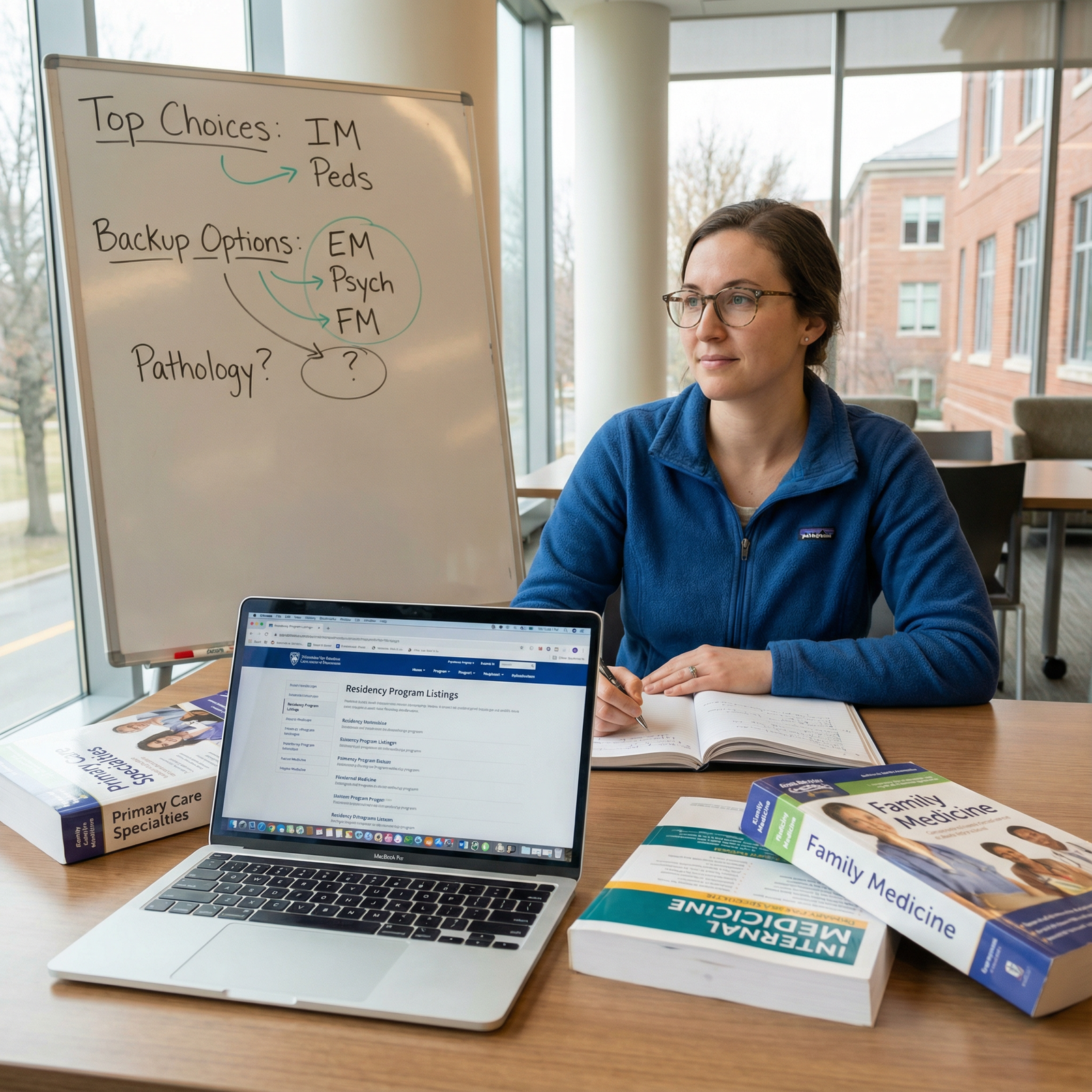
- Surgery PD: “If someone dual-applies surgery and anesthesia, we assume anesthesia is the backup if their story doesn’t match.”
- IM PD: “If their whole background screams radiology, we do not believe their sudden love of inpatient wards.”
- Psych PD: “We get flooded with ‘backup’ applications from people who’ve never set foot in our clinic. They do not get interviews.”
Advisors rarely see those meetings. PDs live in them.
Your job is to bridge the gap between “what looks safe on paper” and “what actually earns an interview.”
The Backup Specialty Shortlist: Who Sees Through You Fastest
Not all specialties respond the same way to being a backup. Some are used to it. Some are offended by it. Some simply filter you out silently.
Here’s how different fields typically react when they sniff out desperation.
| Specialty | Tolerance for Obvious Backup Applicants | Common PD Reaction |
|---|---|---|
| Internal Med | Moderate | “We’ll take them if they’re honest.” |
| Family Med | High | “We expect some pivots, just be sincere.” |
| Psych | Low–Moderate | “We want committed psych people.” |
| Anesthesia | Low | “We’re not Plan B for surgery rejects.” |
| EM | Very Low | “Dual-app with IM? We usually pass.” |
Is this universal? No. But it’s close enough to reality that you ignore it at your own risk.
Emergency Medicine in particular has become extremely sensitive to dual-apply behavior, especially with IM or FM. They’ve seen too many applicants trying to game the system, and their response has been brutal in some places: if your story looks split, you get neither.
Top Red Flags That Scream “Desperate Backup”
Let’s be explicit. These are the patterns that, when your file is onscreen, trigger those quiet comments that sink you.
5. Completely Different CVs for Different Specialties
I see this a lot with people trying to be “strategic.”
- One personal statement for derm, another for IM.
- Different volunteer experiences emphasized in each.
- Different “why this specialty” narratives that have nothing to do with each other.
On your side, it feels clever. On theirs, it feels disjointed.
Programs in the same institution talk. The derm PD mentions your name at lunch. The IM PD says, “Funny, I interviewed them yesterday and they told a completely different story.” That’s the end of that.
6. Overapplying Without Coherent Focus
You apply to:
- 80 IM
- 70 FM
- 50 Psych
- 40 Neurology
PDs see the same name showing up in multiple lists across departments. This is especially obvious at mid-sized hospitals where the same GME office processes all applications.
The whispered remark: “They’re just trying to match anywhere.”
And that’s the exact applicant most programs are no longer excited about, especially as the Match has gotten tight in multiple fields.

| Step | Description |
|---|---|
| Step 1 | Applicant builds scattered backup plan |
| Step 2 | Applies broadly to unrelated specialties |
| Step 3 | Different narratives and letters |
| Step 4 | PDs notice inconsistency |
| Step 5 | Application moved down or off rank list |
| Step 6 | Considered but with caution |
| Step 7 | Perceived as desperate? |
7. Ignoring Obvious Skill Mismatch
This is harsher, but let’s be honest. Some people back up to fields that want the very thing their application lacks.
- Applying radiology with mediocre board scores and zero radiology exposure.
- Applying anesthesia having repeatedly failed Step exams but saying you’re “passionate about pharmacology and physiology.”
- Applying EM with no EM rotation, no SLOEs, and research only in geriatrics.
Programs assume you didn’t plan. Or you planned, it failed, and now you’re throwing darts.
How to Build a Backup Plan That Doesn’t Look Pathetic
Now the part you actually need: how to be strategic without looking like every other panicked dual-applier.
8. Choose Backups That Share a Coherent Narrative
The strongest backup plans are not “whatever is less competitive.” They’re specialties where your existing story still makes sense.
Examples that work:
- Ortho → PM&R: Musculoskeletal focus, rehab connection, shared patient population.
- ENT → Anesthesia: OR environment, head/neck familiarity, procedural interest.
- Derm → IM: Complex medical patients, autoimmune disease continuity.
Examples that often look incoherent:
- Ortho → Psych: Hard pivot with no visible psych track record.
- Path → EM: No acute-care exposure, no ED time.
- Derm → Anesthesia: Totally different skill and patient focus without a bridge.
If a PD can explain your move in one sentence that doesn’t sound like failure, you’re in good shape.
9. Create One Core Professional Identity
You do not need to pretend you’ve always wanted the backup field. You do need a unifying thread.
Something like:
- “I’m oriented toward longitudinal management of complex patients”
- “I’m drawn to procedure-heavy fields with acute decision making”
- “I care about system-based care and high-volume patient contact”
Then both your primary and backup specialties are just two ways of living out that theme. That’s what a PD can believe.
Instead of inventing two versions of you, create one identity that can live credibly in more than one field.
Timing: When the Switch Looks Reasonable vs. Desperate
Timing is everything. PDs actually have a mental calendar for “reasonable pivot” vs “panic.”
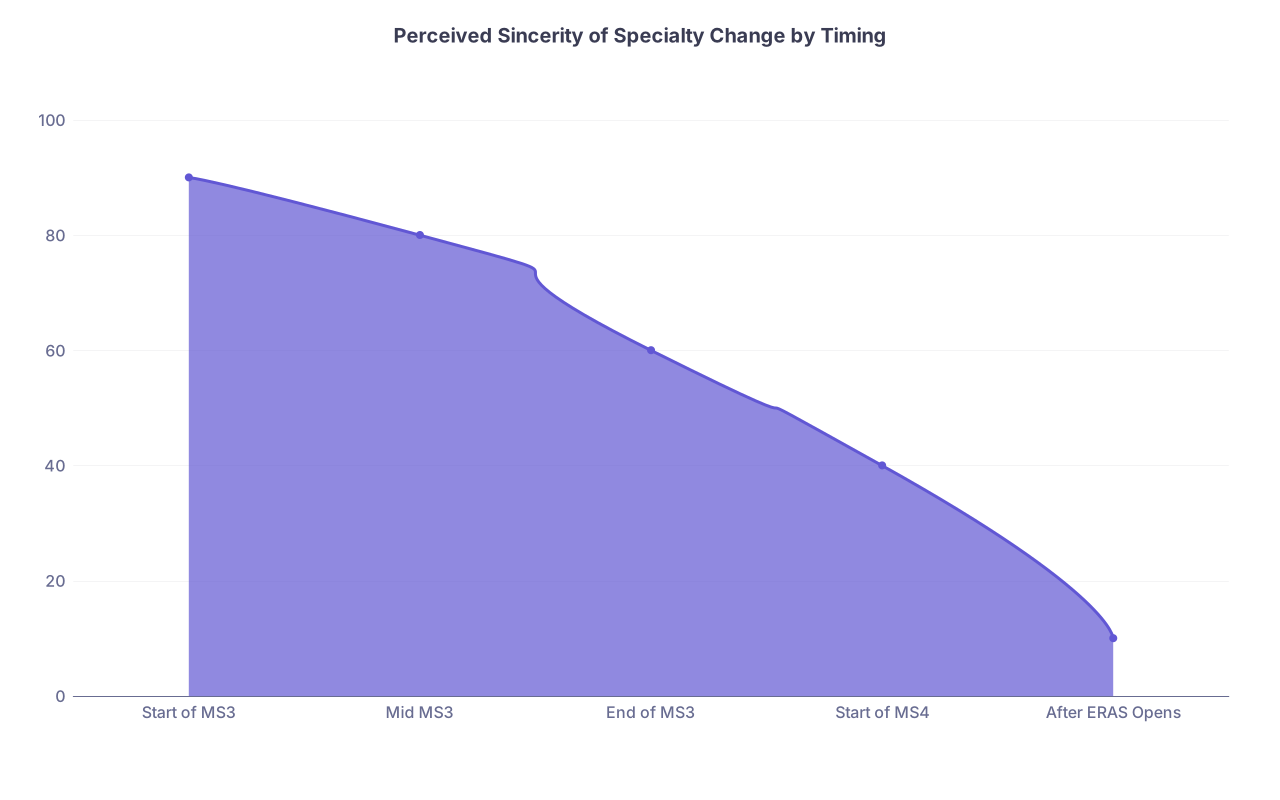
| Category | Value |
|---|---|
| Start of MS3 | 90 |
| Mid MS3 | 80 |
| End of MS3 | 60 |
| Start of MS4 | 40 |
| After ERAS Opens | 10 |
Again, not hard data, but very close to how these decisions feel in real committees.
If you pivot:
- During MS3 and then build a track record? Very believable.
- End of MS3 with at least two rotations in the new field before ERAS? Still workable.
- After ERAS opens? That’s where the desperation label starts.
You can’t rewrite the past, but you can at least stop making it worse. If you know you’re leaning toward a backup field, stop collecting primary-specialty-only experiences and start building even minimal credibility in the backup.
What To Actually Say When You’ve Switched
This is where most applicants either lie badly or ramble.
A credible pivot sounds like this:
- Clear acknowledgment: “I entered third year intending to pursue X.”
- Trigger for change: “After my Y rotation, I recognized that…”
- Positive framing: “…I found that the aspects of medicine I enjoy most were actually in Z.”
- Evidence trail: “So I sought out an away/sub-I/mentorship in Z and confirmed that fit.”
What PDs hate is:
- Pretending you never considered the original field.
- Suddenly rewriting your entire life’s passion to match your new choice.
- Acting like this has been your plan since undergrad, when your CV screams otherwise.
You can be honest without saying, “I didn’t match X so now I’m here.” That line is never necessary.
Dual-Applying Without Sabotaging Yourself
Sometimes, dual-applying is rational. Scores are borderline. The main specialty had a brutal match year. Your home department is honest with you.
But if you do it, do it with discipline.
Here’s how the people who match with backup plans usually play it:
- They narrow to two related fields, not three or four random ones.
- They prioritize one in their actions, not just their feelings.
- They ensure every letter they send is acceptable for both specialties or have field-specific sets that don’t contradict each other.
- They don’t tell each specialty they’re “the one and only dream” in melodramatic terms. They talk about fit, not destiny.
The ones who crash are the ones spraying 70–100 applications everywhere, chasing interview counts, and hoping nobody compares notes.
They do compare notes. Especially when GME offices and PDs sit in the same meetings.
When Your Backup Is Actually the Smarter Long-Term Choice
There’s a quiet subset of applicants whose “backup” is actually the better life for them. PDs can sense that too.
You see it in the file:
- Student told everyone they wanted CT surgery. Then did an IM sub-I and lit up.
- Their evaluations in the backup specialty are stronger. Comments clearly better.
- They suddenly show more initiative and joy there.
The IM PD reads the file and says, “This is actually our person. Surgery was the mistake.”
Those applicants match. Even with a late pivot.
Why? Because their story doesn’t smell of desperation. It smells of clarity.
Your responsibility is to decide which side of that line you’re on—and then build your materials to match that reality, not your pride.
Final Check: Does Your Backup Plan Look Desperate?
Ask yourself the questions PDs are quietly asking in those rooms:
- If someone read my file without hearing my speech, would they see a coherent path to this specialty?
- Do my letters reinforce this specialty—or subtly undermine it?
- Does my timeline look like growth and refinement, or like failure and scramble?
- Could my primary and backup both live under one believable professional identity?
- If the departments at a single hospital talked about my application, would the stories they heard from me line up—or clash?
If you’re cringing at those answers, good. That’s where you fix things.
Because years from now, you won’t remember how many programs you spammed with applications. You’ll remember whether you built a story you can stand behind—and whether a roomful of PDs believed it.