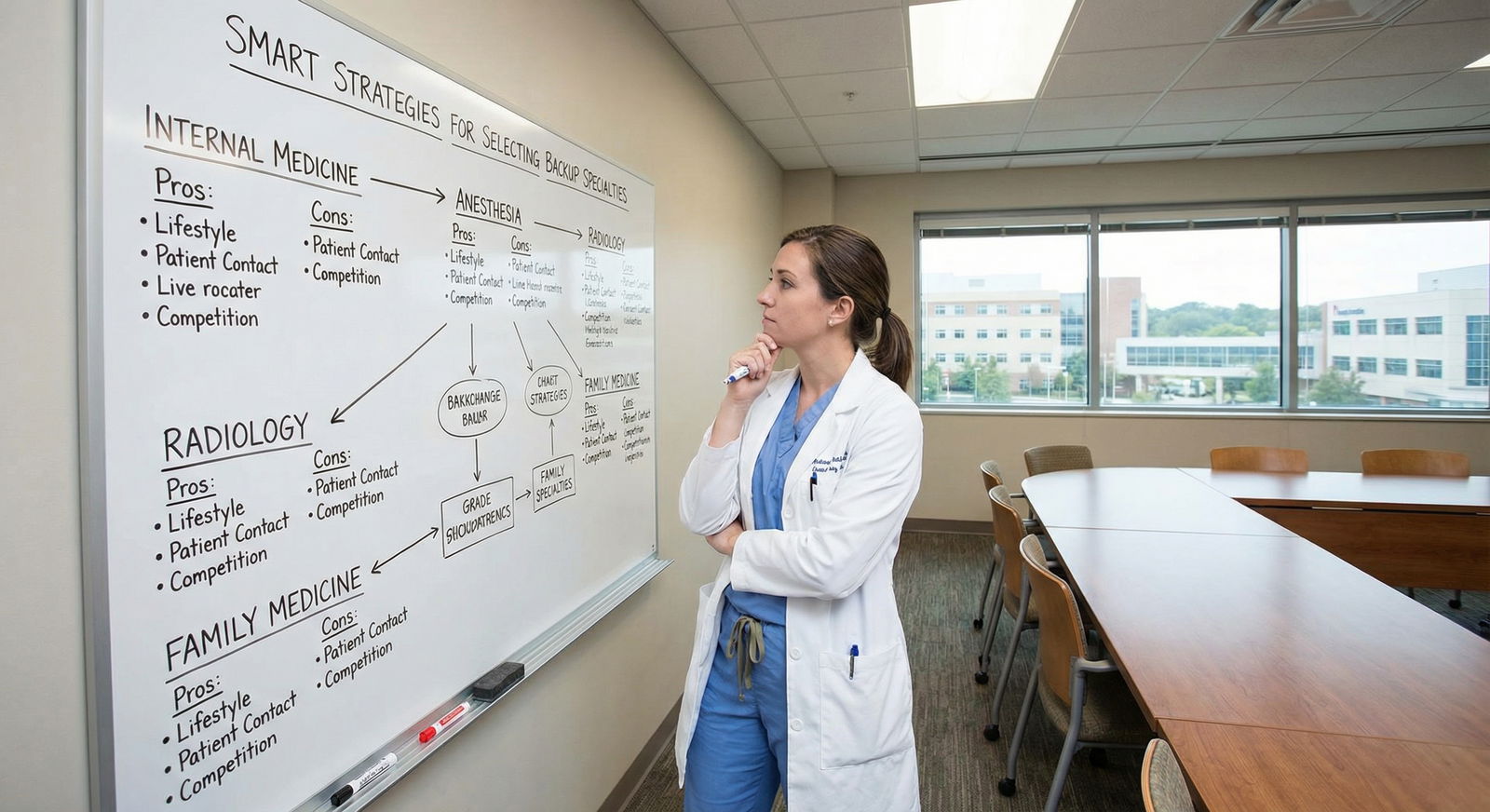
Last fall, I watched a medicine chair read a draft letter on her screen, pause, then say quietly, “He’s applying to cardiology, but he told me he might pivot to anesthesia. I’m not sticking my neck out with superlatives.” She replaced “outstanding” with “very good,” deleted a line about “future academic leader,” and hit save.
That’s what you are up against when you float a backup specialty plan to the wrong person, in the wrong way, at the wrong time. The letter changes. The tone changes. And yes, programs can hear it between the lines.
Let me walk you through what actually happens on the other side of the screen when you tell a chair you’re “maybe also applying to X as a backup.”
What Chairs Actually Care About (That No One Tells You)
Chairs are not just writing a letter for you. They’re protecting three things at the same time:
- The department’s match stats and reputation
- Their relationship with program directors in that specialty
- Their own professional credibility
You walk in seeing your future. They see their scoreboard. At many places, the dean’s office literally circulates a match outcome summary to department leadership every year.
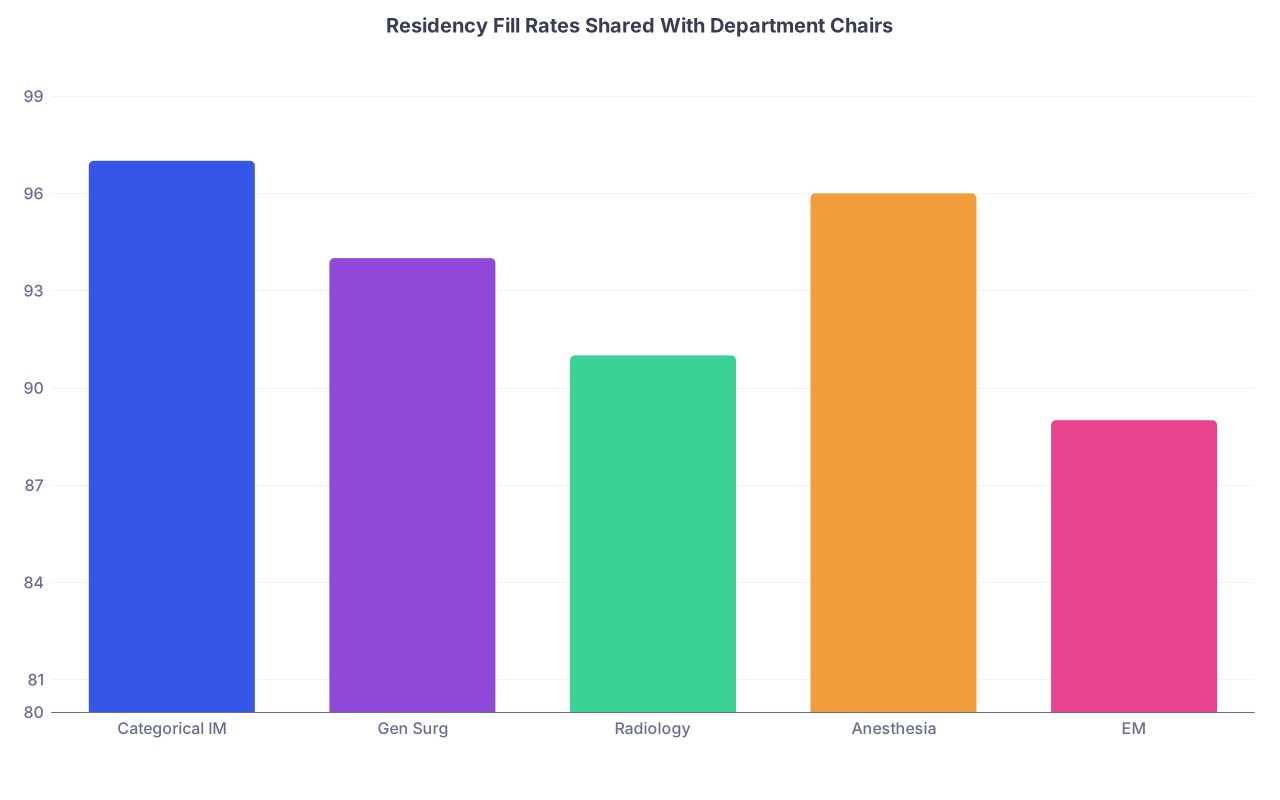
| Category | Value |
|---|---|
| Categorical IM | 97 |
| Gen Surg | 94 |
| Radiology | 91 |
| Anesthesia | 96 |
| EM | 89 |
When a chair signs a specialty-specific letter, they are implicitly saying:
- “This person is committed to my field.”
- “I’m using my capital with colleagues to push this applicant.”
- “If I vouch for them and they bail, I look either clueless or dishonest.”
So when you announce a backup specialty, what they hear is:
“I might make you look foolish in front of your peers.”
That’s the core tension. Everything else is details.
The Quiet Tax on Your Chair Letter
Nobody will tell you this out loud, but I’ve seen it repeatedly on internal review committees and when faculty screen letters for their own specialty.
Chairs use a quiet, internal “commitment scale” when they decide how strong or specific to make your letter. It looks something like this:
| Commitment Signal From Student | Typical Chair Letter Response |
|---|---|
| Clear single specialty, did away rotations, research | Strong, specific, “future leader” language |
| Single specialty, but late interest, thin exposure | Supportive but cautious, more generic |
| Declared dual-apply early and explicitly | Polite, hedged, non-committal |
| Hinted at backup late, but primary is obvious | Primary strong; backup sometimes faintly undermined |
| Refuses to commit to any primary | Short, generic, sometimes lukewarm |
Now let’s talk about how chairs actually change their writing when you declare a backup plan.
1. Superlatives Disappear
If you tell the surgery chair you’re also applying to radiology “just in case,” do not expect to see phrases like:
- “Top 5% of students I’ve worked with”
- “Unequivocally recommended without reservation”
- “Will be a future leader in surgery”
Those phrases are reserved for people the chair believes are going to their field. Declaring a backup makes them downgrade you to:
- “Strong candidate for residency training”
- “I am pleased to recommend…”
- “I anticipate they will be successful in residency”
That shift may sound subtle to you. It is not subtle to program directors. I’ve watched PDs read those lines and say, “So the chair likes them, but doesn’t love them. Next.”
2. Specificity Gets Stripped Out
A committed letter says things like:
- “On our busy CTICU service, she consistently took ownership of complex, critically ill patients.”
- “His interest in cardiology is longstanding, reflected in [project], [elective], [conference].”
When a chair knows you’re hedging with another specialty, they start writing in generalities:
- “On clinical rotations, he performed at a high level.”
- “She has demonstrated strong clinical skills and professionalism.”
Why? Because if you end up in another field, they don’t want a record of having sworn you were “deeply committed to neurology” when you match into dermatology.
3. Length Shrinks
Look closely at letter length. When a chair really backs someone for their specialty, they write a full page, sometimes more. Multiple paragraphs with concrete examples, stories, and specific comparisons.
When the chair feels used, or views you as “partial commitment,” the letter mysteriously becomes half a page. Short, generic, safe. They check the box without putting their weight behind you.
I’ve sat in meetings where PDs literally say, “If the chair only gave them half a page, they’re not going to bat for this person.”
4. The “Future in This Field” Line Vanishes
There is a sentence every strong specialty letter tends to have. Some variant of:
“[Name] has the temperament, skill set, and passion to become an outstanding [specialty] physician.”
Backup declarations kill that line fast. Instead you get:
“[Name] will make a fine resident and colleague.”
See the difference? One is about your place in their field. The other is just vague positivity.
How Different Chairs React to Backup Plans
Not all chairs react the same way. But there are patterns by specialty and personality.
The “Gatekeeper” Chair
Think surgery, ortho, some older IM chairs. They take loyalty personally.
If you say, “I love surgery, but I’m also applying to anesthesia,” they hear: “I’m not sure about your field; I’m protecting myself first.”
Response you’ll never see in writing but I’ve heard in offices:
- “If she’s not sure she wants surgery, I’m certainly not going to push her.”
- “I’ll write something supportive, but I’m not staking my reputation.”
That translates into a carefully neutral letter with just enough positivity to not hurt you—but nowhere near enough to rescue you in a competitive pile.
The “Politician” Chair
These are the ones who smile, tell you they “understand the market is tough,” promise to “fully support” you—then write the safest, vaguest letter you’ve ever seen.
They’re not angry. They just know how this game works.
They will:
- Avoid strong rankings (“top 5%”)
- Avoid colorful anecdotes
- Avoid strong endorsements for any specific field
They protect themselves first. You get a polite, content-free document.
The “Advocate, But Only For One Field” Chair
Some chairs will say explicitly (or implicitly): “I’m happy to write a strong letter for you for [primary specialty], but I will not support a dual-apply.”
I’ve heard this exact sentence from a respected subspecialty PD:
“If they’re with us, they’re with us. If they’re shopping around, I’m not doing cartwheels in their letter.”
For those chairs, if you formally declare a backup? Your primary specialty letter gets dialed down. They just will not go all in on someone they see as half-invested.
How Programs Read Between the Lines
You need to understand how your chair letter gets interpreted when it lands in front of a PD or selection committee.
They look for three things:
- Strength of endorsement
- Specificity to the specialty
- Evidence of commitment and trajectory
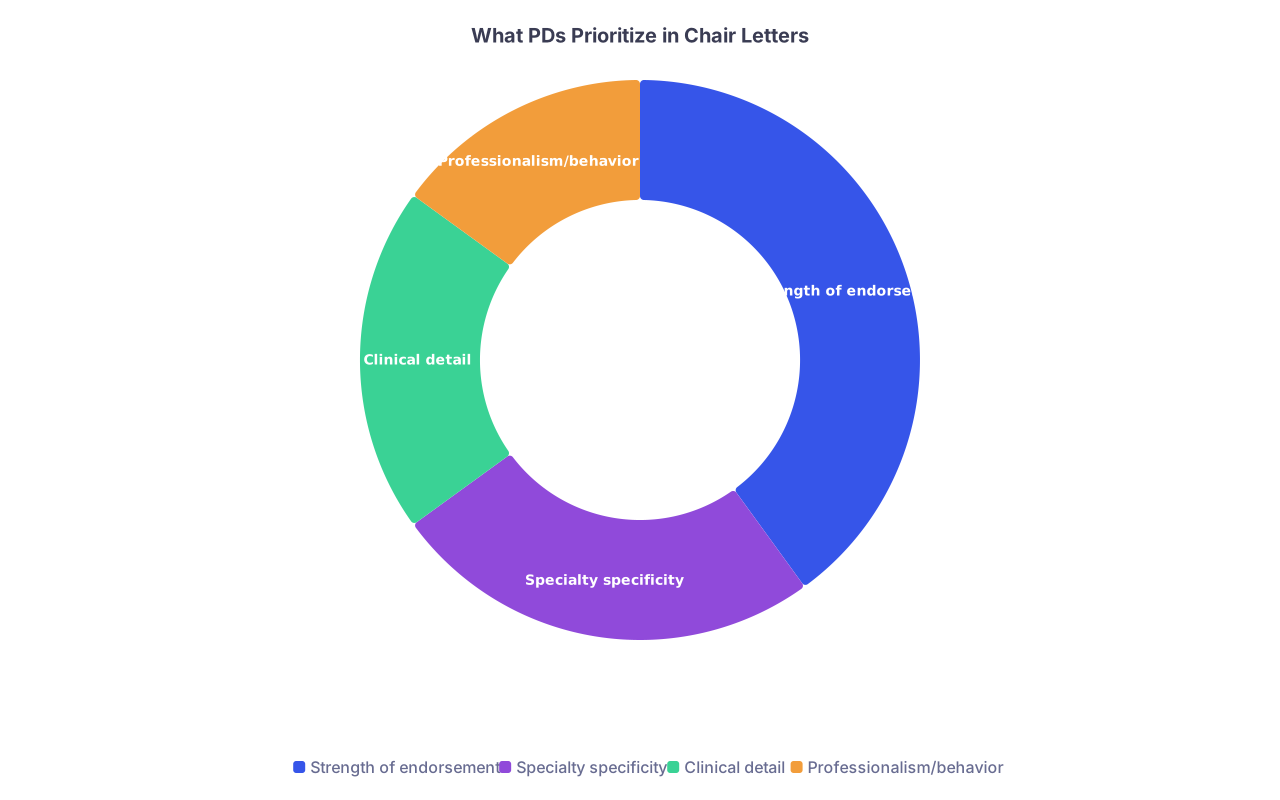
| Category | Value |
|---|---|
| Strength of endorsement | 40 |
| Specialty specificity | 25 |
| Clinical detail | 20 |
| Professionalism/behavior | 15 |
If you told your chair you’re double applying, here’s what the PD will often see on the page:
- Missing or weak specialty-specific language
- No explicit statement that you’re committed to their field
- “Safe” descriptions without concrete comparative rankings
PDs are not stupid. They connect the dots. I’ve seen them say verbatim:
- “This sounds like a dual-applicant letter.”
- “Chair is hedging—probably told them they’re applying to something else, too.”
- “If the chair isn’t fully in, I’m not taking a risk on this one.”
The irony: you think telling your chair the full truth is honorable. On the receiving end, that “honesty” often shows up as a watered-down, lukewarm letter that quietly tanks you.
Timing: When Declaring a Backup Hurts the Most
The timing of your backup announcement changes how hard your letter gets hit.
Early MS4 / Pre-ERAS
If you confidentially discuss “possible” backups in the spring or early summer, but present a clear primary specialty plan by the time ERAS letters are requested, many chairs will still go to bat for your primary.
Key nuance: they need to feel you’ve decided by the moment they write.
Right Before Letters Are Due
Walking into the chair’s office in August or September saying, “So I’m going to apply to IM and anesthesia” is where the real damage happens.
At that moment, they know your ERAS will carry two parallel narratives. Chairs hate that. They don’t know what story they’re co-signing.
Their instinct is to default to generic.
After Letters Are In
Occasionally, students send their letter requests for, say, EM, then in October quietly register extra programs in a backup like IM.
Chairs eventually hear about those match outcomes at the end of the year. Some remember. And they do not forget.
The damage is delayed—it hits the next class:
“I’m not going to write such strong letters this year; remember last year’s EM student who matched into IM after I called half the EM PDs I know?”
I’ve watched that domino fall more than once.
How to Talk to Your Chair Without Sabotaging Your Letter
You can have a backup plan without nuking your chair letter. But you have to be precise with language and strategy.
1. Pick a True Primary Specialty
You cannot go into that chair’s office as a “maybe EM, maybe anesthesia, maybe IM” person and expect a powerful letter. Pick a lane for the purpose of your chair letter.
Internally, the dean’s office and advisors can know you’re considering contingencies. But when you’re in front of the specialty chair:
You are applying to their field. Period.
Does that feel dishonest? Welcome to the residency application gray zone. You are not promising them your soul. You are telling them your current first choice is their field, which is usually true.
2. Control Who Hears About Your Backup
The chair is often the last person you should tell about a formal dual-apply—especially in fields with strong identity (surgery, EM, some subspecialties).
Who can safely know?
- Your dean’s office / student affairs
- A trusted mentor not writing your chair letter
- Your primary specialty program director (sometimes), if they’ve seen your full record and you have a long-standing relationship
Who should not get the full “backup” term dropped in their lap right before ERAS?
- The department chair who writes the standardized letter that every PD reads
3. Use Commitment Language—On Purpose
When you meet with your chair, you want certain phrases coming out of your mouth. For example:
- “I’m applying to [specialty] as my first choice.”
- “I see myself as a [specialty] physician long term.”
- “I’d be grateful for a strong chair letter for [specialty].”
Notice: that’s not the same as swearing you will never match anywhere else. You’re framing your trajectory.
If pressed on other options, you can say something like:
“I’ve talked with student affairs about safety nets if things go badly, but my application is being built first and foremost for [specialty].”
That’s very different from, “I’m applying full-on to anesthesia too.”
4. If You Must Disclose a Dual-Apply
Sometimes the numbers are so ugly (low Step 2, failed Step 1, red flags, catastrophic late interest) that your chair needs to know what’s happening. In those cases, do damage control intentionally.
Frame it like this:
- Lead with your primary specialty, clearly.
- Place the backup as a reluctant, data-driven contingency, not a co-equal dream.
- Explicitly ask whether they’re still comfortable writing a strong letter.
Example approach:
“Dr. X, my long-term goal is still EM, and that’s what I’m building my application around. Student affairs, looking at my academic record and the competitiveness this year, has encouraged me to submit a small number of IM applications as a safety net so I don’t go unmatched. I want to be transparent with you about that, but I am hoping you’ll still feel comfortable writing a strong chair letter in support of my EM applications, because that’s where I want to be.”
Notice the subtext: your loyalty is to their field; the backup is a survival tactic, not a preference.
Some chairs will still water down the letter. But many will respect that framing and advocate anyway.
Specialty-Specific Nuances You’re Not Hearing From Your Advisor
Let me be blunt about a few specialties:
- Emergency Medicine – After the recent application meltdown and shifts in the job market, EM chairs have become very sensitive to commitment. If they sniff “backup,” letters go generic fast.
- Surgery and Ortho – Identity-heavy fields. Dual-applying to anesthesia or radiology and telling the surgery chair is usually a one-way ticket to a bland letter, unless they’ve known you for years.
- Internal Medicine – More flexible on paper, but top IM programs (think MGH, UCSF, Duke) pay close attention to whether their chairs describe you as a “future academic internist” or just “strong resident.” If you’re also applying to anesthesia or EM and the chair knows, that “future internist” phrase often evaporates.
- Radiology, Anesthesia – Often full of dual-applicants from surgery, IM, EM. Their chairs are used to it, but they silently triage: the applicants clearly “all-in” on their field get the strongest language.
What I’ve Seen Go Well (And Go Down in Flames)
Two quick composites that mirror real people I’ve watched over the years.
The Student Who Quietly Survived a Backup Plan
Late MS3, she decided on EM, had solid but not spectacular stats. By summer she was nervous about the job market and competitiveness, started whispering about IM backups.
What she did right:
- Picked EM clearly as primary.
- Told the EM chair, “I want to be in EM; that’s what my application is built around.”
- Talked about IM contingency only with the dean’s office and a non-chair mentor.
- Got a glowing EM chair letter that read like she was EM-or-bust.
Outcome: Matched EM at a solid academic program. No one in EM ever knew she’d flirted with IM on ERAS.
The Student Who Torched His Own Letter
He was split between surgery and anesthesia. Did a surgery sub-I that was fine, not outstanding. In August, told the surgery chair directly:
“I love surgery, but I’m also fully applying to anesthesia as a backup. I’ll go where I end up.”
Chair’s private comment afterward: “Then let anesthesia fight for him. I’m not.”
His surgery chair letter: half-page, generic, no supers, no “future surgeon” language. Anesthesia letters were fine but late; he looked like a waffler to both.
Result: A long, nerve-wracking season, matched low on his anesthesia list, nowhere near home or his preferred region. Could he have matched higher in anesthesia or even mid-tier surgery with a stronger, fully-committed letter? Very probably.
FAQs
1. Is it ever safe to have the same chair letter sent to two different specialties?
Rarely, and only when the chair is in a department that feeds naturally into both (for example, IM chair writing for both IM and cards fellowship–style prelim applications). For two different residency specialties (say IM and anesthesia), using the same generic chair letter may technically be allowed by ERAS, but it looks weak in both directions. Most PDs can tell when a letter was written to be “universal,” and they mentally downgrade it.
2. What if my school requires I tell the chair all specialties I’m applying to?
Some schools have formal policies. Even then, how you talk about those specialties matters. Make one your clearly stated primary and frame others as contingency driven by the match climate and your academic profile. You’re not lying; you’re setting priorities. Then ask explicitly if the chair feels comfortable writing a strong letter for your primary. Their facial expression will tell you almost everything you need to know.
3. Can a mediocre chair letter really sink an otherwise solid application?
Yes. I’ve watched it happen, especially at top- and mid-tier academic programs. A bland or hedged chair letter raises two red flags for PDs: either the student had performance or professionalism concerns the chair is hinting at, or the student isn’t committed to the field. When PDs are sorting a pile of 800 applications, they don’t dig deeper. They move on to the candidate with strong, specific endorsements.
4. Who should I talk to first about backup specialties before I go near the chair?
Start with your dean’s office or student affairs, plus one or two trusted mentors who are not your chair letter writer. Get a read on your competitiveness, realistic targets, and whether a dual-apply strategy is actually necessary. Only after you have a coherent plan—and have chosen a clear primary specialty—should you schedule that meeting with the chair. Walking in confused and conflicted is how you walk out with a forgettable letter.
Remember:
Your chair letter isn’t just another uploaded PDF. It’s a public signal of how much someone with power is willing to gamble on you, in their field, in front of their colleagues.
If you want that signal to be as strong as possible, you have to manage what you say about backups, when you say it, and to whom. Pick a true primary, keep your contingency planning tight and strategic, and do not casually hand your chair a reason to hedge on you in writing.