You are here: It is four weeks before ERAS opens. Your original specialty plan just imploded. Maybe your Step 2 score came back lower than you expected. Maybe your away rotation made you hate the field you thought you loved. Or a mentor sat you down and said, “You need a safer option.”
You need a backup specialty. Fast. And not just in theory. You need a list of programs, a reworked CV, letters lined up, and a story that makes sense when PDs ask, “So why this field?”
Here is a strict four‑week, day‑by‑day style plan to pull off a late pivot that is realistic, defensible, and actually gives you a shot at matching.
Big Picture: Four-Week Structure
At this point you should stop thinking “backup” in a vague way and start running a real project plan. Four weeks. Each week has a primary objective:
- Week 1: Decide on the backup specialty (and commit)
- Week 2: Build viability (letters, experiences, narrative)
- Week 3: Program list, signal strategy, and application structure
- Week 4: Final application polish, docs, and contingency plans
Here is the high‑level arc:
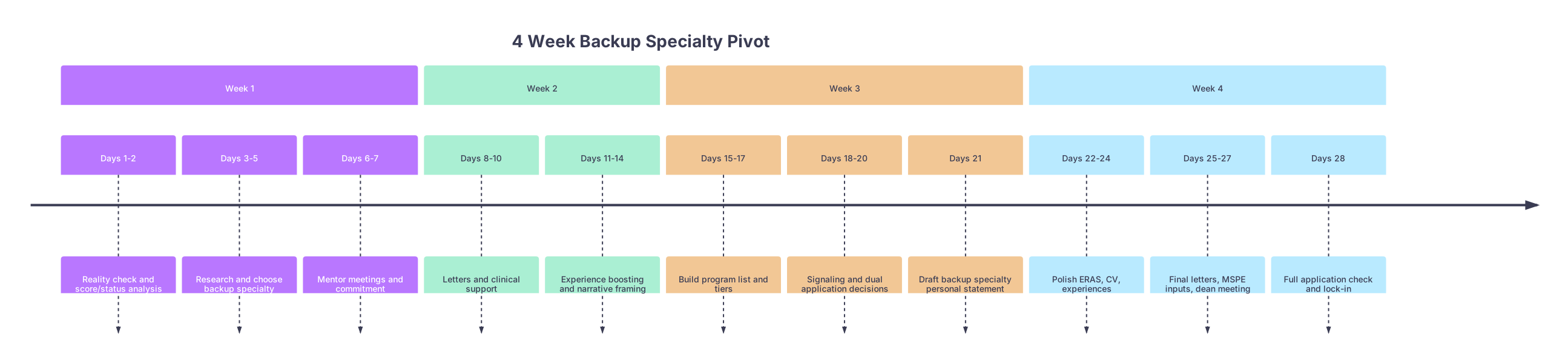
| Period | Event |
|---|---|
| Week 1 - Days 1-2 | Reality check and score/status analysis |
| Week 1 - Days 3-5 | Research and choose backup specialty |
| Week 1 - Days 6-7 | Mentor meetings and commitment |
| Week 2 - Days 8-10 | Letters and clinical support |
| Week 2 - Days 11-14 | Experience boosting and narrative framing |
| Week 3 - Days 15-17 | Build program list and tiers |
| Week 3 - Days 18-20 | Signaling and dual application decisions |
| Week 3 - Days 21 | Draft backup specialty personal statement |
| Week 4 - Days 22-24 | Polish ERAS, CV, experiences |
| Week 4 - Days 25-27 | Final letters, MSPE inputs, dean meeting |
| Week 4 - Days 28 | Full application check and lock-in |
Week 1: Reality Check and Choosing the Backup Specialty
This week is brutal but critical. At this point you should be facing your real competitiveness, not your fantasy draft board.
Days 1–2: Hard Numbers and Constraints
You start with what you cannot change:
- Step 1 (P/F but still influences screening by school)
- Step 2 CK score
- Class rank/quartile
- Red flags: fails, leaves of absence, professionalism comments
- Visa status if IMG or needing sponsorship
Make yourself a one‑page snapshot. No fluff. Numbers, status, and current experiences.
Use that snapshot to narrow what is realistic. For example:
- Step 2 < 215 and no strong home support? Neurosurgery is dead. So is derm. Let it go.
- IMG without US clinical experience and marginal Step 2? Emergency medicine and ortho are almost always fantasy.
- Mid‑220s with solid clinical evals? You might still reasonably pivot into:
- Internal Medicine
- Pediatrics
- Psychiatry
- Family Medicine
- Pathology
- PM&R (with some rehab exposure)
Now map competitiveness vs your profile:
| Specialty | Overall Competitiveness | Typical Step 2 Target Band* | Notes |
|---|---|---|---|
| Internal Medicine | Moderate | 225–240 | Huge range of programs |
| Family Medicine | Lower | 215–230 | Very forgiving narrative |
| Pediatrics | Moderate | 220–235 | Likes advocacy, kid-focused |
| Psychiatry | Moderate+ rising | 225–240 | Narrative heavy, holistic |
| Pathology | Lower–moderate | 215–230 | Research and interest matter |
| PM&R | Moderate | 225–240 | Needs some exposure |
*These are rough directional bands, not hard cutoffs.
If your numbers are below the common range for your primary specialty, your “backup” cannot be something equally or more competitive. That is not a backup; that is denial.
Days 3–5: Shortlist and Deep Dive
At this point you should have 2–3 plausible backup specialties based on:
- Competitiveness fit
- Any prior exposure (even a two‑week elective)
- Transferable skills from your original field
Example pivots I have actually seen work:
- Surgery → Anesthesiology, PM&R, Pathology, Internal Medicine
- EM → IM, FM, Psychiatry
- Ortho → PM&R, FM, Pathology
- OB/GYN → FM, IM, Pediatrics
- Radiology → Pathology, IM
Now for each candidate specialty, do a rapid immersion:
- Read:
- Specialty section on NRMP and FREIDA
- Your school’s match list for that specialty (who matched where)
- Watch or skim:
- 2–3 YouTube videos / podcasts from program directors in that field
- Ask:
- Residents in that specialty at your institution: “If someone pivoted a month before ERAS, what would make them viable here?”
You are not trying to become an expert. You are trying to answer three questions for each option:
- Can I tell a believable story why this fits me now?
- Do I have any existing experiences that already point in this direction?
- Will my school genuinely support me for this field?
By Day 5, you should cut down to one primary backup. A “maybe this plus maybe that” plan just dilutes letters, narrative, and signals.
Days 6–7: Mentor Meetings and Commitment
Now you lock it.
You need three quick conversations:
Primary mentor in original specialty
- Goal: Clear the air, get reality, and avoid burning bridges.
- Script: “I am concerned my profile no longer aligns with a strong chance in [Original]. I am strongly considering [Backup] as my main path or dual applying. I want your honest assessment and any support as I pivot.”
- Output: Either confirmation you should pivot or a clear plan if they still believe you have a real shot.
Faculty in the backup specialty (ideally PD or APD)
- Goal: Check feasibility and ask exactly what you must do this month.
- Questions:
- “Given my metrics and experiences, would I be a realistic applicant in [Backup]?”
- “What minimum exposure or letters would you want to see if I were applying to your program?”
Dean / advising office
- Goal: Align MSPE, letters, and official support.
By the end of Week 1:
You should have:
- One committed backup specialty
- Key faculty aware of your pivot
- A verbal or email “yes, you are reasonable for this field” from at least one person in that specialty
Week 2: Build Viability – Letters, Exposure, Narrative
You have picked the field. Now you need to not look like a tourist.
Days 8–10: Letters of Recommendation – Non‑Negotiable
At this point you should secure 2 letters in the backup specialty if at all possible, minimum one from a core faculty who actually knows you.
Actions:
- Email every relevant attending you have worked with in that field (or closest cousin field) in the last 12–18 months.
- If you have zero exposure, ask the PD/APD:
- “Can I do a focused 1–2 week mini‑elective/observership in [Backup] now, and would faculty be willing to write letters based on that plus my prior evaluations?”
When asking for a letter:
- Provide:
- Updated CV
- Short “pivot” paragraph: why you are moving into this specialty now
- Concrete details of what you did with them (patients cared for, projects, call)
Something like:
“I am pivoting from applying in [Old Specialty] to [Backup Specialty] due to [brief reason]. Working with you on [rotation/project] showed me that I value [X features of field]. I would be very grateful if you could support my application with a strong letter emphasizing my [clinical work, reliability, whatever they actually saw].”
If someone cannot say “I can write you a strong letter,” move on.
Days 11–14: Experience Boost and Narrative Build
You cannot rewrite your entire CV in 3 weeks. But you can re‑frame and slightly upgrade it.
Short targeted clinical time
- If there is any gap in your schedule, fill it with:
- 1–2 week elective / sub‑I in the backup specialty
- If not possible, choose a highly relevant adjacent rotation:
- For Psych: inpatient medicine with lots of delirium, addiction consult service
- For PM&R: neurology, orthopedics, sports medicine
- For Path: ICU, oncology, anything with heavy lab/path tie‑ins
- If there is any gap in your schedule, fill it with:
One micro‑project
- You are not getting a paper accepted this month. But you might:
- Help with chart review
- Present a short case at a local conference or department meeting
- Join an ongoing QI project and own a small piece
- The point is not the line on ERAS. It is the conversation:
- “In the last month I worked with Dr X on a [topic] QI project, which confirmed how much I like the analytic / longitudinal / team‑based side of [Backup Specialty].”
- You are not getting a paper accepted this month. But you might:
Draft your pivot narrative By the end of Week 2, you should be able to say in 2–3 sentences:
- Why your initial field made sense for you
- What changed (data or experience)
- Why the backup specialty is a better fit and not just easier
Example:
“I initially pursued general surgery because I enjoy acute problem solving and working under pressure in teams. During my sub‑I and after receiving my Step 2 score, I realized that my strengths align more with longitudinal patient care and complex medical management. Internal medicine allows me to keep that diagnostic intensity but with more focus on systems thinking, teaching, and long‑term relationships.”
This is the skeleton of your personal statement and how you will answer the “Why this specialty?” question on interviews.
Week 3: Program List, Signaling, and Application Structure
Now you know the field and have some support. At this point you should switch to strategy: where and how you will apply.
Days 15–17: Build a Rational Program List
You need a spreadsheet. No way around it. Columns:
- Program name
- Location
- Type (academic/community)
- Perceived competitiveness tier (1–3)
- Past matches from your school
- IMG‑friendly or not (if relevant)
- Whether you have any connection (geographic, personal, institutional)
Use FREIDA, program websites, and your school’s match list.
For a late pivot backup, you are usually aiming for:
- Fewer “reach” programs
- Heavy middle and safety tier, especially in regions where your school is known
Rough target ranges (US MD, single backup specialty; adjust if dual applying):
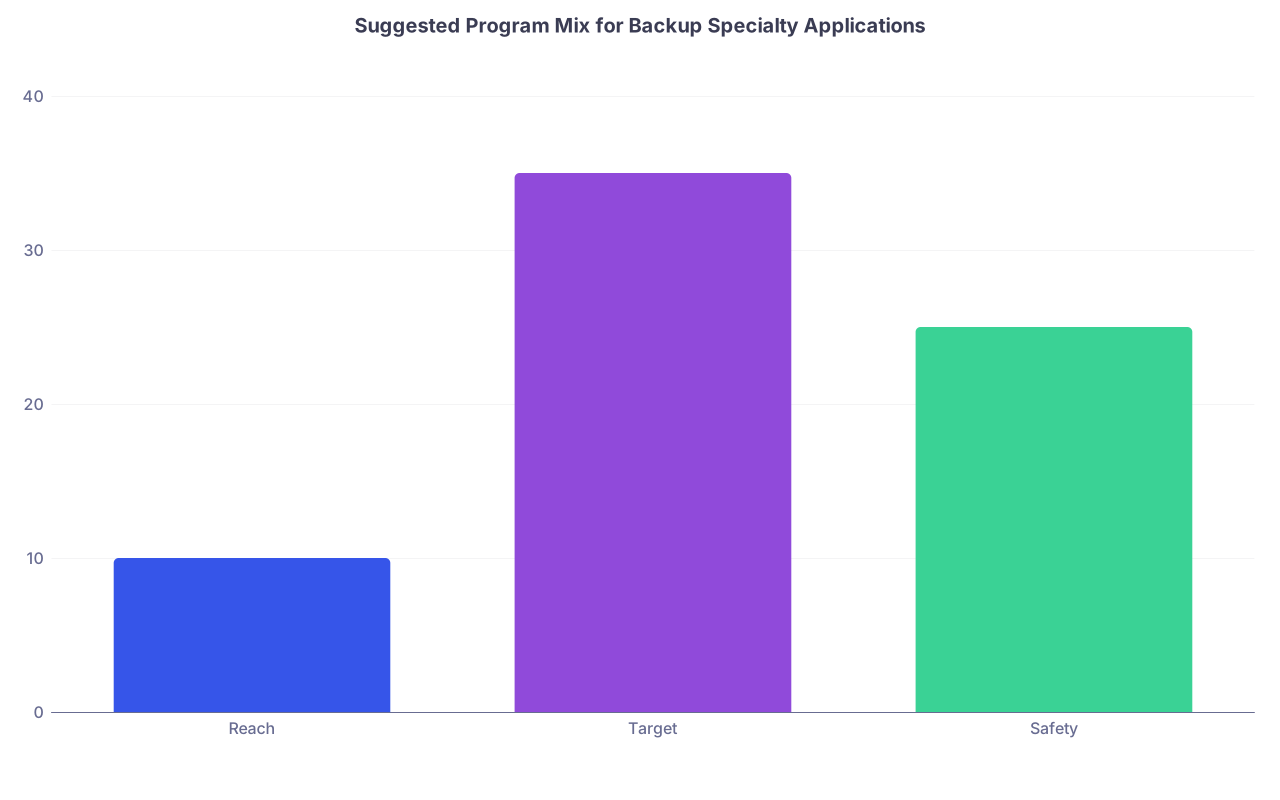
| Category | Value |
|---|---|
| Reach | 10 |
| Target | 35 |
| Safety | 25 |
If you are dual applying (original specialty + backup), total numbers might shift, but do not starve your backup of applications. It is the net that catches you if you fall.
Days 18–20: Signaling and Dual Application Decisions
If your backup specialty uses signals (e.g., IM, EM, some others now experimenting), you need to be strategic.
At this point you should:
- Decide: Are you truly dual applying, or has your primary become a fantasy and you need to treat the backup as your real field?
- If your Step 2 is significantly below your primary specialty’s recent match data and you have no “inside track,” you probably need to prioritize the backup with most signals and program depth.
Signal allocation logic:
- Top tier programs where you have:
- Real geographic tie, or
- Home/institutional connection, or
- A strong letter writer known by them
Not “dream” random places just because the name is shiny.
If no formal signals exist, your “signals” are:
- Targeted emails from known faculty to specific PDs
- Visiting sub‑I / short rotation notes
- Your geographic and institutional pattern on the program list
Day 21: Draft Backup Specialty Personal Statement
Now you write the first full version. One page. No drama.
Structure that works well for pivots:
- Opening: One specific patient or experience that reflects the backup specialty’s core work.
- Background: Brief explanation of your prior focus and what you learned from it.
- Pivot moment: Concrete experience + objective data (e.g., score, evaluations, conversations) that led you to reconsider.
- Fit: What aspects of this specialty match your skills, temperament, and experiences.
- Forward‑looking: What kind of resident you want to be and your long‑term goals.
Avoid:
- Trashing your original specialty.
- Over‑explaining your score or red flag here. Save detailed context for the “additional info” section or a separate note if needed.
By the end of Week 3:
- You should have a working program list in tiers.
- A clear decision on how strongly you are committing to the backup versus dual applying.
- A complete draft personal statement for the backup specialty.
Week 4: Application Polish, Documentation, and Final Checks
This is the execution week. No more big strategic pivots. At this point you should be locking things in and closing loops.
Days 22–24: ERAS Details and Experience Re‑Framing
Go through ERAS line by line. Your goal: every experience should be framed to support either both specialties or at least not contradict the backup.
Re‑frame examples:
Former surgery research →
“Worked on outcomes in critically ill patients, which shaped my interest in complex inpatient medicine and multidisciplinary care.”EM volunteering in a free clinic →
Emphasize longitudinal follow‑up, continuity, and primary care aspects if pivoting to FM or IM.
Check:
- Experiences: No random list of 30 minor things. Curate for depth and coherence.
- Descriptions: Use language that sounds like someone who understands the backup field, not a transplant who missed the point.
- Awards, leadership, and teaching: Highlight anything that aligns with the backup culture (education for academic IM, advocacy for peds, team dynamics for psych, etc.)
Days 25–27: Letters, MSPE, and Institutional Alignment
You cannot afford misalignment now.
Tasks:
Confirm that:
- Your backup specialty letters are uploaded or in progress with clear timelines.
- Your original specialty letter writers are not writing things like “He will be an outstanding surgeon” if you are pitching yourself as fully committed to psychiatry. If they are, either:
- Ask if they can tweak the letter, or
- Use those letters only if you are truly dual applying and can separate applications.
Meet (even briefly) with the dean’s office or MSPE writer:
- Make sure the MSPE summary does not box you rigidly into your original specialty.
- Clarify what field you want listed as your target if your school does that.
If you are dual applying, be precise:
- Which letters go to which specialty?
- Which personal statement gets attached where?
- How your advisors will represent your plan if PDs call them.
Day 28: Final Review and Lock‑In
Last 24 hours before ERAS opens (or you submit).
Run a full application “audit”:
Consistency check
- Specialty choices across:
- ERAS “intended specialty”
- Personal statement
- Experiences/activities
- Letters
- If dual applying, make sure nothing obviously contradicts itself within a single program’s file.
- Specialty choices across:
Backup depth Ask yourself:
- If I suddenly could not apply in my original specialty at all, would my backup application still be strong enough? That means:
- Reasonable program count.
- Proper letters.
- Coherent narrative.
Contingency
- Have a list of additional lower‑tier or community programs to add if early interview season looks thin.
- Have your mentors ready to send targeted emails if you are not getting traction in October.
Once you are satisfied, stop tinkering. You are better off entering ERAS early and clean than three days late because you kept rewriting your personal statement into oblivion.
FAQ (Exactly 4 Questions)
1. Can I successfully pivot and still match if I start only four weeks before ERAS?
Yes, but only if you are disciplined and realistic. I have seen people pull it off when they commit to one backup field, secure at least 1–2 solid specialty‑specific letters, and apply broadly to an appropriate tier of programs. The people who fail are usually the ones who half‑pivot, cling to a doomed primary specialty, and end up under‑applying in both.
2. Should I tell programs I am dual applying?
Usually no, not up front. Your application should read as if you are genuinely committed to the program’s specialty. If asked directly on an interview, you can answer honestly but frame it in terms of safeguarding your ability to train rather than lack of interest: “I applied to a small number of [Other Specialty] programs because of prior work in that area, but I see my long‑term fit primarily in [This Specialty] for these reasons…” Never sound like you are using them as a consolation prize.
3. How many programs should I apply to in a backup specialty?
For a true backup that you are willing to attend, a common pattern for US MDs is in the 60–80 range for IM/FM/psych/peds, sometimes less if you have strong home or regional support. If you are a weaker applicant or IMG, you may need 100+ in some fields. The key is not just raw numbers but a smart mix of safety, target, and a limited number of reaches. Ask your dean’s office where recent graduates with similar metrics matched and copy that volume, then add a safety margin.
4. How do I explain my late pivot in interviews without sounding flaky?
Anchor your explanation in concrete experiences and growth, not vibes. For example: “I initially pursued EM because I liked acute care, but during my medicine sub‑I I realized I was more energized by longitudinal relationships and complex chronic disease management. Combined with honest feedback from mentors and my Step 2 performance, it became clear that internal medicine is a better long‑term fit. Over the last month I have focused my efforts here—working on X service, securing letters from Y and Z, and starting a QI project in this department.” Show reflection, data, and action. Not indecision.
Key points:
- Decide quickly and honestly what backup specialty truly fits your profile and commit to it within the first week.
- Use weeks 2–3 to secure letters, build a believable narrative, and construct a rational, backup‑heavy program list.
- Spend the final week aligning every piece of your application so that, to a PD, you look like a late but genuine convert—not someone who picked their specialty out of a hat in August.