
The biggest ERAS mistake in August is pretending your dream specialty will magically work out instead of engineering a smart backup plan.
You’re in the danger window now. Too late for big reinventions, just in time to make or break choices about backup specialties, program lists, and how your documents tell a coherent story instead of a confused mess.
I’ll walk you through August week by week, then down to specific days and checklists. By the end, you’ll know exactly how to finalize backup specialties, structure program lists, and tune your personal statement, MSPE context, and LOR strategy so they all hang together.
Week 1 of August: Reality Check and Backup Framework
At this point you should stop guessing and start deciding.
Step 1: Brutal self-assessment (1–2 days)
Block off 1–2 evenings. No phone. No friends. Just you, your numbers, and your CV.
Pull up:
- USMLE/COMLEX scores
- Transcript and class percentile/quartile
- Research output (posters, pubs, projects)
- Clinical honors and comments
- Home institution specialty support (do you have a home program or not?)
Now put your primary specialty against actual data, not vibes.
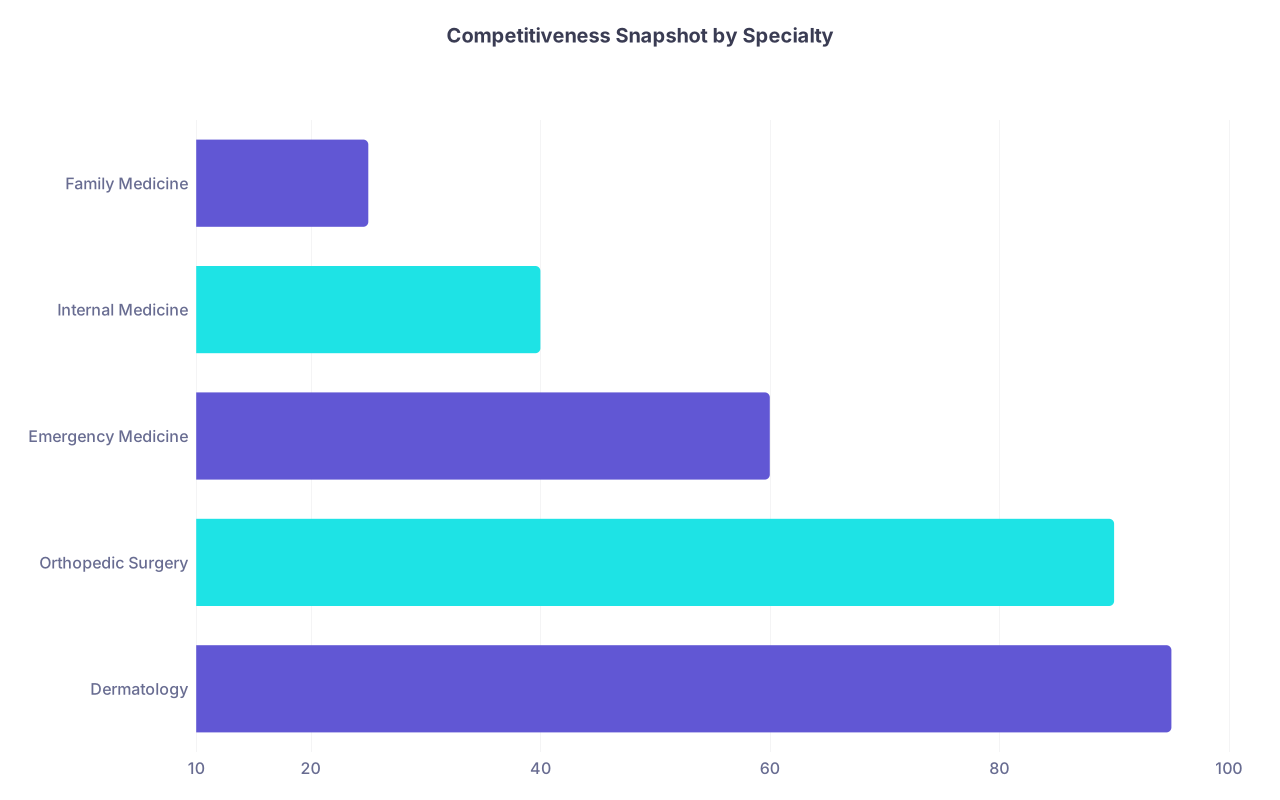
| Category | Value |
|---|---|
| Dermatology | 95 |
| Orthopedic Surgery | 90 |
| Emergency Medicine | 60 |
| Internal Medicine | 40 |
| Family Medicine | 25 |
Interpretation (rough, but directionally right):
- 80–100: Extreme (Derm, Ortho, Plastics, ENT, Optho)
- 60–79: High (Anesthesia, EM, Rad, some IM subspecialties paths)
- 40–59: Moderate (Peds, Psych in many regions, OB/GYN)
- 0–39: Less competitive (FM, many IM programs, some prelim/TY)
If you’re applying to a “90+” specialty and:
- You have any failures or repeats
- You’re middle or lower of your class
- Your letters are more “solid” than “glowing”
…then you need a real backup. Not a fantasy.
Step 2: Identify realistic backup specialties (1–2 days)
At this point you should narrow to one primary and one clear backup, occasionally two if strategically connected.
Your backup should:
- Accept your scores realistically
- Align with at least some of your prior experiences
- Make sense when a PD reads your file
Common pairings that actually work:
| Primary | Realistic Backup |
|---|---|
| Ortho | General Surgery, FM |
| Neurosurgery | Neurology, IM |
| Dermatology | IM, FM |
| EM (competitive region) | IM, FM |
| OB/GYN | IM, FM |
Do not create a backup that makes your story incoherent, like:
- “I’m deeply committed to Derm” + backup in General Surgery with zero surgical exposure
- “I love long-term continuity” + backup in EM with no ED rotations
Pick a backup you can actually talk about without sounding like you made it up last night.
Week 2 of August: Program List Architecture
At this point you should build the skeleton of your ERAS program lists: primary vs backup, number of programs, and tiers.
Step 3: Decide application volume (1 day)
You’re not choosing individual programs yet. You’re deciding ballpark numbers.
Use this as a rough frame:
- Primary very competitive (Derm/Ortho/ENT/Plastics/Neurosurg):
- 40–80+ programs primary
- 30–60 backup in IM/FM/Prelim/TY
- Primary moderately competitive (EM, Anesthesia, Radiology, OB/GYN, some IM-heavy paths):
- 30–60 primary
- 20–40 backup (IM/FM/Peds/etc.)
- Primary less competitive (FM, many IM, Psych in some regions):
- 25–40 primary
- Backup optional; use mainly for geography insurance
Then check your budget. Do not ignore this.
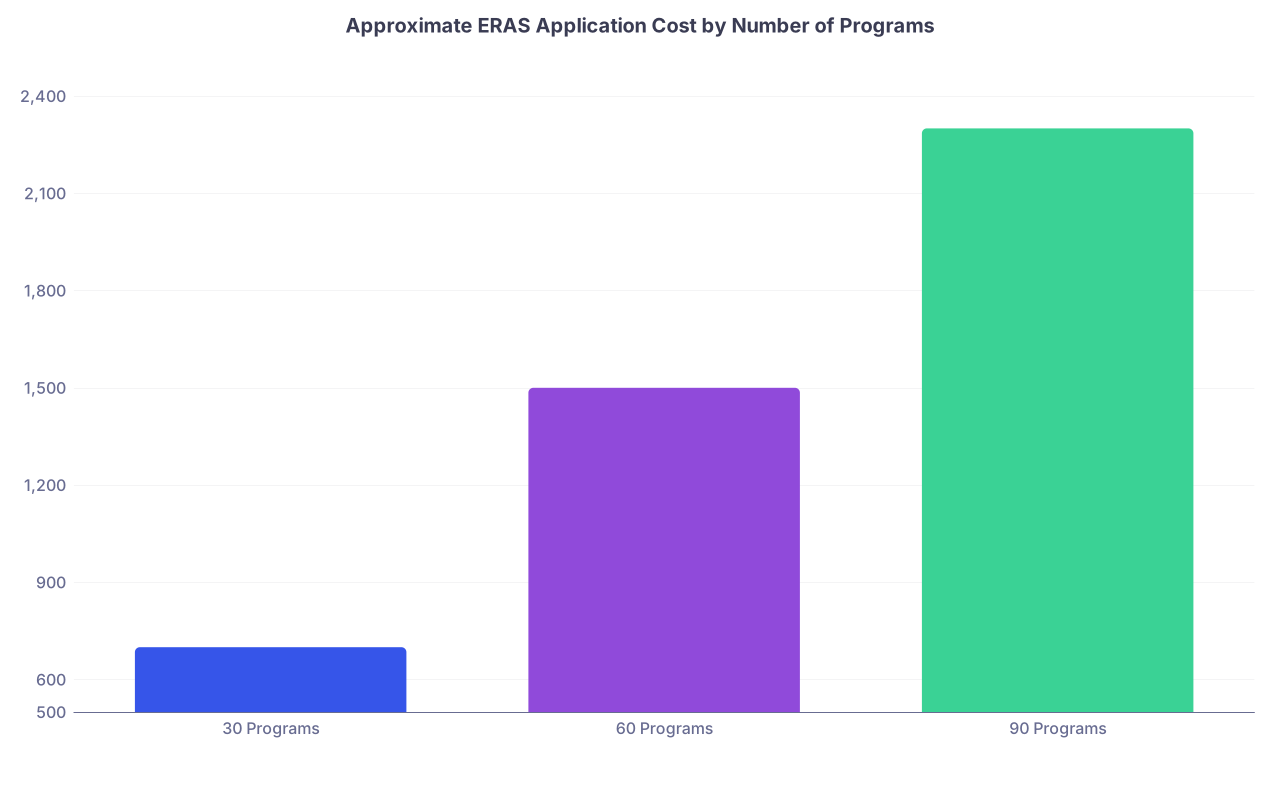
| Category | Value |
|---|---|
| 30 Programs | 700 |
| 60 Programs | 1500 |
| 90 Programs | 2300 |
If you cannot afford what your competitiveness truly requires, you adjust in one of two ways:
- Accept more geographic risk (fewer big-city and prestige programs, more community and smaller cities).
- Lean harder into backup specialty with more total programs there.
Step 4: Build your tiered list skeleton (1–2 days)
Now divide by tier for each specialty:
- Reach (top academic / very competitive locations)
- Target (mid-range academic + strong community)
- Safety-ish (solid but less selective community, smaller regions)
For each specialty, sketch something like:
Primary specialty:
- 10–15 reach
- 20–30 target
- 10–20 safety-ish
Backup specialty:
- 5–10 reach (if any)
- 15–25 target
- 10–20 safety-ish
At this point you should not over-personalize yet. You’re building structure, not romance. Save “I loved this city when I visited once” for later.
Week 3 of August: Document Strategy and Story Coherence
Here’s where people quietly sabotage themselves. They create a backup list but leave their documents screaming only “Primary specialty or bust.”
You’re smarter than that.
Step 5: Global narrative decision (1–2 days)
You have to pick one of three strategies and then commit.
Strategy A: All-in primary, quiet backup
- You present as primarily committed to Specialty A.
- Backup programs read you as “strong candidate who would be happy here too.”
Best when: You’re borderline but not totally unrealistic for primary.
Strategy B: Dual-interest, honest split
- You explicitly acknowledge interests in both specialties.
- Your personal statement and experiences make that believable.
Best when: Your numbers make primary tough but possible, and backup is a natural fit.
Strategy C: Primary pivoting to backup
- You essentially accept backup as your main realistic path.
- ERAS still technically goes to both, but narrative leans backup.
Best when: Your primary is a long shot and would require lottery-level luck.
Pick one this week. Don’t waver.
Step 6: Personal statement strategy (2–3 days)
At this point you should lock in how many statements you’re writing and what each will say.
For most people:
- 1 statement for primary specialty
- 1 statement for backup specialty
Do NOT send a generic “I love medicine and patient care” essay to both. PDs can smell that in the first two sentences.
Here’s how to structure both without sounding like two different people.
Primary specialty statement:
- Clear story: how you got here (one rotation, one patient, one project)
- Depth of understanding of that field
- Evidence: rotations, research, leadership, letters that line up
- Tone: “This is my professional home.”
Backup specialty statement:
You’re walking a tightrope: genuine interest without “this is my second choice” energy.
Use this frame:
Anchor in something real:
- A rotation you genuinely liked, even if you didn’t think it would be your path originally.
- A patient or clinical pattern that stuck with you.
Show continuity with your existing experiences:
- “My work in neuro ICU made me appreciate long-term neurologic follow-up…”
- “My ED exposure highlighted how much I value continuity, which drew me to FM…”
Avoid fatal phrases:
- “As my backup option…” (obvious, but I’ve actually seen it)
- “If I do not match into [primary], I would also consider…”
- “While [primary] remains my top choice…”
You never need to say “backup” in writing. Ever.
Week 3–4 of August: Letters and MSPE Alignment
Now you refine the supporting documents so your story is consistent specialty to specialty.

Step 7: LOR strategy (2–4 days)
At this point you should have all letter writers confirmed and at least several letters already uploaded or promised with dates.
Think in terms of buckets:
- Bucket 1: Specialty-specific strong letters (for primary)
- Bucket 2: Specialty-specific strong letters (for backup)
- Bucket 3: General strong letters (IM, surgery, sub-I attendings, etc.)
For each specialty, you typically want 3–4 letters:
Primary (e.g., Ortho):
- 2–3 Ortho letters
- 1 general strong IM/surgery letter or research letter
Backup (e.g., IM):
- 2 IM letters
- 1–2 general letters
Use your ERAS assignment wisely:
- Do not send 3 Ortho letters to an IM program. They’ll question your commitment.
- Do not send 0 specialty-specific letters to a competitive backup program. That screams last-minute panic.
If it’s August and you’re missing critical backup letters:
- Immediately email/meet 1–2 attendings from backup-appropriate rotations.
- Give them a tight but respectful deadline: “If possible, submitting by early September would be incredibly helpful as ERAS opens.”
- Provide: CV, short paragraph on why you’re now also applying to X specialty, and key stories they might highlight.
Step 8: MSPE and Dean’s Office coordination (1–2 days)
You don’t rewrite your MSPE in August. But you can influence context.
Request a short meeting or email with your Dean’s office or advisor. At this point you should:
- Clearly state: “I’m applying primarily to X, with a backup in Y.”
- Ask:
- “Can my MSPE summary reflect my interest in both specialties?”
- “Are there any institutional comments that might confuse PDs about my dual application?”
You want your MSPE summary paragraph to not sound like:
- “She is committed to a career in competitive surgical subspecialties” when you’re also applying broadly to IM.
Better:
- “She has shown particular interest in surgical care and complex inpatient medicine, and is applying in [Ortho] and [IM].”
Not every school will tweak language. Some will. You won’t know unless you ask.
Late August: Converting Strategy to Concrete Program Lists
Time to get granular.
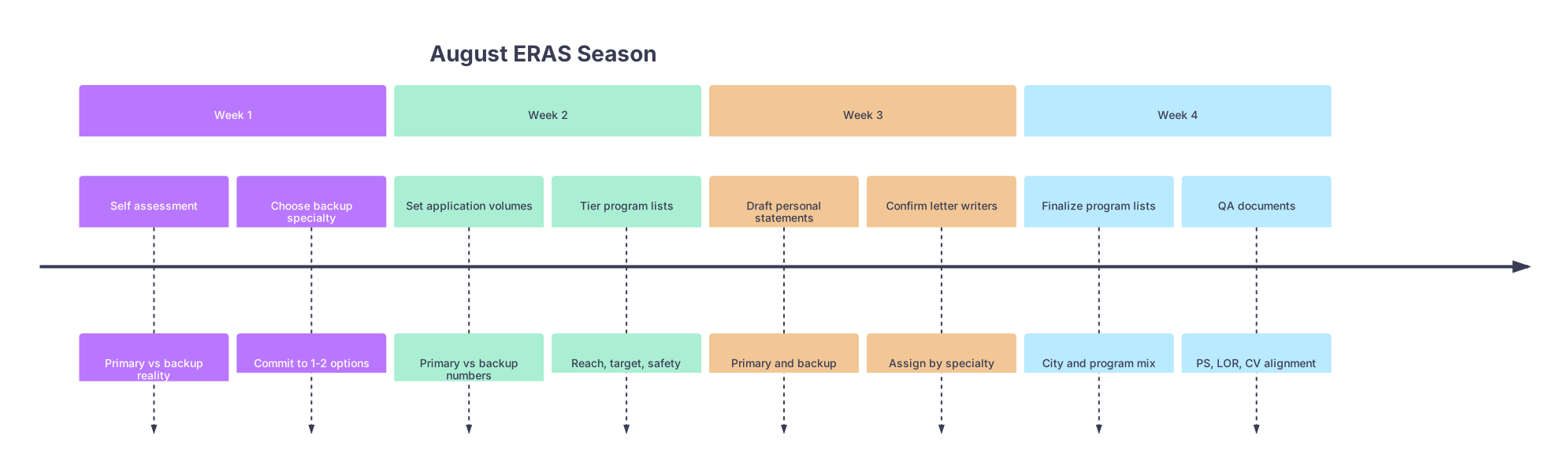
| Period | Event |
|---|---|
| Week 1 - Self assessment | Primary vs backup reality |
| Week 1 - Choose backup specialty | Commit to 1-2 options |
| Week 2 - Set application volumes | Primary vs backup numbers |
| Week 2 - Tier program lists | Reach, target, safety |
| Week 3 - Draft personal statements | Primary and backup |
| Week 3 - Confirm letter writers | Assign by specialty |
| Week 4 - Finalize program lists | City and program mix |
| Week 4 - QA documents | PS, LOR, CV alignment |
Step 9: Day-by-day list-building (5–7 days)
Here’s how I’d break one focused week.
Day 1–2: Data pull
For each specialty:
- Filter programs by:
- Region (must-have vs avoid)
- Program type (academic, community, hybrid)
- Required scores or explicit cutoffs
- Visa policies if relevant
Build a spreadsheet with columns like:
- Program name
- City/state
- Type (academic/community)
- Perceived competitiveness (High/Med/Low)
- Your interest (1–5)
- Notes (home ties, rotations, alumni there, etc.)
Day 3–4: Rough assignment
For each specialty:
- Mark 10–15 “auto-apply” programs: solid fit, reasonable chance, acceptable location.
- Mark 10–20 “stretch but worth it” programs.
- Mark 10–20 “safety-ish but acceptable” programs.
Cross-check your total count against your earlier volume decisions and budget. Adjust up or down.
Day 5–6: Sanity review with someone real
At this point you should schedule one 30–60 minute session with:
- Your specialty advisor
- A mentor who has been a PD or APD
- At minimum, a recent grad in the same specialty
Ask them to scan:
- Your program distribution (by region and tier)
- Whether your backup specialty choices look realistic
- Whether your total list size is responsible given your file
If they tell you your list is too top-heavy, do not argue for 20 minutes about your “passion for the field.” Fix the list.
Day 7: Finalize “no regret” list
Create two final lists:
- “Absolutely applying” – the ones you won’t second-guess in October.
- “Optional add-on” – programs you’d only add if you under-applied or something big changes.
You can always add more later if your budget and timing allow, but locking in a solid core now prevents chaotic spraying in September.
Document QA: Last 3–5 Days of August
Now you tie the bow.

Step 10: Consistency audit (1–2 days)
Print or open side-by-side:
- CV
- Personal statement(s)
- List of LORs per specialty
- Program lists
Ask yourself:
- Does someone reading my primary application see a focused, credible candidate?
- Does someone reading my backup application see a genuinely interested candidate, not a reject refuge?
- Do my experiences support both stories without contradiction?
Red flags to fix:
- Personal statement says: “I’ve tailored every experience toward Derm” but your actual experiences are generic IM and FM.
- Backup specialty programs get zero specialty letters.
- Your CV headline or summary (if you use one) screams single specialty only.
Clean those up. Subtle changes, not full rewrites.
Step 11: Technical lock-in (1–2 days)
By the last couple days of August, you should:
- Have both personal statements proofread by at least one human who knows ERAS standards.
- Double-check LOR assignments by specialty in ERAS.
- Confirm with letter writers that submissions are on track.
- Make sure your photo, CV entries, and publication list are accurate and consistent.
One trick I recommend:
Create a one-page “Application Snapshot” for yourself:
- Primary specialty: # programs, regions, LORs, PS file name
- Backup specialty: # programs, regions, LORs, PS file name
- Any special notes (prelim + advanced pairings, couples match, visa)
This snapshot will keep you from making dumb clicks at 1 a.m. when you’re assigning documents.
Quick August Checklist: Backup Lists & Document Strategy
Use this as your end-of-month audit:
- Primary specialty chosen and realistically assessed
- Backup specialty (or two related ones) selected and justified
- Application volume set for both specialties based on competitiveness and budget
- Program spreadsheets built with tiering (reach/target/safety-ish)
- Global narrative chosen: all‑in primary, dual-interest, or pivot
- Two personal statements drafted (primary + backup)
- LOR strategy mapped – which letters go to which specialty
- Dean/advisor informed about dual-application plan
- Program lists reviewed by at least one knowledgeable human
- Final document QA done for consistency across ERAS
You’re in August. That means you’re out of “someday” and deep into “decide now or live with it later.”
Your next concrete step: Tonight, open a blank document and create a two-column table.
Label the left column “Primary Specialty” and the right column “Backup Specialty.” Fill in:
- Number of programs
- Target regions
- Planned letters
- Personal statement status
If you can’t fill that table in 30 minutes, your August ERAS strategy is not ready. Fix that now, while you still can.