
Most students backing up derm, ortho, or ENT choose the wrong “safety” specialty—and then are shocked when it does not save their match.
Let me be blunt. If you treat backup planning like a box-checking exercise (“I’ll just add FM or IM and be fine”), you are gambling with an unmatched year. Competitive surgical and lifestyle fields do not behave like the rest of the Match. The backup has to be chosen with the same level of strategy as your primary specialty.
I am going to break this down the way I would with a solid-but-not-perfect applicant sitting in my office late August of 4th year, ERAS open on the laptop, panic simmering in the background.
We will talk in terms of “specialty families” and realistic backup ecosystems for:
- Dermatology
- Orthopaedic Surgery
- Otolaryngology (ENT)
And we will separate fantasy from what the NRMP and real program behavior actually support.
Core Principles: What a “Real” Backup Looks Like
Before we go specialty by specialty, you need a framework. A real backup specialty is not:
- “Something less competitive”
- “Something I would absolutely hate but will suffer through if I have to”
- “Something my advisor told me vaguely ‘could work’”
A real backup specialty has three properties.
- Score and profile alignment
Your USMLE/COMLEX profile, research, and letters need to be at or above the median for the backup field. Or at least solidly within the realistic match range.
- Application timeline alignment
You can actually assemble a competitive application for the backup before:
- Programs start offering/using interviews heavily
- You lock yourself into one field only
You can say in an interview, with a straight face and coherent narrative, why you are genuinely interested in this field. Not “I did not match derm so I am here.” That answer kills applications.
Keep those three in your head. Every “backup” idea has to clear all three, not one.
Understanding the Competitiveness Landscape
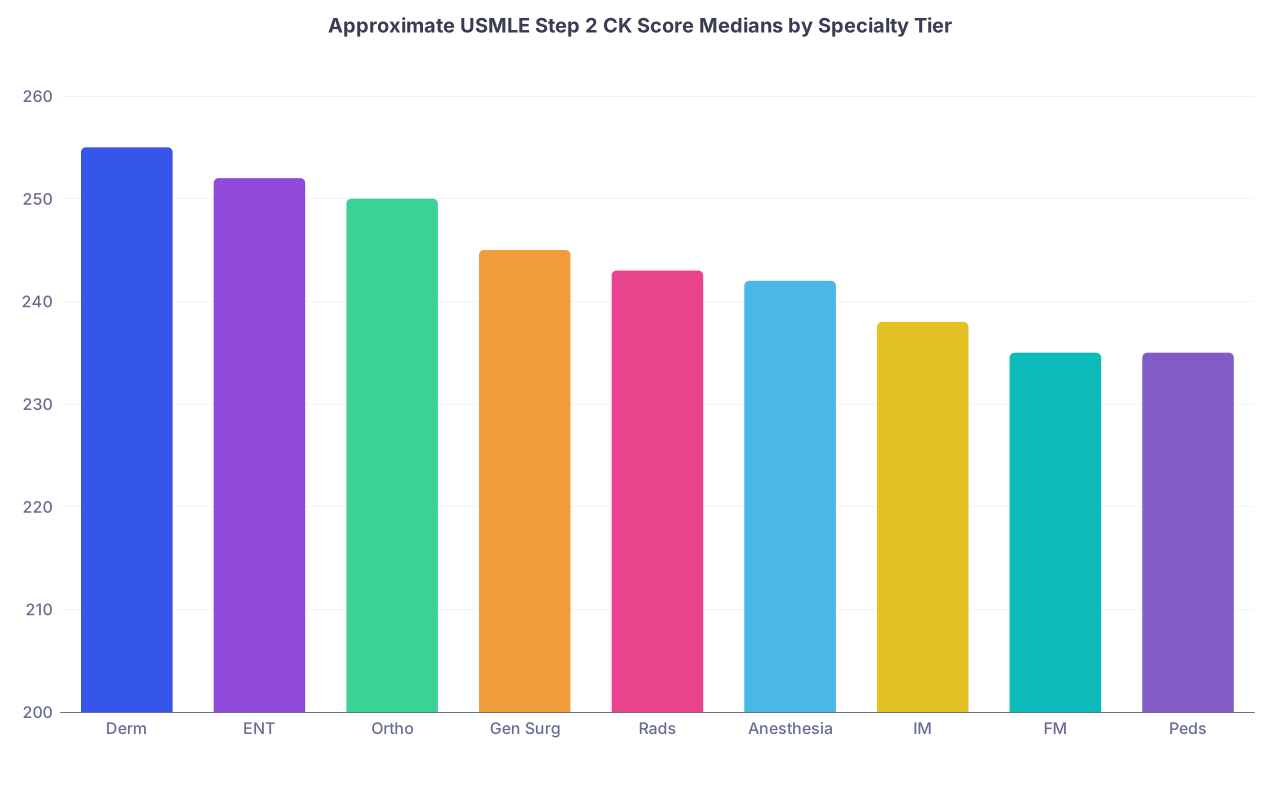
You cannot choose a backup without a basic view of where your primary field sits relative to others.
| Category | Value |
|---|---|
| Derm | 255 |
| ENT | 252 |
| Ortho | 250 |
| Gen Surg | 245 |
| Rads | 243 |
| Anesthesia | 242 |
| IM | 238 |
| FM | 235 |
| Peds | 235 |
Are these exact numbers? No. But they capture reality: derm, ENT, and ortho sit in that ultra-competitive band. General surgery, radiology, and anesthesia are not “easy,” but they are usually more forgiving if your application is coherent and you apply broadly.
The takeaway: backing up derm with ENT is not a backup. That is just picking two extremely competitive fields and hoping one bites.
Specialty Family #1: Dermatology and Its Realistic Backups
Derm is its own animal. Tiny number of spots, heavy research culture, and a personality/tone to interviews that is quite different from surgery-heavy fields.
Who even needs a derm backup?
If you are derm-strong (Step 2 255+, multiple derm pubs, strong derm letters, applied broadly including community programs), your risk of going completely unmatched is lower, but not negligible. Still, many in this group match something.
If you are derm-hopeful but with clear weaknesses (Step 2 <245, limited derm-specific research, applied late, or very geographic-restricted), you need to think very seriously about a parallel or backup.
Realistic derm backup “families”
Derm sits closest, in practice, to four broad families:
- Internal medicine (+ subspecialty hopes later)
- Pathology
- Radiation oncology (with cautions)
- Transitional/prelim years + reapplication strategy
1. Internal Medicine as the “grown-up” derm backup
Internal medicine (categorical IM) is probably the most rational backup for many derm applicants. Not because it looks like derm day-to-day. Because it respects the same intellectual profile.
Why IM works for derm-type applicants:
- Strong IM programs actually like high-board-score, research-heavy students.
- You keep open routes to rheum, allergy-immunology, heme-onc, or academic niches that scratch the analytic itch.
- Plenty of derm applicants already have basic science or outcomes research that can be reframed as “medicine-relevant.”
Where it fails:
- If you fundamentally hate inpatient medicine and wards, you are setting yourself up for a miserable 3+ years. Do not do that.
- If your letters are all from derm and not a single core IM attending can vouch for your clinical performance, you look suspicious.
You can make IM a genuine parallel application if you:
- Get at least one strong, narrative IM letter (IM clerkship, sub-I, or acting internship).
- Write a separate IM-specific personal statement (no “since I was 10 I dreamed of derm, but…”).
- Have a coherent story: research, interest in complex multisystem disease, maybe an outpatient focus.
| Component | Derm-Only Weak | Derm + IM Safer |
|---|---|---|
| Step 2 CK | 240–245 | 245+ |
| IM Letter Quality | Generic | Strong, detailed |
| IM Sub-I Completed | No | Yes |
| Research Reframable to IM | Minimal | Moderate–Strong |
If you are short on one of those right now (early MS4), you can still fix some of them by quickly scheduling an IM sub-I and asking for a real letter.
2. Pathology as an underused but honest backup
Pathology is not glamorous to most med students. Which is exactly why it remains accessible to high-score seekers who pivot late.
Why pathology pairs surprisingly well with derm:
- The histology mindset overlaps heavily with dermpath.
- Your derm research and derm letters often come from people plugged into dermpath/academic path networks.
- The lifestyle can be good, with intense but largely non-clinical patient contact.
The problem: You cannot fake interest in path. If you have never set foot in a path sign-out room and your only line is “I like derm and slides so I figured…”, programs will smell the desperation.
If considering path as a derm backup, you need to:
- Do at least a short elective or rotation in pathology early enough to get one letter.
- Learn the language: frozen sections, grossing, sign-out, tumor boards, quality assurance.
- Be prepared to commit. There is not a clean, guaranteed hop from path to derm later.
3. Radiation oncology: not the safety net it used to be
Years ago, rad onc was often floated as a derm-adjacent backup: radiation for skin cancers, outpatient vibes, imaging, procedural elements. Those days are largely gone. The field has been contracting, positions are fewer, and applicant numbers fluctuated.
If you already:
- Have oncology/physics/rad-onc-related research
- Have shadowed or rotated in rad onc
- Can get a true rad onc letter
Then rad onc can be a parallel direction. It is not something to casually slap onto ERAS in October as an emergency “backup.” Programs will see right through that.
4. Transitional/prelim year + reapply derm vs. real backup
Some derm applicants decide: “I will just grab a prelim IM or TY year, then reapply derm stronger.”
Sometimes that works. More often than students think, it creates:
- A lot of stress during intern year.
- Very limited time to build new derm research.
- A very similar application 12 months later, now with the label “did not match derm PGY-1.”
If your application is fundamentally weak for derm (scores, research depth, letters), a prelim year is not a magical fix. Better to have a categorical backup you are at peace with than chase derm from a worse psychological and logistical position later.
Specialty Family #2: Orthopaedic Surgery and Its Backup Ecosystem
Ortho is brutally simple from an application standpoint: surgical skills, letters from big names, Step 2 CK usually >245, and proof you like the OR and teams with a certain culture.
The common fantasy backup for ortho is “I will just do general surgery or another big OR field.” That can work. If you execute correctly.
Ortho’s realistic “backup families”
For most ortho applicants, the real universe of backups is:
- General surgery
- Categorical anesthesia
- PM&R
- Emergency medicine (for a subset)
And occasionally:
- Neurosurgery or plastics for the hyper-competitive with an early pivot, but these are not true backups—they are lateral transfers into equally brutal fields.
1. General surgery: the classic surgical backup
Gen surg is the most obvious backup, but there is a catch. Many general surgery programs know exactly when they are being used as a backup by ortho or neurosurg hopefuls. They do not always love that.
Why gen surg can work:
- Overlapping skill set: OR comfort, strong work ethic, surgical basic science research can often be reframed.
- Plenty of spots, including strong academic and many community programs.
- Pathways after gen surg remain broad: MIS, surg oncology, trauma/critical care, etc.
Where things go wrong:
- Application materials scream “I am really an ortho person.” Entire PS about sports, bones, “fixing broken limbs,” and letters all from orthopaedic surgeons. Then suddenly this student applies general surgery with no gen surg letter. Programs see it constantly and often pass.
- You do not even do a general surgery sub-I. Or your only exposure is your MS3 clerkship.
To do this correctly:
- Complete at least one general surgery sub-I and obtain a serious, narrative letter.
- Write a unique general surgery personal statement. Not a Ctrl+F “orthopaedics” to “general surgery” pseudo-edit.
- In interviews, never say, “I really wanted ortho but…” You pivot the narrative: exposure to complex abdominal emergencies, ICU, broad procedural interests.
2. Anesthesiology: a more realistic modern backup
Over the last 10–15 years, anesthesia has quietly become a common backup/parallel option for high-score surgical applicants who realize late that they might not match ortho.
Why anesthesia works for some ortho-type students:
- You stay in the OR. You work with surgeons. Same environment, different role.
- High-board-score profiles are attractive to anesthesia programs.
- If you have done an anesthesia elective and can speak to physiology/pharmacology interest, the story holds.
Anesthesia is not a dumping ground, though. You cannot succeed with:
- Zero anesthesia exposure
- No anesthesia letter
- A personal statement that reads like, “I like surgery but anesthesia is okay too”
If you are even half-seriously considering anesthesia as a backup, do this early:
- Schedule a 2–4 week anesthesia elective MS4 year.
- Get to know at least one attending well enough to write you a real letter.
- Pay attention to what interests you: airway management, regional blocks, critical care, etc., so you can speak concretely in interviews.
3. PM&R as the functional-medicine bridge
Physical medicine and rehabilitation (PM&R) is an underappreciated but very rational backup for some ortho applicants—especially those who liked the musculoskeletal side more than the OR lifestyle.
Typical good-fit applicant:
- Ortho interest was driven by sports medicine, MSK, and rehab potential rather than love for big joint replacements or trauma ex-fix.
- Has done sports medicine clinic, maybe some spine clinic time, and can imagine an outpatient-heavy career.
- Values work-life balance more than being in the OR at 2 am.
You sell this well if:
- You do a PM&R elective and get one PM&R letter.
- Your story is: “I realized my favorite part of ortho was long-term function, neurologic recovery, spasticity management, and team-based rehab.” Not “Ortho did not work out so PM&R is what is left.”
4. Emergency medicine: only for a certain ortho subset
Some ortho-interested students end up liking the acute side of trauma and ED procedures more than the long recovery arc. Those are the ones for whom EM can be a plausible parallel.
But pure “I like procedures” is not enough. EM has had its own turbulence with job market concerns. So you must actually:
- Like shift work and nights.
- Tolerate undifferentiated patients and volume metrics.
- Have at least one SLOE (standardized letter of evaluation) from an EM rotation.
If you are planning EM as a backup and have not scheduled an EM rotation or gotten a SLOE by late summer, it is fantasy, not a plan.
Specialty Family #3: ENT (Otolaryngology) and Its Backup Paths
ENT is one of the most competitive surgical subspecialties, period. Fewer spots than gen surg or ortho, heavy research load at top programs, and a tight-knit community.
ENT applicants often have a mix of qualities: they like delicate surgery, anatomy, a mix of cancer and functional work, and sometimes the clinic/OR balance. That profile lends itself to a very specific set of backups.
Realistic ENT backup families:
- General surgery
- Plastic surgery (for those who pivot extremely early)
- Neurosurgery (again, early pivot, not real “backup”)
- Radiation oncology and medical oncology routes via IM
- Anesthesiology (for some, as with ortho)
1. General surgery: again, but different flavor
For the ENT applicant, general surgery plays a slightly different role than for the ortho applicant. The overlap is more on complex oncologic cases, head and neck exposure, endocrine surgery, and maybe upper GI.
What makes it more believable:
- Many ENT applicants already rotate on big head & neck teams that are partially staffed by general surgeons.
- Research in cancer, quality-of-life outcomes, or oncologic surgery easily ports into gen surg.
Same pitfalls apply:
- No general surgery letter.
- A personal statement transparently about ENT with a few nouns swapped.
- Zero willingness to actually be a general surgeon.
If you know deep down you only enjoy small-field, microscope-driven work and cannot stand big laparotomies or bowel, then gen surg is the wrong field for you, even as a “backup.”
2. Radiation oncology via the head & neck cancer route
For ENT applicants who were genuinely drawn to tumor boards, adjuvant planning, and the multidisciplinary management of head and neck malignancies, rad onc can be a logically coherent alternative.
Signs you might fit this bridge:
- Your ENT research is largely oncology-focused.
- You loved the multidisciplinary tumor board more than the 8-hour neck dissection itself.
- You can talk cogently about dose planning, toxicity, functional outcomes.
Again, rad onc is not currently a “safe” harbor. Contraction in jobs and variable applicant volumes mean you have to be truly committed, with rad onc exposure and letters, not just using it as a last-minute parachute.
3. Internal medicine → Hematology/Oncology as a long-game pivot
Some ENT applicants realize the part they loved most was cancer medicine itself: longitudinal care, targeted therapies, trials. Those applicants can pivot to IM with an eye toward heme/onc.
But let us be very clear: that is a multi-year pathway, not a quick backup.
For it to make sense:
- You must be genuinely okay training in general internal medicine.
- You accept that you might not end up a pure “head and neck cancer” doctor; you may do GI, lung, or general solid tumor oncology.
- You can frame your ENT interest as an early sign of cancer-care interest, not a failed dream you cling to.
This is not the right path for someone who hates the wards and only loves being scrubbed.
4. Anesthesia again: ENT-style
An ENT applicant who thrived in the OR, liked airway management, and enjoyed team communication can sometimes find anesthesia a good fit. Especially if:
- You already liked the anesthesiologists managing complex airways during ENT cases.
- You have some ICU interest.
- You can articulate why your love of anatomy and physiology steers you that direction.
Same requirements: anesthesia elective + anesthesia letter + honest interest.
Parallel Planning vs. True Backup: Timing and Logistics
One of the biggest mistakes students make is waiting too late to commit to a parallel plan. They cling to “I am all-in on derm/ortho/ENT” until mid-September, then scramble to “add a backup.” Programs read that panic in every line of ERAS.
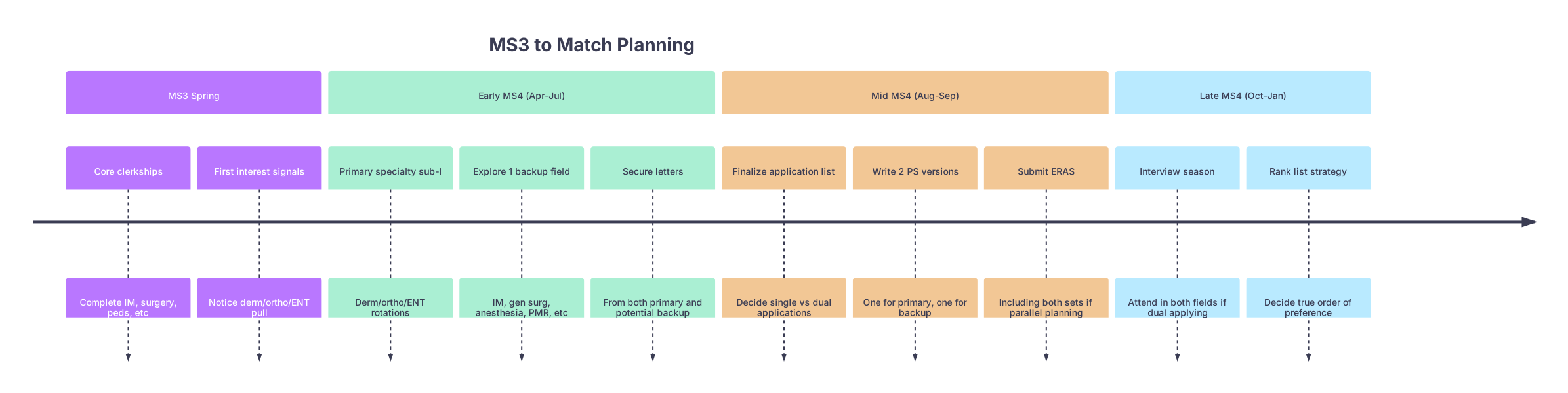
Here is what a rational timeline looks like.
| Period | Event |
|---|---|
| MS3 Spring - Core clerkships | Complete IM, surgery, peds, etc |
| MS3 Spring - First interest signals | Notice derm/ortho/ENT pull |
| Early MS4 (Apr-Jul) - Primary specialty sub-I | Derm/ortho/ENT rotations |
| Early MS4 (Apr-Jul) - Explore 1 backup field | IM, gen surg, anesthesia, PMR, etc |
| Early MS4 (Apr-Jul) - Secure letters | From both primary and potential backup |
| Mid MS4 (Aug-Sep) - Finalize application list | Decide single vs dual applications |
| Mid MS4 (Aug-Sep) - Write 2 PS versions | One for primary, one for backup |
| Mid MS4 (Aug-Sep) - Submit ERAS | Including both sets if parallel planning |
| Late MS4 (Oct-Jan) - Interview season | Attend in both fields if dual applying |
| Late MS4 (Oct-Jan) - Rank list strategy | Decide true order of preference |
If you are past early MS4 and have not done a rotation in a realistic backup, your options narrow fast.
Dual Applying: Pros, Cons, and How Not to Sabotage Yourself
A lot of derm/ortho/ENT applicants will ask, “Should I dual apply?” Meaning: apply concurrently to both their dream field and a backup.
There is no universal answer, but there are clear trade-offs.
| Strategy | Pros | Cons |
|---|---|---|
| Single (Derm/Ortho/ENT only) | Cohesive narrative, full focus | Higher unmatched risk |
| Dual, primary-heavy | Safety net, still signal strong interest | More interviews to juggle |
| Dual, 50/50 | Maximum flexibility | Risk of seeming non-committal |
My view:
- If your numbers and profile are borderline for derm/ortho/ENT, and you do not have strong geographic or institutional advantages, dual applying is usually rational.
- But you must do it cleanly: separate PS, appropriate letters, and differentiated interview narratives.
How to avoid torpedoing yourself
Do not let your backup specialty see materials clearly written for your primary. That means:
- No mention of “since my derm rotation…” in an IM personal statement.
- No ENT-specific language in a general surgery PS.
Do not tell programs in your backup field that you are “definitely ranking them high” while obviously planning to rank every derm/ortho/ENT program first. They can count too.
You must actually be willing to match your backup. Crushing disappointment is human, but do not rank a backup specialty at all if you would be unwilling to train in it.
Hard Truths: Backup Choices That Usually Do Not Work
Let me cut through some persistent myths:
“I will back up derm with plastics.”
Plastics is at least as competitive, often more so. That is not a backup. That is lateral escalation.“I will back up ortho with neurosurgery.”
Same story. Neurosurgery is not a safety net. Different letters, different expectations, intense 7-year path.“I will back up ENT with ophthalmology.”
Ophtho is a separate, early match with its own process (SF Match), letters, and timeline. If you have not been building an ophtho application, it is not a last-minute backup.“I will just add Family Medicine or Pediatrics to my list in October.”
Yes, some very competitive students “fall back” into FM or peds, and they can be incredible physicians. But if you have done zero rotations, have no letters, and cannot convincingly explain why you care about longitudinal primary care or kids, you will look like someone who is panicking and using them as a catch-all safety. Many programs will pass in favor of someone who actually chose them.
Matching Profile to Backup: A Few Concrete Scenarios
Let me walk through a few realistic composite cases.
Case 1: Derm-leaning with strong IM fit
- Step 2 CK: 248
- 2 derm abstracts/posters, 1 derm manuscript in submission
- Solid IM clerkship comments, but no IM sub-I yet
- Loves complex medical disease + outpatient continuity
Smart plan:
- Apply to derm broadly with full derm package.
- Do an IM sub-I July/August MS4, get a strong letter.
- Apply in parallel to mid-to-high tier IM programs (academic and community), with an IM-focused PS.
- Rank derm programs first, then IM programs where you would truly be happy.
Case 2: Ortho applicant realizing competitiveness late
- Step 2 CK: 239
- Average comments on surgery clerkship, one ortho research project just starting
- Loved MSK, sports, rehab more than hardcore trauma nights
Ortho match odds are mediocre. PM&R is actually a cleaner story than general surgery here.
Smart plan:
- Do a PM&R elective early, get 1–2 PM&R letters.
- Apply to both ortho (maybe with a constrained list) and PM&R (broadly).
- Be honest with yourself: you may end up in PM&R, and that is not a failure—it fits your interests better.
Case 3: ENT applicant obsessed with head & neck cancer
- Step 2 CK: 245
- Multiple head & neck cancer research projects
- Loved tumor boards, multidisciplinary planning, survivorship issues
- Mixed feelings about 12-hour cases
This is the student who might actually be happier long-term in heme/onc or rad onc.
Possible path:
- Apply ENT if they still genuinely want the surgical route.
- Simultaneously secure an IM sub-I, an IM letter, and a rad onc elective/letter.
- Decide early fall whether to dual apply ENT + rad onc or ENT + IM. Not all three. That is overkill and looks scattered.
How to Talk About a Backup in Interviews (Without Sounding Like You Settled)
Programs listen for one thing above all: whether you actually want to be there. That means your story must center on what attracts you to their field, not on what you failed to achieve elsewhere.
Bad answer:
“I really wanted derm, but it is so competitive, so I am applying to IM as a backup.”
Better answer:
“During my derm rotations I realized my favorite part of the work was managing complex systemic disease—psoriasis with cardiometabolic risk, connective tissue disease with multi-organ involvement—which pushed me back toward internal medicine. I want to train where I can build strong foundations in managing these patients longitudinally, regardless of what subspecialty I pursue later.”
You acknowledge reality without framing them as second choice.
Same for a surgical pivot:
“I loved my exposure to orthopaedic surgery, but what surprised me was how much I enjoyed the breadth of general surgery—particularly acute care and complex cancer operations. Over the last year my focus has shifted toward wanting that breadth and ICU exposure, which is why I am committed to training in general surgery.”
It is not about lying. It is about putting the emphasis where it belongs: on why this field is a good fit, not why the other one rejected you.
Final Check: Are You Actually Okay With Your Backup?
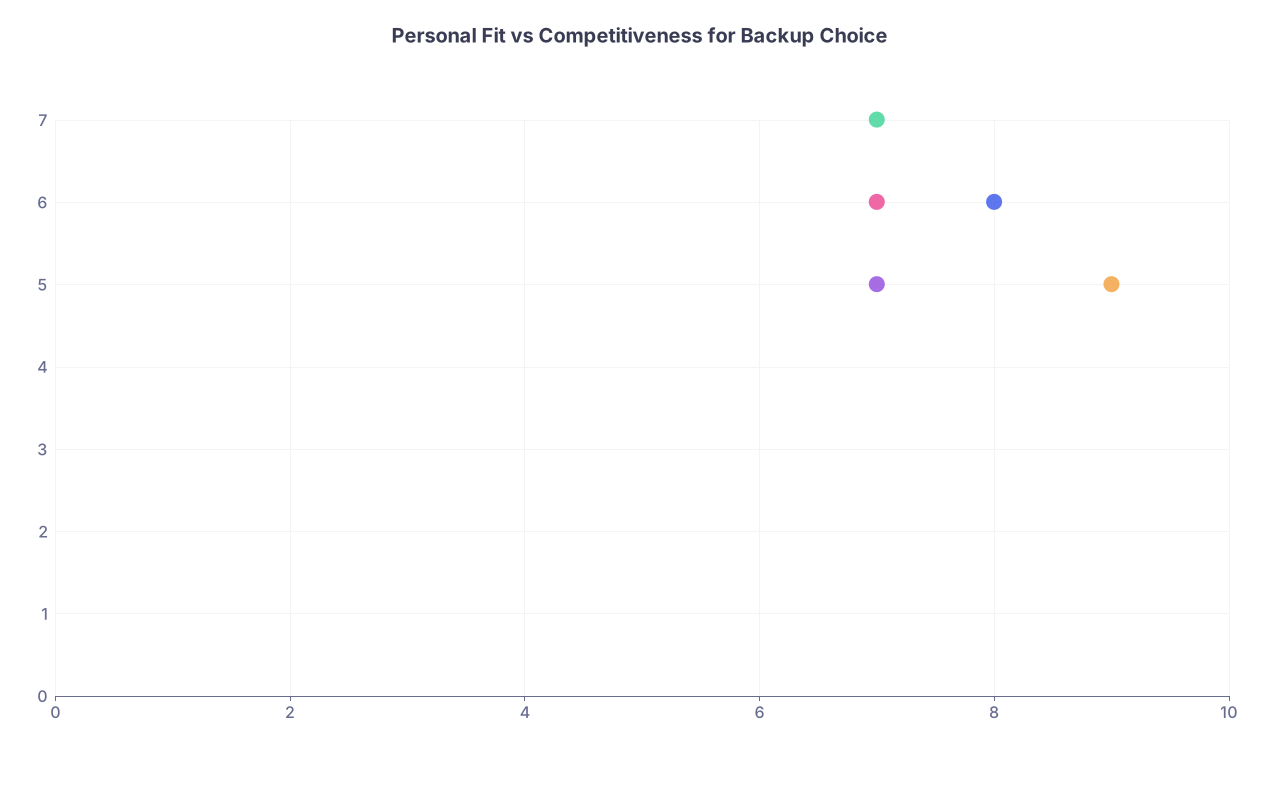
Here is the last sanity check I walk students through.
| Category | Value |
|---|---|
| Derm→IM | 8,6 |
| Derm→Path | 7,5 |
| Ortho→Gen Surg | 7,7 |
| Ortho→PMR | 9,5 |
| ENT→Gen Surg | 7,6 |
Interpretation (roughly):
- X-axis: Personal fit (1–10)
- Y-axis: Competitiveness “safety” relative to your stats (1–10, higher = safer)
If your backup idea would land you low on both axes (you do not like it, and it is still very competitive for your numbers), it is a bad backup.
You want a backup that:
- You can live with. Really live with.
- You can match based on your actual application, not your imagined one.
If you cannot find such a field, your problem is not the backup strategy. It is that you have not honestly explored enough specialties or you are clinging too tightly to one identity.
Key Takeaways
- Backing up derm, ortho, or ENT requires a real second identity, not a token specialty tossed onto ERAS at the last minute.
- The best backups live in related ecosystems: derm → IM/path/rad onc; ortho → gen surg/anesthesia/PM&R; ENT → gen surg/anesthesia/onc-directed paths.
- Dual applying only protects you if you commit to doing it properly: separate rotations, letters, and narratives, and a genuine willingness to match—and train—in your backup field.