
Most applicants pick backup specialties backward—and their personalities pay the price.
You are not just matching scores to competitiveness tiers. You are matching a nervous system, a risk tolerance, a way of thinking, and a set of social needs to a job description. If you ignore that and only ask “What will take me with my Step score?” you can absolutely match… into a miserable four-year grind.
Let me walk you through how to use your actual personality profile—real data, not vibes—to screen backup specialties rationally.
1. Step Zero: Use a Real Personality Framework, Not Buzzfeed-Tier Labels
Do not start with “I’m an introvert who loves people but also science.” That is useless.
You want structured, semi-quantifiable traits you can map onto specialty demands. Three frameworks actually help:
Big Five (OCEAN) – scientifically grounded, granular
- Openness
- Conscientiousness
- Extraversion
- Agreeableness
- Neuroticism (emotional stability)
MBTI (e.g., INTJ, ESFP) – less scientific, but widely used and easy to reason with
Holland Codes (RIASEC) – directly connects personality to work environments:
- Realistic
- Investigative
- Artistic
- Social
- Enterprising
- Conventional
You do not need all three, but you should have at least:
- A Big Five style profile, and
- Either MBTI or Holland.
If you have none, pause reading for 20 minutes, do:
- IPIP-NEO short form (Big Five)
- Any decent MBTI-style instrument
- A quick Holland code inventory
Now you have something we can work with.
2. Translate Personality Scores into Workstyle Requirements
Raw scores like “Conscientiousness 82nd percentile” are meaningless until you translate them into what you need from a work environment.
Let me break down the main traits and what they imply for residency/specialty fit.
Big Five → Clinical Workstyle
You are looking for mismatches first. Backup specialties must not actively fight your baseline wiring.
Openness
High:
- Likes novelty, complexity, conceptual work, teaching, research.
- Tolerates ambiguity and gray zones.
- Often enjoys “we do not fully know the answer” fields.
Fits more naturally with:
- Psychiatry
- Neurology
- Academic Internal Medicine
- Heme/Onc, Rheum
- Pathology with academic/research bent
Low:
- Prefers clear protocols, established paths, concrete tasks.
- Likes checklists, standardization, reproducible outcomes.
Fits better with:
- Anesthesiology
- EM (protocol-heavy settings)
- General Surgery
- Hospitalist medicine
- Radiology (especially bread-and-butter practice)
Conscientiousness
High:
- Detail-oriented, organized, follows through.
- Good for long-term management, complex med lists, continuity.
Strong alignment with:
- IM subspecialties (Cardiology, Endo, Rheum)
- Pediatrics
- Nephrology, ID, Heme/Onc
- Radiation Oncology
- Any outpatient-heavy field
Low–Moderate:
- Struggles with grinding, meticulous detail day after day.
- Needs more “chunked,” episodic work.
Better off in:
- EM
- Anesthesia
- Psych (depending on practice style)
- Radiology (varies by subspecialty)
- Procedural-heavy with short tasks (GI, IR) if you can be meticulous during bursts.
Extraversion
High:
- Gains energy from people, enjoys talking, teaching, leading.
- Handles frequent patient and team interactions well.
Aligns with:
- EM
- OB/GYN
- Surgery (if you like being team leader in a high-intensity environment)
- Pediatrics
- Outpatient-anything with lots of patient flow
- Administrative/leadership pathways
Low (Introverted):
- Needs downtime, focused work, fewer high-stimulation interactions.
- Often resents constantly being “on.”
Aligns with:
- Pathology
- Radiology
- Anesthesia (depending on practice setting)
- Research-heavy academic IM subspecialty
- Psychiatry with controlled patient volume
Agreeableness
High:
- Conflict-averse, supportive, empathetic.
- Good rapport with patients, but can be exploited in toxic systems.
Better in:
- Pediatrics
- Family Medicine
- Psych
- PM&R
- Palliative Care, Geriatrics
Low–Moderate:
- Competitive, blunt, comfortable with confrontation.
- Often thrives where hierarchy and decisive action matter.
Better in:
- Surgery and subsurgical specialties
- EM (if you can modulate at bedside)
- Some procedural IM subs (GI, Cards, IR)
- Administration/lead roles
Neuroticism (reverse = Emotional Stability)
High neuroticism:
- Prone to anxiety, rumination, stress sensitivity.
- Vulnerable to burnout in constantly chaotic, high-stakes settings.
Should be cautious with:
- EM
- Trauma Surgery
- OB in high-volume, under-resourced centers
- ICU-heavy careers
Probably safer with:
- Outpatient IM/FM (in well-run systems)
- Psych (with good support and boundaries)
- Pathology
- Radiology
- Allergy/Immunology, Endo, Rheum
Low neuroticism:
- Tolerates chaos, pressure, uncertainty.
- Can sustain shocks and move on.
Can manage:
- EM, Trauma, critical care
- High-acuity surgery, OB
- Night-float heavy lifestyles better than average
MBTI & Holland Codes as Secondary Checks
MBTI: Do not worship it, but treat it like an angle.
- NT (INTJ, ENTJ, INTP, ENTP): Systems, logic, planning
→ IM subspecialties, Radiology, Anesthesia, Neurology. - NF (INFJ, ENFJ, INFP, ENFP): Meaning, people, counseling
→ Psych, Peds, FM, Palliative, some IM. - SJ (ISTJ, ISFJ, ESTJ, ESFJ): Order, duty, structure
→ IM, Peds, Anesthesia, Radiology, PM&R. - SP (ISTP, ESTP, ISFP, ESFP): Hands-on, action, immediate feedback
→ EM, Surgery, Ortho, some OB, anesthesia.
Holland:
- Realistic–Investigative: Procedural + analytic → Surgery, IR, Cards, GI, Anesthesia.
- Investigative–Social: Thinking + talking → IM, Psych, Neurology.
- Social–Enterprising: People + leadership → Peds, FM, OB, Administration pathways.
- Conventional–Investigative: Order + data → Path, Radiology, Hem/Onc, Endo.
Use these to confirm or question what your Big Five suggests, not as a replacement.
3. What “Backup Specialty” Actually Means (And What It Does Not)
You are not trying to find a “low-tier version” of your dream specialty. You are trying to find:
- A field you can realistically match into with your competitiveness profile.
- A field that does not clash with your core personality traits.
- A field whose worst days you can survive without hating your life.
Common failure mode:
- “I want Derm, my backup is FM, because it is less competitive.”
If you actually detest high-volume primary care, chronic social complexity, and longitudinal relationships, this is not a backup. It is a trap.
You should screen backups with three filters:
- Competitiveness filter – realistic shot with your stats and context.
- Personality fit filter – does not oppose your core traits.
- Lifestyle/values filter – aligns with your non-negotiables (location, call, scope).
The personality filter is the one most people skip. Which is why you are reading this.
4. Build a Personality–Specialty Mapping Table (Your Personal Matrix)
Now the practical part. You want a one-page matrix where you can see how your profile overlays common specialties.
Let us say your profile is:
High Openness
High Conscientiousness
Low–Moderate Extraversion
High Agreeableness
High Neuroticism
MBTI: INFJ
Holland: Investigative–Social (IS)
Now you want to see which specialties are in-bounds and which are danger zones.
| Specialty | Fit with Profile | Major Risk Factor |
|---|---|---|
| Internal Med | Good | System burnout |
| Psychiatry | Very good | Emotional fatigue |
| EM | Poor | Chaos, shift work |
| Pathology | Moderate–Good | Social isolation |
| Pediatrics | Good | Emotional load |
That is the type of table you should build for yourself, but tailored with 10–15 specialties that are realistically in play for you, not the whole NRMP book.
5. Translate Personality into Screening Rules
Let’s turn traits into direct “include / exclude / caution” rules. This is where you stop vaguely “considering” backup specialties and actually cut some.
You want explicit statements like:
- “Because my neuroticism is high and I catastrophize, my backup list must exclude EM and trauma-heavy surgical fields.”
- “Because I am low on extraversion, my backup list should avoid high-volume, constant-patient-interaction outpatient primary care.”
Not soft preferences. Hard rules.
Here are concrete personality-linked rules I have seen work.
Rule Set A: Neuroticism / Emotional Stability
If you are high neuroticism (and you know it):
- Exclude as backups:
- EM (esp. community, high-volume)
- Trauma surgery, high-acuity surgical subspecialties
- OB in safety-net hospitals with minimal support
- Caution:
- Critical care–heavy careers (Pulm/CC, Cardiac anesthesia)
- Favor:
- Outpatient IM subspecialties (Endo, Rheum, Allergy/Immunology)
- Psych (if you can set boundaries)
- Pathology, Radiology
- PM&R
If you are low neuroticism:
- You can tolerate backup specialties that are more chaotic. But still screen for other traits; emotional stability does not automatically mean “do EM.”
Rule Set B: Extraversion
Low Extraversion (Introverted):
- Exclude as backups:
- High-volume primary care with 20–25 patients/day in low-support settings
- High-constant-people specialties if you find them draining (busy inpatient FM, some OB)
- Favor:
- Radiology
- Pathology
- Anesthesia (depending on local culture)
- IM subspecialties with focus time (Endo, Rheum, Heme/Onc with good support)
- Psych with controlled panel sizes
High Extraversion:
- Exclude as backups:
- Super-isolated roles (solo path practice with minimal team contact, telerads 100% remote)
- Favor:
- EM
- Peds, FM
- OB/GYN
- Hospitalist medicine
- Psych with heavy group therapy, consult-liaison, or team-facing roles
Rule Set C: Conscientiousness / Detail Orientation
Low–Moderate Conscientiousness:
- Exclude as backups:
- Fields with punishing documentation and medication complexity as day-in-day-out reality (nephrology, some geriatrics-heavy settings, very complex IM clinics)
- Favor:
- Episodic-care specialties: EM, Anesthesia, many surgical fields
- Radiology (if you can be meticulous during reads, even if your life outside is less structured)
High Conscientiousness:
- You are capable of surviving high-detail environments. But watch for perfectionism plus high neuroticism → recipe for burnout in:
- EM (chaos vs desire for control)
- Surgical fields with unforgiving attendings and malignant culture
6. Use Personality to Differentiate Between Similar Backups
Two applicants, both failing to match Ortho, might both consider “backup: Anesthesia or Radiology or PM&R.” Personality is what should break the tie.
Let me show you how this actually plays out.
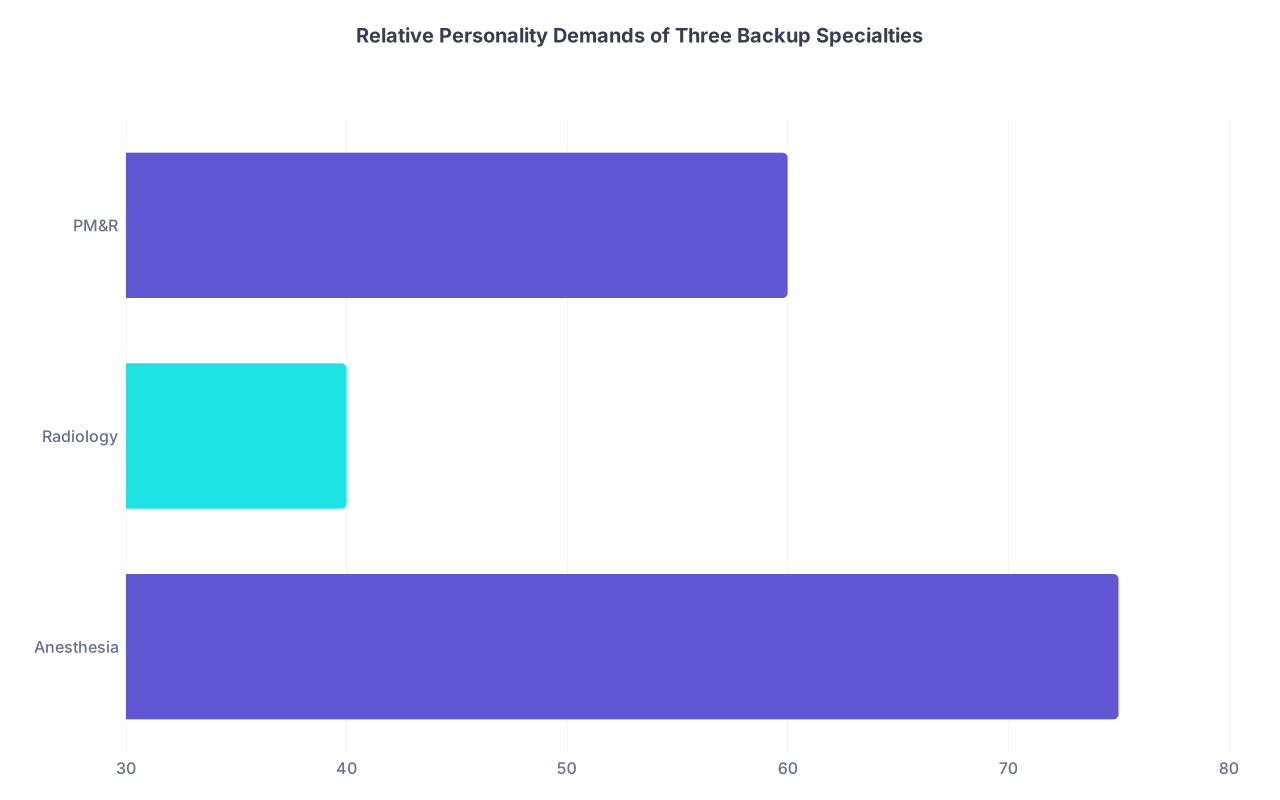
| Category | Value |
|---|---|
| Anesthesia | 75 |
| Radiology | 40 |
| PM&R | 60 |
Imagine that “value” here is a composite “need for high acute stress tolerance and rapid decision making.” Radiology has less, Anesthesia more, PM&R in the middle.
Now add your own trait profile on top.
Example 1: Failed Ortho, Profile A
- High Extraversion
- Low Neuroticism
- Moderate Conscientiousness
- Holland: Realistic–Enterprising
Better backup:
- Anesthesia or EM (if EM still in play), then PM&R.
Radiology may bore you and feel too isolated.
Example 2: Failed Ortho, Profile B
- Low Extraversion
- High Conscientiousness
- Moderate Neuroticism
- Holland: Realistic–Investigative
Better backup:
- Radiology or PM&R.
Anesthesia may feel too “edge of death” and chaos-heavy, especially if you already ruminate.
Personality is not a decorative layer here; it is the tie-breaker between several “reasonable on paper” options.
7. Step-by-Step Process: From Personality Report to Backup List
Here is the actual workflow I would use with you sitting in my office.

| Step | Description |
|---|---|
| Step 1 | Get Personality Profiles |
| Step 2 | Summarize 3-5 Key Traits |
| Step 3 | Define Hard Exclusions |
| Step 4 | List Realistic Specialties |
| Step 5 | Score Each Specialty vs Traits |
| Step 6 | Eliminate Poor Fits |
| Step 7 | Prioritize Top 2-3 Backups |
Let’s unpack this.
Step 1: Extract 3–5 “Anchor Traits”
From your reports, write down the traits that truly define you. For example:
- High neuroticism, high conscientiousness, low extraversion.
- Or: High extraversion, low agreeableness, moderate conscientiousness.
You are not writing a full psych eval. You are identifying the 3–5 forces that most shape your work life.
Step 2: Convert Anchors into Non-Negotiables
You write these as actual sentences:
- “I do not tolerate chaotic, constant life-or-death decision-making environments well.”
- “I am exhausted by constant face-to-face patient contact without breaks.”
- “I need some blend of teaching/research/abstract thinking in my work.”
These become your personality guardrails.
Step 3: List All Specialties That Are Realistic Given Your Competitiveness
This is where Step scores, clerkship performance, research, and red flags come in.
For example:
- You scored 205 on Step 1, 218 on Step 2 CK, mid-tier med school, 1 fail on surgery shelf.
- Realistic broad-field list might include: FM, IM, Psych, Peds, Path, PM&R, Neuro, OB (maybe), EM (depending on region), Anesthesia (borderline), Radiology (borderline in less competitive programs).
You are not picking yet. You are defining the sandbox.
Step 4: Score Each Realistic Specialty Against Anchor Traits
Make a simple 1–5 scale for each specialty vs your top traits:
- 1 = Actively fights my trait
- 3 = Neutral / modifiable
- 5 = Strongly aligns
Do this quickly. Do not overthink.
Example for a high-neuroticism, low-extraversion applicant:
EM vs Neuroticism: 1
EM vs Extraversion: 4
EM vs Conscientiousness: 2–3
→ Overall personality fit: poor backup.Psych vs Neuroticism: 3 (can be okay with good support)
Psych vs Extraversion: 3
Psych vs Conscientiousness: 4
→ Overall: reasonably safe.Path vs Neuroticism: 4
Path vs Extraversion: 5
Path vs Conscientiousness: 4
→ Overall: strong alignment.
Step 5: Hard-Eliminate Low-Fit Specialties From Backup List
This is where people get squeamish. You must actually cross things off. The point of using a personality profile is not to feel seen. It is to say “No” to bad options.
If something scores consistently 1–2 against your core traits, it should not be on your backup list, unless there is literally no other path to a license and income.
Step 6: Prioritize 2–3 Backup Specialties, Not 7
Dilution kills you.
Trying to write personal statements and get letters for 4–5 different fields? That is how you end up looking half-committed to all of them.
Your goal:
- 1 primary specialty
- 1–2 personality-safe backup specialties that share overlapping rotations, letter writers, or narratives.
For example:
- Primary: Radiology
- Backups: Internal Medicine, Pathology
Or:
- Primary: EM
- Backups: IM, Anesthesia (if traits and scores allow)
Or:
- Primary: Ortho
- Backups: PM&R, Anesthesia
Notice that in each set, there are personality through-lines: analytic / procedural, or acute care vs chronic care preferences. That matters.
8. Watch Out for Two Common Self-Deception Traps
I have seen these ruin people’s decision-making more than any Step score.
Trap 1: “I’ll Just Adapt”
You will adapt… somewhat. But you will not change your core nervous system. The introvert can become an excellent communicator. The anxious person can learn CBT techniques. But after a 16-hour shift in chaotic ED volume, your underlying traits assert themselves.
Use a simple check:
- Think about a med school rotation where the baseline environment fit you well.
- Now think of one where you constantly felt braced, overstimulated, or bored.
Your personality profile should map onto that experience. If it does not, your test is garbage or you are lying to yourself about the rotation.
Trap 2: “I Liked the People, So I Must Fit the Field”
You might have loved your EM rotation because the residents were funny and the attending did not pimp you to death. That does not mean your long-term personality fit is with EM. It means your sample was nice.
Always separate:
- Cultural fit with that specific team/program
vs - Structural fit with the underlying job (schedule, acuity, workstyle, cognitive demands)
Your personality profile should be used to evaluate the structure, not your temporary vibe at one site.
9. Quick Specialty-by-Trait Cheat Sheet
This is not gospel. It is a starting heuristic.
| Specialty | Best With | Worst With |
|---|---|---|
| EM | Low neuroticism, high extraversion | High neuroticism, low extraversion |
| IM | High conscientiousness | Very low conscientiousness |
| Psych | High agreeableness, high openness | Very low boundaries, extreme neurotic |
| Path | Introversion, conscientiousness | Needs constant social stimulation |
| Radiology | Analytic, introverted, focused | Craves non-stop face-to-face contact |
Again: this is directional, not destiny. Use your actual profile, not this table alone.
10. Making This Real Before Your Next Application Cycle
If you’re in the match cycle now or reapplying:
Get your personality data on one page
- Big Five percentile bars
- MBTI/Holland labels
- 3–5 anchor trait sentences.
Write a “Personality-Fit Statement” for each potential backup
Example:- “Psych aligns with my high openness and agreeableness, but I must guard against emotional over-identification with patients.”
- “Path fits my need for focused, low-chaos work, but I must intentionally build social contact.”
Show this to someone honest
- Not just your advisor who does not want to crush you. Someone who has seen residents suffer in misfit fields. Ask: “Does this sound like a plausible long-term fit, or am I kidding myself?”
Then commit
Once you pick 1–2 backup specialties that pass the personality screen and competitiveness screen, stop wandering. Devote your letters, rotations, and personal statements accordingly.
Personality profiles are not there to flatter you. They are there to keep you out of specialties that will grind your specific nervous system into dust.
Use them accordingly.
FAQ (exactly 5 questions)
1. What if my personality profile points away from my dream specialty? Should I abandon it?
Not automatically. Personality is one signal, not a verdict. If your traits clash badly with your dream field and your experiences on that rotation were consistently exhausting or demoralizing, then yes, you should question it seriously. If the clash is mild and you loved the day-to-day work in real life, you may still pursue it but choose backups that align more purely with your natural wiring.
2. Can I change my personality enough to “fit” a more extreme specialty like EM or Trauma?
You can adjust behavior at the margins—develop coping skills, improve communication, raise your stress tolerance. You will not turn a chronically anxious, ruminative person into someone who genuinely thrives in perpetual chaos. Banking your entire career on “I will become a different temperament” is a high-risk bet. The better play is to choose specialties where your baseline does not constantly fight the environment.
3. Is MBTI alone enough to guide backup specialty choices?
No. MBTI can give you a language for preferences (intuition vs sensing, thinking vs feeling) but it is not sufficiently predictive on its own. Big Five traits—especially neuroticism, extraversion, and conscientiousness—map far more cleanly to residency demands. Use MBTI as a secondary lens, not your primary decision tool.
4. How should couples matching factor personality into backup specialties?
You each do this process separately first. Then you overlay the resulting realistic specialty lists and look for overlap that respects both of your personality guardrails. Do not sacrifice your own core fit just to align geographically; two burned-out attendings in the same city is not a win. Sometimes that means one person chooses a broader field (IM, FM) in a practice style that still fits their traits, rather than contorting into a bad specialty match.
5. What if all the realistic, less-competitive specialties look like poor personality fits for me?
That is a red flag that your current path may need more than a backup specialty tweak. It might mean reconsidering how you practice (academic vs community), what country or system you work in, or in extreme cases, whether clinical medicine is the right long-term fit. In the short term, you would prioritize the least-bad personality clash while making a clear plan to modify practice style (more outpatient vs inpatient, academic vs private, part-time vs full-time) once you are trained. The worst move is pretending the mismatch does not exist and hoping it will magically fix itself in residency.