The worst backup specialty for you is the one that fits the wrong part of your brain.
You are not “choosing a backup.” You are choosing the life you will live if Plan A fails. And the biggest predictor of whether that life will feel right is this: how much of your day is procedures vs pure cognitive work.
Let me break that down specifically.
Most students think in titles: “ENT vs gen surg vs EM vs anesthesia vs IM.” Programs do not care which buzzword you like. What matters for your long-term sanity is procedure density — how many times per day, per week, per month you are using your hands in a real, consequential way vs sitting, thinking, writing, calling, interpreting.
Once you understand procedure density, backup choices get much clearer. And a lot of very bad “safe backup” ideas start to look obviously wrong.
1. Understand Procedure Density Before You Touch ERAS
Forget prestige for a minute. Focus on what your nervous system wants.
Some brains are viscerally happy with:
- Needle in hand
- Immediate feedback
- Physical problem → physical solution
Others are happiest when:
- They own the whole diagnostic puzzle
- They are synthesizing massive amounts of data
- They control uncertainty with knowledge, not scalpels
If you mismatch this, you get the classic story I hear every year:
- The surgery-leaning student who “safely” backs up with categorical IM, matches, then spends PGY-1 standing in hallway triage wishing they were in the OR.
- The cerebral, detail-obsessed student who backs up with EM, then spends 3 a.m. doing lac repairs and reading 1-line consult notes, hating the lack of depth.
So we need a language for what your day actually looks like.
I use a simple working scale:
- High procedure density
- Moderate procedure density
- Low procedure density
Within each, you have high vs low cognitive load, and high vs low longitudinal ownership. But start with procedure percentage first.
2. A Practical Procedure Density Map by Specialty
This is not theoretical. This is based on what people actually do hour to hour.
| Specialty | Procedure Density | Cognitive Depth |
|---|---|---|
| General Surgery | High | Moderate-High |
| Emergency Med | High | Moderate |
| Anesthesiology | High | Moderate |
| Interventional Radiology | High | High |
| Internal Medicine | Low | High |
| Neurology | Low-Moderate | High |
| PM&R | Moderate | Moderate-High |
This is obviously simplified, but it gives you a spine to organize your thinking around. Now let’s sharpen this further.
High procedure density specialties
Core examples:
- General surgery and surgical subs (ortho, ENT, urology, vascular, etc.)
- OB/GYN (especially if you like L&D, operative gyn)
- Emergency medicine
- Anesthesiology
- Interventional radiology, interventional cards, EP
- Some procedural-heavy hospitalist/IM niches (but that is fellowship-dependent)
These are “hands frequently in the patient” fields. Your day is anchored by moving, doing, and fixing.
Moderate procedure density specialties
Core examples:
- PM&R (injections, EMG, some procedures but not all-day)
- GI (endoscopy-heavy, but still lots of clinic/cognitive)
- Pulm/critical care (lines, bronch, ICU procedures, but again, not constant)
- Cardiology (caths/Echo for interventional types; more cognitive for noninvasive)
- Some EM + IM hybrids / critical care paths
You use your hands often enough to scratch the itch, but you are not in the OR all day, every day.
Low procedure density specialties
Core examples:
- Internal medicine (categorical)
- Neurology
- Psychiatry
- Radiology (diagnostic)
- Pathology
- Allergy, endo, rheum, geri, heme/onc (as fellowships)
You may do the occasional tap, LP, or biopsy, but it is not what defines your day. The job is thinking, deciding, interpreting, and communicating.
3. The Two Axes That Actually Matter: Hands-On vs Cognitive Ownership
“Hands-on vs cognitive type” is too simplistic unless you define what kind of cognitive work you enjoy.
There are two main axes:
- Procedure density (how often you physically intervene)
- Cognitive ownership (how much you own the entire medical picture, long-term)
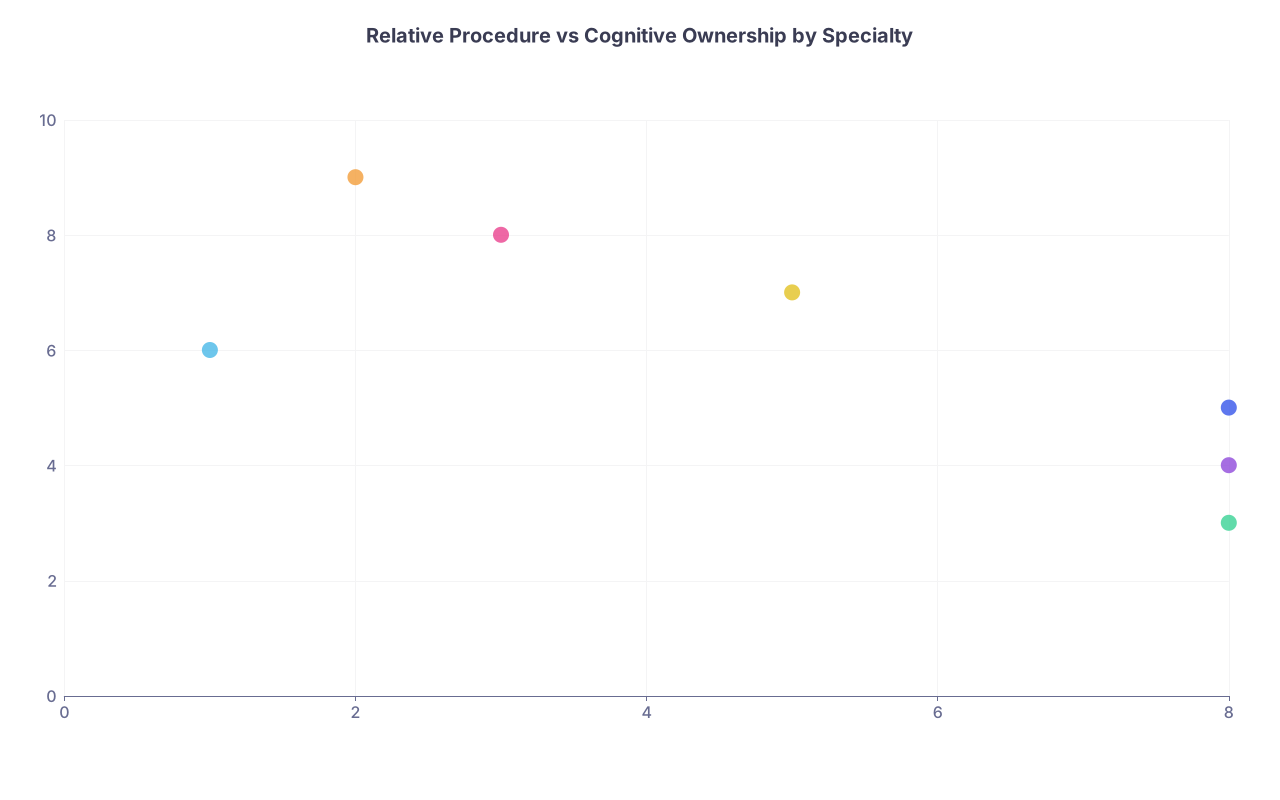
Let’s map some key specialties on that 2D grid.
| Category | Value |
|---|---|
| General Surgery | 8,5 |
| Emergency Med | 8,4 |
| Anesthesia | 8,3 |
| Internal Med | 2,9 |
| Neurology | 3,8 |
| Radiology | 1,6 |
| PM&R | 5,7 |
(Here, x-axis = procedure density 1–10, y-axis = cognitive ownership 1–10.)
- General surgery: high procedures, moderate-to-high cognitive, but focus is narrower (perioperative episodes, not lifelong management for most patients).
- Emergency medicine: high procedures, moderate cognitive, low longitudinal ownership.
- Anesthesia: high procedures, moderately complex physiology, but very time-bounded episodes.
- Internal medicine: low procedures, high cognitive ownership across systems and time.
- Neurology: lower procedure use, extremely high diagnostic complexity, longitudinal in many cases.
- Radiology: low procedures (unless IR), high interpretive cognition, no direct longitudinal ownership.
- PM&R: moderate procedures, quite a bit of cognitive planning for function and trajectory.
When choosing backups, you want to stay in the same quadrant if Plan A fails, even if it is a different specialty.
4. If You Are a Hands-On Type: Smart and Stupid Backups
You know you are procedure-driven if:
- You get restless on rounding-heavy months but come alive during line placements, LPs, paracenteses, suturing, joint injections.
- Shelf exams feel like a means to an end. Skills labs and OR days feel like the real thing.
- You are naturally drawn to “fix it now” problems instead of “what is the complex pathophysiology here over 10 years?”
Let’s say your Plan A is something high-procedure: general surgery, ortho, EM, or ENT.
Good backup patterns for hands-on people
You want:
- Still reasonably high procedure density
- Similar acute-care tempo
- Overlap in skills and mindset
Common pairs that actually make sense:
- Ortho → general surgery (or vice versa)
- ENT → general surgery
- EM → anesthesia or critical-care–oriented IM/EM hybrid
- Gen surg → EM (for those who like broad acute care more than longitudinal)
- OB/GYN → EM (if you like acute, nights, and are flexible on gender/age mix)
- EM → OB/GYN (less common, but for people who love procedures + women’s health)
Here is a rough comparison:
| Plan A | Reasonable Backup | Why It Fits |
|---|---|---|
| General Surg | EM, Anesthesia, OB/GYN | Still procedural, acute-care environment |
| EM | Anesthesia, OB/GYN | Fast pace, procedures, shift-like work |
| Ortho | Gen Surg | OR heavy, similar workflow |
| ENT | Gen Surg | Operative focus, head/neck overlap |
| OB/GYN | EM | L&D-like adrenaline, procedures |
Notice what is not on this list: categorical IM as the default backup for surgery-leaning students. That is how people end up miserable.
When backing up “downward” in competitiveness
If you are applying to something very competitive (e.g., ortho, derm — derm is low procedure density early but procedural later — neurosurgery, plastics), your hands-on nature still matters.
- Ortho → gen surg or EM is logical.
- Neurosurgery → gen surg, maybe neurology if you genuinely like the diagnostic piece and can tolerate low procedures.
- ENT → gen surg or possibly anesthesia if you like airway management more than cutting.
Dangerous backup moves for hands-on types
Things that look safe on paper and toxic in reality:
- Surgery → categorical IM as sole backup. Daily reality is notes, dispo, med rec, family meetings. Very light procedures.
- EM → radiology or neurology “because lifestyle.” You have taken someone who loves fast feedback and put them in dark rooms or long neuro workups.
- Anesthesia → pathology. Night and day difference in sensory environment, tempo, and hands-on work.
You can make these work if you genuinely like the cognitive work. But if the real reason is “this is easier to match” or “my advisor said I need a backup,” you are playing with long-term dissatisfaction.
5. If You Are a Cognitive Type: Backups That Do Not Betray Your Brain
Cognitive types are not less “practical.” They are wired differently.
Signs you are primarily cognitive:
- You actually enjoy complex differential diagnosis.
- You feel more satisfaction from puzzling out an obscure presentation than from putting in a central line.
- Scrubbed-in OR time sometimes feels boring or performative, not energizing.
- You like literature deep-dives and second opinions more than you like “get in, fix it, get out.”
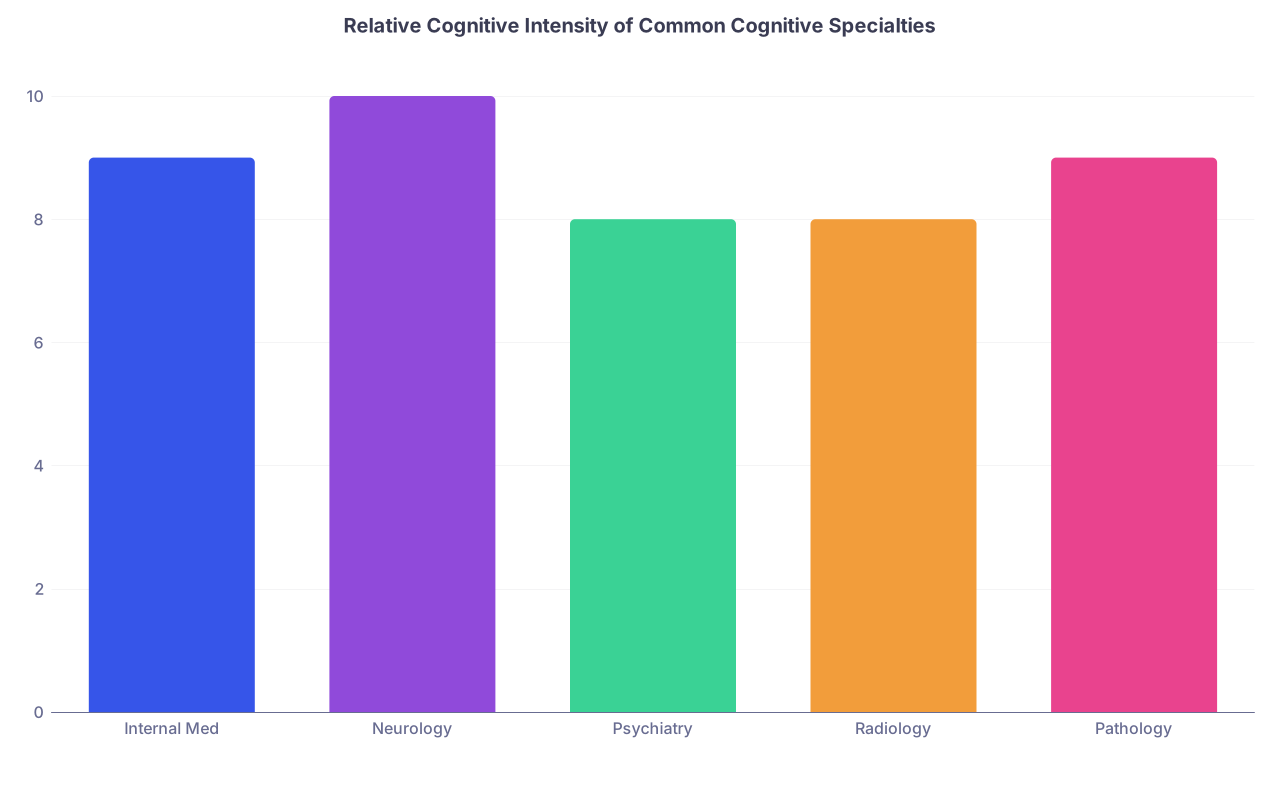
Typical Plan A’s for this group: internal medicine, neurology, psychiatry, radiology, heme/onc, rheum, maybe diagnostic-heavy subs.
Good backup patterns for cognitive people
You want:
- High or at least solid cognitive load
- Tolerable procedure burden (some or none, depending on taste)
- Work you can do for 30 years without resenting the lack of adrenaline
Reasonable pairs:
- IM → neurology or psychiatry (or vice versa, depending on your flavor)
- Neurology → IM
- Psych → neurology or family med (mental health–heavy practice)
- Radiology → IM or neurology (if you genuinely enjoy patient contact and comprehensive care)
- Pathology → radiology (pattern recognition, interpretive depth) or heme/onc via IM route (if you want some patient-facing detail)
| Category | Value |
|---|---|
| Internal Med | 9 |
| Neurology | 10 |
| Psychiatry | 8 |
| Radiology | 8 |
| Pathology | 9 |
If your Plan A is heme/onc, for example, your real choice is not “heme/onc vs nothing.” It is “IM-categorical in a program where heme/onc is realistic vs another cognitive specialty you can live with if you never see chemo orders again.”
Backing up from semi-procedural cognitive fields
Some fields live in the middle: they are cognitive and procedural, but not all-day procedures.
Examples: GI, cardiology, pulm/CC, some PM&R roles.
If your Plan A is GI for the endoscopy + cognitive mix, your backups might logically be:
- General IM with specific interest in hospitalist or complex outpatient medicine
- PM&R if you like function/outcomes and can accept injections/EMG as procedure scope
- Pulm/CC if you like ICU physiology and can handle fewer scopes
The key is: do not fall back all the way into high-procedure, low-ownership fields solely for match odds. A GI-bound IM resident rarely thrives in EM, for example.
6. Specialty-by-Specialty: What the Day Actually Looks Like
You cannot choose backups intelligently if your mental model of what people do is wrong. Let us anchor this with realities I have actually watched play out.
Internal medicine
- Rounds. Notes. Med rec. Diagnostic dilemma solving. Chronic disease management.
- Procedures: often delegated (especially at academic centers): lines, taps, LPs pushed to procedure services, IR, ICU.
- Procedure density: low, unless you deliberately build a procedure-heavy niche (ICU, some hospitalist roles).
Good for: high-cognitive, low-procedure people. Bad backup for: surgery addicts who think they will “just do cards or GI later” but have a Step score or application profile that makes that unlikely.
Emergency medicine
- Constant interruptions. Bread-and-butter stuff with lightning-fast throughput.
- Procedures: intubations, lac repairs, reductions, LPs, chest tubes, lines, pelvic exams, I&Ds.
- Longitudinal ownership: almost none. You stabilize, start a plan, then sign out to inpatient or discharge.
Good for: acute-care hands-on people who like variety but not detail over years. Poor backup for: long-form puzzle-solvers who enjoy slowly refining a diagnosis or a therapeutic regimen.
Anesthesiology
- High procedures: airways, lines, neuraxial blocks. Monitoring physiology in real time.
- Cognitive: physiology heavy, pharmacology heavy, but largely time-bounded around cases.
- Ownership: episodic, not longitudinal.
Good backup for: EM or surgery applicants who love procedures and physiology, but are less attached to being “the primary doctor” over months to years.
General surgery
- OR. Consults for acute abdomen, trauma, surgical problems.
- Procedures define identity. Even clinic is often dominated by operative planning and post-op visits.
- Cognitive: high but relatively focused (compared to IM’s system-wide optimization).
If you love this and are backing up: think EM, anesthesia, or OB/GYN before jumping to IM.
Neurology
- Cognitive density is brutal (in a good way if it fits you). Detailed exams, long consult notes.
- Procedures: occasional LPs, EMG if you sub-specialize, maybe botox/injections. But not a “hands” field.
- Ownership: often longitudinal for chronic neuro disease.
Good backup for: IM-bound or radiology-bound cognitive types, NOT for adrenaline junkies looking for a “lighter” field.
PM&R
- Moderate procedures: injections, EMG, spasticity management.
- Cognitive: oriented to function, rehab trajectories, multidisciplinary care.
- Tempo: slower than EM or surgery, but you still see physical improvement and do hands-on interventions.
Excellent bridge for people who want some procedures but also like cognitive planning and non-ICU worlds.
7. How To Audit Yourself Before You Choose Backups
Strip away scores and competitiveness for a moment. Ask three brutally practical questions based on your real experiences.
On rotations, when were you most awake?
- Was it codes, sutures, airways, drains, scopes?
- Or was it complex family meetings, puzzling through rare diseases, deep-dives on imaging and lab trends?
When you had a lighter day, did you:
- Go find procedures to watch/assist?
- Or go read notes/labs and refine the plan for your existing patients?
On ICU or ED months, did you love:
- The chance to do stuff?
- Or did you enjoy carefully re-balancing complex regimens and tracking small clinical changes over days?
Your honest answers place you on the map.
Now apply this:
- If you were always hunting for lines, chest tubes, reductions, scopes → high procedure density backup.
- If you were always trying to get to the bottom of puzzling cases, or arguing about diagnostic criteria → cognitive-heavy backup.
Do not lie to yourself here to chase prestige, lifestyle, or what your peers are doing.
8. Strategy: Pairing Plan A and Backup by Procedure Profile
Let us make this concrete with some archetypes.
Archetype 1: The OR-obsessed student (Plan A: ortho)
Profile: happiest when scrubbed, loves anatomy, hates endless rounding notes.
Bad backup: categorical IM at a program with minimal procedure exposure. You will be trapped chasing fellowships to get back to procedures.
Better backup: general surgery, or maybe EM if you truly like full-body acute care more than post-op clinics.
Archetype 2: The physiology nerd who loves procedures but not long notes (Plan A: EM)
Profile: loves codes, airways, stabilization. Hates clinic.
Bad backup: neurology or psych. Completely different tempo and sensory environment.
Better backup: anesthesia, critical-care–oriented IM/EM pathways, maybe OB/GYN if you like L&D pace and pelvic procedures.
Archetype 3: The puzzle-solver who dislikes being scrubbed (Plan A: IM with heme/onc interest)
Profile: enjoys diagnostic complexity and long-term rapport. OR days feel like wasted time.
Bad backup: EM, anesthesia, or surgery. Different brain. You will resent the superficiality of many cases.
Better backup: neurology, radiology, or even pathology if you like pure pattern recognition and do not miss patient contact.
Archetype 4: The mixed-type who likes both thinking and doing (Plan A: GI)
Profile: likes complex path + scopes. Comfortable in clinic and procedure suite.
Backups: general IM with understanding you may or may not get GI; pulm/CC; PM&R (if you are more function-focused than gut-focused) or hospitalist-oriented career planning.
9. Procedure Density and Competitiveness: How Many Fields To Apply To
For the Match phase, you need to translate this conceptual work into ERAS strategy.
You are deciding:
- How much risk you will tolerate in your Plan A
- Whether your backup is:
- a less competitive version of the same quadrant, or
- a different quadrant entirely
For a hands-on applicant:
- High-risk Plan A (ortho, neurosurg, plastics) → at least one backup that preserves procedure density (gen surg, EM, anesthesia).
- If your Step 2 and application are borderline, applying to two high-procedure fields at once is very defensible.
For a cognitive applicant:
- Competitive Plan A (derm, rad onc, some subs) → backup in IM, neurology, or psych that retains high cognitive ownership.
- Do not let panic push you into a procedural backup if you never enjoyed those rotations.
10. The Single Worst Backup Mistake I See
Every cycle, someone does this:
- Loves procedures and acute care.
- Applies to EM or surgery.
- Adds categorical IM as their “safety.”
- Matches IM.
- Six months into internship, they are calling consults all day and watching procedure teams do the fun parts.
They then scramble for:
- EM or anesthesia PGY-2 transfers (rare and painful).
- Trying desperately to get into cards, GI, or ICU just to get procedures back, often without the scores or research to make it easy.
You avoid this entire spiral by being honest about procedure density when picking backups.
11. Quick sanity check before you click “submit”
Before you send ERAS, ask yourself:
If I never matched into my Plan A and had to live in my backup field forever, would I:
- Still get enough “doing” vs “thinking” (or vice versa) to feel right?
- Be OK watching colleagues in my Plan A field without constant regret?
On my worst call day in this backup specialty, is the core type of work still a fit for my brain?
Example: A brutal cross-cover night in IM for a cognitive person is still better than a boring OR list for them. The reverse is true for hands-on people.Am I choosing this backup because of:
- Fit with my actual work preferences, or
- Fear + what everyone else is doing?
If it is the second, fix it now. Not after Match Day.
12. Short list: backup logic by primary “type”
To close this down to something you can keep in your head, here is the 30-second version.
If you are primarily:
Hands-on, acute-care:
- Keep backups in EM, surgery, OB/GYN, anesthesia, IR/acute subspecialties.
- Avoid pure clinic cognitive fields unless you truly liked them.
Hands-on, but slower tempo is fine:
- Consider PM&R, procedural subs via IM (GI, cards, pulm), some interventional radiology paths.
- You want moderate procedure density, not all-day adrenaline.
Cognitive, system-level:
- Stay in IM, neurology, psych, radiology, pathology, heme/onc, rheum, endo style fields.
- Avoid backing into EM/surgery purely for job security.
Cognitive, pattern-recognition/interpretive:
- Radiology and pathology, with backups in IM/neurology if you miss some patient contact.
Match your backup to your procedure density needs, not to someone else’s ranking list.
Key points to remember
- Procedure density is as important as lifestyle and prestige when choosing backups. If your daily work style is mismatched, you will hate your “safe” specialty.
- Keep your Plan A and backup in the same general quadrant of procedure density and cognitive ownership whenever possible. That is how you avoid long-term regret.
- Do not let fear push you into a backup that fits a different kind of brain. Backups should protect your chances of matching, not destroy your odds of being satisfied once you do.