
You are four tabs deep into FREIDA, it is 1:12 a.m., and your co-resident just said the quiet part out loud: “If I don’t match cards, I have no idea what I’m doing with my life.”
You laughed. But you felt that in your bones.
You want IR. Or interventional cards. Or advanced endoscopy. Or structural. You like wires, needles, and contrast more than clinic. You also know these fellowships are brutally competitive and getting worse every cycle.
So here is the actual problem:
Not “how do I show interest in IR/cards/GI” — you already know that part.
The real question is: how do you build a serious, non-delusional backup path for an interventional career without blowing up your primary plan?
Let me break this down specifically.
1. Reality check: how competitive are the interventional tracks you’re chasing?
You cannot design a backup plan if you do not understand the true risk.
We are talking about three main interventional families:
- Interventional Radiology (IR)
- Interventional Cardiology (IC)
- Interventional/Advanced GI (ERCP/EUS, advanced endoscopy, therapeutic IBD, etc.)
Each has its own funnel and choke points.
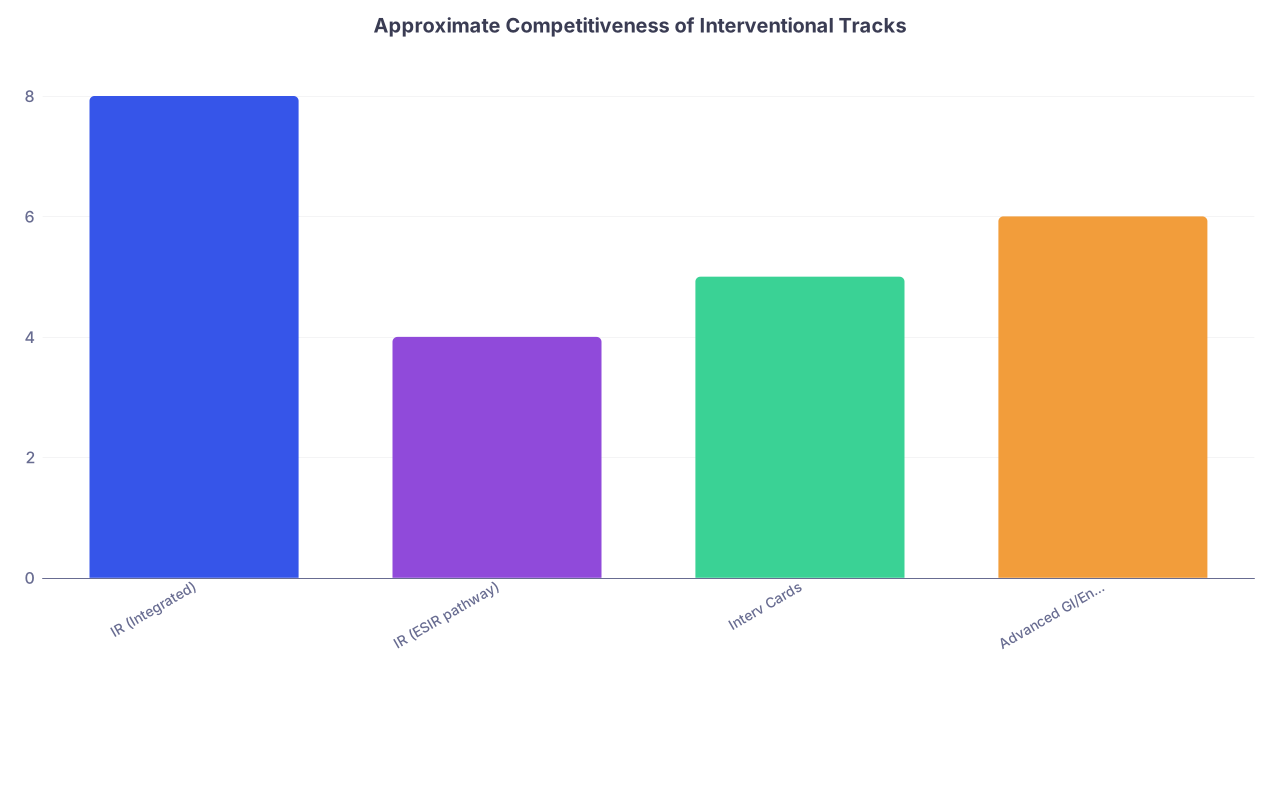
| Category | Value |
|---|---|
| IR (Integrated) | 8 |
| IR (ESIR pathway) | 4 |
| Interv Cards | 5 |
| Advanced GI/Endoscopy | 6 |
Scale: 1 = easy, 10 = insane. These are ballpark based on positions vs applicants, not vibes.
Interventional Radiology
Two main roads:
Integrated IR (IR/DR)
Apply in med school. Direct IR training with DR.
Very few spots. Huge applicant interest. Heavy Step, research, home IR department effect.
If you are asking about “backup,” you are already in the danger zone here.Diagnostic Radiology → Independent IR
Match DR first. Then ESIR or standard DR → IR fellowship.
More flexible. More surface area to succeed.
Realistically, this is the built-in backup for most IR hopefuls.
People who insist on “IR or nothing” from M4 are the ones I’ve seen end up in prelim surgery, then floating.
Interventional Cardiology
The choke point is cards fellowship, not IC itself.
Path is:
IM → General Cardiology fellowship → then Interventional Cardiology fellowship.
- General cards is competitive, but not 1-in-10 impossible if your IM residency is reasonable and you are not asleep at the wheel.
- Interv cards is competitive, but once you are in a solid cards program, your odds are drastically better.
So your real backup is:
“If I do not get interventional, can I live a satisfying life as a general cardiologist / imaging cardiologist / EP / HF?”
That is a values question more than a numbers question.
GI and Advanced Endoscopy
Again, bottleneck is GI fellowship first.
IM → Gastroenterology fellowship → then Advanced Endoscopy / Interventional GI + (sometimes) an extra fellowship.
- GI is routinely one of the top 2-3 most competitive IM subspecialties.
- Once in GI, advanced endoscopy spots are limited but not impossible if you are at a strong center and show real procedural focus.
Backup question here:
“Would I be content as a therapeutic-focused general GI without formal ‘advanced’ fellowship?”
Because most community GIs do a lot of bread-and-butter procedures.
2. Your first fork: medical student vs resident
Backup planning looks completely different depending on where you are in the pipeline.

| Step | Description |
|---|---|
| Step 1 | Medical Student |
| Step 2 | Apply IR and DR |
| Step 3 | IM or Surgery |
| Step 4 | Build DR Backup |
| Step 5 | Consider Cards or GI |
| Step 6 | Choose IM Residency |
| Step 7 | Plan Early Fellowship Strategy |
| Step 8 | Want IR? |
If you are a medical student aiming for IR
Let me be blunt: your backup is Diagnostic Radiology, not Family Medicine.
If your heart is set on IR, here is what a sane rank strategy looks like:
- Rank Integrated IR programs you are competitive for.
- Rank strong DR programs that:
- Have an IR residency and/or independent IR fellowship.
- Support ESIR pathways.
- Have at least 2–3 interventional attendings (not the “one guy who does ports and lines” setup).
| Priority | Primary Aim | Built-in Backup |
|---|---|---|
| 1 | Integrated IR programs | Match IR directly |
| 2 | DR at IR-heavy sites | DR → ESIR → IR fellowship |
| 3 | DR at strong academic | DR → IR via standard path |
The stupid move I have seen more than once:
Ranking a couple IR programs, then a completely unrelated specialty “just to match somewhere.”
They match that unrelated specialty, hate it, and spend years fighting their own choice.
If you are going to make a “swing big or bust” attempt at IR, the safety net should still be in the same ecosystem: imaging-heavy, procedural-friendly, and with IR mentors around.
If you are a medicine resident aiming for Cards or GI
Different logic. You are already in IM. Your “backup” is intra-IM, not bailing to a new specialty.
If you want:
- Interventional Cards → You must secure a cards fellowship first.
- Advanced GI → You must secure a GI fellowship first.
So your backup layers are:
- Match some cardiology or GI fellowship (not necessarily at your dream brand name).
- Within fellowship, position yourself for your procedural subspecialty.
- If you miss the interventional fellowship:
- Cards: imaging / EP / HF / general with heavy cath lab support.
- GI: ERCP/EUS skill via on-the-job training in certain settings, or high-volume general GI with therapeutic focus.
That means your residency backup planning is less about “what if I cannot do cards at all?” and more about “what are my credible alternate pathways within IM that still scratch the procedural itch?”
3. Mapping “procedural personality” to realistic backup specialties
“Interventional” is a personality type as much as a skill set.
You:
- Hate long clinic days with no procedures.
- Enjoy acute, high-stakes decision-making.
- Tolerate (or like) call.
- Prefer tech, devices, and fluoroscopy over long counseling conversations.
- Tend to like clear endpoints: stent in, stone out, bleeding stopped.
So when we talk backup, it is not just about matching somewhere. You will be miserable if you back into a cognitive specialty with minimal procedures.
Here are more procedural backups that stay in the same psychological neighborhood.
If you are aiming for IR
Primary: IR
Realistic, related backups:
Diagnostic Radiology with heavy procedural practice
- Many DR attendings do:
- US-guided biopsies
- Drainages
- Joint injections
- Spine procedures
- At community sites, you may still do lines, ports, some basic vascular.
- Many DR attendings do:
Neurointerventional via Neuro or DR
- DR → Neuroradiology → NeuroIR (in some systems).
- Or Neuro residency → Vascular Neurology → Neurointervention (less common, very niche).
Interventional Pain (via Anesthesia, PM&R, or sometimes Neuro)
- If what you love is needles, anatomy, imaging, and procedures, pain fellowships can give you a lot of image-guided work.
The bad idea is bailing from IR entirely into pure clinic, then wondering why you are burned out.
If you are aiming for Interventional Cardiology
Primary: IC
Solid backups that still feel interventional-ish:
General cardiology with a big cath share
- Many communities let general cardiologists do a significant portion of diagnostic caths.
- You can still live in the lab a fair chunk of the week.
EP (Electrophysiology)
- Still wires. Still catheters. Just in the left atrium instead of the LAD.
- Very procedural, heavy use of mapping systems, ablations, devices.
Advanced Imaging
- CT angiography, cardiac MRI, TEE-heavy practice.
- Less hands-on wire manipulation, but still device-heavy, tech-forward.
If you are aiming for Advanced GI / Interventional GI
Primary: Advanced endoscopy (ERCP, EUS, POEM, complex EMR/ESD).
Backups that still deliver procedures:
General GI in a high-volume procedural practice
- You can do colonoscopy, EGD, PEGs, basic therapeutic interventions all day.
- In some markets, you may pick up more advanced skills on the job.
Hepatology with procedural component (paracenteses, TIPS liaison, liver biopsies in some centers)
- Still not wires, but you remain tied to procedural teams.
4. How to build a “Plan A + Plan A-Prime” application strategy
Backup planning is not confessing failure. It is engineering redundancy.
Let’s go case by case.
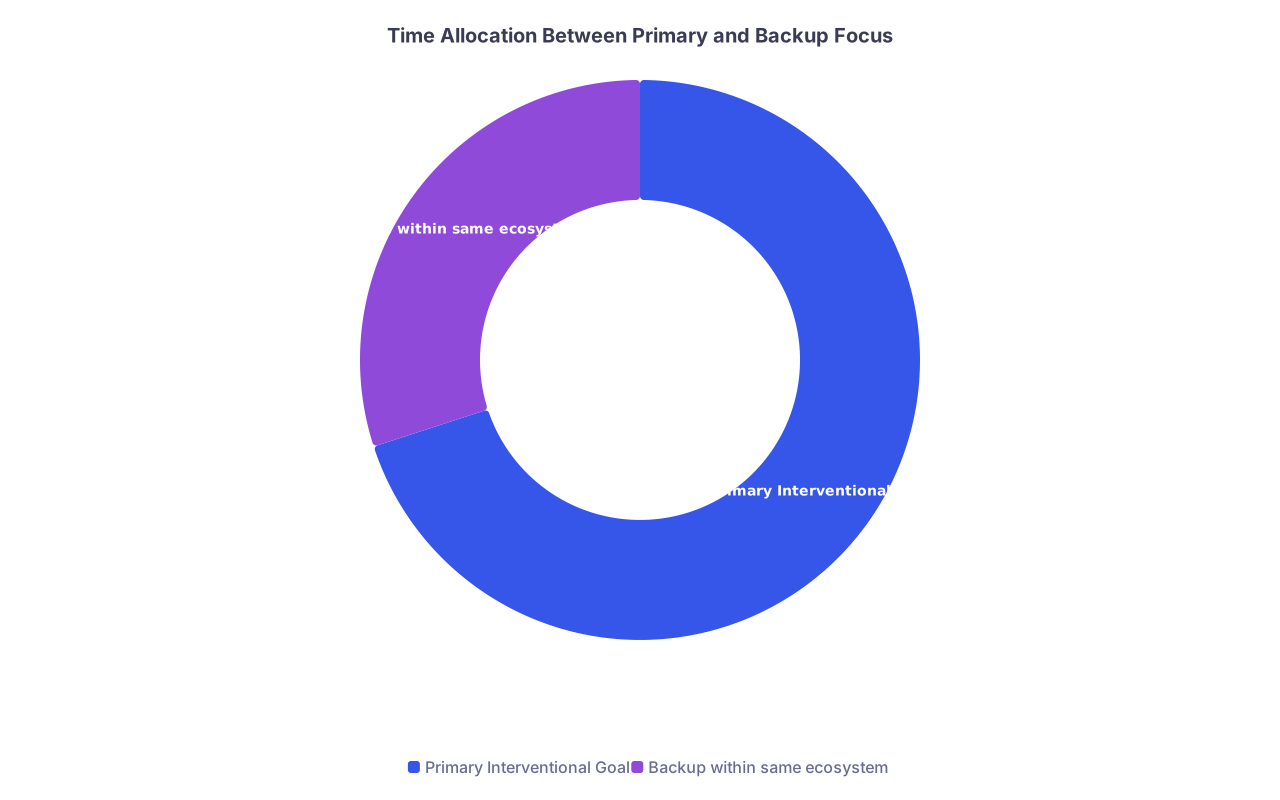
| Category | Value |
|---|---|
| Primary Interventional Goal | 70 |
| Backup within same ecosystem | 30 |
A. Med student who wants IR
Your ERAS has to do two things simultaneously:
- Convince IR programs you are seriously committed to IR.
- Convince DR programs you are not using them as sloppy second choice.
How?
Research portfolio
- Prefer:
- IR-specific projects (bleeding control, TACE outcomes, PAD interventions).
- But DR-centric projects still help: oncologic imaging, vascular imaging, procedural safety, etc.
- If you have mostly DR work and 1 small IR case series, that is still fine as long as you can talk like a future proceduralist.
- Prefer:
Letters
- At least one strong IR letter if you are applying IR.
- Two DR letters that speak to procedural mindset, image interpretation, work ethic.
Personal statement
- For IR applications: clear interventional story.
- For DR-only programs: emphasize love of imaging, procedures, and collaboration with IR — without saying “I will leave DR for IR ASAP.” Just do not advertise you are already halfway out the door.
Rank strategy
- Top: IR programs where you had strong vibes, home program preference, or clear support.
- Then: DR programs that:
- Have ESIR.
- Have IR faculty that know you.
- Have prior residents who successfully matched IR.
What you must avoid: a list that looks like you simply chased prestige without thinking about IR ecosystem. Your backup is not “a famous DR program with no IR training path that barely knows you.”
B. IM resident who wants Cards
Start with a hard assessment:
- Are your scores, research, and letters in the “competitive but not superstar” band?
- Is your program mid-tier, with limited national name recognition?
If yes, you should already be thinking in backup layers.
During residency:
Clinical exposure
- Do as many cards rotations as you can without compromising core training.
- Learn echo, stress testing, basics of cath indications. Be the intern who actually knows how to interpret tele, not just eyeball the rate.
Research
- At least 1–2 solid projects in cardiology.
- Ideally something procedural or outcomes-oriented (STEMI door-to-balloon, PCI outcomes, cath lab efficiency, etc.).
Relationships
- Your fellowship letter writers must believe you are cards-bound.
- They should be able to say “this person will succeed in any cardiology subspecialty, including interventional if they choose.”
Application strategy:
- Cast a broad, realistic net of cards programs:
- Home program (if they have cards).
- Regional mid-tier programs where your PD/attendings know someone.
- A few aspirational places if your metrics justify it.
And simultaneous backup:
- Keep one or two other IM subspecialties warm that would still make you content:
- Pulm/CC for procedures and ICU.
- Heme/Onc if you like complex pathophysiology.
- Even Hospitalist medicine with palliative/critical care focus in certain systems.
But here is the key: do not half-commit. Programs smell it. You cannot apply half-heartedly to cards and half-heartedly to pulm and expect either group to rank you high.
Your backup is more about mental flexibility and long-term happiness than dual-applying.
C. IM resident who wants GI / Advanced Endoscopy
Same structure, but slightly harsher competition at the entry gate.
You do:
- More GI electives.
- Dedicated research in:
- Endoscopy outcomes.
- IBD.
- Hepatology (still valuable).
- GI-specific letters.
Your backup if you fail to match GI on first try:
- 1 year chief + research heavy GI exposure → reapply.
- Hospitalist with strong GI connection, moonlighting endoscopy exposure → reapply.
- Pivot to another procedurally heavy field (Pulm/CC, for instance) if you absolutely cannot see yourself in long-term general IM.
What I would not recommend lightly: dual-applying to GI and something totally orthogonal in the same cycle. You end up a weaker candidate in both lanes.
5. Concrete alternate specialties for interventional-leaning residents
Let us put some structure on this. You want an interventional feel even if you do not land the exact fellowship.
| Primary Goal | Strong Backup Specialty | Why It Fits Procedural Mindset |
|---|---|---|
| IR | DR with ESIR / high-procedure volume | Image-guided procedures, close to IR ecosystem |
| IR | Interventional Pain (Anes/PM&R route) | Needles, imaging, anatomy, longitudinal care |
| Interv Cards | EP | Catheters, devices, lab-based procedures |
| Interv Cards | General Cards with cath share | Still in cath lab, acute coronary care |
| Advanced GI | General GI in high-volume scope practice | Daily procedures, some therapeutic work |
| Advanced GI | Hepatology with procedural emphasis | Ascites, liver biopsies, transplant interfaces |
Some narrower but real-world options I have seen work out:
IR hopeful who did not match IR, matched DR → became a high-volume body imager doing tons of drainages and biopsies, then carved out a niche for oncology interventions with IR colleagues.
Cards hopeful who did not land IC → leaned into structural imaging (TEE, CT structural planning) and now spends all day in the hybrid OR for TAVR, MitraClip, LAA occlusion. Still feels very “interventional” in daily practice.
GI hopeful who missed advanced endoscopy → joined a large GI group with strong mentorship, gradually took on more complex EMR and selected EUS/ERCP procedures under supervision. No formal advanced fellowship, but functionally 60–70% therapeutic practice.
These paths are not obvious when you are a PGY-2 staring at fellowship match data. But they are real.
6. Tactical mistakes that sabotage both your primary and your backup
I have watched otherwise strong applicants kneecap themselves because they assumed “I am good, I will match somewhere.” Arrogance and poor strategy hurt more than a mediocre Step 1 sometimes.
Here are the big unforced errors.
1. Refusing to adjust based on feedback
If three mentors tell you:
- Your IR application is marginal.
- You have no DR safety net on your list.
- You are ranking only places that barely know you.
Listen.
For IR:
If your med school has a DR program that likes you and is offering an interview, that is gold. You cannot treat that as equivalent to some random famous program where you are applicant #264.
For cards/GI:
If your PD is lukewarm about your competitiveness and suggests broadening, broaden. Pride does not pay your loans.
2. Backup that is too far from your core interests
“IR or Pediatrics.”
“Interv Cards or Psychiatry.”
This is how people burn out. You can force yourself to like something for a few months. Not 30 years.
Your backup needs at least:
- Procedures or acute care if that is your core driver.
- Similar team structures (OR/cath lab/ICU vs clinic-heavy) where you feel at home.
3. Ignoring geography as a leverage point
For competitive fellowships like GI, cards, advanced endoscopy, and IR, your best shot often comes from places where you:
- Trained for residency.
- Grew up.
- Have family ties.
- Did an away or research year.
If you act like you are too good for regional programs that would rank you highly, you are voluntarily shrinking your safety net.
7. How to mentally approach “failing” to get the exact interventional slot
You might not want to hear this part now, but you will want it at 4:30 p.m. on Match Day if things go sideways.
I have had trainees sit in my office devastated:
- IR applicant who matched only DR.
- Cards fellow who did not get an IC spot.
- GI fellow who struck out on advanced endoscopy.
Most of them, five years later, are fine. Some are thriving. The ones who did best shared three things:
They let themselves grieve briefly, then looked for procedural opportunities where they were.
“What can I actually do with the tools and system I have?”They negotiated for procedural niches.
They asked:- “Can I be the go-to person for X procedure?”
- “Can I take on more scope days / cath days / image-guided interventions?”
They stayed close to their interventional colleagues.
Still scrubbed in sometimes. Still read imaging. Still joined QI projects. That scratch-the-itch adjacency matters.
I am not going to give you the “everything happens for a reason” speech. Sometimes it does not. But there is a lot of room between “perfect interventional dream job” and “career failure,” and most people land somewhere in that middle.
8. A very concrete step-by-step for you, right now
Let me strip this down into an actionable sequence.

| Step | Description |
|---|---|
| Step 1 | Define primary interventional goal |
| Step 2 | Assess competitiveness honestly |
| Step 3 | Identify 1-2 procedural backups |
| Step 4 | Map training pathways for both primary and backup |
| Step 5 | Align research and letters to support both |
| Step 6 | Build rank list with primary then backup within same ecosystem |
| Step 7 | After match, maximize procedural exposure where you land |
Then fill in your specifics.
Example — M4 aiming for IR:
- Primary: Integrated IR
Backup: DR with ESIR. - Honest assessment:
- Step scores moderate.
- One IR project, two DR projects.
- Good home faculty support.
- Training map:
- Apply IR broadly.
- Apply DR broadly but favor programs with IR residencies and ESIR.
- Application:
- IR PS focused on procedural life.
- DR PS emphasizes imaging but mentions interest in interventions without sounding like you will bail.
- Rank list:
- IR programs first where you had strongest fit.
- Then DR programs with IR infrastructure and supportive culture.
Example — PGY-2 IM aiming for cards/IC:
- Primary: Cards → IC
Backup: Cards → EP / imaging; or Pulm/CC if cards fails. - Honest assessment:
- Mid-tier residency.
- Top 25% of class.
- Small but solid cards research.
- Training map:
- Apply cards widely, with heavy weight on programs that know your attendings.
- Keep a viable Pulm/CC pathway in conversation but do not actively dual-apply unless cards application collapses.
- Application:
- Cards-focused letters, clear story.
- No ambiguous “I am exploring many options” nonsense.
- Post-match:
- In cards fellowship, angle for labs, procedures, and research in interventional; keep EP/imaging in pocket as real option.

9. The bottom line: what smart backup planning for interventional careers really means
You are not planning to fail. You are refusing to be fragile.
The key points you should carry out of this:
Keep your backup inside the same ecosystem.
If you want interventional anything, your backup should still be procedural, tech-heavy, and adjacent to the field you love. DR for IR; EP/imaging/general cards for IC; high-volume GI for advanced endoscopy.Design your application so Plan A and Plan A-Prime both look intentional.
Your CV, letters, and statements should make sense for your primary interventional goal, but they must also make you a strong, believable candidate for the adjacent backup routes.Be brutally honest about your risk and use geography and relationships to widen the net.
Prestige-chasing with no safety net gets people burned. Programs that know you and like you are often your real backup — and sometimes your best long-term fit.
If you structure things right, you are not choosing between “interventional dream” and “giving up.” You are choosing between several different ways to build a hands-on, procedural career that still feels like you.