
The worst backup specialty is the one you pick at 2 a.m. on ERAS day because someone on Reddit said it was “less competitive.”
Let me be very clear: radiology, pathology, and neurology are not generic fallback bins. They are good backup choices only for particular students, with particular profiles, in particular situations. For the right applicant, they are smart, strategic hedges. For the wrong applicant, they are a fast track to being miserable or unmatched twice.
Let me break this down specifically.
The Real Point of a Backup Specialty
Backup specialties exist for one reason: to increase the probability that you successfully match into a field you can actually tolerate doing for decades.
Not to “get any residency.” Not to impress your aunt. Not to keep your classmates from gossiping about you going SOAP.
For most students considering backup specialties, the situation looks roughly like this:
- Your primary target is highly competitive (derm, ortho, ENT, plastics, neurosurgery, IR, maybe EM in certain regions).
- Your Step 2 score or clinical grades are average or slightly below average for that field.
- You realized this late: M3 or even early M4.
- You either did not build a parallel plan early, or you did it half-heartedly.
So you start eyeing radiology, pathology, neurology. Why those three? Because they:
- Historically had lower fill rates in some cycles.
- Use the same intellectual muscle as many competitive specialties.
- Seem like you can “pivot into them” with fewer extra rotations than, say, family medicine or pediatrics.
Sometimes that logic is sound. Often it is not.
Before we talk about each field, you need a framework.
The Three Filters for Any Backup Specialty
If I am advising you 1:1, I run your options through three filters.
Statistical feasibility
- Do your Step 2, clerkship grades, school reputation, and research make you reasonably competitive in that field, this year?
- Not “oh maybe somewhere.” I mean: your profile sits around or above the median for at least a subset of programs.
Narrative coherence
- Can you write a personal statement, get letters, and talk on interview day in a way that makes sense? Or does your file scream “failed ortho applicant trying to hide”?
Lived-experience tolerability
- Could you realistically do this job on an average Tuesday without hating your life? Not the idealized version. The real one: call schedule, patient population, diagnostic vs procedural balance.
Radiology, pathology, and neurology each pass or fail these filters differently depending on your background. So let us look at the profiles where they actually make sense.
When Radiology Makes Sense as a Backup
Radiology is a terrible backup for people who primarily love direct patient contact and procedures. But it can be an excellent backup for a certain type of “procedure-leaning, image-oriented, academic-leaning” applicant.
Who radiology fits as a backup
Radiology makes sense as a backup if most of the following are true:
- You are currently aiming for:
- Interventional radiology (IR), neurosurgery, ortho, ENT, plastics, vascular, CT surgery, urology, sometimes EM.
- You genuinely like:
- Anatomy
- Imaging
- Pattern recognition
- Sitting and thinking for long stretches
- Your stats:
- Step 2 CK: around or above national mean (≈ 245–250+ helps for mid-range radiology programs)
- Strong basic science foundation
- Some research, often in imaging, surgery, or neuro fields
And crucially: the idea of spending 80–90% of your workday reading images does not repel you.
If your favorite moment on surgery was reviewing CT anatomy pre-op, not closing skin, radiology as a backup is almost textbook logical.
Statistical reality check
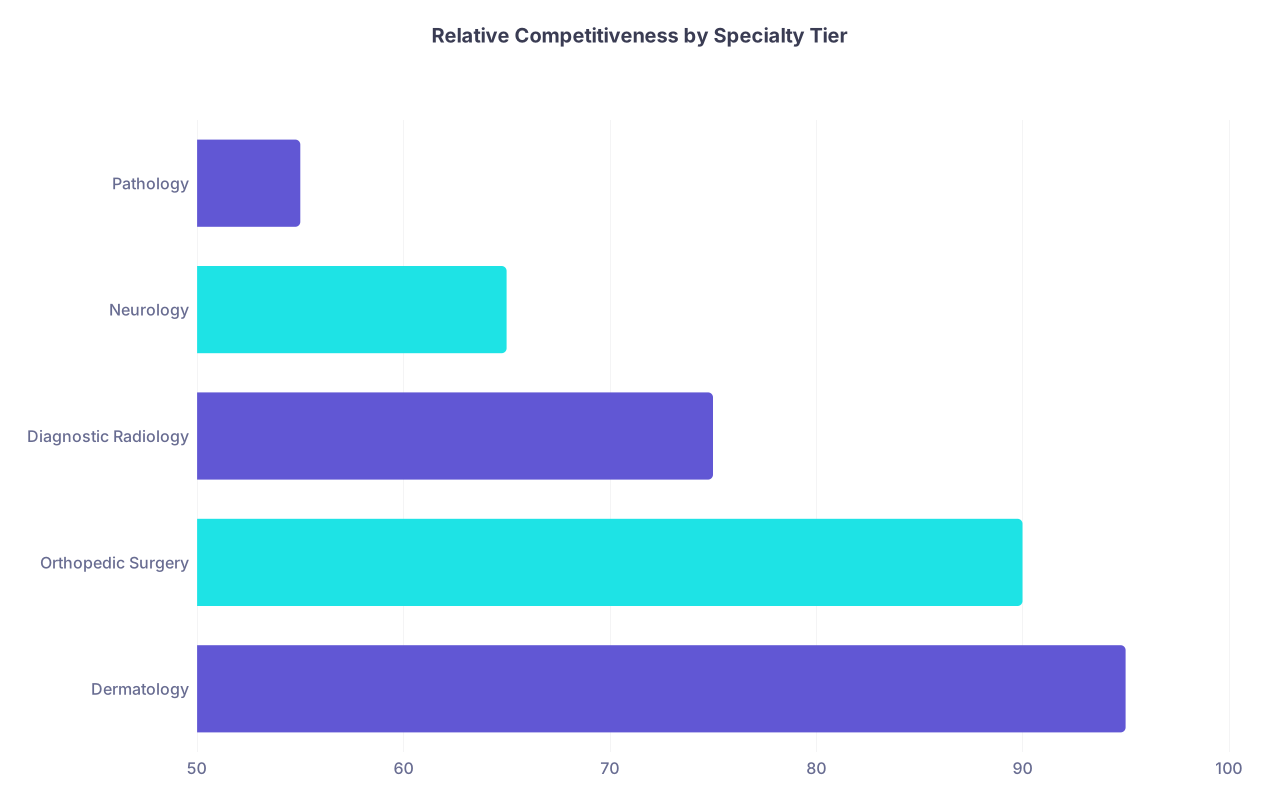
Radiology has tightened from its “safety” days. But it still has a wide distribution of program competitiveness.
| Category | Value |
|---|---|
| Dermatology | 95 |
| Orthopedic Surgery | 90 |
| Diagnostic Radiology | 75 |
| Neurology | 65 |
| Pathology | 55 |
That 75 for radiology hides a key point: there are top-tier radiology programs as competitive as many surgical subspecialties and lower-tier community programs that will rank solid, less flashy applicants highly.
Radiology makes sense as a backup if:
- You are underpowered for your dream ultra-competitive specialty.
- But you are still competitive for mid-tier radiology programs (especially in less popular locations).
If your Step 2 is 225 with mediocre clinical grades, radiology is not your backup. It is your new risk.
(See also: How PDs quietly judge your backup specialty choices on rank day for perspective.)
Narrative coherence: why radiology, not your original field?
Programs will ask. You need an answer that is not “I realized ortho was too competitive.”
The coherent radiology backup narrative usually sounds like this:
Intellectual pull:
“On my surgical rotations, I was consistently drawn to pre-op imaging review. I realized the diagnostic decisions upstream shaped everything we did in the OR.”Longstanding interests:
“I worked with Dr. X on a project correlating imaging findings with clinical outcomes. That opened my eyes to radiology as a primary decision point in patient care.”Real exposure:
“I did a dedicated diagnostic radiology elective and felt at home with the workflow, the pace of interpretation, and the collaborative consultative role.”
You must line this up with:
- At least one radiology letter (ideally from an academic radiologist, not just someone you shadowed).
- A personal statement without “since I was young I dreamed of…” nonsense that conflicts with your CV.
Lived reality: who actually does well switching into radiology?
Students who do well using radiology as a backup usually:
- Are comfortable with high volumes of screen-based work.
- Enjoy high-cognition, lower-immediate-feedback tasks.
- Do not need constant patient interaction for job satisfaction.
- Like the idea of subspecializing (neuro, body, MSK, IR, etc).
I have seen a few catastrophes: students who liked the “prestige + lifestyle” idea of radiology but actually missed being physically in patient rooms, performing procedures, hearing breath sounds. They were miserable by PGY-2.
If you are using radiology as a backup, force yourself to answer this bluntly:
“If all I ever do again is interpret images and occasionally talk to clinicians, is that enough?”
If the answer is a genuine yes, radiology is in play.
When Pathology Makes Sense as a Backup
Pathology is the most misunderstood of the three. Many students treat it as an emergency parachute if everything else fails. That is a mistake.
Pathology is a smart backup for a narrow but real slice of applicants.
Who pathology fits as a backup
Pathology makes sense as a backup if:
- You are aiming for:
- Oncology, heme/onc, academic internal medicine, sometimes surgery with heavy interest in tumor boards and cancer.
- You genuinely enjoy:
- Microscopy
- Pathophysiology
- Lab medicine
- Being upstream of clinical decisions, not at the bedside.
- Your stats:
- Step 2 can be modest, but a strong basic science record helps.
- You may have weaker clinical evals if you are not naturally extroverted in patient-facing settings.
- Your personality:
- Introverted is fine.
- Detail-focused, comfortable with ambiguity and long diagnostic puzzles.
If your favorite part of internal medicine was dissecting why the biopsy showed what it did, not managing fluids and electrolytes, pathology is not a demotion. It is a fit.
The hidden risk: career misunderstanding
Pathology fill rates and competitiveness can mislead people into thinking it is “easy.” It is not. The bar to be a truly competent pathologist is very high.
Where pathology works as a backup:
- You have repeatedly found yourself drawn to:
- Tumor boards
- Reading pathology reports carefully
- Asking “what does the histology actually show?”
- You have done:
- A pathology elective or autopsy rotation, and did not hate it.
- Maybe a research project in cancer biology, basic science, or translational work.
Where it fails badly:
- You just want to avoid patient contact and think pathology is your only option.
- You have no genuine interest in histology, molecular diagnostics, or lab operations.
Statistical feasibility
Pathology has historically been more forgiving on test scores and grades, but even here, there is stratification:
| Factor | Pathology (Backup Fit) | Neurology (Backup Fit) | Radiology (Backup Fit) |
|---|---|---|---|
| Step 2 CK | 220–240 can match broadly | 230–245 for solid programs | 240–255 for solid programs |
| Research need | Helpful, not mandatory | Helpful in neuro fields | Increasingly important |
| Letters importance | Strong path letter ideal | Strong neuro letter essential | At least one solid rads letter |
| Patient contact | Minimal | High | Minimal to moderate (IR more) |
| Visual pattern work | Very high (micro, gross) | Moderate (neuro exam, imaging) | Very high (imaging interpretation) |
These numbers are rough, but you see the pattern. Pathology can rescue certain “basic science strong, clinical weaker” applicants. But again, that only works if they like pathology’s day-to-day.
Narrative coherence for pathology
You cannot pretend you wanted family medicine your whole life and then suddenly appear in the pathology pile. Programs read your file.
A coherent pathology-backup story usually has:
- Evidence of early preclinical curiosity:
- Strong performance in pathology courses.
- Maybe a teaching role in path or histology.
- A sense of fit with the diagnostic role:
- “I realized I am most engaged when working through the mechanisms of disease and correlating histologic findings with clinical presentations.”
- Concrete exposure:
- “During my dedicated pathology elective, I found the sign-out process and interdisciplinary tumor boards particularly satisfying. They align with the way I like to think and work.”
You do not have to claim you always loved pathology. But you must show you actually know what it is.
Lived reality: can you tolerate the job?
You will spend a lot of time:
- At a microscope, at a workstation, in a lab environment.
- Handling specimens, grossing, reviewing slides, signing out cases.
- Arguing with clinicians (gently) about what the sample does and does not show.
I have seen several “backup” pathology residents exit the field mentally in year one because they:
- Never really accepted the lack of direct patient contact.
- Underestimated how intense and high-stakes the diagnostic decisions are.
So if you are mainly drawn by “lower competition” and “good hours,” do not pick pathology. If you are lit up by pathogenesis, classification systems, and microscopic pattern recognition, then yes—pathology can be a very rational backup.
When Neurology Makes Sense as a Backup
Neurology is the most “clinical” of these three and the one that most easily supports a believable pivot from other specialties.
For a certain type of internal-medicine-adjacent or neuro-leaning student, neurology as a backup is not downgrade; it is a lateral move.
Who neurology fits as a backup
Neurology makes sense as a backup if:
- You are aiming for:
- Internal medicine (with neuro interests), neurosurgery, PM&R with neuro focus, psychiatry with neurobiological leaning, EM with stroke-heavy environments.
- You like:
- Long-form diagnostic reasoning.
- Detailed neuro exams.
- Following chronic, complex patients over years.
- Your stats:
- Step 2 in the low-mid 230s and up is often enough for a solid spread of programs.
- Clinical evaluations: decent to strong, especially in IM and neuro rotations.
Neurology is quite tolerant of the “thoughtful, slower, detail-obsessed” style of physician. If that is you, it starts looking attractive as a backup when your primary competitive target becomes unrealistic.
Why neurology often makes the most narrative sense
If you had to pick one of the three to explain in an interview without sounding like you crashed and burned elsewhere, neurology is usually easiest.
Your story might sound like:
- “Through my internal medicine rotation, I kept gravitating toward patients with neurologic presentations. I enjoyed localizing lesions, correlating imaging with exam findings, and managing long-term issues.”
- “My neurosurgery interest turned out to be less about the OR and more about the science and clinical course of neurologic disease, which I experienced more fully in my neurology rotation.”
This contrasts with radiology or pathology, where the pivot from heavily clinical specialties can sound more like a reaction to competitiveness if you are not careful.
Statistical feasibility
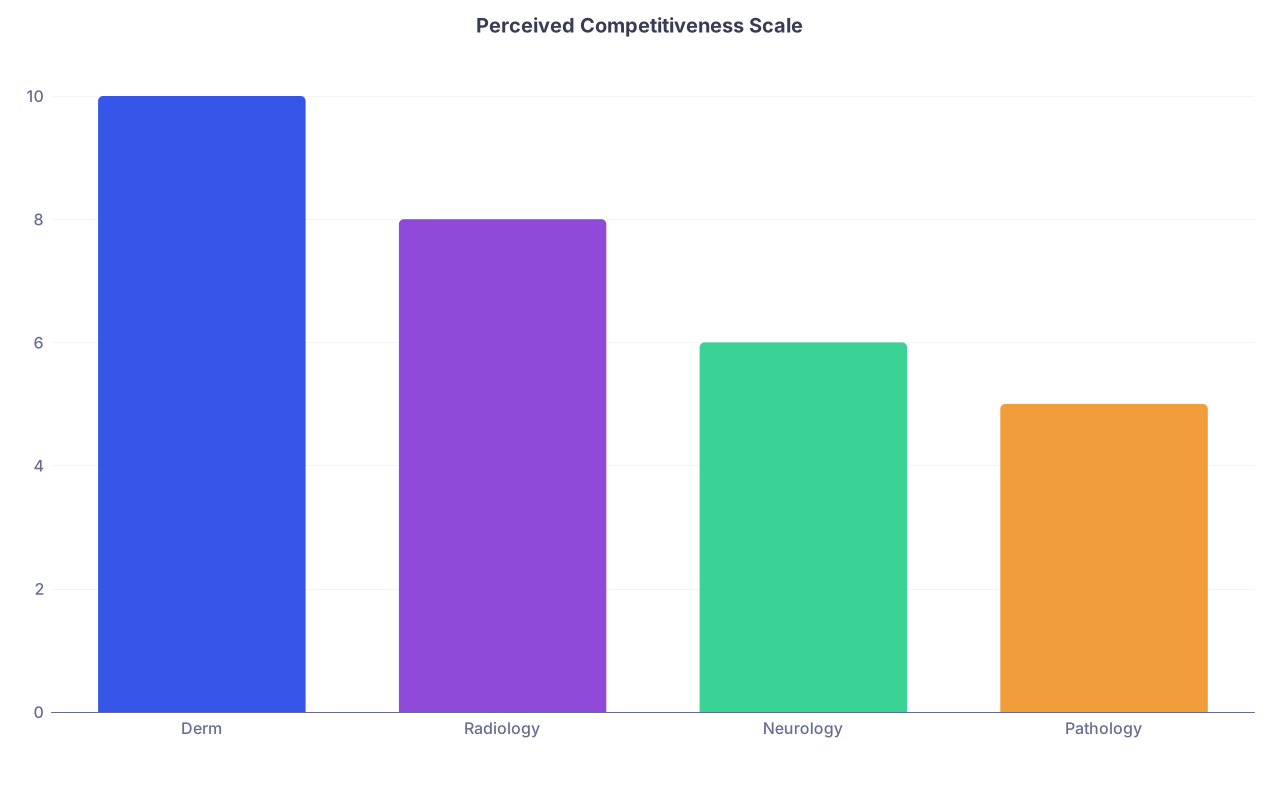
Neurology’s competitiveness has risen, but it remains more forgiving than many surgical or dermatologic fields. It sits in that middle band where:
- Solid but not perfect Step 2 scores.
- Some research or none.
- Good clinical letters.
can still open a good mix of academic and community programs.
| Category | Value |
|---|---|
| Derm | 10 |
| Radiology | 8 |
| Neurology | 6 |
| Pathology | 5 |
The key phrase is “perceived competitiveness.” Students still underestimate neurology. The stronger applicants have discovered it, especially with expanding stroke and neurocritical care markets.
Lived reality: you will be seeing sick, complex patients
Backup-neurology disasters usually come from students who:
- Underestimate how sick stroke, neuro ICU, and progressive neurodegenerative disease patients are.
- Thought neurology was “cerebral IM” without the heavy end-of-life and disability burden.
You must be able to:
- Sit with chronic disability and bad prognoses.
- Have difficult family goals-of-care conversations.
- Accept that many neurologic conditions are treated, not cured.
If you found that part of IM, ICU, or EM emotionally draining and unrewarding, neurology may not save you. If you found it intense but meaningful and you loved the exam and localization puzzle, neurology as a backup can be highly satisfying and very defensible.
Matching Your Primary Target to a Rational Backup
Let me make this more concrete. Here is how I map typical primary choices to these three when it actually makes sense.
1. Neurosurgery primary
Reasonable backups:
Neurology
- If: you loved neuroanatomy, clinical neurology, and the longitudinal management more than just the OR.
- Story: “I realized I was more drawn to the diagnostic and long-term management side of neurologic disease.”
Radiology (especially neuroradiology interest)
- If: you found yourself fascinated by imaging, loved going through MRIs in detail, and enjoyed case conferences.
- Story: “Imaging was the anchor of my interest. Radiology allows me to stay embedded in neuro care from a diagnostic standpoint.”
Pathology as a backup to neurosurgery is rare, but some people who are obsessed with brain tumors and neuropathology make that pivot.
2. Orthopedic surgery / plastics / ENT / vascular
Reasonable backups:
- Radiology (MSK or body)
- If: you liked pre-op imaging, anatomy, and precise visual analysis as much as the OR.
- You should have at least a late M3 / early M4 radiology elective and one radiology letter if you are serious.
- Neurology only fits here if your real interest was peripheral nerve, neuromuscular disease, or spine more broadly, and you have the narrative and exposure to prove it.
Using pathology as a backup from these is uncommon and often incoherent unless you have a very clear tumor board / oncologic interest with real path exposure.
3. Dermatology primary
Reasonable backups:
- Pathology (dermatopathology interest)
- If: you truly love histology, pattern recognition under the microscope, not just clinical skin exams.
- You need: dermpath or pathology exposure, maybe research bridging derm and path.
- Radiology sometimes, if your derm interest was more about imaging + pattern recognition generally, but that is a stretch without good rads exposure.
- Neurology usually does not make much narrative sense unless your research or clinical story has a strong neuro link.
4. Internal Medicine with subspecialty ambitions (cards, GI, heme/onc)
Reasonable backups:
- Neurology
- Very common and credible. Many IM applicants realize they prefer neuro’s diagnostic style over organ-based IM.
- Pathology (for those strongly pulled toward hemepath, molecular, or oncologic diagnostics)
- Requires: tangible pathology exposure and a basic science / lab interest record.
- Radiology only if you have strong imaging exposure / interest.
This is the category where all three can be plausible depending on what you actually did in medical school.
5. EM primary (especially in competitive markets or with modest scores)
Reasonable backups:
- Neurology
- If: you like acute stroke, seizures, neuro emergencies, and value diagnostic reasoning.
- Radiology, occasionally
- If: you were drawn to ED imaging interpretation and enjoyed sitting with the scans more than with the patients.
Pathology rarely makes narrative sense from EM unless your preclinical background screams “path person who accidentally liked EM rotations.”
How to Actually Execute a Backup Strategy with These Fields
Hand-waving about “maybe I will add radiology” is worthless. You need a concrete execution plan.
Step 1: Get real exposure. Fast.
Before ERAS locks:
- Do at least:
- One radiology elective if considering radiology.
- One pathology elective if considering pathology.
- One dedicated neurology elective if considering neurology beyond the core.
- On that elective:
- Tell the program director or clerkship director directly: “I am strongly considering this as my primary or backup specialty and want honest feedback on my fit.”
You will learn more from one blunt conversation with a PD than from 20 anonymous forum posts.
Step 2: Secure field-specific letters
Non-negotiable if you want programs to take your backup seriously:
- Radiology: at least one radiologist letter, ideally two, showing you can do the work and fit the culture.
- Pathology: at least one pathologist letter from a real rotation or meaningful project.
- Neurology: one neurology letter from an inpatient or outpatient rotation where you carried patients.
If September is looming and you have zero of these for your backup field, you are too late for a true parallel plan. In that case, reassess whether you are actually using a “backup” or just spraying applications.
Step 3: Align your personal statement and ERAS content
Do not write a personal statement that screams “I wanted something else.” For a backup specialty to work:
- Your statement must read as if this field is a deliberate, positive choice, not a consolation prize.
- Your activities section should show at least some plausible path to this interest:
- Teaching in neuro block? Good for neurology.
- Imaging-related research? Good for radiology.
- Basic science or histology projects? Good for pathology.
(See also: How chair letters change when you declare a backup specialty plan for more details.)
You do not have to rewrite your entire life. You do have to avoid contradictions.
Step 4: Be strategic about application numbers and tiers
If you are using these as true backups:
- Radiology:
- Apply broadly. Include community and less desired geographic regions.
- Do not only apply to “name” academic centers. That is how backup plans fail.
- Pathology:
- You can be somewhat more selective if your metrics are decent, but still cast a wide net first time around.
- Neurology:
- Mix academic and community programs realistically based on your Step 2 and clinical performance.
Your primary competitive specialty may get a tight, curated list. Your backup should be broad enough that your match probability is meaningfully higher.
Red Flags: When These Three Are Actually Bad Backup Choices
Let me be blunt about when radiology, pathology, or neurology should not be your backup.
- You have zero exposure to the field and no time left to get any.
- You dislike the core daily activities (screens for rads, microscope for path, heavy chronic disability for neuro).
- Your metrics are below average even for these fields, and you are banking on “they are less competitive” to save you.
- Your only reason is lifestyle, without any evidence of actual fit.
If you recognize yourself in that list, it is safer to:
- Pick a field you have actually done and tolerated (IM, FM, peds, psych, etc.).
- Or take an extra year to build a coherent application for a more suitable field, rather than rushing a bad pivot.
How These Choices Play Out in Real Life
I have seen all of the following:
- The neurosurg applicant who pivoted to radiology with a strong neuroradiology letter, matched at a solid academic center, and is now a happy neurointerventionalist.
- The derm hopeful who pivoted to pathology, fell in love with dermpath, and ended up with a niche that still aligns with their original vision.
- The IM applicant who used neurology as a “soft backup,” discovered they liked it more than wards, and is now doing a stroke fellowship.
I have also seen:
- The “I hate people, I will just do path” applicant who realized too late that pathology still requires intense coordination, responsibility, and complex cognitive load.
- The “radiology seems chill” student with a 220 Step 2 and no radiology exposure go unmatched and then scramble into something they had never considered.
- The burned-out IM applicant who chose neurology as an escape, only to find neurology patients sicker, more chronically disabled, and emotionally harder.
Backup specialties magnify your underlying preferences and weaknesses. They do not erase them.
With that in mind, radiology, pathology, and neurology can be very smart backup choices—when they fit your mind, your record, and your story. If you do the honest self-audit and structured prep, they stop being “backups” and start being legitimate, long-term careers you can respect.
Once you have that sorted, your next real task is tactical: how to split your ERAS, letters, and interview season between a primary and a backup without sabotaging both. That requires a different kind of precision—and deserves its own deep dive on another day.