The usual “backup specialty” advice ignores the thing that will actually make or break your career: how your life looks at 2 a.m. on a random Tuesday five years from now.
You are not just picking a backup field. You are picking a version of your future self’s body, marriage, sleep cycle, and burnout risk. So we are going to talk about call, nights, and flexibility in a way that is brutally concrete and specialty-specific.
Step 1: Get Honest About Your Lifestyle Non‑Negotiables
Start here. Not with “What’s competitive?” or “What looks good with my scores?” but with “What am I absolutely not willing to live with?”
Break it down into three buckets:
- Call structure
- Night/shift work
- Flexibility and control over schedule
You are going to use these three to filter backup choices rationally instead of panicking into “I guess I will add Family or IM.”
1. Call: What Kind, How Often, How Long
“Call” is not one thing. People say “call is bad” or “this field has a lot of call” and it becomes meaningless.
You care about:
- Home vs in‑house call
- Frequency (per month)
- Realistic overnight workload when on call
- Post‑call expectations (full day, half day, home)
- How this changes from PGY1 to attending
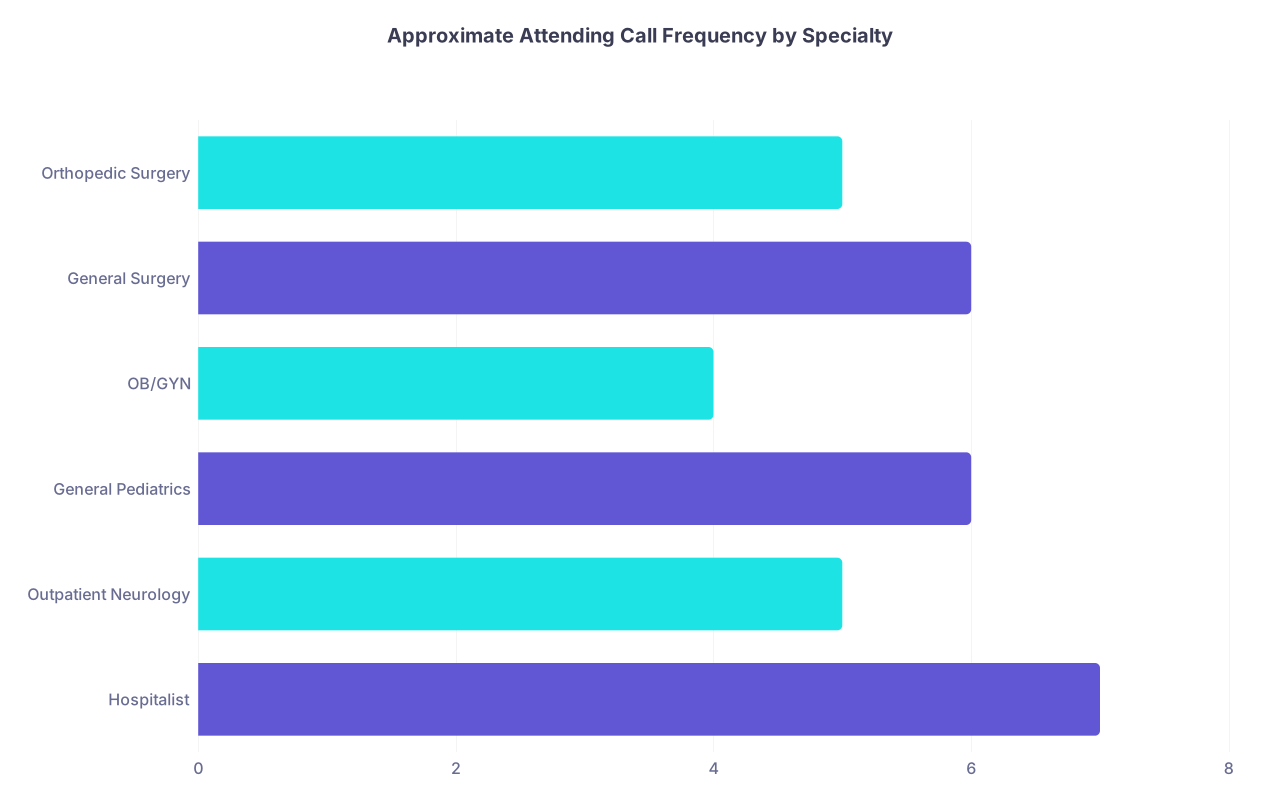
Typical patterns by attending stage (averages, not guarantees):
| Category | Value |
|---|---|
| Hospitalist | 7 |
| Outpatient Neurology | 5 |
| General Pediatrics | 6 |
| OB/GYN | 4 |
| General Surgery | 6 |
| Orthopedic Surgery | 5 |
Values here are “calls per month,” roughly: hospitalist nights, outpatient neuro home call, and so on. Your exact numbers will vary by group, but the shape of the work is consistent.
Now translate that into you:
- Can you function safely after being awake most of the night? Regularly?
- Are you ok missing some weekends and holidays, or will that wreck your family plans?
- Do you hate the feeling of being “tethered” to your phone even at home?
If you are truly miserable when your sleep is disrupted, certain fields should be off the backup list entirely (surgical subspecialties, OB/GYN, EM, NICU-heavy pediatrics, adult cards).
2. Nights: Rotations vs Lifelong Identity
Everyone does some nights as a resident. That is just the price of admission.
The question is: In attending life, are nights:
- A fixed part of your job definition forever? (EM, hospitalist, ICU, nocturnist tracks)
- An occasional duty you share? (many surgical and acute subspecialties)
- Something you can largely minimize or eliminate if you choose the right practice? (outpatient-heavy fields)
If your brain permanently melts after 11 p.m., EM is not a responsible “backup,” no matter how great the shift‑work flexibility sounds on Reddit.
3. Flexibility: Control vs Constraint
There are three main levels of scheduling control:
Low control, high rigidity:
- OR schedule drives your day.
- Emergencies dictate nights/weekends.
- Flexibility tied to partners’ needs and call coverage.
Typical: most surgical fields, OB/GYN, anesthesiology early career.
Medium control:
- You have some outpatient vs inpatient mix options.
- Shift models exist in many markets.
- Part‑time is possible but not trivial.
Typical: internal medicine subspecialties, pediatrics subspecialties, radiology, some hospitalist setups.
High control:
- Clinic-based, predictable daytime work.
- Part-time or 4-day weeks commonly available.
- Easier geographic and practice-type switches.
Typical: outpatient psych, primary care, outpatient neurology, allergy, PM&R (especially MSK/spine), occupational medicine, many lifestyle‑oriented jobs.
If you have strong non‑clinical commitments (young kids, dual‑physician couple, chronic illness), you should bias your backups heavily toward category 2 or 3.
Step 2: Map Common Backup Choices To Lifestyle Reality
Let me go specialty by specialty and translate the brochure language into “what your month actually looks like” for common backup fields.
Internal Medicine (Categorical) As Backup
Everyone lists IM as “default” backup. It is not automatically lifestyle‑friendly. It is lifestyle‑flexible if you are intentional.
Residency:
- Call: Typically night float systems now; some places still do 24‑hour call.
- Nights: Multiple months of night float over 3 years, often week‑on/week‑off.
- Weekends: 2–3 weekends per month on many rotations.
Attending options:
- Hospitalist:
- 7‑on/7‑off or variations.
- Nights either part of your block or separate nocturnist coverage.
- High intensity during “on” block, but real time off.
- Outpatient primary care:
- Usually weekdays, some evening or Saturday clinics.
- Call is often phone‑only, low volume, shared among many physicians.
- Subspecialties (cards, GI, pulm/crit, heme/onc)
- Each has its own call/nights beast; do not assume “IM backup” means cush.
Where IM shines as a backup:
- You can pivot later to hospitalist/nocturnist, outpatient-only, academic, or admin.
- You can progressively reduce nights and call as your career evolves, especially if you lean into outpatient or niche consult roles.
Where IM fails lifestyle expectations:
- If you thought IM means “no nights” you will be shocked during residency and early attending years.
- If you deeply hate inpatient medicine, IM as a backup will feel like a bait‑and‑switch.
Family Medicine As Backup
Family is often pitched as “chill” or “easy lifestyle.” That is lazy thinking. The residency can be rough; the attending options can be incredibly flexible.
Residency:
- Call: Varies wildly. Community programs often have busy OB, peds, and adult inpatient.
- Nights: Yes, though less ICU-heavy than IM in many places.
- Weekends: Regular for inpatient and OB months.
Attending options:
- Outpatient clinic‑only FM:
- High flexibility: 3–5 day weeks, part‑time, telehealth, urgent care.
- Call: Many systems use nurse triage; you get filtered calls. Often low‑burden.
- OB‑heavy FM:
- Call looks like a mild version of OB/GYN. Nights, weekends, unpredictability.
- Hospitalist‑style FM:
- Similar to IM hospitalist.
Ideal if:
- You want maximal geographic flexibility.
- You want the option to move between clinic, urgent care, telemed, admin.
- You value control over your hours more than a narrow clinical niche.
Not ideal if:
- You hate primary care tasks: chronic disease management, long‑term relationships, psychosocial complexity.
- You want to avoid call completely (call‑free FM jobs exist, but that is the job, not the specialty).
Psychiatry As Backup
Psych is the classic “lifestyle field” but students oversimplify. There is psych and then there is how you practice psych.
Residency:
- Call: Usually home call, with occasional in‑house nights depending on program.
- Nights: Less than medicine/surgery, but there are night rotations.
- Weekends: Lighter than most other fields, but not zero.
Attending options:
- Outpatient psych (adult or child):
- Mostly weekdays.
- Little to no nights.
- Call often shared, very light, sometimes completely outsourced.
- Inpatient psych / C‑L:
- Can involve weekends and some call, but still usually more predictable than acute medical/surgical fields.
- Telepsychiatry:
- Extremely flexible; high control over schedule.
Psych is a strong backup if:
- You want a career where true “no nights, minimal call” is genuinely realistic at scale.
- You are okay with high emotional/cognitive load instead of physical intensity.
- You like longitudinal thinking more than acute procedures.
Bad backup if:
- You loathe the idea of sitting, talking, dealing with chronic suicidality, substance use, trauma.
- You are running from work hours rather than running toward the actual work.
Anesthesiology As Backup
On paper, anesthesia looks like: “Great pay, controlled environment, shifts.” The truth is more nuanced.
Residency:
- Call: In‑house. Nights, weekends. OR emergencies, labor epidurals, ICU months.
- Nights: Real nights, real pages. You will be up, not “resting on call room couch.”
- Post‑call: Depends on program; usually home post‑call but the night might have been brutal.
Attending options:
- Academic:
- Early starts, OR days, some 24‑hour call or night shifts.
- EMS/trauma, OB, cardiac can be very intense.
- Private practice:
- Mix of early‑morning OR days and overnight call.
- Supervision models, often high-volume.
- Lifestyle variants:
- Outpatient surgery centers (ASC) — more daytime, less call, but early starts.
- Pain medicine (after fellowship) — clinic heavy, procedures, more regular hours.
Anesthesia is a moderate lifestyle field if you end up in the right practice. It is not a “no call, no nights” specialty across the board.
Use it as a backup if:
- You genuinely like acute physiology, airways, and OR time.
- You can tolerate nights and call in exchange for block time and decent compensation.
- You want options (OR, ICU, pain, procedural clinics).
Skip it as a backup if:
- Your primary non‑negotiable is “I do not want to get called at 3 a.m. for an emergency C‑section.” Because you will.
Emergency Medicine As Backup
For a certain personality, EM is lifestyle‑amazing. For the wrong person, it is a burnout factory.
Residency:
- Shift work.
- Nights, evenings, weekends, holidays. Guaranteed.
- No “home call” but you are physically in the department when you work.
Attending life:
- Pure shift‑based.
- You can work fewer shifts for less money, or more shifts for more money.
- Nights usually part of the deal; some groups have “nocturnists” but most attendings still eat some nights.
- Fantastic control over which days you work, poor control over what your circadian rhythm looks like.
EM is an excellent backup if:
- Your #1 priority is control over days off, not avoiding nights.
- You like acute, undifferentiated presentations and can tolerate chaos.
- You are okay with the emotional hit of shift transitions, boarding, and volume pressure.
Terrible backup if:
- You are already struggling with sleep, mood, or chronic illness aggravated by circadian disruption.
- You think “I’ll just avoid nights somehow later.” That is fantasy in most markets.
Radiology As Backup
Radiology is often misunderstood. Not “easy.” But the flexibility portfolio is strong.
Residency:
- Call: Night float systems common; some home call.
- Nights: Real night work during rotations.
- Weekends: Yes, but usually predictable.
Attending options:
- Daytime diagnostic radiology:
- Early start, finish mid to late afternoon.
- Some weekends.
- Nighthawk / telerad:
- High‑paying nights from home. Terrible for circadian but extreme flexibility for location.
- IR:
- More call, procedure-based, like a hybrid between surgery and rads.
As backup, rads suits someone who:
- Likes high cognitive load, detail work, less patient‑facing drama.
- Can tolerate some nights early, with the realistic option to swing to daytime-heavy work later.
- Values remote work options; telerad can radically change lifestyle.
Not ideal if:
- You are allergic to computer‑based work and attention to minutiae.
- You assumed “no nights” — rads has nights; they are just structured differently.
PM&R, Neurology, And Other “Lifestyle Adjacent” Fields
A quick reality check on some others that get thrown around as “nice lifestyle” backups:
PM&R:
- Residency: consults, inpatient rehab, some call. Lighter than surgery/IM, but not trivial.
- Attending: huge spectrum. MSK/spine clinic can be 8–5 weekday with minimal call; inpatient rehab can have some weekends and call; pain adds procedures but often predictable hours.
Outpatient Neurology:
- Attending: Mostly clinic, some call, often home‑call consults. Epilepsy, MS, headache clinics are particularly controllable.
- Hospital‑based or stroke-heavy roles will have real call.
Allergy/Immunology:
- After IM or Peds.
- Very outpatient, very few nights, call is mostly phone and low acuity.
- Strong lifestyle, but fellowship slot availability is the bottleneck.
These are strong backup paths if you realistically could enjoy the core patient population and are willing to invest in fellowship if necessary.
Step 3: Match Your Primary Target To Rational Backups
Your backup should not feel like a completely different universe from your primary choice in terms of: patient type, acuity, and “how the day feels.”
Let me spell this out concretely.
| Primary Target | Lifestyle Priorities | Rational Backups |
|---|---|---|
| Dermatology | No nights, clinic-based | Outpatient psych, outpatient FM, allergy (via IM/Peds), outpatient neurology |
| Orthopedic Surgery | Procedural, OK with call but want job options | Anesthesiology, PM&R (MSK/spine), radiology, general surgery at community programs |
| ENT/Plastics | OR-based, some call tolerable | Anesthesiology, general surgery, radiology, PM&R (if OK with less OR) |
| Radiology (diagnostic) | Cognitive, limited patient contact | Neurology, IM with cards/neuro focus, EM (for acute thinkers) |
| EM | Shift control more than day structure | IM or FM hospitalist tracks, critical care, anesthesia |
This is not exhaustive. It is a pattern: try to preserve at least two out of three:
- Similar patient population (peds vs adults, acute vs chronic).
- Similar procedural vs cognitive balance.
- Similar tolerance for call/nights.
Anyone telling you “Just add FM and IM, they’re good backups for everything” is giving trash advice.
Step 4: Build A Lifestyle Decision Grid For Yourself
You need a personalized, ruthless filter. Not vibes.
Make a simple 3×5 matrix for the specialties you are seriously considering as backups.
Columns (score each 1–5, where 1 = terrible for you, 5 = excellent for you):
- Call burden (as an attending)
- Nights/shift work long‑term
- Daytime schedule predictability
- Flexibility for part‑time / non‑traditional paths
- Geographic flexibility
Then weight the first three hardest. Because those are what wreck people.
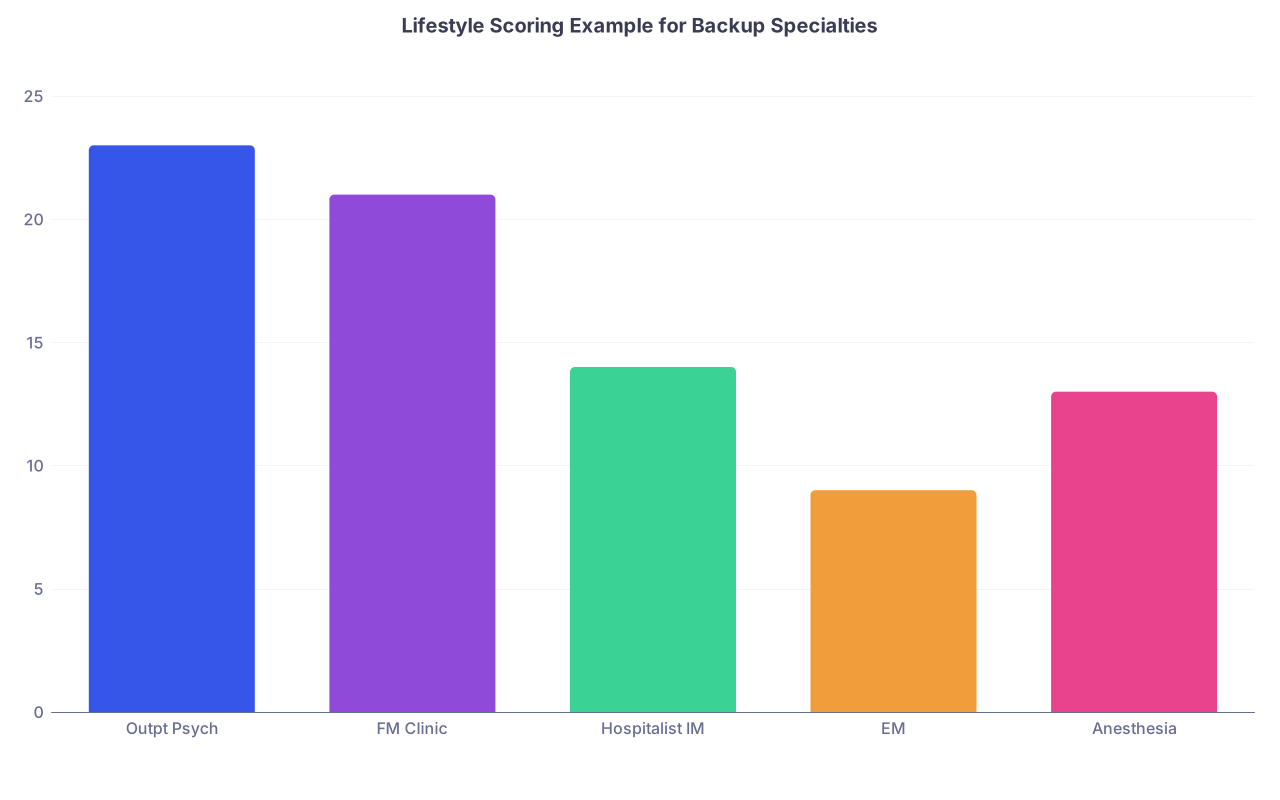
Example (hypothetical resident who values no nights and predictable days):
| Category | Value |
|---|---|
| Outpt Psych | 23 |
| FM Clinic | 21 |
| Hospitalist IM | 14 |
| EM | 9 |
| Anesthesia | 13 |
Assume max possible is 25; this hypothetical person should not be backing up with EM or anesthesia, no matter what their peers suggest.
Your numbers will look different. That is the point.
Step 5: Understand How Backup Choice Interacts With Competitiveness
Some of you are not just choosing “backup lifestyle,” you are choosing “how much more training pain do I accept for a later lifestyle payoff.”
Three patterns I see over and over:
- Students backing up derm with EM “because acute stuff is fun” even though they hate nights.
- Students backing up surgery with IM hospitalist paths, then realizing later they cannot tolerate clinic or chronic disease.
- Students backing up any competitive field with “I’ll just do radiology” without understanding rads call and nights.
Here is how to think of it more sanely:
High‑burn residency, higher‑control attending life:
- Anesthesia (if you move into ASC/pain later)
- Some IM subspecialties (allergy, outpatient cards, non‑crit‑care pulm, rheum)
- Radiation oncology, pathology
Moderate‑burn residency, high‑control attending life:
- Psych, PM&R, outpatient‑heavy neurology, allergy, outpatient FM
Moderate‑burn residency, moderate‑control attending life:
- Categorical IM, pediatrics, radiology (diagnostic), EM
Your backup field should sit in a lifestyle “band” you can live with across both training and career. Do not choose a cushy attending life if you know you will break during residency.
Step 6: Check Specific Job Structures, Not Just Specialties
You are not matching to “Psychiatry.” You are matching to “The set of jobs I can reasonably get after Psych training.”
So when you evaluate a backup field, your question is:
“What fraction of realistic jobs in this field match my lifestyle priorities?”
Examples:
- Psych: A large fraction of jobs are outpatient, clinic‑hour based. Many with telehealth options. Easy to find no‑night roles in most markets.
- FM: Numerous full‑outpatient roles exist, but some markets push you toward urgent care or hospital work unless you are selective.
- IM: If you do not subspecialize, hospitalist work is common early. Outpatient‑only jobs exist, but some are low‑pay, high‑panel.
- EM: The job is shifts, including nights. Your ability to avoid nights is limited.
- Anesthesia: Hospital‑based call is common, but ASC‑only or pain‑only jobs exist with targeted searching.
If only 5–10 percent of jobs in a specialty are compatible with your lifestyle, you are signing up for a long hunt and maybe geographic sacrifice. You need to be honest about whether you and your future family will tolerate that.
Step 7: Use Your Application Strategy To Signal Lifestyle Fit, Not Panic
When you pick backup specialties, the way you apply matters. You cannot just spray applications in multiple directions and hope programs do not notice.
Three practical rules:
Align your story.
If you are applying to, say, Derm and Psych, your personal statements and letters should tell a coherent story about your interest in chronic disease, patient relationships, and outpatient work. Do not write one statement about “loving surgery and procedures” and another about “valuing long‑term therapeutic alliance” and expect programs not to see through it.Be selective with how many radically different fields you list.
One competitive field + 1–2 rational backups is reasonable. Four completely different specialties looks unfocused and desperate.Protect your true deal‑breakers.
If you know you cannot live with heavy nights and acute emergencies, do not “just add EM” to help you match. Matching into the wrong specialty is worse than not matching once.
Step 8: Reality‑Check With People Actually Living It
Last piece. You cannot do this based purely on online charts and program websites.
You need firsthand data:
- Ask third‑year residents in your target backups: “How many nights did you do this year? What will your call look like as an attending where you are going?”
- Ask attendings with kids or chronic illnesses: “What has been sustainable for you? What would you avoid if you had to pick again?”
- Ask locums docs: they see multiple practice setups and will give you the unvarnished truth about what is typical vs exceptional.
Watch for red flags:
“Well this job is bad for nights, but there are some magical jobs with no call at all if you’re willing to… [insert three major sacrifices].”
That means those jobs are rare and expensive. Do not plan your life around unicorns.“You can always leave EM/anesthesia/hospitalist work later and find a cushy clinic gig.”
Possible. Not guaranteed. Transition costs (retraining, pay cut, relocation) are real.
Use those conversations to adjust your decision grid, not to justify what you already wanted to hear.
Let me boil it down.
- Backups must match your real lifestyle non‑negotiables around call, nights, and control — not your fantasy that “it will get better later.”
- Evaluate fields based on typical jobs, not the rare unicorn positions people flex about at conferences.
- Preserve continuity between your primary field and backup options in patient type and daily work, so your career arc stays coherent and you do not end up hating the very thing that “saved” your match.
Pick your backups like your future life depends on it. It does.