
You’re here
It’s 1:13 a.m. You’ve got VSAS, FREIDA, and like five Reddit tabs open. Your dream specialty is pulled up on one monitor, and on the other is a list of “less competitive” fields people on SDN keep calling “good backups.” You’ve got a Step score you’re not sure is “good enough,” a handful of interviews lined up (but is it enough?), and this question playing on loop in your head:
“If I have to use a backup specialty… how strong does that plan actually need to be so I don’t go unmatched and completely tank my life?”
Let me be brutally clear: you’re not the only one spiraling about this at 1 a.m. I’ve watched people do mental gymnastics about backup specialties for months. I’ve seen people refuse to back up at all and match just fine. I’ve seen people refuse to back up and absolutely crash. I’ve seen people over-backup and end up somewhere they hate.
So let’s talk about what a real backup plan looks like. Not the fantasy version. The “I’m terrified of going unmatched but I also don’t want to torch my career” version.
Step 1: Get honest about your actual risk
Before you even pick a backup specialty, you need to answer the question your brain is avoiding:
“How likely am I to go unmatched in my primary specialty if I apply only there?”
Not what you wish the answer was. The actual data plus your specific application.
Start with 3 things:
- Competitiveness of your chosen specialty
- Your objective metrics compared to that specialty
- How many red flags you have
Your brain probably wants to say, “Well people match with worse stats than mine all the time,” which is technically true and also completely useless.
Pull numbers. For real.
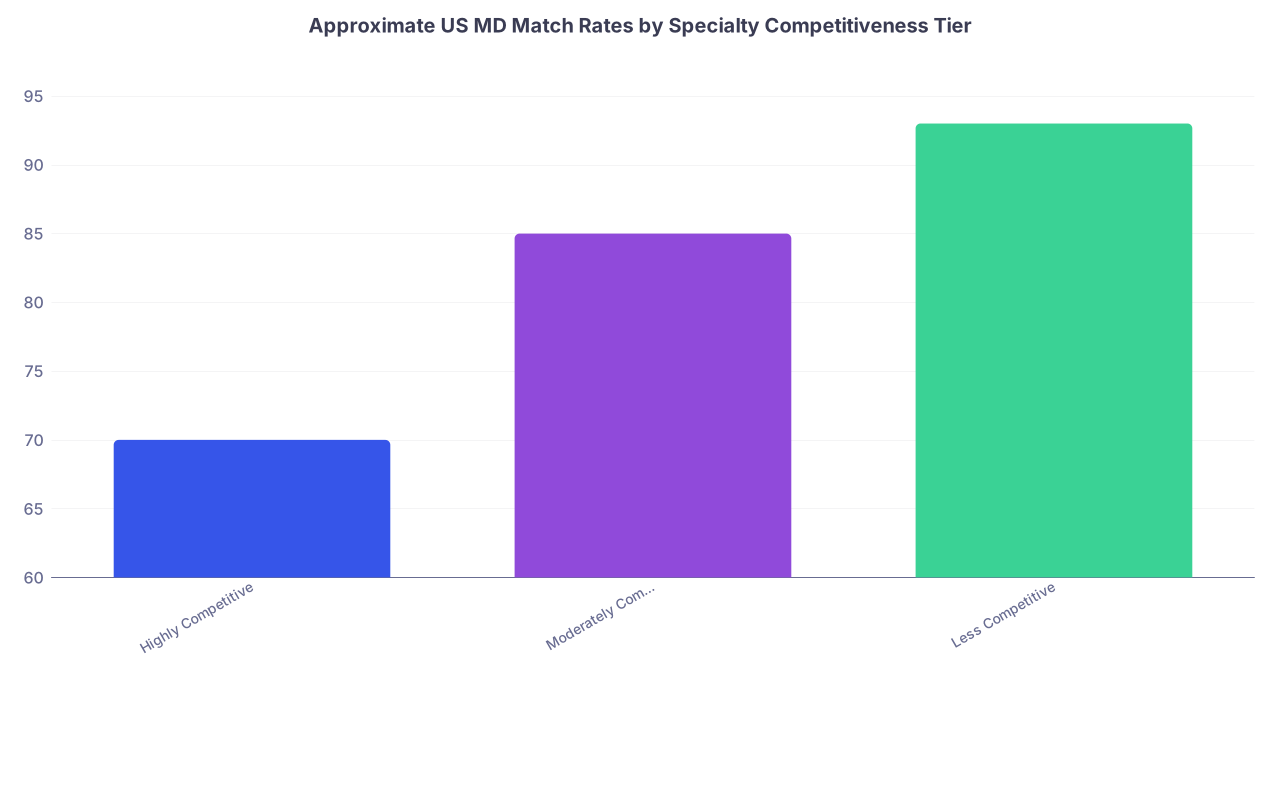
| Category | Value |
|---|---|
| Highly Competitive | 70 |
| Moderately Competitive | 85 |
| Less Competitive | 93 |
Are these exact? No. Are they directionally accurate enough to stop you from lying to yourself? Yes.
Ask yourself:
- Are you applying to something like derm, plastics, ortho, ENT, urology, neurosurgery? You are by definition in a high-risk group, even with good stats.
- Is your Step 2 in the “average or slightly below average” range for that specialty? That pushes risk up.
- Do you have any of these: failed Step attempt, LOA, professionalism concern, weak clinical grades, limited home support, late app, barely any interviews? That’s more risk.
If your honest answer is, “My specialty is competitive and I’m not above-average for it,” then a backup isn’t paranoia. It’s basic survival.
If your specialty is more middle-of-the-road (IM, Peds, FM, Psych, Neuro, OB/GYN) and you’re reasonably solid on paper, the backup conversation is different. Not gone. Just different.
The strength of your backup plan should match your actual risk, not your anxiety level. Your anxiety will always say “10/10 risk.” The data almost never agrees.
Step 2: What a real backup plan actually looks like
A “backup plan” isn’t just, “Sure, I’ll toss in a few FM applications in ERAS the night before.” That’s not a plan. That’s denial with some extra steps.
A real backup plan has:
- A specific backup specialty (not “uhh something less competitive”)
- A real connection to that specialty in your app
- Programs you’d actually go to, not just names on a spreadsheet
- A strategy for how many programs and how to explain your story
The strength of the plan = how many of those boxes you actually check.
Let’s say your dream is Ortho. You’re mid-tier stats, few interviews, no home program, and you’re scared. Here are three versions of “backup” I see all the time:
| Plan Type | Description |
|---|---|
| Fake Backup | 5 random IM programs, no tailored docs |
| Weak Backup | 10-15 programs, 1 generic PS |
| Real Backup | 30+ programs, letters + PS fit specialty |
Only the last one is an actual backup plan. The first two are mostly vibes.
Ask yourself bluntly: if I had to pivot to my backup, would my backup application look like something I built on purpose, or like digital trash I slapped together at 2 a.m.?
If it’s the second, your backup plan is not strong enough.
Step 3: How to pick a backup specialty without hating your life
Here’s the part nobody wants to say out loud: your backup specialty shouldn’t be something you actively resent.
If your thought process is, “I’ll do anything just to not go unmatched,” you’re in a bad headspace. You’re way more likely to end up miserable and burnt out.
You need some criteria for backup specialties:
- You can imagine yourself actually doing the day-to-day work
- Your clinical evals/letters can be repurposed or make sense there
- The specialty legitimately has more spots and slightly lower bar
- You have at least one real reason to be interested that doesn’t sound fake
Examples that often work as backups (not always, but often):
| Primary (More Competitive) | Common Backup Specialty |
|---|---|
| Dermatology | Internal Medicine, Pathology |
| Orthopedic Surgery | General Surgery, PM&R |
| ENT | General Surgery |
| Neurosurgery | Neurology, General Surgery |
| Plastic Surgery | General Surgery |
Is this perfect? No. But it’s how many real humans pivot.
- Something you know nothing about and haven’t even rotated in
- Something you bad-mouthed on the wards
- Something with fewer spots than your primary (yes, people actually do this)
- Something where your letters will clearly not fit
A strong backup plan starts months before ERAS opens, with at least one solid rotation and 1–2 letters in that backup. If you’re past that point? You can still salvage something, but stop pretending “interest” alone will carry you.
Step 4: How strong is “strong enough”? Numbers, not vibes
Let’s talk about volume. This is where everyone panics.
No one can give you an exact number, but I’ll give you a framework that’s a lot better than Reddit roulette.
Think in tiers:
- Primary specialty: number of programs to give you a fair shot
- Backup specialty: enough programs that you’d expect solid interview volume if that were your only field
Example (rough, not gospel):
You’re applying ENT with an above-average Step 2, decent research, couple of home away rotations.
- ENT: maybe 60–80 programs (most of them)
- Backup (Gen Surg or something else): 30–50 programs, with a tailored PS and at least 1 decent letter
Vs someone applying Derm with average stats and 0 home program support:
- Derm: 50+ programs because… Derm
- Backup (IM or Path): 40–60 programs
If your primary specialty has a 60–70% match rate and you’re below-average for that field, your backup needs to be pretty robust. Think: “I could credibly match just in this backup specialty alone if I had to.”
If your primary has >90% match rate and you’re solid for it, your backup can be lighter or even just a SOAP plan. Different universe.
Here’s the ugly truth: a “strong” backup plan usually feels a little overkill in the moment… and looks perfectly rational if you end up needing it.
Step 5: Dual applying without looking fake
Big anxiety point: “If I dual apply, won’t programs think I’m not committed and then nobody will rank me?”
Here’s the reality: lots of people dual apply. Programs know that. The problem isn’t dual applying. It’s doing it sloppily.
You need:
- Separate personal statements that actually make sense for each field
- Letters that fit the story (don’t send your Ortho love letter to IM)
- A somewhat coherent narrative for how you ended up with those two choices
You do not need some magical perfect explanation.
You do need to avoid obvious self-sabotage like:
- Applying to FM with a PS that screams “I’m actually a surgeon at heart”
- Telling backup programs in interviews, “So yeah, this is my backup…”
- Using the exact same PS with find+replace of the specialty name (yes, people do this, and yes, they get caught)
If you’re torn between, say, IM and Neurology, most PDs won’t be scandalized that you applied to both. If you’re applying Ortho and Psych? Yeah, you’ll need a cleaner story about personal fit and evolving interests.
But here’s the thing: if a PD likes you, they don’t usually go CSI on your entire ERAS life trying to “catch” you dual applying. They’re trying to fill spots with people who will show up, work hard, and not be disasters. You’re overestimating how much they care about your existential narrative.
Step 6: When a backup should be SOAP-only
Sometimes the best backup plan isn’t a second specialty on ERAS at all. It’s a realistic SOAP plan.
Who is this reasonable for?
- People in less competitive specialties with otherwise solid stats
- People in IM/FM/Peds/Psych who applied decently broadly
- People who have some home support and can scramble intelligently
Who should not rely just on SOAP?
- Derm/Plastics/ENT/Ortho/Uro/Neurosurg applicants with mid/below stats
- Anyone with red flags who already struggled getting interviews
- People with very few interviews in a competitive field
SOAP is not a gentle safety net. It’s chaos week. You’re competing for leftovers while half-dead and emotionally gutted.
A “strong” backup that’s SOAP-only basically requires:
- You’d be surprised to go fully unmatched given your field and stats
- Your school actually has a structured SOAP support system
- You’re willing to land basically anywhere, in anything that works
If your nightmare scenario is “unmatched with literally nothing,” and that thought paralyzes you, a SOAP-only backup plan is probably too thin.
Step 7: Emotionally — how strong does your backup need to feel?
Let’s talk about the part you don’t put on spreadsheets.
There’s this sickening fear underneath all of this: “If I back up too hard, am I giving up on my dream? Am I selling out?”
I’ve watched people cling to a “pure” application strategy in a hyper-competitive field because they’re terrified of what backing up “means” about them. Then they end up unmatched and have to take a research year they never wanted, or SOAP into something truly random.
Here’s the framing I’ve seen actually help:
A backup plan isn’t you saying, “I don’t believe in myself.”
It’s you saying, “I refuse to let one random March email decide whether I get to be a doctor at all.”
Your backup needs to be strong enough that:
- If your primary specialty falls apart, you’re not fully destroyed
- You’d be disappointed, yes — but not trapped, not ruined
- You could imagine building a decent life in the backup, even if it wasn’t the original dream
That’s the bar.
Not “I’d be just as happy in either.” That’s fake and you know it.
But “I won’t be walking into residency every day thinking I made the worst possible mistake just to avoid going unmatched once.” That’s realistic.
Step 8: The worst-case scenarios you’re imagining (and what actually happens)
Let’s walk through the horror movies your brain is playing:
“I won’t back up. I’ll go all in on my dream specialty. I’ll go unmatched and my life is over.”
What actually happens: you’re wrecked for a while. Then:- Research year
- Preliminary year then try again
- SOAP into something else and some people actually end up liking it
It’s not fun. But it’s not the end.
“I back up ‘too hard’ and end up matching into my backup when maybe I would’ve gotten my primary if I’d just believed in myself more.”
Reality: that “maybe” will haunt you a bit. But you will also have a job, a salary, a defined path, and you can still course-correct (fellowship, reapplying, niche within the field). You’re not trapped in stone.“Programs will see my dual app and nobody will want me in either specialty.”
I have literally never seen someone not match solely because they dual applied. I have seen people not match because they had weak applications and blamed dual applying instead of the actual problem.
Your anxiety is obsessed with the most catastrophic version of every path. The real world is messier, more forgiving, and a lot more “you’ll just have to adapt” than “your career is dead.”
Quick recap: How strong does your backup plan need to be?
Keep these 3 things in your head:
- Match your backup strength to your real risk, not your worst fears. Competitive field + average stats = real, intentional backup. Lower-risk field + strong stats = lighter backup or SOAP plan might be enough.
- A real backup plan looks like its own application, not leftovers. Proper PS, appropriate letters, real number of programs you’d actually attend. Not 5 random programs and vibes.
- You’re not betraying your dream by protecting yourself. You’re just refusing to let a single match cycle dictate the next 40 years of your life.
You’re allowed to be scared of going unmatched and still make rational, protective choices. Those two things can coexist. And honestly? For most of us, they have to.