
It’s 1:37 a.m. You’ve got VSAS/ERAS open in one tab, NRMP data in another, and a half-finished personal statement document glaring at you. One draft says “I’ve always known I wanted to be an internist.” The other says “Surgery drew me in from the first time I stepped into the OR.”
And your brain keeps looping the same thought:
“If I apply to two specialties… are programs just going to think I didn’t match anywhere real? Like I failed and panicked?”
You’re not even sure which anxiety is louder: the fear of not matching at all, or the fear that everyone will secretly judge you for “hedging” and see you as less committed, less serious, less… whatever.
Let me say this bluntly: you are not the first person to sit there, cursor blinking, thinking, “If I apply to two specialties, will I tank both of them?”
You’re in good (anxious, overthinking) company.
The Ugly Fears You’re Probably Not Saying Out Loud
Let’s just drag all the ugly, embarrassing thoughts into the light, because pretending they’re not there doesn’t actually help.
The greatest hits usually sound like this:
- “If I apply to two specialties, won’t programs assume I wasn’t competitive enough for my ‘real’ one?”
- “What if my letters don’t ‘match’ and I look mixed up or flaky?”
- “Are PDs going to talk to each other and be like, ‘Wow, this person clearly doesn’t know what they’re doing’?”
- “If I tell my advisor I want a backup specialty, will they secretly downgrade me and stop advocating for me?”
- “What if I get stuck in the backup and everyone assumes it was my only option?”
Here’s the annoying truth I’ve had to swallow watching people go through this:
Some programs will think things you can’t control. Some people will jump to conclusions. You can’t fix that part.
But the idea that “everyone will assume I failed” just because you apply to two specialties? That’s not how this actually works in real life.
And in a lot of cases, applying to a backup specialty is the only reason people don’t end up SOAPing into something they really, really don’t want.
Do Programs Really Judge You for Applying to Two Specialties?
Let’s separate fear from reality.
There are three different groups here:
- Programs in Specialty A
- Programs in Specialty B
- People on Reddit who act like they run the NRMP
Only one of those actually decides if you match.
Most program directors aren’t dumb. They’ve watched the match get more brutal every year. They know people hedge. They know not everybody has a 265 and six first-author papers in NEJM.
They care about three things way more than whether you applied to more than one specialty:
- Are you actually interested in their field, not just anything with a paycheck?
- Do you look like you’ll show up, do the work, and not be a nightmare?
- Does your story make sense, even if it’s not perfectly linear?
Do some PDs dislike dual applicants? Yep. I’ve heard it. Usually in more “identity” specialties where people romanticize that everyone always “knew” they wanted it since age 5. But even then, it’s not the dual application itself that kills you. It’s when your application looks lazy, generic, or obviously copy-pasted.
What they really hate is:
- A personal statement that reads like: “I just want to help people in any environment.”
- No home specialty involvement: no interest group, no elective, no mentor.
- Letters that don’t actually say anything beyond “pleasant to work with.”
If you apply to two specialties and you look half-in on both, then yeah, that’s a problem.
But if you apply to two specialties and you look fully in on whichever one they’re reading? That’s survivable. I’ve watched it work.
The Match Data Reality Check (That No One Likes Hearing)
Let me be a little harsh for a second.
A lot of people say, “I’m applying to only one specialty because I want to show commitment.”
What they actually mean is, “I’m gambling that my anxiety is wrong and I’m secretly competitive enough that I’ll be fine.”
Sometimes they are.
Sometimes they’re not.
And the NRMP data doesn’t really care how “committed” you felt when you clicked submit.
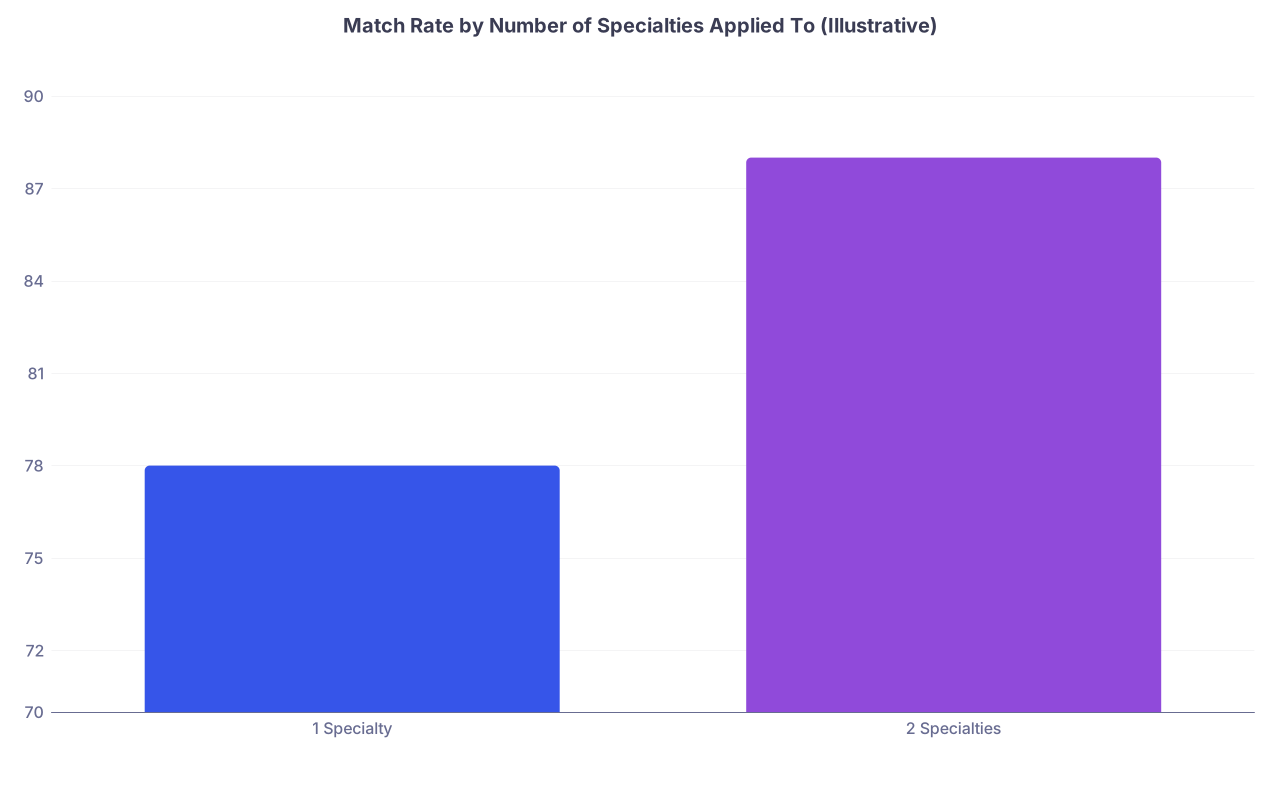
| Category | Value |
|---|---|
| 1 Specialty | 78 |
| 2 Specialties | 88 |
Those numbers aren’t official; I’m just illustrating the pattern I keep seeing through real stories:
People who are realistic and strategic about applying to a second specialty when they’re borderline for their dream one? They sleep better on Match Week. And they have more options.
People who go “all or nothing” into a super competitive specialty with a weak Step 2 and no backup? They end up on SOAP day, crying in a call room, refreshing their inbox.
I wish that was exaggeration. It’s not.
When Does a Backup Specialty Actually Make Sense?
Not everyone needs a backup. But some people clearly do, even if no one wants to say it to their face.
Here’s where a backup specialty starts to make real sense:
- Your dream specialty is objectively brutal: Derm, Ortho, Plastics, ENT, Neurosurg, Urology, Integrated IR, etc., and your app is middle or below-average for that field.
- You had a late switch and don’t have the “right” letters or sub-I timing to look strong on paper.
- You’re an IMG/non-US grad trying for a competitive field without standout stats or home connections.
- You had a serious red flag: Step fail, leaves of absence, professionalism issue, weak clinical evals.
And you’re not applying to a backup you’d absolutely hate.
That last part matters more than people admit. You shouldn’t be SOAPing into a random preliminary spot “just to match” if it will make you miserable. But there are adjacent specialties that make sense as genuine Plan B options.
Example patterns I see a lot:
| Primary (More Competitive) | Backup (Often More Attainable) |
|---|---|
| Dermatology | Internal Medicine |
| Orthopedic Surgery | General Surgery |
| ENT | General Surgery |
| Radiology | Internal Medicine |
| Anesthesiology | Internal Medicine / Prelim |
None of these are “easy.” They’re just relatively more feasible with the same stats.
If your numbers and experiences put you in a place where matching your dream specialty is a coin flip at best, a backup isn’t cowardly. It’s adult.
“Won’t Everyone Think I Failed If I End Up in the Backup?”
This one stings the most, so let’s handle it head-on.
There’s this fantasy that everyone in every program chose it as their #1 from birth. That’s just not true. At all.
You will meet:
- The anesthesiologist who started as a prelim surgery who realized they hated rounding at 5 a.m.
- The internist who applied Ortho, didn’t match, SOAPed IM, and then found their people.
- The psychiatrist who started in family medicine and pivoted because they loved clinic conversations more than everything else.
Do some people secretly assume “backup” when they hear your path? Sure. But here’s the part your brain doesn’t want to accept: three months into residency, people care way more about whether you pick up cross-calls, write decent notes, and don’t dump sign-outs.
Not your NRMP history.
And you don’t need to volunteer the whole saga on day one. You can say, “I explored a few fields but ultimately realized I was happiest in ___.” Which, honestly, is probably true. Nobody has to know how much of that was choice vs statistics.
The “everyone will think I failed” narrative is mostly your own pride talking. Pride mixed with fear. And yeah, it’s human. But it’s not a good basis for high-stakes career decisions.
How to Apply to Two Specialties Without Looking Like a Mess
If you’re going to go dual-specialty, you can’t half-ass it and hope nobody notices. You have to be deliberate.
Here’s what I mean.
1. You need two different stories that both actually make sense
This is the part that feels fake, and where people get paralyzed.
You’re not lying if you choose to highlight different threads of your real experiences for different audiences. You’re curating.
For Specialty A: talk about what drew you in, specific rotations, patient stories, mentors in that field, what kind of attending lifestyle and patient mix you see yourself in.
For Specialty B: do the same. Different patient story. Different mentor. Different angle.
The mistake people make is trying to write one vague, generic personal statement and reuse it. That’s how you look noncommittal.
Yes, it’s annoying. Yes, it’s more work. Yes, you have to write two real essays. You either do that, or you live with a higher chance of getting filtered out.

2. Your letters need to be at least somewhat specialty-aligned
Perfect world: letters for A are from A; letters for B are from B. Real world: sometimes you don’t have that.
But you can still be smart. For each specialty, try to:
- Use at least 2 letters from attendings in that field or adjacent rotations that make sense.
- Avoid sending a super-ORTHO-specific letter to IM programs where the writer says, “He will make a fantastic orthopedic surgeon.” That just screams “I lost Plan A.”
Some letter writers are actually great about writing more general strength letters that can flex across fields. If they liked you, ask directly: “Would you feel comfortable writing a letter I can use for both [Specialty A] and [Specialty B]?” If they hesitate, believe them and don’t push.
3. Your experiences don’t have to be perfect — just not contradictory
You don’t need 12 home rotations in both fields. But don’t be the person saying they’re “deeply committed to radiology” with zero imaging-related anything and 4 surgical sub-Is.
You can frame things like:
- “Through my surgery rotations I realized I loved the diagnostic and procedural aspects most, which led me to radiology.”
- Or: “I originally explored [Field A], but what stayed with me was the longitudinal care and complex medical decision-making, which I found more fully in [Field B].”
You’re allowed to evolve. People actually respect that storyline if you don’t sound flaky.
How to Keep From Sabotaging Yourself With Anxiety
Here’s the twisted thing: the fear of “looking bad” sometimes pushes people into choices that hurt them way more than any imagined judgment would have.
I’ve watched people:
- Apply to only Derm with a 220 and no research “to show commitment,” then end up unmatched and devastated.
- Refuse to list a backup program on their rank list because they “didn’t want to train there anyway,” then spend SOAP fighting for anything.
- Not ask for letters in a backup specialty because they felt embarrassed, then scramble late and look disorganized.
You know what programs actually notice? Disorganization. Sloppy applications. Red flags that could have been handled months earlier with one uncomfortable email.
Your anxiety is trying to protect you from shame. But it’s aiming at the wrong target.
Instead of, “How do I avoid anyone ever thinking I wasn’t perfect?”
Try, “How do I avoid being stuck in a situation I’ll hate with no options?”
I’d rather have you matched in a solid backup where you have a stable job, colleagues, a life — and then reassess after internship if you still want to pivot — than unmatched with a massive rock of regret in your stomach.
Practical Reality: Programs Are Busy, Not Stalking You
One last thing, because the paranoia gets really loud about this:
“Won’t they see I applied to another specialty and blacklist me?”
On ERAS, they don’t get a list saying “this applicant also applied to ENT, Derm, and Rads.” They see the application you send them. They see the personal statement you attached. They see the letters you chose for them.
Could they guess you applied elsewhere? Sometimes. Especially if your school is small and your whole class knows each other’s business. Or if you’re in a super niche competitive field.
But the idea that PDs from different specialties are all in some secret group chat comparing your life story? No. They barely have time to get through their own inbox. They’re not pausing their day to investigate your “loyalty.”
They care if you’re a risk. Not if you ever thought about another field.

| Step | Description |
|---|---|
| Step 1 | Self assessment |
| Step 2 | Consider single specialty |
| Step 3 | Plan dual specialty |
| Step 4 | Create two narratives |
| Step 5 | Align letters per specialty |
| Step 6 | Submit targeted applications |
| Step 7 | Interview and rank realistically |
| Step 8 | Competitive for dream field? |

The Quiet Truth Nobody Tells You
There are absolutely people in every specialty who started there as “Plan B” and now wouldn’t leave for anything.
They don’t walk around wearing a label that says “backup.” They’re just your senior resident who teaches you how to put in lines. Your attending who quietly goes home late because they stayed to talk with a family. Your co-intern who hands you a coffee after a terrible night float.
Residency isn’t high school. No one is keeping a running gossip log of “who matched where first try in their #1 choice specialty.”
They care: Are you here? Are you working? Are you decent to be around?
The rest fades so much faster than you think.
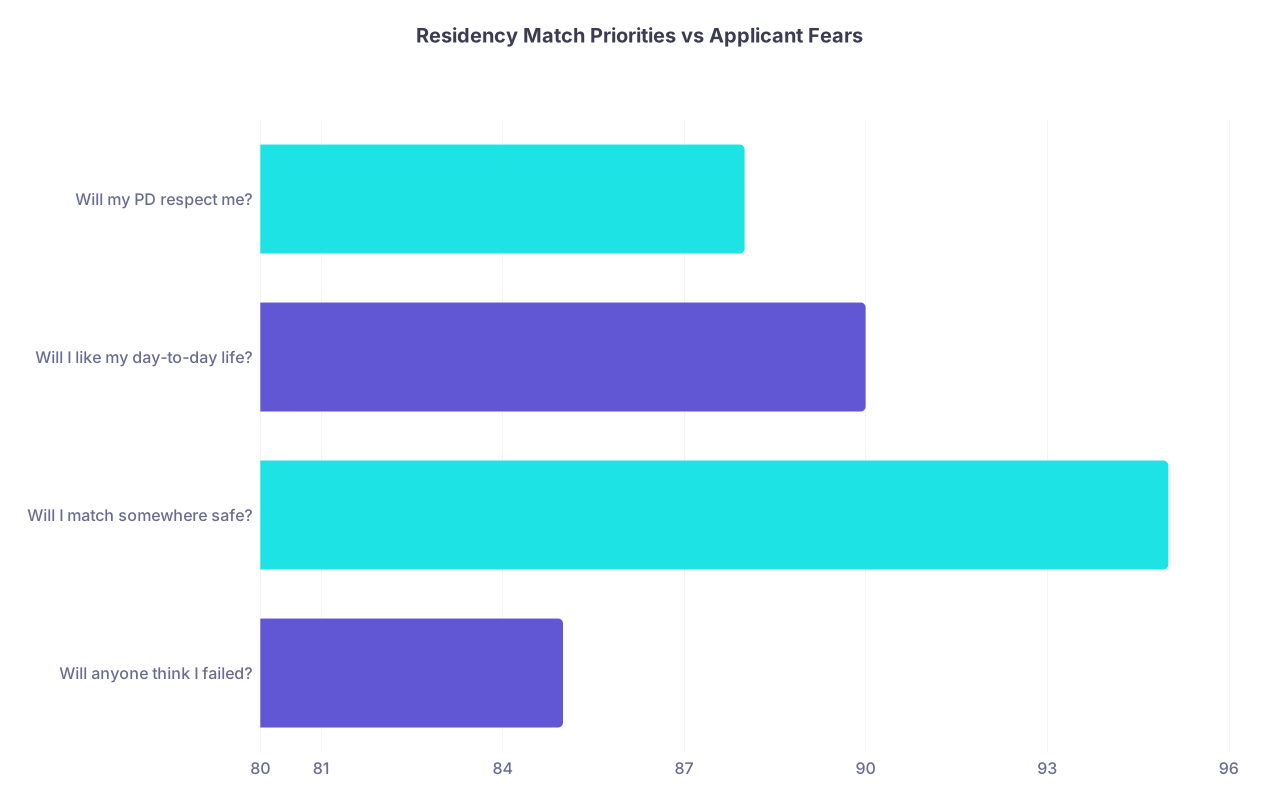
| Category | Value |
|---|---|
| Will anyone think I failed? | 85 |
| Will I match somewhere safe? | 95 |
| Will I like my day-to-day life? | 90 |
| Will my PD respect me? | 88 |

Bottom Line: What Actually Matters
Let me boil this down so you have something concrete to hang onto:
- Applying to two specialties does not automatically make programs think you failed. Sloppy, generic applications do. If you’re going to hedge, do it cleanly and deliberately.
- Your future self will care a lot more about whether you matched somewhere acceptable than whether a tiny minority of people think your path wasn’t perfectly linear. Don’t let imaginary judgment push you into reckless decisions.
- You’re allowed to protect yourself with a backup. That isn’t weakness. It’s strategy. And strategy is how people in this process sleep at night — or at least sleep a little more.