The unspoken rule is this: once you’re seriously talking about more than two backup specialties, faculty stop believing you actually want any of them.
Let me tell you what really happens in those closed-door meetings and late-night text threads between program directors and faculty. They are not counting how many programs you applied to. They are clocking how many different stories you’re trying to sell.
You’re worried about how many backups is “too many.” They’re worried about whether you actually want their specialty, or whether you’re just scatter‑shooting out of fear.
Let’s pull the curtain back.
What Program Directors Actually Think When You Have Multiple Backups
Program directors will never say this on a podcast, in a webinar, or in a brochure. But in committee? Different story.
There’s a mental scale they use when they see your file:
- Is this a committed applicant who had to be realistic about competitiveness?
- Or is this an anxious applicant who doesn’t know what they want, so they applied to everyone?
They infer that from three things:
- How many specialties your application “smells” like
- How tightly your story is aligned in your personal statement, letters, and experiences
- Whether your signals and interview conversations match that story
They do not have a dashboard that says: “This person applied to 3 specialties.” But they’re not stupid. They notice patterns.
I’ve sat in ranking meetings where someone says, “This kid is also in our IM pool and I heard from cards that they interviewed him for their research track too… I’m not convinced he actually wants us.” Once enough people say that about you across specialties, your stock drops everywhere.
The Realistic Ceiling: How Many Backup Specialties Before It Hurts You
You want a number, so I’ll give you one.
For the average U.S. MD/DO applying in 2026:
- 0–1 backup specialty → Completely fine, often smart
- 2 backup specialties → Needs to be strategic and very well executed
- 3 or more → You’re in the “we don’t believe your narrative” danger zone
Notice I’m counting backup specialties, not your primary.
So:
- Primary: Derm
- Backups: IM and Path
= 2 backups. Doable with a carefully controlled story.
But:
- Primary: Ortho
- Backups: IM, FM, Anesthesia
= 3 backups. That’s where you start to look like you’re just flailing.
Now, does that mean no one matches with 3+? No. Desperate, scrambled, or very noncompetitive applicants do throw their applications at 3–4 specialties and sometimes it works. But it’s not a “strategy.” It’s damage control.
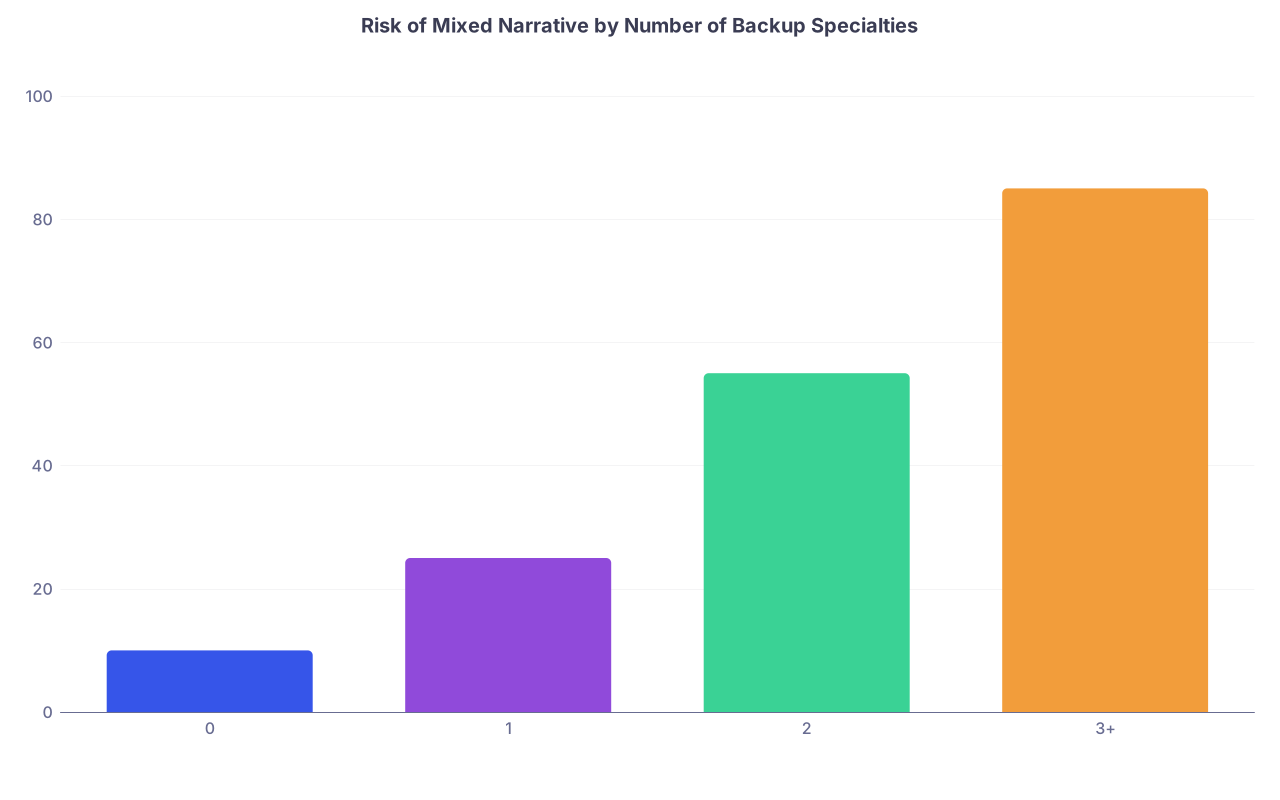
| Category | Value |
|---|---|
| 0 | 10 |
| 1 | 25 |
| 2 | 55 |
| 3+ | 85 |
The more backups you add, the harder it is to maintain a coherent story. That’s what actually kills you—not the raw number of specialties.
The Hidden Variable: Your Baseline Competitiveness
Here’s the part students never account for correctly. How many backups is “too many” depends heavily on how risky your primary specialty choice is compared to your application strength.
Let’s simplify with a mental model that attendings actually use when advising students after hours:
| Applicant Type | Primary Specialty Risk | Typical Profile | Backup Strategy Sweet Spot |
|---|---|---|---|
| A | Low | Strong IM applicant applying IM | 0–1 backup |
| B | Moderate | Solid but not stellar EM, Anes, OB | 1 backup |
| C | High | Borderline for Ortho, Derm, ENT, Plastics | 1–2 backups |
| D | Very High | Multiple red flags, low scores, weak portfolio | 2 backups (max) but more focus on volume within one backup |
Some real-world examples I’ve seen:
Case 1: The Overconfident “No-Backup” Ortho Applicant
- Step 2: 235
- Mid-tier MD, limited research, average letters
- Applied: Ortho only, 60+ programs
- Outcome: 3 interviews → No match
Faculty had told him privately: you should dual apply with prelim surgery or categorical IM. He refused. “I’ll just gun my sub‑Is.” He is now two years out of school, still trying to backdoor into Ortho via research and prelim years. Very hard road.
For him, 1–2 backups would’ve been correct.
Case 2: The Over-scattered “Everything” Applicant
- Step 2: 223, one fail on Step 1
- DO student
- Rotations: some EM, some IM, one anesthesia elective
- Applied: EM, IM, FM, Anesthesia (4 specialties)
- Outcome: A smattering of interviews, mostly FM; lots of weird conversations (“So do you really want EM or…?”)
- Matched: Late into FM at a place that ranked them low but needed to fill
They could have had a much calmer cycle applying to just IM + FM and building a crisp primary-care‑oriented story. Instead, faculty kept describing this person as “lost.”
The more scattered you get, the more your file triggers that word.
The Core Principle: One True Story, Not Five Weak Ones
The real question isn’t “how many specialties can I list?” It’s: Can I tell one believable, coherent story that can stretch across more than one specialty without looking fake?
Program directors are pattern recognizers. They see hundreds of applications in a week. They’re very good at smelling inconsistency.
Here’s how they detect multi‑specialty applicants:
- Letters talking about “future surgeon” but you’re applying to IM
- Personal statement language that’s generic enough to apply to anything
- Experience list that has a bit of peds, a bit of gas, a bit of EM, no clear anchor
- Interview answers that change emphasis too aggressively depending on specialty
If they sense that, they immediately file you under: “maybe good, but will probably leave if something better comes along.”
What they actually want to see is this:
You have a clear primary identity, and your backup is clearly a rational, believable alternative for that same identity.
Example that works:
- Primary: EM
- Backup: IM
- Story: You’re drawn to acute care, resuscitation, and complex undifferentiated cases. EM is your ideal environment, but you also genuinely like inpatient medicine and could see yourself thriving as a hospitalist or intensivist. Your letters and experiences show ED, ICU, and inpatient IM exposure.
Example that doesn’t work:
- Primary: Derm
- Backup: Anesthesia
- Story: “I like procedures, I like lifestyle, and I’m chill.” Program directors privately roll their eyes at this. It sounds like “I like high pay and fewer hours.”
How to Pick the Right Number (and Types) of Backup Specialties
Stop thinking of “how many” as a math problem. Think of it as a branding problem.
Step 1: Decide who you are clinically
Harsh truth: many M4s have no idea. But you need to commit on paper.
Ask yourself seriously:
- Do I fundamentally like continuity or episodic care?
- Do I prefer procedures or cognitive work?
- Do I like high-acuity chaos or controlled, scheduled work?
- Do I want broad scope or deep sub-specialization?
Once you anchor your identity, your backups should be adjacent, not random.
Examples of reasonable adjacency:
- Surgery ↔ Ortho ↔ ENT (but don’t do all three)
- EM ↔ IM (with ICU interest)
- Peds ↔ Peds‑IM ↔ FM (peds-heavy narrative)
- OB/GYN ↔ FM with strong women’s health lens
Bad adjacency:
- Ortho ↔ Psych ↔ Pathology ↔ Anesthesia
That’s not a “backup strategy.” That’s a crisis.
Step 2: Choose a maximum of two lanes
This is the part that rarely gets said out loud:
Most faculty who know what they’re doing will push you to two lanes total, tops.
Lane = primary + one reasonably related backup.
Sometimes Lane = primary only, if your risk is low.
So:
- Lane 1: EM + IM
- Lane 2: OB/GYN + FM (optional, for some applicants)
You pick one lane per cycle.
If you’re applying to more than two specialties, you are in three lanes. That’s when letters contradict each other, your interview answers start to sound rehearsed, and PDs smell desperation.
The Mechanics: How to Actually Run a Dual-Apply Without Imploding
You want insider tactics. Here’s how the better-advised students actually do this without getting caught in contradictions.
1. Two versions of your personal statement
Yes, you write at least two.
- One specialty‑specific, with clear reasons for that field
- One for the backup that shares a core narrative but shifts emphasis
You do not write one generic “I love patient care and teamwork” essay and blast it everywhere. That’s how you become forgettable.
2. Letters that are “bilingual”
Savvy letter writers know how to do this. They don’t write, “She will be an outstanding future psychiatrist.” They write, “She will be an outstanding clinician in any field that values careful listening, diagnostic reasoning, and longitudinal relationships.”
Then they drop a couple of clues that tilt toward one specialty, but don’t box you in.
If one powerful letter is hyper-specific (e.g., “He is destined for surgical training”), then either:
- You actually commit to surgery as primary, or
- You don’t use that letter for the non-surgery backup
I’ve seen people torpedo their IM application by submitting a glowing but completely off‑message surgery letter.
3. Experience curation
You don’t list every shadowing experience you ever had.
You selectively highlight the things that can support both specialties in the lane.
Example: EM + IM applicant
- EM sub‑I
- MICU rotation
- Inpatient ward heavy blocks
- ED research or QI
- Maybe one outpatient continuity experience
Someone reviewing this sees: acute care, complex medicine, systems-thinking. Works for both.
What you don’t do: sprinkle in derm clinic, ortho research, and two random psych electives “for fun” without context. That just looks indecisive.
How Many Programs Per Specialty When You Dual-Apply?
Another thing they never say publicly: programs gossip.
Not formally. But attendings talk. And they Google you. When they see you also applied to another specialty at their institution, they form an opinion.
The safer pattern, if you must dual-apply:
- Heavier volume in your true primary
- Moderate volume in a single, clearly‑related backup
- No third specialty quietly tacked on at the end “just in case”
For a borderline-competitive applicant:
- 60–80 in primary
- 30–50 in backup
What you don’t want:
- 30 derm
- 40 anesthesia
- 40 IM
- 50 FM
Now you look like a residency nomad before you’ve even started.
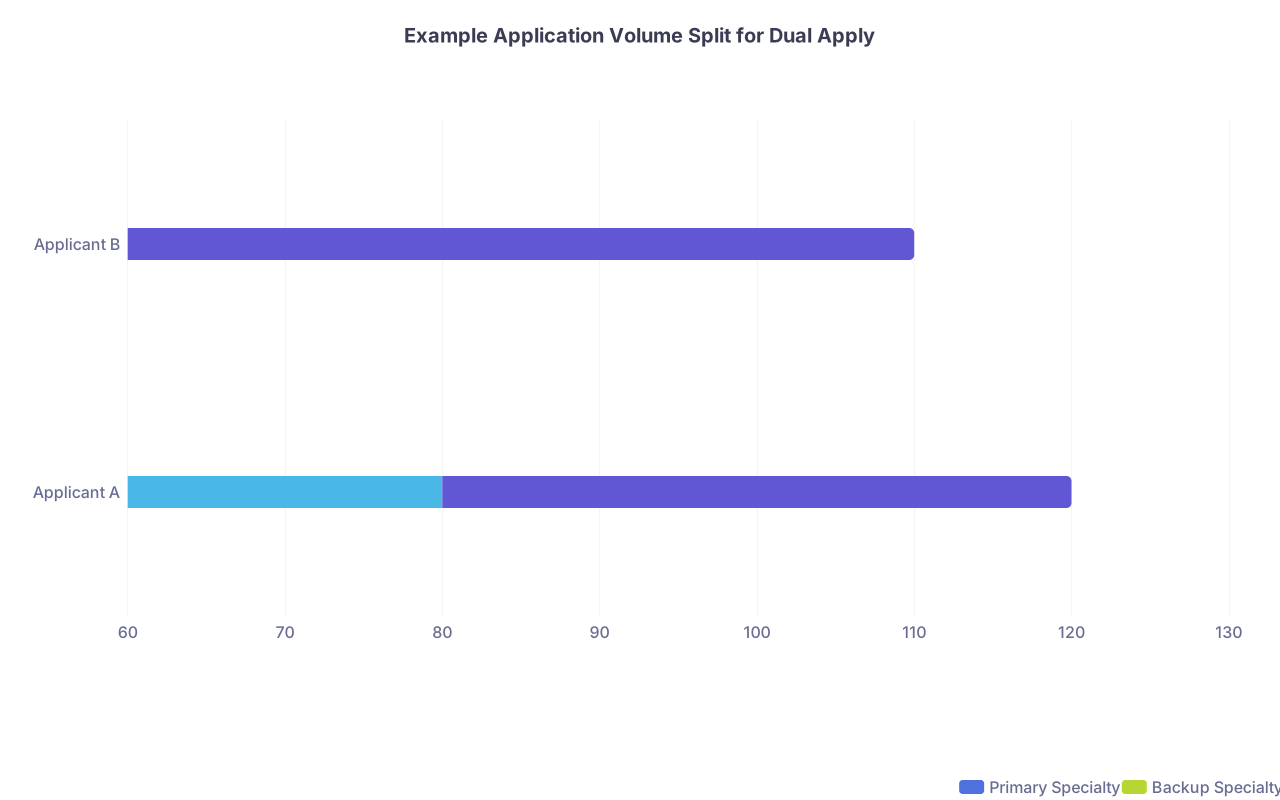
| Category | Primary Specialty | Backup Specialty |
|---|---|---|
| Applicant A | 80 | 40 |
| Applicant B | 60 | 50 |
Applicant A is derm‑primary with realistic IM backup.
Applicant B is EM‑primary with IM backup. Both are fine.
The red flag pattern is low numbers everywhere across 3–4 specialties. That screams “no commitment.”
Special Cases: When More Than One Backup Might Be Defensible
There are a few edge cases where having more than one backup can be rational, but even then you have to be surgical in execution.
1. The “primary is dead” scenario
If you failed Step 1, barely passed Step 2, and your entire MS3 year was rocky, some competitive specialties are just not realistically on the table. Some students still apply to them as “primary” out of emotion or sunk-cost thinking, but functionally, your real primary is one of your backups.
In that scenario, you might:
- Apply lightly to the dream (Orthopedics, say),
- Then have two realistic specialties (e.g., IM + FM)
But the truth? Faculty who care about you will tell you to skip the dead primary and focus fully on one realistic field. Emotional, not strategic, to keep the fantasy alive.
2. The strong but late-decider student
Occasionally, there’s someone with:
- Strong clinical evaluations
- Solid Step 2
- Great letters in multiple fields because they were genuinely exploring
They might end up torn between, say, OB/GYN, IM, and EM late in M4.
In theory, they could apply to two of those. But when someone like this tries for three, what happens in the committee is brutal:
“Good applicant. No idea what they want. They’ll just leave if they don’t like us.”
So even here, you pick two max. Ideally one.
The Quiet Reality: Your Backup Is Often Your Real Career
You may not want to hear this, but attendings talk about it all the time.
A lot of people end up living their entire career in their “backup” field. Not as a failure. Just reality.
The PDs know this. So when they see you, say, treating IM as your backup to Cards, they’re asking themselves:
“Will this person still be content as a hospitalist ten years from now, or will they resent that they didn’t match cards and check out mentally?”
If your backup specialty is something you cannot see yourself doing long-term without bitterness, it’s a bad backup. Even if it’s easy to match. That’s where the “too many” problem starts: you keep adding backups you don’t actually want.
Fewer backups, chosen honestly, beats a long list of “I guess I could live with it.”
Visualizing a Sane Strategy
Let me sketch how a reasonable decision flow actually looks in the mind of a good advisor.

| Step | Description |
|---|---|
| Step 1 | Choose primary specialty |
| Step 2 | Apply primary only or 1 close backup |
| Step 3 | Select 1 realistic adjacent backup |
| Step 4 | Reconsider primary or focus on 1 realistic field |
| Step 5 | Craft unified narrative for both |
| Step 6 | Reduce to 1 lane or change backup |
| Step 7 | Limit to max 2 specialties |
| Step 8 | Is primary realistically achievable? |
| Step 9 | Can single story fit both? |
If you’re walking around outside this flowchart—e.g., picking 3–4 backups with totally different vibes—you’re operating on anxiety, not strategy.
The Real Answer: Where “Too Many” Actually Starts
So let me answer your question directly.
How many backup specialties is “too many”?
- For most students: More than one
- For high-risk, competitive-primary applicants: More than two
- For anyone with three or more: it’s already too many unless your “primary” is a fantasy and you’ve emotionally accepted that
The unspoken rule among program directors?
They’re willing to believe:
- One clear passion
- One thoughtful, believable plan B
They stop believing once you start selling three or four different futures. At that point, they’re not sure who you are. So they rank someone else higher—someone with a story that feels stable.
Years from now, you will not remember exactly how many specialties you toggled in ERAS. You will remember whether you were honest with yourself about the kind of doctor you actually wanted to be, and whether you had the courage to commit to that story—even when you were scared.