
Only 41% of internal medicine residents who plan a hospitalist career at graduation are still hospitalists 10 years later.
That number blows up a myth a lot of applicants secretly believe: “Once I’m a hospitalist, that’s my path.” Not really. Your entry job might be hospitalist or outpatient, but your backup specialties and your training choices shape what your options look like when you want to pivot.
Let me break this down specifically for residency applicants trying to be smart about backups.
You are not just choosing “IM vs FM vs Med-Peds.” You are deciding:
- How easy it will be to work as a hospitalist.
- How easy it will be to work as an outpatient doc.
- How trapped you will feel if your first choice (say, cards or GI) never happens.
Most people only realize this in PGY-3. That is late.
The real question: what does your backup actually buy you?
Everyone talks about “backup specialties” in vague terms. “I’ll apply IM as a backup to cards,” or “I’ll put FM on the list in case I do not get IM.” That is not a strategy. That is a superstition.
The real question you should be asking:
If I match this backup specialty at this type of program, what specific hospitalist and outpatient career options do I actually gain or lose?
Different primary specialties give you very different leverage in the hospitalist vs outpatient world.
Here is the 10,000-foot view.
| Pathway | Adult Hospitalist | Outpatient Adult | Outpatient Peds | Mixed Inpatient/Clinic |
|---|---|---|---|---|
| Categorical IM | Strong | Strong | None | Some (academics) |
| Categorical FM | Variable | Strong | Strong (general) | Common in community |
| Med-Peds | Good (adult) | Strong | Strong | Strong (especially academic/community hybrids) |
That table is the core reality you are playing with. But there are layers:
- Where you train (big academic vs small community).
- How much ICU / acute care you actually do.
- How much continuity clinic and outpatient procedures you actually learn.
- What you tell PDs in your application about your future plans.
Those pieces determine whether your “backup” keeps doors open or quietly closes them.
Let’s walk through the big paths.
Internal Medicine as a backup: hospitalist default, outpatient optional
If you are applying to something competitive (cards, GI, heme-onc, derm, radiology, anesthesia) and considering internal medicine as backup, you are essentially picking this: “I am okay starting as a hospitalist or general internist, and maybe trying for fellowship later.”
For hospitalist vs outpatient careers, IM is the most straightforward:
- Hospitalist jobs: abundant, structurally aligned with IM training.
- Outpatient adult primary care: also wide open, but more nuanced than students realize.
How IM training actually shapes hospitalist options
Every categorical IM program will tell you, “Our grads are well-prepared for hospitalist careers.” That is technically true. But “prepared” is not “maximized.”
Programs differ in three concrete ways that matter:
- ICU exposure and autonomy
- Night float / cross-cover intensity
- Complex inpatient pathology
Academic heavyweights (say, MGH, UCSF, Michigan, BIDMC) give you very strong hospitalist resumes: tertiary/quaternary pathology, complex discharges, plenty of ICU. Community-heavy programs may be weaker on complexity but stronger on throughput and efficiency, which some hospitalist groups actually value.
Hospitalist employers quietly look for:
- Comfort with cross-cover on multiple services.
- Confidence managing sepsis, DKA, GI bleed without constant attending hand-holding.
- Experience running or at least assisting with rapid responses and codes.
If your backup specialty is IM and you know hospitalist is your likely default, weight your rank list toward:
- Solid ICU exposure (preferably at least 4–6 months total).
- True night float where residents are first line, not always calling the fellow.
- High volume general medicine services, not just subspecialty electives.
That can be the difference between:
- Landing a desirable 7-on/7-off, reasonable-volume hospitalist job in a good metro, versus
- Being told you “need a year of additional training” or ending up in a less-preferred location or staffing model.
Outpatient careers from IM: not automatic
Here is the trap. Many IM residents think: “If I do not get fellowship, I will just do clinic.” But a lot of programs accidentally de-emphasize outpatient skills.
Watch for these red flags when choosing IM as a backup with an eye on outpatient careers:
- Continuity clinic is chaotic, no-show heavy, low preceptor engagement.
- Almost no exposure to:
- Musculoskeletal complaints
- Office procedures (joint injections, skin procedures)
- Chronic pain management strategies
- Residents routinely say, “The clinic is just something to survive.”
If you attend a program like that and do nothing extra, you will still find outpatient jobs. But you will feel underprepared for:
- Managing large diabetes panels with complex psychosocial issues.
- Behavioral health integration.
- Time-pressed visits in RVU-driven environments.
So, if outpatient internal medicine is part of your backup plan:
- Actively request ambulatory electives (endocrine clinic, geriatrics clinic, women’s health, etc.).
- Ask graduating residents what outpatient-heavy grads from that program actually do and where they landed.
- Look for practices affiliated with your program that might recruit you after residency.
And be realistic: some pure outpatient jobs strongly prefer FM or Med-Peds because of comfort with “whole family” medicine and peds.
Fellowship dreams vs reality with IM backup
If you are using IM as backup to a fellowship-heavy goal (cards, GI, heme-onc), your hospitalist vs outpatient future is a probability problem, not a wish.
Quick reality snapshot:
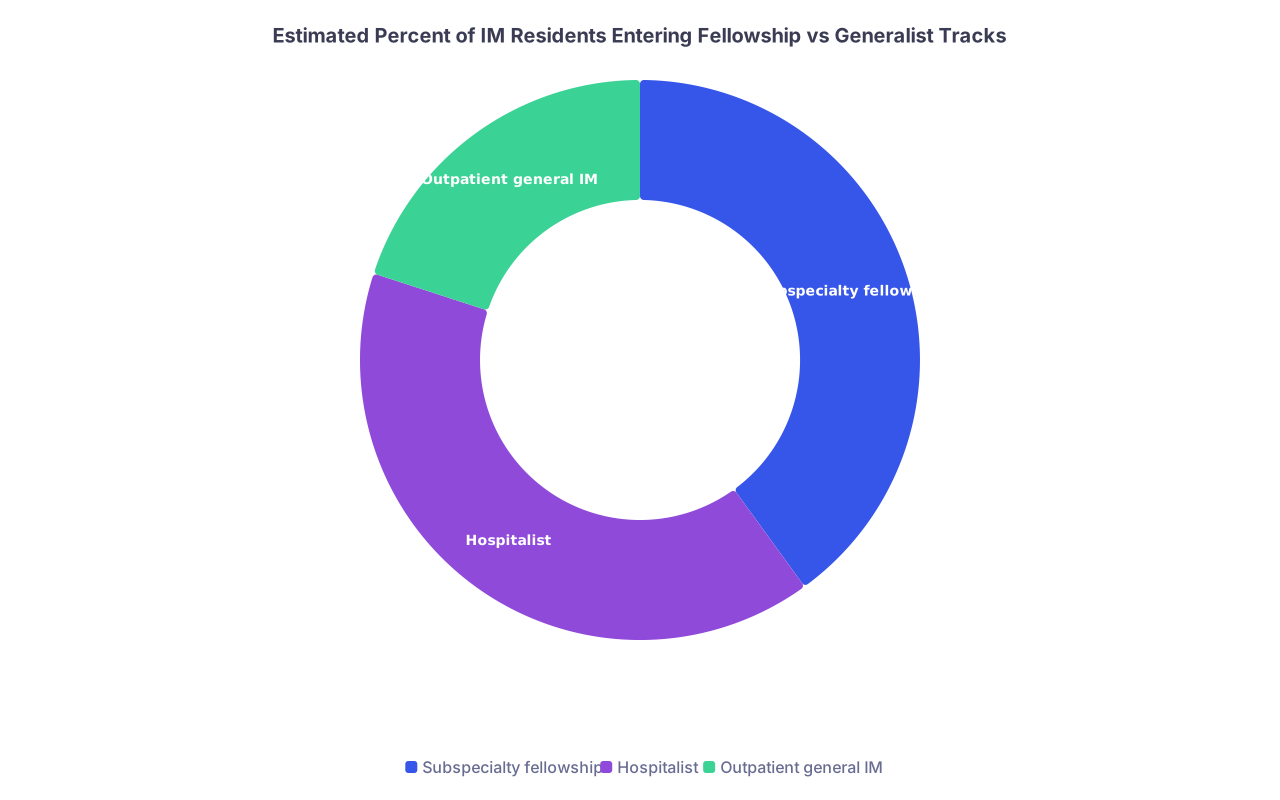
| Category | Value |
|---|---|
| Subspecialty fellowship | 40 |
| Hospitalist | 40 |
| Outpatient general IM | 20 |
Numbers vary by program tier. At big-name academic IM programs, subspecialty rates might hit 60–70%. At smaller community IM programs, hospitalist becomes the dominant outcome.
So your “backup” may actually be:
- At a top academic IM program: 1st job might still be fellowship track → hospitalist after, or academic hospitalist.
- At a smaller community IM program: 1st job is more likely pure hospitalist or generalist outpatient. Fellowship later becomes harder.
If your long-term tolerance for “permanent hospitalist” is low, you cannot ignore that split when ranking.
Family Medicine as a backup: outpatient default, hospitalist conditional
Using family medicine as a backup is common for:
- Borderline IM applicants
- People flirting with pediatrics, med-peds, or EM
- People who “just want outpatient” but are anxious about competitiveness
FM gives you broad outpatient power, but hospitalist options are more variable than applicants realize.
How FM sets you up for outpatient careers
If your future you strongly prefers seeing patients in clinic at 8:30 with coffee rather than admitting septic shock at 2 a.m., FM is your friend.
FM training, when done right, gives you:
- Bread-and-butter adult primary care
- Pediatric continuity
- Prenatal care +/- OB depending on program
- Women’s health procedures (IUDs, Nexplanons, endometrial biopsies)
- Office-based procedures (skin, MSK, joint injections, etc.)
That combination creates a career lattice, not a single ladder:
- Pure adult outpatient
- Full-spectrum family medicine (adults + kids + some OB)
- Rural “do-everything” including inpatient and ED
- Focused clinics (sports medicine, women’s health, addiction treatment)
If your backup is FM and you want maximal outpatient flexibility, look for:
- Strong full-spectrum training programs (e.g., Swedish First Hill, Contra Costa, MAHEC, Sioux Falls, etc.).
- A track record of graduates doing diverse outpatient careers, not just urgent care or low-autonomy clinic jobs.
- OB exposure even if you are not sure you want to keep OB. It signals breadth.
The uncomfortable truth about FM hospitalists
Can you be a hospitalist with FM? Yes. Do all hospitalist employers treat FM and IM the same? Absolutely not.
Here is how it actually plays out:
- Some regions (especially rural and mid-size communities) love FM hospitalists, because their system is used to FM docs doing everything.
- Some large academic centers and urban hospitalist groups quietly or explicitly say “IM only.”
Common, unspoken filters:
- FM + strong inpatient training + maybe ICU experience? Considered.
- FM + mostly outpatient training + little ICU? Often sidelined for hospital medicine.
So if you are backing up with FM but want hospitalist as an option:
- Choose FM programs with heavy inpatient exposure.
- Ask explicitly: “Do FM grads from this program work as hospitalists? Where?”
- Notice whether your inpatient time is supervised primarily by IM hospitalists vs FM faculty.
Some programs design FM training that is essentially mini-IM-plus-outpatient. Those grads slide into hospitalist work more easily.
Why FM can be a better backup for some people
If your genuine interest includes:
- Pediatrics
- Behavioral health
- Community medicine
- Procedures in clinic
- Maybe a mix of inpatient and outpatient in smaller communities
then FM as backup often makes more sense than IM, even if your peers are telling you otherwise.
I have seen too many residents match IM “because it is more prestigious,” then spend three years doing almost no peds, almost no procedures, then end up in outpatient primary care anyway and regret not having the FM toolkit.
If your likely eventual job is outpatient primary care, FM usually prepares you better and gives you a wider population base.
Med-Peds: the ultimate flexibility card (if you can get it)
Med-Peds sits in a weird corner of the discussion. It is not always thought of as a “backup,” but many candidates do exactly that: list Med-Peds alongside IM and/or peds to keep doors open.
In terms of hospitalist vs outpatient careers, Med-Peds is incredibly powerful.
What Med-Peds actually opens
With Med-Peds training you can:
- Work as an adult hospitalist.
- Work as a pediatric hospitalist (often with an extra year or some focused training, depending on institution).
- Do hybrid hospitalist roles covering both adults and peds in smaller hospitals.
- Do outpatient internal medicine, outpatient pediatrics, or combined clinics.
- Pursue almost any IM or peds subspecialty fellowship.
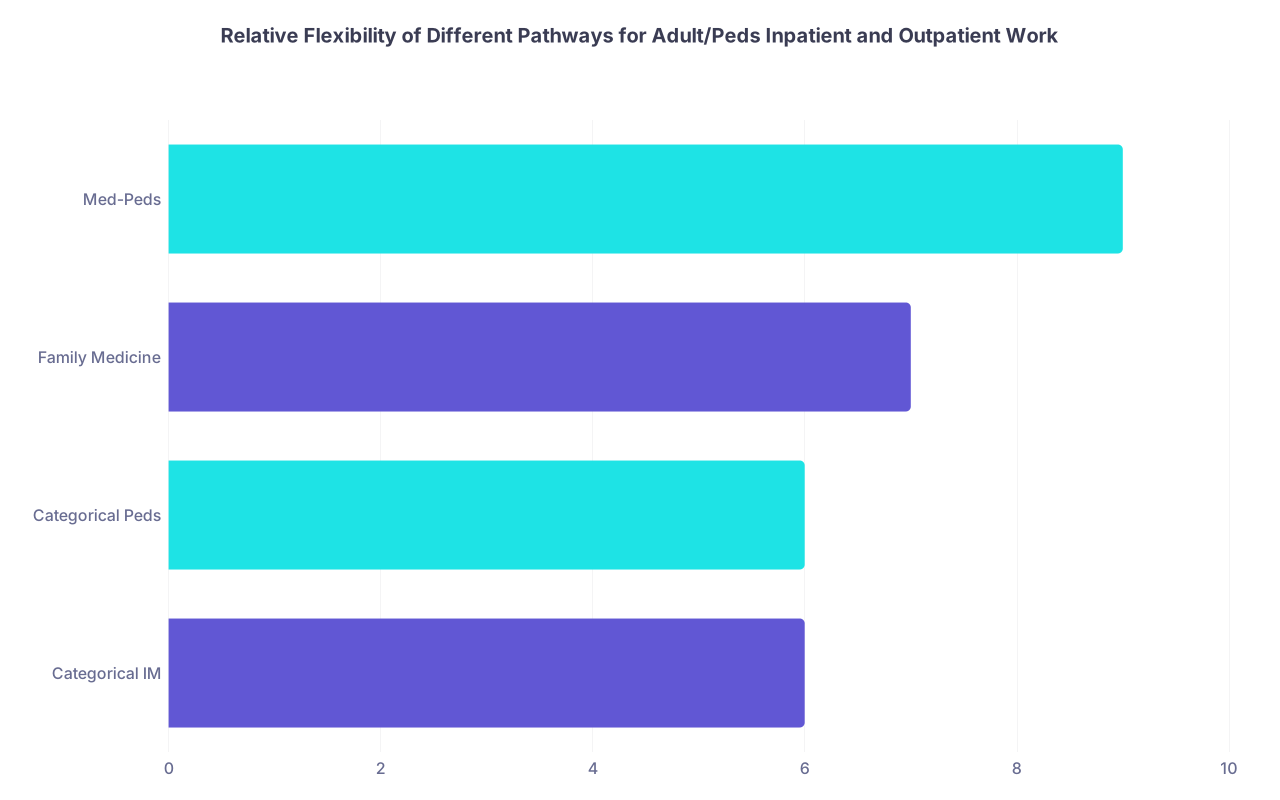
| Category | Value |
|---|---|
| Categorical IM | 6 |
| Categorical Peds | 6 |
| Family Medicine | 7 |
| Med-Peds | 9 |
(Scale 1–10, rough “flexibility across inpatient/outpatient adult + peds” score.)
Med-Peds shines for people who are:
- Torn between adult and peds.
- Unsure whether they like hospital medicine or clinic better.
- Considering complex care or transition-of-care roles.
Med-Peds as backup vs primary application
If you are aiming for Med-Peds as backup, you have to understand one thing: Med-Peds spots are often few but not always hyper-competitive. The match dynamics are weird.
Typical strategies I see:
- Strong applicant, loves both adult and peds, applies Med-Peds + some categorical IM and Peds programs.
- Applicant trying to keep both fellowship worlds open (cards vs peds cards, heme-onc vs peds heme-onc, etc).
- Applicant worried about burnout wants maximal pivot room between hospitalist, outpatient, and subspecialty on either side.
The med-peds graduate entering the job market can:
- Do adult hospitalist while keeping peds outpatient clinic on the side.
- Take peds hospitalist job and moonlight adult urgent care.
- Build combined complex care clinics spanning both age groups.
From a backup-specialty perspective, that is gold. It makes future pivots less painful.
If some part of you is strongly drawn to both hospitalist medicine and continuity clinic across ages, I would rank Med-Peds above pure IM or peds in many scenarios.
How program type quietly locks in or unlocks options
Specialty choice is only half the story. The other half is where and how you train.
Applicants obsess over “prestige” and “university vs community,” but those labels matter less than concrete training realities.
Academic-heavy IM vs community-heavy IM
For hospitalist vs outpatient paths, academic vs community IM programs differ like this:
| Feature | Academic-Heavy IM | Community-Heavy IM |
|---|---|---|
| Fellowship match rate | Higher | Lower |
| Hospitalist job prep | Strong for complex cases | Strong for throughput |
| Outpatient exposure | Often weaker, fragmented | Often stronger continuity |
| Name recognition | Higher for academic jobs | Variable |
If your plan is:
- Backup = IM
- Primary imagined career = hospitalist
Then either environment can work, but the flavor of hospitalist job you get might differ:
- Academic IM → academic hospitalist or hospitalist in complex system, significant teaching.
- Community IM → community hospitalist, possibly high volume, less teaching, more RVU focus.
If your plan is:
- Backup = IM
- Second-choice career = outpatient generalist
You might want an IM program with genuinely robust ambulatory training, which surprisingly is often better at strong community programs or hybrids, not at the ultra-subspecialty-focused quaternary centers.
FM program variation is even more extreme
Family medicine programs are wildly variable. Some are essentially outpatient-heavy with light inpatient exposure. Others are true full-spectrum with ICU, OB, ER, and inpatient adult/peds.
These differences will determine:
- Whether you are taken seriously by hospitalist groups.
- Whether you feel comfortable taking overnight call in a small hospital.
- Whether you can credibly pitch yourself as “full-spectrum” in rural communities.
When choosing FM as a backup, actually read the curriculum:
- How many months of inpatient adult wards?
- How much ICU time, and what is your role?
- Does anyone do hospitalist work right out of this program?
And do not trust glossy websites. Ask residents directly: “What do your last three classes of grads do?” If they say: “Mostly outpatient clinic or urgent care,” that is what the ecosystem shapes you toward.
Application messaging: do not lie, but do not box yourself in
PDs pay attention to how you talk about your future. If you spend your whole personal statement screaming “I MUST BE A CARDIOLOGIST,” you are signaling you see general IM or FM as consolation prizes.
That has two problems:
- It hurts your application in your “backup specialty” where PDs want people who might actually stay generalist.
- It makes later pivots harder because your letters, evaluations, and CV all scream sub-specialty tunnel vision.
You need to thread a needle.
How to talk about “backups” without sounding like you dislike them
In your IM, FM, or Med-Peds applications:
- Emphasize genuine interest in core fields (hospital medicine, outpatient continuity, longitudinal care).
- Mention subspecialty interest in measured language: “strong interest in cardiology OR generalist careers that allow me to care for complex cardiac patients.”
- Highlight specific rotations or projects that show you cared about general medicine, not just the shiny subspecialty service.
Common phrases that actually work:
- “I am drawn to roles that balance inpatient acuity with longitudinal relationships, whether as a hospitalist with continuity clinic or in a subspecialty fellowship.”
- “I could see myself thriving as a hospitalist or outpatient internist, and I am also exploring fields like gastroenterology where I can apply those same skills to a focused population.”
PDs read thousands of essays. They can smell “I only want fellowship” from a mile away. That is fine for some programs, but not for many FM and a good chunk of IM programs that need actual hospitalists and outpatient docs.
LORs and how they lock perceptions
Letters of recommendation that say:
- “She is absolutely destined for heme-onc.”
- “He will be an outstanding cardiology fellow.”
are double-edged. They impress fellowship PDs later, but they can make some categorical PDs think, “This person will leave as soon as possible; we need service coverage.”
Try to diversify:
- At least one letter that explicitly praises your general internal medicine or family medicine skills: diagnostic reasoning, patient communication, continuity care, ward leadership.
- Maybe one from a hospitalist who can say, “I would hire this intern as a hospitalist in a second.”
You are building a portfolio that supports both primary dream and backup realism.
How different “backup” choices change your long-term lattice
Let’s compare a few concrete archetypes. This is where applicants usually wake up.
Case 1: “Cards-or-bust” applicant
You love cardiology. You are eyeing competitive IM programs.
Option A – Backup = Categorical IM at academic program
Long-term lattice:
- Direct: IM → cards fellowship → cardiologist.
- If no fellowship: academic or community hospitalist.
- Later shift: easier to go hospitalist → outpatient general IM → maybe NPs/PA-run cardiology clinic as supervising physician.
Option B – Backup = Categorical IM at community program
Lattice:
- IM → local or regional cards fellowship (harder but possible if top performer).
- If no fellowship: primarily hospitalist or outpatient generalist in that region.
- Harder to jump to high-prestige academic jobs, easier to move to similar community roles.
Option C – Backup = Med-Peds
Lattice:
- Med-Peds → adult cards or peds cards (highly variable by program; some med-peds grads match well).
- If no fellowship: adult hospitalist, peds hospitalist, or combined inpatient.
- Can later exit to outpatient adult, peds, or both.
If you genuinely care about both hospitalist medicine and peds options, Med-Peds may be a better backup than low-tier IM. If you are singularly obsessed with adult cards, high-tier IM is clearly superior.
Case 2: “I think I want outpatient primary care, but I like ICUs too”
Option A – Backup = IM
Result:
- Strong path to hospitalist.
- Outpatient requires you to chase good ambulatory experiences.
- No peds. Limited OB/women’s health beyond basics.
Option B – Backup = FM
Result:
- Bread-and-butter outpatient across ages, strong peds exposure, potentially OB.
- ICU/hospitalist options depend strongly on program structure and local culture.
- In many urban centers, you will find more outpatient jobs than inpatient jobs open to FM.
Option C – Backup = Med-Peds
Result:
- Balanced ICU/inpatient adult + peds.
- You can elect later to be hospitalist, outpatient, or hybrid on either side.
- Slightly longer and more demanding residency (more total call, more switching between worlds), but maximal flexibility.
If your future self might burn out on nights but still want to keep peds and some inpatient in the mix, Med-Peds or a full-spectrum FM program is often smarter than pure IM.
Case 3: “I may want EM, but I also like wards and clinic”
Many EM applicants pick IM or FM as backup.
- IM backup: leads more cleanly to hospitalist, ICU exposure, and subspecialty options. Less peds, limited procedures outside hospital.
- FM backup: better for outpatient + urgent care + minor ED roles in smaller hospitals, more peds, more procedural variety in clinic.
- Med-Peds backup: good for pediatric ED or general ED in smaller hospitals; more complex but versatile.
You should ask yourself: if EM disappears as an option, do you see yourself:
- Fulfilling the ED lust for acuity via hospitalist work? → IM or Med-Peds.
- Replacing EM with urgent care and high-throughput outpatient? → FM probably fits better.
Geography and credentialing: the stuff nobody tells MS4s
Credentialing committees and state/regional markets matter a lot more than specialty lore.
Hospitalist hiring preferences by region
Some trends I consistently see:
- Large coastal academic centers: prefer IM or Med-Peds; FM hospitalist roles are rare.
- Midwestern and Southern community hospitals: much more open to FM hospitalists, especially if trained broadly.
- Rural critical access hospitals: FM, IM, Med-Peds all used as hospitalists; local experience often matters more than residency brand.
If you come from FM and want hospitalist work, you need to think regionally. Do not assume that what is easy in Kansas will be easy in Boston.
Outpatient job rigidity
Outpatient primary care hiring tends to be less picky:
- IM, FM, Med-Peds all welcome for adult clinics.
- Pediatric-only clinics want Peds or Med-Peds.
- FQHCs, community health centers, and rural clinics often love FM and Med-Peds because of breadth.
If outpatient is your more likely backup, FM and Med-Peds can give you an edge in the types of clinics that actually care about whole-family, whole-community medicine.
How to actually make a decision: a structured lens
You do not need a flowchart with fifty boxes. But you do need a framework.
Here is a simple mental model: three probabilities and three tolerances.
Step 1: Estimate your own probabilities
Be honest with yourself. Rough guess:
- Probability you end up as a hospitalist.
- Probability you end up as outpatient generalist.
- Probability you land subspecialty or niche job long-term.
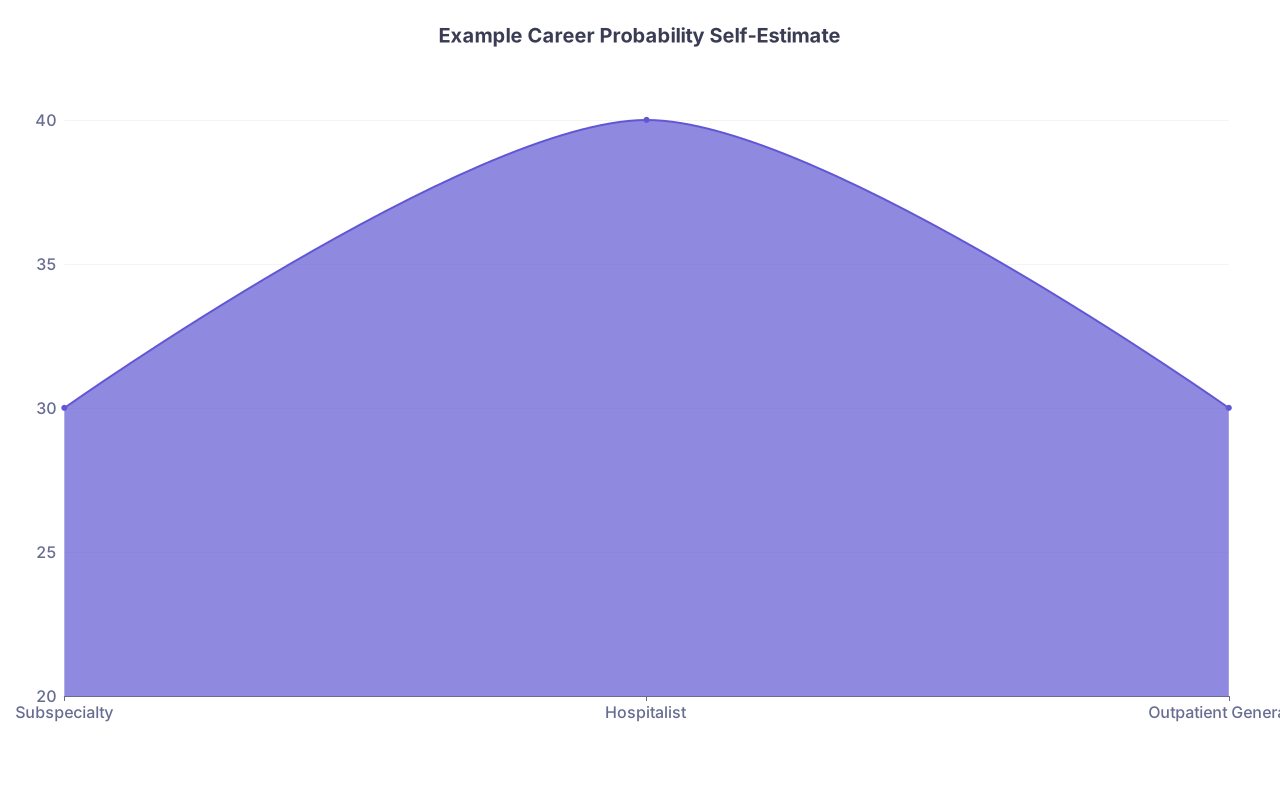
| Category | Value |
|---|---|
| Subspecialty | 30 |
| Hospitalist | 40 |
| Outpatient Generalist | 30 |
You are not predicting the future. You are just forcing yourself to admit where you might land.
Step 2: Rate your tolerances
On a 1–10 scale, how tolerable would it be if:
- You were a permanent hospitalist?
- You were a permanent outpatient primary care doc?
- You never did fellowship or subspecialty?
Write those numbers down. Do not lie to look “noble.”
Step 3: Map specialties against that
Then ask:
- Does IM as backup make my high-probability outcomes more tolerable or less?
- Does FM as backup align better if outpatient ends up being my default?
- Does Med-Peds hedge my bets in a way that matches my ambivalence?
At this point, many people realize:
- They actually care a lot about outpatient.
- Or they would absolutely hate pure clinic forever and should lean hospitalist-optimized training.
- Or they really want the peds side kept open.
That recognition should push your rank list.
One last thing: pivots are normal, but path-dependent
You will change your mind. People who swear they are “ICU-only” as interns end up in outpatient weight loss clinics five years later. Life happens. Relationships change. Kids appear. Parents get sick.
You cannot perfectly predict your future preferences. But you can:
- Choose backup specialties that preserve both hospitalist and outpatient lanes you might plausibly want.
- Pick programs that give you real skills in both domains, not just lip service.
- Write applications that keep you credible as a generalist, not just a future subspecialist.

| Step | Description |
|---|---|
| Step 1 | Match in IM FM or Med-Peds |
| Step 2 | Consider hospitalist path |
| Step 3 | Focus on outpatient |
| Step 4 | IM - adult focus |
| Step 5 | FM - broad age range |
| Step 6 | Med-Peds - dual training |
| Step 7 | Adult hospitalist or clinic |
| Step 8 | Outpatient or mixed roles |
| Step 9 | Adult and peds options |
| Step 10 | Like inpatient? |
| Step 11 | Specialty choice |
Your “backup specialty” is not a consolation prize. It is the scaffolding that will hold whatever real life throws on top of your career.
Pick it with that level of seriousness.
Key points:
- Backup specialties are not just about matching; they determine how easily you can move between hospitalist and outpatient careers later.
- IM, FM, and Med-Peds each create distinct lattices of options; geography and program type further tighten or loosen those branches.
- Shape your rank list and your application messaging around the jobs you could actually tolerate if fellowship never happens: hospitalist, outpatient, or both.