Only about 30–40% of residents end up in the exact subspecialty and role they imagined as MS2.
If you want to be an educator, administrator, or institutional leader, that number drops even further—because many students anchor on a single “dream” specialty and forget that leadership paths are tied far more to platform than to procedure set.
Let me be direct: if your long‑term goal is academic leadership, being “Cardiology or bust” is stupid strategy. The specialty is your vehicle, not your identity. The question is not “What will I love doing every day?” alone. It is also “What reliably positions me for teaching, curriculum, QI, program leadership, and system influence—even if Plan A fails?”
This is where backup specialties actually become strategic weapons instead of consolation prizes.
We will go through which specialties are structurally friendly to future educators and leaders, which are terrible backups for that goal, and how to rank and apply intelligently when you have a leadership‑heavy future in mind.
Step One: Define the Career, Then Backfill the Specialty
Before we even touch specialties, you need to be brutally clear about what kind of educator/leader you see yourself becoming. Because “I want to teach” is meaningless without context.

| Step | Description |
|---|---|
| Step 1 | Future Educator/Leader |
| Step 2 | UGME Focus |
| Step 3 | GME Focus |
| Step 4 | Hospital Admin |
| Step 5 | Health System/Public Health |
| Step 6 | Primary Goal |
Translate that into real jobs people actually hold:
UGME focus
Associate Dean for Medical Education
Clerkship Director
Course Director (Foundations, Clinical Skills, etc.)GME focus
Program Director (PD)
Associate PD
Core Faculty for a residency or fellowshipHospital/clinical operations focus
Medical Director of a service line
Chief Medical Officer (CMO)
Quality & Safety leadershipSystem / policy focus
Population health leadership
Health system education lead
VP for Academic Affairs, etc.
Most of these roles have three things in common:
- They sit in broad‑based, high‑headcount specialties (IM, FM, Peds, EM, Psych, General Surgery, OB/GYN, Anesthesiology).
- They require consistent exposure to learners and committees.
- They reward people who can see patterns across services, not just inside a narrow procedural silo.
So your backup specialties should maximize:
- Exposure to medical students and residents
- Size of academic presence nationally
- Flexibility to pivot: hospitalist, clinic, consults, admin, education
- Pathways to chief roles, PD, or clerkship roles
A good backup specialty for future leaders is not just “less competitive than my dream.” It is “still an academic power base if my dream falls through.”
The Core “Leadership Platform” Specialties
If you want a career heavy in teaching, curriculum, or admin, there are a handful of specialties that disproportionately produce leaders. They are not sexy on Instagram. They are absolutely dominant in committees.
1. Internal Medicine (Categorical IM)
If I had to pick one best all‑around backup for future educators and administrators, it is categorical Internal Medicine. Not glamorous, but structurally powerful.
Why IM is a leadership machine:
- Every academic hospital has a huge IM department. Big departments = more PDs, APDs, section chiefs, vice chairs, committee chairs.
- IM residents interact with almost every service: ICU, subspecialties, ED, consults. That network is gold for future institutional roles.
- Many med schools lean on IM for:
- Clerkship directorship
- Foundations of clinical medicine courses
- Longitudinal ambulatory precepting
From IM, you can become:
- Hospitalist → Medical Director → Chief of Hospital Medicine → Associate CMO
- Clinician‑educator → APD → PD → Vice Chair for Education → Associate Dean
- Subspecialist (cards, pulm, ID, etc.) → Fellowship PD → Department vice chair
| Feature | Internal Medicine Categorical |
|---|---|
| Department size | Very large |
| Med student exposure | Continuous |
| Hospital committees | Heavy representation |
| Fellowship options | Extensive |
| Common path to Deanship | Yes |
When IM is an especially smart backup:
- You initially aimed for a competitive IM subspecialty (cards, GI) but may not match.
- You are interested in hospitalist work, QI, or clinical reasoning teaching.
- You like adult medicine and complexity more than procedures.
Bad news: if you hate inpatient medicine, rounds, or chronic disease management, do not pick IM. For leaders, misery is not sustainable.
2. Family Medicine
Family Medicine is underrated as a leadership launchpad, especially for those interested in:
- Curriculum reform
- Community engagement
- Population health and primary care innovation
FM is deeply embedded in:
- Longitudinal preceptorships for MS1–MS2
- Outpatient clerkships
- Interprofessional education with nursing, pharmacy, PA programs
I have seen FM faculty become:
- Course directors for physical diagnosis or clinical skills
- Longitudinal integrated curriculum leads
- Associate deans for community engagement or primary care
If you are interested in rural leadership, community hospital administration, or “Dean for Regional Campus X,” FM is a very strong platform.
Strengths for future educators:
- You can own the outpatient teaching experience.
- You see patients across lifespan; great for teaching continuity, social determinants, systems thinking.
- Many FM departments are hungry for people willing to take on educational admin.
Weaknesses:
- Less representation on high‑level internal medicine subspecialty committees.
- In tertiary academic centers, FM sometimes has less political capital than IM or Surgery.
Still, as a backup specialty for future teachers, especially those who like continuity, FM is a highly rational option.
3. Pediatrics
Pediatrics is a powerhouse for:
- Med student clerkship leadership
- Simulation‑based education
- Advocacy and population health teaching
If you enjoy working with kids and also care about policy, education, or advocacy, Peds gives you:
- A giant clerkship that med schools must staff well.
- Lots of involvement in first‑year developmental, behavior, or wellness content.
- Strong pathways into education leadership: PD, APD, Vice Chair for Education.
Peds as a backup works especially well if:
- Your dream is Neonatology, Peds EM, or a competitive subspecialty but you are not locked in.
- You genuinely like kids/families and find pediatrics intellectually satisfying.
- You see yourself in advocacy, child health policy, or education reform.
If you dislike parental dynamics, chronic complex pediatric disease, or the emotional toll of sick kids, do not force Peds as a “leadership backup.” That will crack later.
4. Psychiatry
Psychiatry is one of the fastest‑growing leadership pipelines in:
- Wellness and physician mental health
- Curriculum around communication, professionalism, and ethics
- Collaborative care and integrated behavioral health
Where Psych shines for educators:
- Heavy med student exposure on clerkships, especially in communication skills and mental status exam.
- Psych attendings are frequently tapped to teach:
- Difficult conversations
- Boundary issues
- Burnout and resilience
- Departments are relatively young and expanding; there is room to rise.
This is a subtle but real advantage: psychiatry departments often have fewer entrenched senior faculty blocking promotion. For an ambitious educator, that matters.
Psych as a backup is strong if:
- You are interested in wellness, DEI, curriculum culture, or professionalism committees.
- You like longitudinal relationships more than procedures.
- You enjoy thinking about systems: homelessness, substance use, trauma.
Weaknesses:
- Slightly less direct route into hospital CMO / COO roles unless you intentionally build administrative and operational experience.
- Some institutions still underestimate psychiatry’s leadership potential (though that is changing fast).
5. Emergency Medicine (with caveats)
Emergency Medicine used to be a near‑automatic route to leadership in:
- ED medical directorship
- Hospital throughput and patient flow
- Simulation centers and resuscitation training
EM faculty often run:
- Simulation programs
- ACLS/ATLS courses
- Interprofessional resuscitation training
But right now, you have to be very sober about EM as a backup. The job market in some regions is saturated. Corporate groups control staffing. Some residents struggle for preferred jobs post‑training.
As a leadership platform, EM is best if:
- You are specifically interested in operations, throughput, or disaster response.
- You like high‑acuity teaching environments and sim.
- You train in a strong academic EM department that has PD/APD and robust GME infrastructure.
As a generic backup because “I like variety and procedures,” EM is currently risky. For future educators/admins, I would only choose EM as backup if you have done your homework on job markets and academic department strength.
6. Anesthesiology
Anesthesia might not be the first specialty you think of for teaching, but:
- They dominate simulation, crisis resource management, and airway teaching.
- They hold many OR operations and perioperative leadership roles.
- Many anesthesiologists become:
- OR medical directors
- Perioperative services leads
- Safety and QI leaders
Anesthesia is especially good if you like:
- Physiology
- Procedural skills
- Acute care
- Team‑based coordination
For educators, anesthesia can anchor roles in:
- Simulation programs
- Difficult airway courses
- Acute pain or regional anesthesia education
If your long‑term vision includes OR throughput, perioperative medicine, and simulation, anesthesia is a surprisingly solid backup.
Specialties That Are Usually Poor Backups for Future Leaders
Some specialties are beloved but structurally weak for certain types of leadership and education roles. I am not saying you cannot lead from them—people do. But the average probability and surface area are lower.
1. Extremely small, narrow procedural fields as primary backup
Examples:
- Dermatology
- Radiation Oncology
- Ophthalmology
- Certain surgical subspecialties (e.g., ENT subspecialty, some plastics tracks)
Why they are problematic as backups for leadership‑oriented students:
- Small departments = fewer PD/APD roles, fewer vice chairs, fewer committees.
- Limited exposure to medical students beyond a single elective or small clerkship.
- Narrow clinical domain; does not naturally touch broad hospital operations.
Could you become department chair of Dermatology and have major influence? Yes. But if your backup plan is “I want a high‑likelihood route to academic leadership,” these fields are more like lottery tickets than diversified portfolios.
2. Hyper‑competitive fields as your only Plan A/B
If your main goal is leadership/education and you only rank:
- Derm
- Ortho
- Plastics
- ENT
- Neurosurgery
…with no broad‑based backup like IM, FM, Peds, Psych, Anesthesia, you are betting your entire future platform on matching into one of the most bottlenecked spaces in the house.
That is not strategy. That is gambling.
How to Pick Backup Specialties When You Care About Leadership
Now we get practical. You are building a rank list or debating whether to dual‑apply. How do you choose?
Step 1: Clarify your non‑negotiables
You need to be ruthless here. Examples:
- “I need regular med student teaching built into the job.”
- “I want a strong chance of becoming PD or APD someday.”
- “I want to be positioned for hospital operations/CMO level.”
Map that to specialties:
- Heavy med student teaching baked in: IM, FM, Peds, Psych, Surgery, OB/GYN.
- GME leadership density: IM, Peds, FM, EM, Anesthesia, Surgery.
- Hospital operations: IM (hospitalist), EM, Anesthesia, some Surgery.
Step 2: Sort specialties by leadership “surface area”
Think of “surface area” as the number and variety of roles you could reasonably grow into. For future educators/admins, bigger is better.
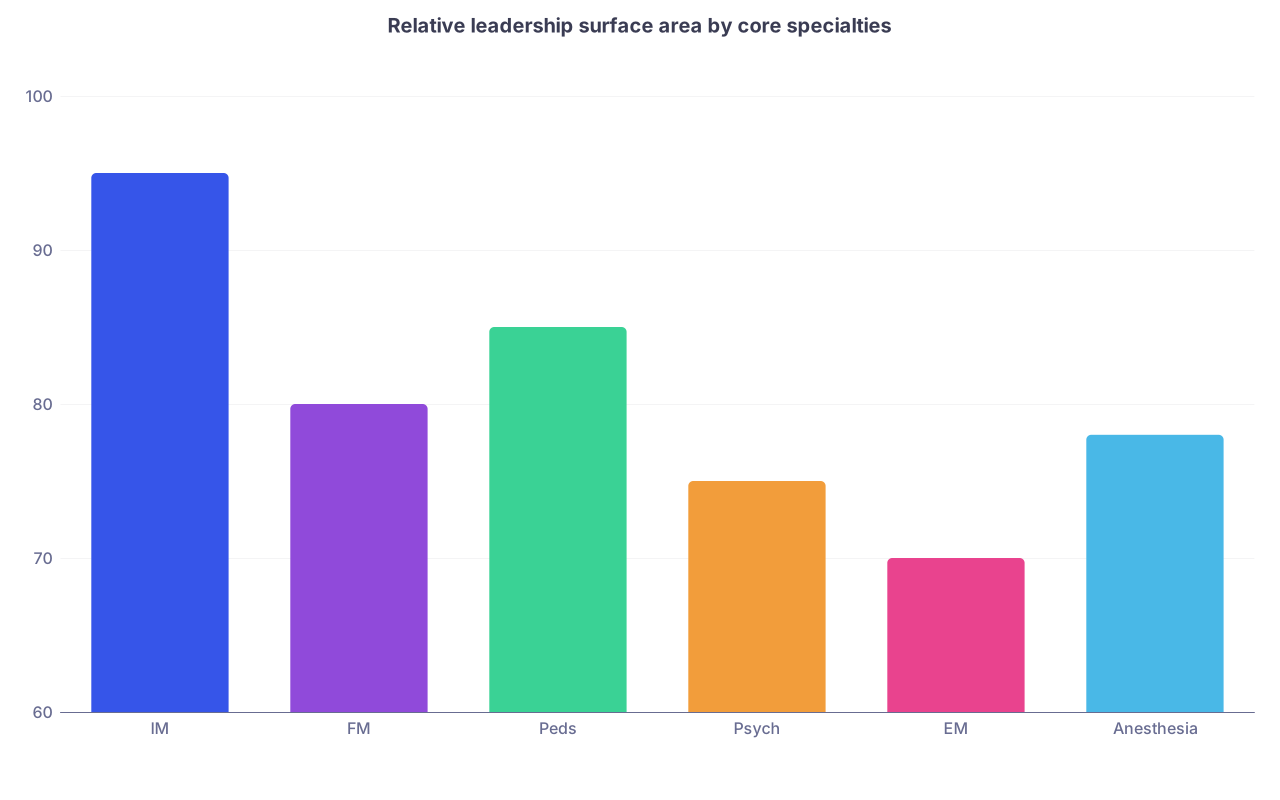
| Category | Value |
|---|---|
| IM | 95 |
| FM | 80 |
| Peds | 85 |
| Psych | 75 |
| EM | 70 |
| Anesthesia | 78 |
(Values are conceptual, not literal percentages—just illustrating comparative breadth.)
Internal Medicine tops the list largely because:
- It feeds multiple fellowships.
- It dominates medicine clerkships.
- Hospitalists have essentially become their own leadership ecosystem.
FM and Peds follow closely with major clerkship and community roles. Psych, EM, and Anesthesia all have meaningful but slightly more domain‑specific leadership footprints.
Step 3: Be honest about lifestyle and personality fit
You will not last 25 years in a field you despise just to get a dean title. Misery kills careers.
Important fit questions:
- Do you tolerate high admission volume and rounding (IM, Peds)?
- Do you enjoy continuity of care (FM, Peds, Psych)?
- Do you prefer shift work (EM, Anesthesia to some extent)?
- Are you comfortable with frequent procedures (Anesthesia, EM) or not?
If you are a future leader, burnout is not abstract. It will sabotage your credibility and productivity. Choose a backup where your clinical life is sustainable enough to leave energy for teaching and admin.
How to Structure Your Actual Application and Rank List
Let’s make this concrete with real scenarios.
Scenario 1: Future Cardiology Leader, IM‑based
You: MS4, wants to be a cardiologist, run a fellowship program, and eventually be a medicine department vice chair.
Reality: Cards is competitive. Fellowship match probability has noise.
Smart structure:
- Apply categorical IM at a mix of academic programs (middle and top tier) where:
- Hospitalist tracks are strong.
- There is a visible clinician‑educator track.
- You see existing IM PDs/vice chairs who started as generalists.
Your “backup” is not a different specialty. It is a general IM leadership trajectory if cards never pans out. You can:
- Become a hospitalist with educational roles.
- Aim for APD/PD in IM.
- Eventually move into departmental leadership.
This is a case where a single specialty (IM) contains both Plan A (cards) and Plan B (clinician‑educator/hospitalist leader). No need to dual‑apply to FM or Psych unless your Step scores or application are very weak.
Scenario 2: Future UGME Dean Who Loves Teaching, Specialty Flexible
You: Care more about teaching and curriculum than one organ system. Like variety, rounding, and talking to families. Scores are decent but not stellar.
Best backup framework:
Primary target: Peds or FM (pick based on genuine clinical preference).
Backup: The other of those two, or IM if you enjoy adult medicine.
Rank list logic:
- Rank academic Peds or FM programs first where:
- They have visible med school leadership roles held by department faculty.
- Clerkship director is embedded in the department, not siloed.
- Include some solid community programs that are educationally oriented, not just service mills.
Your long‑term play:
- Become core faculty → clerkship director → assistant dean.
- Keep CV heavy on teaching awards, curriculum committees, and med ed research.
Either FM or Peds works. IM is fine too if you prefer adult patients. All three keep you squarely in the running for UGME leadership.
Scenario 3: Procedural Dream (Ortho/ENT/Plastics) but Leadership‑Minded
You: Want a surgical subspecialty, but you also like teaching and maybe PD work. Scores are borderline for your dream field.
The big mistake here is only applying to the competitive subspecialty and calling Gen Surg or IM “not me.” That is how people go unmatched and disappear from academic trajectories entirely.
Smarter structure:
- Primary: Ortho / ENT / Plastics (if genuinely committed).
- Backup: General Surgery or Anesthesia or EM, whichever you actually like.
How to choose the backup:
- If you like the OR but not clinic: Anesthesia.
- If you like the OR and are okay with post‑ops and long cases: General Surgery.
- If you like acute care, trauma, and throughput: EM (after carefully evaluating the job market in your region).
If you ultimately end up in the backup, you then:
- Lean hard into teaching residents and students on your service.
- Get involved early with simulation, skills labs, or morbidity and mortality conferences.
- Position yourself as the “education person” in that department.
You might never be Chair of Ortho. You can still be an outstanding Program Director for Gen Surg or an EM residency and build a national leadership footprint.
Scenario 4: Future CMO / Health System Ops Leader
You: Care most about hospital operations, throughput, quality, and leading big systems. You enjoy clinical work but see it as only part of your career.
Best specialty platforms for this long game:
- Internal Medicine (especially hospitalist‑heavy programs)
- EM (with attention to job market)
- Anesthesia
- Sometimes General Surgery, depending on institution
As a backup strategy:
- Choose IM as the most robust platform if you are at all okay with inpatient adult medicine. Hospitalist roles are now a dominant path to CMO‑like positions.
- If you hate rounding but love acute care and ORs, Anesthesia is a solid alternative, particularly in systems that lean heavily on anesthesiologists to run OR operations.
The logic: CMOs are disproportionately drawn from IM, hospitalists, EM, and Anesthesia—people who live at the interface of throughput, resource allocation, and interdepartmental friction.
How to Evaluate Individual Programs Through a Leadership Lens
Specialty is only half the game. A mediocre program in a great specialty can still stunt your leadership trajectory. You need to read programs like a shark.
Look for these signs:
- Visible clinician‑educator track or pathway.
- Multiple APDs/associate program directors—indicates real structure, not just a token PD.
- Faculty holding institutional roles:
- “Vice Chair for Education”
- “Associate Dean”
- “Medical Director of X service”
- Resident involvement in:
- Curriculum committees
- QI committees
- Diversity and wellness committees
Red flags if you want leadership:
- Residents describe the culture as “service heavy, no teaching.”
- PD is obviously over‑burdened and has no support.
- No one in the department holds cross‑cutting roles beyond their own niche.
If you have to choose between:
- Program A: more name‑brand but education is clearly an afterthought.
- Program B: less prestigious but rich in med ed infrastructure and leadership opportunities.
For a future educator/admin, Program B often wins.
Dual‑Applying Without Signaling Panic
You might be thinking: “If I apply to two specialties, I will look non‑committal.” That is only true if you are sloppy.
Strategy for a leadership‑oriented dual applicant (example: Peds + Psych, or IM + Peds):
Separate narratives, same core theme.
- To Peds: emphasize interest in child development, family systems, advocacy, teaching.
- To Psych: emphasize human behavior, systems of care, communication, teaching.
Underneath both: “I aim to become a clinician‑educator and program leader.”
Letters of recommendation that align with each specialty.
Do not send Psych letters to Peds programs or vice versa unless they clearly support general academic potential and teaching.Be explicit on interview day without sounding flaky.
“I am all in on [this specialty]. I did consider [other specialty] early in the process because I knew I wanted a career in education and leadership, and both fields support that. But my clinical experiences have confirmed that [this specialty] is where I see myself long‑term.”
Programs are not allergic to nuance. They are allergic to people who act like they could not decide until last Tuesday.
Building Leadership Skills During Residency, Regardless of Specialty
One last piece: you can pick the perfect leadership‑friendly specialty and still vanish into anonymity if you behave like a passive resident.
The residents who later become PDs, APDs, or deans tend to:
- Volunteer for resident education roles: noon conference planning, intern boot camps, simulation debriefing.
- Drive at least one meaningful QI or curriculum project to completion.
- Build a track record of presenting at local or national education conferences (APDIM, SGIM, STFM, AAMC, etc.), even early.
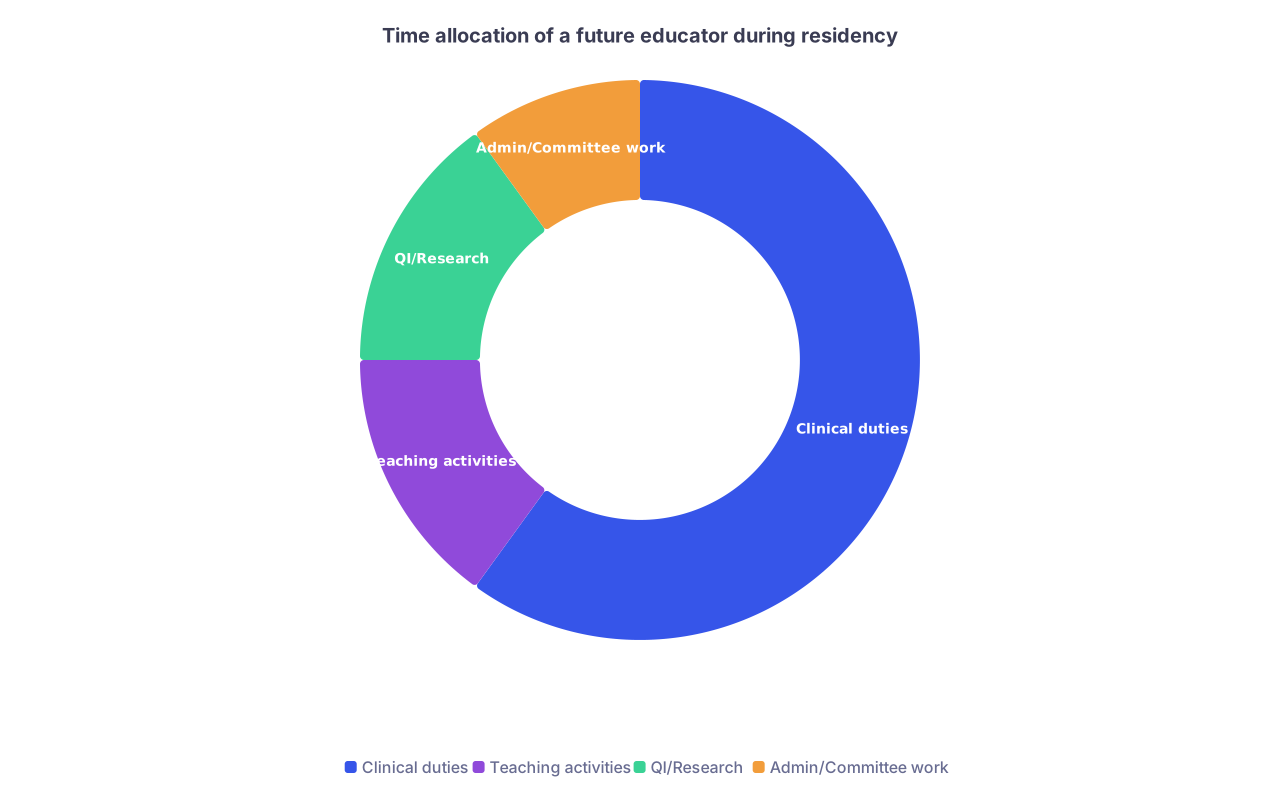
| Category | Value |
|---|---|
| Clinical duties | 60 |
| Teaching activities | 15 |
| QI/Research | 15 |
| Admin/Committee work | 10 |
That split will shift as you advance, but during residency, something roughly like this is realistic. Clinical work is dominant. Education and leadership are layered on top. You want a specialty and program that make those extra slices possible without entirely breaking you.
With a clear picture of the leadership roles you want, a realistic view of which specialties actually generate those roles, and a sober backup plan anchored in broad‑based fields, you are already ahead of most of your classmates.
From here, the next big move is not only matching into the right specialty, but using those first two or three years of residency to build a visible identity as “the educator” or “the systems person” in your program. That is how you convert a backup specialty into a primary platform for the career you actually wanted.
But how to architect that identity during residency—what projects to pick, which committees to join, and how to avoid being the overworked “yes” person? That is the next step in your journey.