
The most common backup choices for surgical applicants are misunderstood, misused, and often misaligned with reality.
You cannot just “throw in” Internal Medicine, Emergency Medicine, or Anesthesiology as safety nets and expect the Match to sort it out. Each of these is a fundamentally different career from surgery, with different gatekeepers, different selection metrics, and different day‑to‑day misery points. If you treat them as generic backups, you will sabotage both your primary and your backup plans.
Let me break this down specifically.
1. The brutal truth about “backup” specialties
Before we talk about IM, EM, and Anesthesia individually, we need to get three things straight.
- Programs in these fields can tell when you are using them as a backup.
- Your entire application—the story, the letters, the rotations—has to make sense.
- Poorly chosen backups can sink your match, not save it.
I have seen this play out more times than I like:
- Fourth‑year set on General Surgery.
- All core clerkships done, two Sub‑Is in surgery, strong letters from surgeons, zero exposure to IM/EM/Anesthesia beyond core.
- Step scores: fine, not stellar. Surgery increasingly risky.
- September: panic. Advisor says “throw in some IM and Anesthesia apps.”
- Result: 15 Gen Surg interviews, 4 IM interviews at community programs that do not believe the story, 0 Anesthesia, a rank list full of places the student is lukewarm about. Massive anxiety with a non‑trivial chance of not matching anywhere.
That is the default if you do this haphazardly.
To use IM, EM, or Anesthesia intelligently as backup paths from a surgical trajectory, you must answer three questions clearly:
- What is my realistic competitiveness in my primary surgical field?
- What long‑term lifestyle and scope of practice do I actually tolerate and possibly enjoy?
- How much time is left to course‑correct—letters, rotations, personal statement, narrative?
We will look at each “backup” through four lenses:
- Competitiveness and selection filters
- Clinical reality (schedule, stress, work style)
- Application narrative: will my surgical‑heavy profile make sense?
- Long‑term: can this reliably bridge to some procedural or acute‑care life that scratches the surgical itch?
Then we will talk strategy: how to pick one credible backup rather than three half‑baked ones.
2. Internal Medicine: the deceptively “easy” backup
Internal Medicine is the default backup people name when they have no real plan. That is a mistake. It is both more and less forgiving than you think.
2.1 Competitiveness and filters
For most U.S. seniors, categorical IM positions are obtainable if:
- Your Step 2 CK is not catastrophically low (think ≥ 215–220 for community; ≥ 230+ for more academic programs).
- You do not have multiple red flags (failures, professionalism issues).
- You can produce at least one proper IM letter.
But "obtainable" is not the same as “good fit” or “good program.” And academic IM at strong university hospitals is not a trash can. They filter.
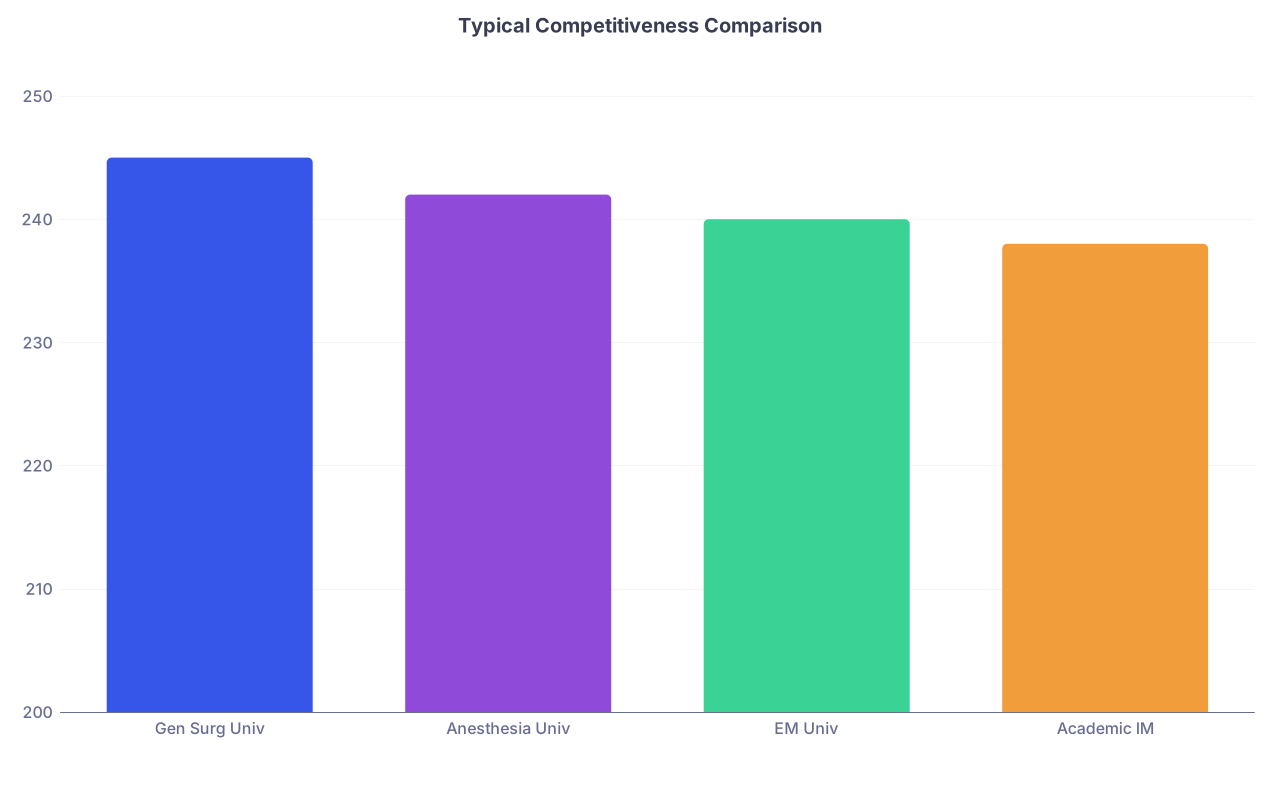
| Category | Value |
|---|---|
| Gen Surg Univ | 245 |
| Anesthesia Univ | 242 |
| EM Univ | 240 |
| Academic IM | 238 |
Those Step 2 CK numbers are illustrative, but the point stands: internal medicine at good institutions is competitive enough that lazy applications get quietly screened out.
If you are a surgical applicant with:
- One medicine Sub‑I
- One or two IM letters (at least one strong)
- Decent exam scores
…you can be a viable IM candidate, but only if you stop signaling “I wish I were cutting.”
2.2 Clinical reality: what you are signing up for
If your primary love is the OR and procedures, pure hospitalist‑style IM will feel like a different planet:
- Longitudinal thinking: multiple comorbidities, polypharmacy, nuance on nuance.
- Cognitive burden: endless med rec, subtle diagnostic work, chronic disease management.
- Less procedural time: central lines, paracenteses, thoracenteses if you are in the right setting—yes—but not daily OR time, not the same hands‑on fixing.
Daily life as a PGY‑1 in IM: pre‑rounds on 8–12 patients, morning rounds, notes, pages, discharge planning, signout. Procedure opportunities exist but are not the backbone.
For some surgical applicants, this is torture. For others, especially those who like physiology, complex decision‑making, and the ICU, IM becomes surprisingly satisfying—if they angle toward hospitalist, critical care, or cardiology down the line.
2.3 Application narrative from a surgical start
Medicine PDs are not stupid. They know students change their minds. They do, however, hate being obviously used as a “backup bin.”
You need a coherent story that connects:
- Your early attraction to acute care / complex physiology / perioperative management
- Genuine experiences on IM that you valued
- A believable future within internal medicine (not “I want to be a surgeon through the back door”)
Common pitfalls I see:
- Personal statement that still reads 60% like a surgery essay, with a few “I now realize medicine lets me form deeper relationships” lines tacked on.
- All letters from surgeons, one lukewarm IM letter saying “X rotated in July and did fine.”
- ERAS activities list dominated by surgical research, no attempt to frame the skills in a way IM people care about (teamwork, longitudinal thinking, ICU, etc.).
Does that mean you need three IM Sub‑Is and a medicine research year? No. But you need at least:
- One solid IM Sub‑I in 4th year with a strong letter.
- An IM‑specific personal statement that is not a hacked surgery statement.
- Your experiences and future plans framed around internal medicine subspecialties or critical care, not “I still like the OR.”
2.4 Long‑term options to keep procedural/acute care
If you are using IM as a backup from surgery, it usually means you care, at least partially, about:
- Acute care
- ICU
- Procedures
- High‑acuity physiology
Within IM, that usually translates to:
- Pulm/CC or straight Critical Care
- Cardiology (especially interventional or EP)
- GI with lots of endoscopy
Yes, that is a long road—residency plus fellowship—but it absolutely gives you a life with procedures, acutely ill patients, call, and that adrenaline you probably like.
So IM is a rational backup path if:
- You can tolerate and maybe enjoy the cognitive, longitudinal side.
- You can credibly show interest in IM (esp. ICU/cardiac) now, not as a last‑ minute post‑Match reinvention.
3. Emergency Medicine: the seductive but risky pivot
Emergency Medicine is the other shiny “surgery adjacent” field students latch onto, often too late and without understanding the politics.
3.1 Competitiveness and specialty turbulence
EM used to be a fairly safe mid‑competitive specialty. Then several years of overexpansion, workforce oversupply talk, and shifting applicant interest distorted the market. Some regions are now relatively easy to match in; others, fiercely competitive.
Here is the part backup‑minded surgical applicants ignore: EM cares a lot about having specific EM experiences and letters.
The standard expectation for a serious EM applicant:
- 2 EM rotations (home and away)
- 2 Standardized Letters of Evaluation (SLOEs) from those rotations
- Clear, early commitment in the MS4 year
If you show up with:
- No EM rotations
- Generic letters from surgeons, an internist, and maybe one ED attending who hardly knows you
- A last‑minute EM personal statement written in October
…you are not a credible candidate at most serious EM programs.
3.2 Clinical reality: do you actually like this?
On paper, EM looks “surgery‑ish”:
- Acute presentations
- Procedures (intubations, lines, reductions, lac repairs)
- Night shifts, trauma, codes, adrenaline
But the actual texture of EM work is very different:
- No continuity. You stabilize, disposition, move on.
- Constant interruptions, volume pressure, time‑to‑disposition metrics.
- You inherit other peoples’ bad outpatient care, missed diagnoses, and system failures.
- Crowding, boarding, “do more with less” is baked into the workflow now.
I have seen surgery‑leaning students love the procedure and trauma piece—and absolutely hate the chaotic, high‑volume, negotiation‑heavy side of EM. You really need an honest ED month, early, to know.
3.3 Application narrative from a surgical profile
If your MS3–early MS4 CV screams “Surgery, Surgery, Surgery,” then to sell EM you must do three things very cleanly:
Get at least one, preferably two EM rotations with SLOEs.
If it is already late (after August) and you have none, EM as a primary backup becomes highly unreliable.Craft a narrative that makes the pivot logical.
For example:- You were initially drawn to operative care but realized you value the diagnostic puzzle, variety, and shift‑based model more than the longitudinal perioperative relationships.
- Experiences during trauma call, airway management, and resuscitations highlighted that acute stabilization and decision‑making are your favorite pieces.
Show some continuity between your past and future.
Surgical ICU experience? Great. Frame it as resuscitation, cross‑specialty coordination, multi‑system thinking.
OR time? Emphasize teamwork, crisis management, exposure to critical emergencies—not “I love holding a scalpel.”
EM faculty read hundreds of personal statements. They are not fooled by: “I loved the excitement of the trauma bay and now realize EM is the perfect fit for me” when everything else about you screams “I’d rather be in the OR.”
3.4 Long‑term options and reality check
If you match EM, paths that keep you close to surgical/acute care include:
- Trauma EM roles in Level I/II centers
- EM‑critical care fellowships
- EMS, toxicology, ultrasound (less procedural, but high‑acuity and technical skill)
But you give up:
- Longitudinal postoperative care
- Operating room as your home base
- “Owning” a patient over days–weeks
EM is a valid backup for some surgical applicants, specifically those who:
- Truly prioritize shift work and off‑time more than owning the inpatient process.
- Enjoy breadth and chaos more than depth and control.
- Have enough runway to gather SLOEs and demonstrate credible interest.
As a late panic choice with no SLOEs and no prior ED investment, it is a trap.
4. Anesthesiology: the quiet cousin that is not a dumping ground
Anesthesia is the third “surgery‑adjacent” backup people mention, often with a dangerous assumption: “They just want decent step scores and bodies for the OR.” That is outdated and, at strong programs, completely wrong.
4.1 Competitiveness and what PDs actually filter on
Anesthesia has historically attracted a lot of surgical‑type applicants and those who like acute physiology and procedures. It is moderately competitive, with big variability between:
- University vs community
- Desirable locations vs less popular regions
- Programs heavy in cardiac, ICU, complex cases vs bread‑and‑butter only
Selection levers anesthesia PDs actually use:
- Step 2 CK (and Step 1 if numeric; they notice 250 vs 210).
- Evidence of strong performance in ICU, anesthesia, or acute care settings.
- Letters from anesthesiologists or intensivists who vouch for your hands, composure, and teachability.
- No glaring red flags in professionalism or work ethic. They know they are trusting you with airways and physiologically fragile patients.
A surgery‑heavy applicant with:
- Solid Step 2 CK (say 230–240)
- Strong ICU rotation
- One anesthesia elective and letter
…is often quite competitive at many anesthesia programs, more so than in EM without SLOEs.
4.2 Clinical reality: what the day actually feels like
For a surgery‑oriented student, anesthesia has a lot of resonance:
- You live in the OR. You know the environment, you know the workflow.
- You manage physiology in real time—airway, hemodynamics, ventilation.
- You do procedures: intubations, central lines, arterial lines, regional blocks.
The trade‑offs:
- You are not “the surgeon.” You hand over the procedural endpoint to someone else.
- Pre‑op and PACU flow matter. Throughput, scheduling delays, surgeon personalities—all of that is your ecosystem.
- Many cases are routine. Healthy ASA I–II patients for quick procedures can get monotonous if you crave high complexity constantly.
If what you love most about surgery is the OR, the team, and the physiology of big cases—not necessarily the act of cutting—then anesthesia can feel surprisingly natural.
4.3 Application narrative from a surgical start
Anesthesia is probably the most forgiving of the three when it comes to a surgical‑heavy background, if you articulate the pivot properly.
Your narrative should highlight:
- Your enjoyment of OR workflow and teamwork.
- Specific experiences where you were drawn to managing hemodynamics, ventilation, resuscitation.
- Appreciation for the pre‑op evaluation and risk stratification side, not just “I liked intubations.”
What does not fly:
- “Surgery was too hard / lifestyle too bad so I chose anesthesia.”
- Zero anesthesia exposure and a generic statement rebranded overnight.
You really want:
- At least one dedicated anesthesia rotation by early 4th year.
- A strong anesthesia letter. Two is even better at competitive places.
- Maybe ICU or step‑down experience to show comfort with critical illness.
4.4 Long‑term options that keep it “surgery adjacent”
Anesthesia offers several ways to intensify the acute, complex side if that is what you want:
- Critical Care fellowship → you become an intensivist with a strong procedural base.
- Cardiac anesthesia → high‑complexity, high‑acuity, TEE, long cases.
- Regional anesthesia → advanced blocks, pain pathways, lots of ultrasound skill.
If your brain likes:
- Pharmacology
- Real‑time physiology
- Work that is intense but bounded by the case length
…anesthesia is a very rational backup from a surgical trajectory.
5. Side‑by‑side: which backup actually fits you?
Let me simplify the core differences in format. This is the part students ask for on paper in advising rooms all the time.
| Factor | Internal Medicine | Emergency Medicine | Anesthesiology |
|---|---|---|---|
| Core work style | Longitudinal, cognitive | Episodic, high volume, chaotic | Case-based, physiologic, procedural |
| OR exposure | Limited | Occasional (trauma/consults) | Constant |
| Essential application piece | At least 1 strong IM letter | 1–2 SLOEs from EM rotations | 1–2 anesthesia/ICU letters |
| Timeline sensitivity | Moderate | Very high (rotations early) | Moderate |
| Best for ex-surgeons who | Like ICU/cardiac complexity | Like chaos, variety, shift work | Love OR/physiology, not cutting |
This is where you stop asking “What is competitive?” and start asking “What feels like my version of tolerable long‑term misery?”
6. Strategy: how to actually deploy a backup without self‑destructing
Now to the part that determines whether you match somewhere you can live with, or end up scrambling.
6.1 Pick one true backup, not three fantasy options
The most common mistake: trying to apply sincerely to a primary surgical field and three potential backups at once. That fractures your narrative and dilutes your resources.
You are better off with:
- 1 primary surgical specialty
- 1 serious, well‑built backup (IM or Anesthesia or EM, rarely two)
…than trying to half‑court press four specialties simultaneously.
You simply do not have enough:
- Rotations
- Letters
- Time to craft specialty‑specific statements and coherent interview answers
…to do more than one backup well.
6.2 Know when you are truly in “backup territory”
You should start seriously considering a backup if:
- Step 2 CK is significantly below the mean for your surgical specialty of choice.
- You have failed a course/rotation or an exam and your school advisors are clearly worried.
- You applied once in surgery and went unmatched.
- Your home surgical department is gently telling you to widen scope.
If none of those are true, and you are aiming at, say, community general surgery with solid but not superstar stats, you might not actually need a backup specialty. What you need is:
- A smart mix of academic + community surgery programs
- Geographic flexibility
- Realistic expectations
Adding a backup just because “everyone says to” can weaken your main application.
6.3 Align your 4th‑year schedule with your chosen backup
Once you pick a backup, you restructure your 4th year like an adult, not a tourist.
Example: primary General Surgery, backup Anesthesia:
- July–August: Surg Sub‑I (home), Surg away rotation
- September: Anesthesia rotation (home or away) with letter
- October: ICU rotation (great for both surgery and anesthesia narrative)
- Remaining months: electives, interviews, restful blocks
Example: primary Ortho, backup IM:
- July: Ortho Sub‑I
- August: IM Sub‑I
- September: Ortho away
- October: ICU or cardiology elective
- You now have 2 strong ortho letters, 1–2 IM letters, and a coherent backup.
If you are reading this in October with no backup rotations and you are suddenly panicking, the strategy changes. You cannot manufacture a fully credible EM path in November if you have zero SLOEs. In that case, IM or Anesthesia as backup may still be salvageable; EM probably is not.
6.4 Be honest but not self‑sabotaging in interviews
You will get asked—in backup interviews—about your surgical interests.
Bad answer:
“I really wanted to be a surgeon but it is too competitive, so I am doing IM/anesthesia/EM instead.”
Better answer:
“I was initially drawn to the operative side of patient care and spent a lot of time in the OR. Over time I realized that what I value most is [fill in: longitudinal management / acute resuscitation / perioperative physiology] rather than the technical act of operating itself. That is why I focused my 4th‑year time on [ICU, ED, anesthesia, etc.] and why I am committed to training in [IM/EM/Anesthesia].”
You are not required to pretend you never liked surgery. You are required to have an adult, internally consistent story about why you are not pursuing it now.
7. Common pathological backup patterns I see—and how to avoid them
Let me call out a few patterns bluntly. If you see yourself in one of these, fix it now.
Pattern 1: The “Spray and Pray” Multi‑Specialty Application
- Applying to: General Surgery, Ortho, EM, Anesthesia, IM.
- One generic personal statement with minor edits.
- Letters: two surgeons, one internist, one random EM attending from an EM “observation” month.
Outcome:
Most programs in all specialties see you as unfocused. You collect a small, random set of interviews in places that do not really get you. High risk of mismatch between you and program culture.
Fix:
Cut down to 1–2 specialties, each with correct letters and a real story.
Pattern 2: The Last‑Minute EM Pivot with No SLOEs
- No EM rotation until October or November.
- No SLOE in ERAS by the time most invites go out.
- Hoping your good surgery letters “carry over.”
Outcome:
You will be invisible in EM filters at many places. You may get a few late invites but you are not in the main pool.
Fix:
If it is already late and SLOEs are impossible on a meaningful timeline, pick IM or Anesthesia instead. Harsh but real.
Pattern 3: The Hidden Misery IM Backup
- You are a procedure‑loving, ICU‑loving, OR‑loving person.
- You pick IM as “safe” without thinking.
- You end up at a program with minimal procedures, minimal ICU exposure, heavy clinic focus.
Outcome:
Chronic dissatisfaction. You will try to pivot to pulm/CC or cardiology, but you are starting behind those who actually wanted this field.
Fix:
If you pick IM as backup, target programs with strong ICU, cardiology, and procedural exposure. On interview day, ask pointed questions: “Which residents are doing most of the central lines? How many ICU months? How is procedural experience distributed?”
8. Putting it together: how to choose between IM, EM, and Anesthesia
Ask yourself, ruthlessly:
- When was the last time I genuinely enjoyed non‑operative medical thinking? Was it on IM floors? In the ICU? In the ED?
- What do I actually want more:
- Owning a patient’s course over days–weeks (IM / ICU)?
- Stabilizing and moving on (EM)?
- Managing physiology in the OR (Anesthesia)?
- How much time do I realistically have to build a credible application in a new field?
General guidance:
- If you love ICU, complex co‑morbidities, and the idea of cardiology/GI/CC down the line → Internal Medicine backup.
- If you love chaos, breadth, shift work, and you already have or can get SLOEs early → Emergency Medicine backup.
- If you love the OR environment, physiology, procedures, and you can get an anesthesia rotation + letter → Anesthesia backup.
And if you read all of this and think, “Honestly, I still only care about being the person holding the knife, everything else sounds miserable,” then the answer is: apply more broadly in surgery instead of playing games with backups you will hate.

| Step | Description |
|---|---|
| Step 1 | Want surgical backup |
| Step 2 | Consider Anesthesia |
| Step 3 | Consider Internal Medicine |
| Step 4 | Consider Emergency Medicine |
| Step 5 | Reevaluate if backup is needed |
| Step 6 | Love OR the most |
| Step 7 | Enjoy longitudinal care |
| Step 8 | Like chaos and variety |