
The way most students pick “backup” specialties is exactly how you raise red flags you never see coming.
You think you’re signaling “I’m versatile” or “I just want to take care of patients.” Faculty often read it as: “I don’t actually know who I am yet” or worse, “I just want a job anywhere that will take me.”
Let me walk you through what people actually say in selection meetings when your primary and backup specialties are too far apart.
The Hidden Mental Math Faculty Do When They See Your Backup
Nobody on a selection committee says, “Let’s judge them for having a backup.” We’re not that honest. But we do quietly run a mental consistency check on every application.
Here’s the part you never see: after the formal scoring, the conversation always turns to “Does this person make sense?”
That “sense-making” is where distant backups hurt you.
If you’re applying, say, orthopedic surgery and pediatrics, or dermatology and general surgery, or neurosurgery and family medicine, the room starts asking the same three questions:
- Is this person hedging because they are weak on paper?
- Does this person actually understand either specialty well enough?
- If we train them, are they going to bail the second something shinier appears?
Nobody cares that you wrote “I’m passionate about both.” They look at the trajectory, not the adjectives.
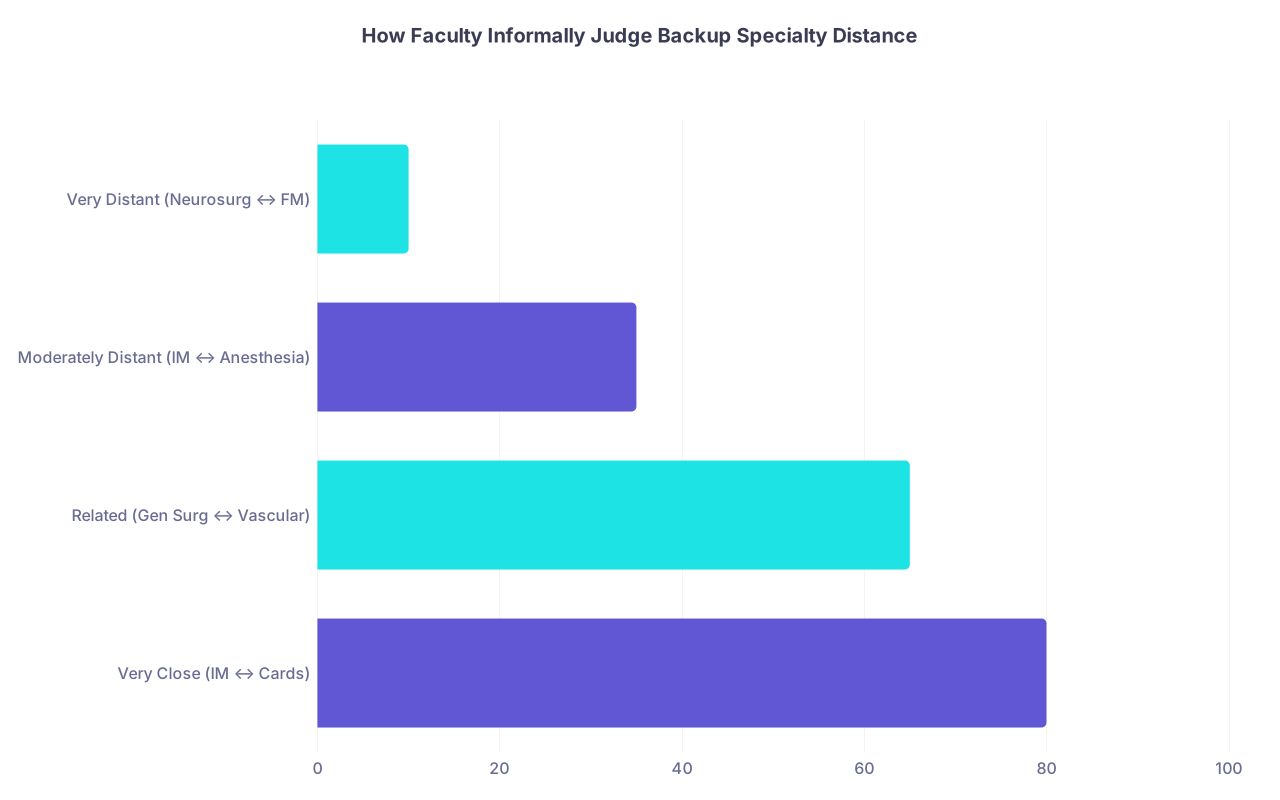
| Category | Value |
|---|---|
| Very Close (IM ↔ Cards) | 80 |
| Related (Gen Surg ↔ Vascular) | 65 |
| Moderately Distant (IM ↔ Anesthesia) | 35 |
| Very Distant (Neurosurg ↔ FM) | 10 |
That chart is the reality: the farther apart your fields look in identity, patient population, lifestyle, and training culture, the fewer faculty buy your “dual passion” story. They won’t say it to your face. They absolutely say it when you leave the room.
What “Too Distant” Really Means (From the People Ranking You)
“Too distant” is not a strict list of forbidden pairs. There’s no secret ACGME rule. It’s more about psychological whiplash.
Here’s how program directors quietly categorize things.
They see specialties as clusters:
- Medicine-like: Internal medicine, pediatrics, neurology, psych, heme/onc, cards, pulm/crit.
- Surgery-like: General surgery, ortho, ENT, neurosurgery, urology, plastics, vascular.
- Outpatient/cognitive: Family med, outpatient psych, many IM/FM/geri practices.
- Procedural but non-surgical: Anesthesia, EM, IR, interventional cards, GI.
- Lifestyle/consult-heavy: Derm, radiology, path, allergy, PM&R (depending on practice).
When your “primary” and “backup” cross multiple clusters with no clear story, that’s when you trigger concern.
Examples that routinely set off alarms in the back room:
- Dermatology ↔ General surgery
- Neurosurgery ↔ Family medicine
- Orthopedic surgery ↔ Psychiatry
- Radiology ↔ Obstetrics & gynecology
- ENT ↔ Pediatrics (with no peds ENT or strong kids narrative)
It’s not that people can’t logically like both. It’s that faculty know what it actually takes to commit to each path. When your application claims you’re “equally passionate,” it often reads as naïve at best, disingenuous at worst.
Now contrast that with pairings that are quietly accepted as realistic:
- Internal medicine ↔ Neurology
- Internal medicine ↔ Anesthesia
- General surgery ↔ Anesthesia
- Pediatrics ↔ Child psych
- EM ↔ Anesthesia
- IM ↔ FM (yes, common and fine if your story matches)
Same student quality, different perception.
How Faculty Actually Find Out About Your Backup (You Think You Hide It Better Than You Do)
You assume they only know about the specialty you applied for at that program. Wrong. There are more leaks than you think.
Here’s how your “backup” gets exposed:
Your letters give you away.
I’ve read IM letters that literally say:
“Although she is strongly considering a career in dermatology, I believe she would be an excellent internist…”
The IM committee then spends 10 minutes asking: “So why are we the backup?”Your personal statements don’t line up.
You tweak a few lines, but the core narrative is different enough that an attending who sits on two committees (yes, that happens) recognizes the split. They talk. Faculty dine out on that kind of gossip all year.You tell the residents.
On interview day, you relax with the residents and say something like, “Yeah, I’m also applying to ortho just to see what happens.” At least one resident will repeat that quote, verbatim, in the post-interview debrief. Residents are not neutral observers.Your ERAS experiences are specialty-skewed.
Twenty ortho experiences, leadership in the Ortho Interest Group, four away rotations in ortho. Suddenly you’re telling an FM program they’re your “top choice.” Nobody believes you.You rank list slip-ups.
Every year someone emails a PD with: “You’re ranked #2 on my list” when they meant to send that to a different specialty entirely. Or they write a “love letter” and forget to change the specialty name. That person becomes a cautionary tale in the faculty lounge for the next five years.
What We Really Think in the Room: Concrete Scenarios
Let me pull back the curtain on a few types of applications faculty argue about. These are modeled on real patterns I’ve seen, with the identifiers blurred.
Scenario 1: Neurosurgery ↔ Family Medicine
Applicant A:
- Two years of neurosurgery research
- Three neurosurg away rotations
- Strong Step 2, borderline neurosurg competitiveness
- Applies FM “as a backup” at home and regionally
What FM faculty say behind closed doors:
- “So… are we just their safety net?”
- “If they don’t match neurosurg this year, are they going to reapply next year from our intern year?”
- “Does this person even like continuity and bread-and-butter outpatient? I don’t see a single primary care-focused experience.”
Result: Many FM programs will rank them, but often lower than their raw metrics would justify, because nobody wants to be the rebound relationship.
Scenario 2: Dermatology ↔ Internal Medicine
Applicant B:
- Derm research, a derm away, derm interest group leadership
- One IM sub-I at home, decent letters
- Writes two different personal statements: one all about skin disease, one generic “I love complex, multi-system illness.”
In the IM rank meeting, the conversation:
- “This looks like a derm person hedging with us.”
- “Will they bolt to a derm spot PGY-2 the second they get the chance?”
- “They’ll be competent, but will they be happy? 3 AM chest pain is a different life than clinic-based derm.”
If they’re strong on paper, they still match IM easily. But they lose out on the very top spots in competitive IM programs that want people clearly committed to academic internal medicine.
Scenario 3: EM ↔ Anesthesia (The Pair Everyone Pretends Not to Notice)
Applicant C:
- EM rotation honors, strong SLOEs
- Also shadowed anesthesia, has an anesthesia letter
- Some programs know they double-applied; others don’t
What PDs quietly think:
- EM PD: “This is fine. EM ↔ Anesthesia is common. They like acute care. They’ll be happy here.”
- Anesthesia PD: “Also fine. If they decide lines and airways in the OR beat chaos in the ED, they’ll stick.”
Distance here is moderate, but the narrative is coherent: “I love acute care, physiology, and procedures.” That throughline saves them.
The Part Nobody Tells You: Risk Calculus From the Program’s Side
Programs are not just picking who’s good. They’re picking who’s likely to stay.
Unfilled spots are poison. They wreck call schedules, continuity clinics, and faculty workload. So any hint that you might be half-in, half-out of the specialty makes people nervous.
Here’s the mental model many PDs run:
| Backup Distance | Perceived Risk You Leave | How They React |
|---|---|---|
| Very Close | Low | Rank as usual |
| Related | Mild | Ask about it in interview |
| Moderately Distant | Moderate | Rank lower than scores alone suggest |
| Very Distant | High | Some will drop you on rank list |
The biggest fear is:
You match. You do one year. You jump ship to your “true love” specialty as a PGY-2.
Now they’re scrambling to fill a PGY-2 spot with an off-cycle transfer. Or worse, they run a resident short for a year. So the more your file screams “I’m not sure,” the more they discount you.
How to Tell a Coherent Story When Your Backup Is Far
Sometimes your backup is distant because your reality is rough: your scores, letters, or late decisions forced your hand. That’s not a moral failing. But you need to stop pretending you can just hide it.
You cannot always hide the distance. You can absolutely control the story.
Here’s what faculty will actually respect.
1. Own the Timeline
The worst thing you can do is imply you’ve secretly wanted both all along, when your CV screams otherwise.
Better:
“I came into clinical years certain I’d do ortho. I did multiple rotations and serious research in it. Midway through MS4, a long-term mentoring conversation and honest reflection about Step scores and the match landscape forced me to consider whether I could be just as fulfilled in internal medicine, where I’d still manage musculoskeletal disease in a longitudinal setting. That’s why you see a heavy ortho footprint early, and more medicine work recently.”
Is that going to make every program director weep with joy? No. But it reads as honest, thoughtful, and adult. That matters more than the perfect fairy tale.
2. Highlight the Shared Core, Not the Superficial
Do not say: “I like working with my hands, whether in the OR or in clinic pap smears.” That sounds like you’re shopping for hobbies.
Find the real shared threads:
- Type of patient relationship (longitudinal vs episodic)
- Tolerance for emergencies vs controlled environments
- Cognitive vs procedural, and why you actually like that mix
- Population you care about (kids, older adults, underserved communities)
If you double-applied between, say, neurosurgery and neurology, the shared core might be: “I’m fascinated by disease of the nervous system and complex neuroanatomy. I realized I’m more drawn to diagnostic puzzles and long-term care than the OR itself.”
That’s believable. Faculty can work with that.

3. Align Your Letters With the Story
The most damaging thing is a letter that exposes your “true” allegiance in a clumsy way.
If you know you need a distant backup:
- Ask letter writers not to speculate about your final specialty choice.
- Encourage language like: “Regardless of the field he ultimately enters, he has the temperament and work ethic to be an excellent physician.”
- Avoid: “I hope she will choose radiology,” in a letter going to EM programs.
Most attendings will happily honor that if you’re up-front with them.
Smart Backup Pairings vs. Self-Sabotage
Let me be blunt: some backup plans are strategic; some are self-own goals. You cannot change how the market behaves by insisting it’s “not fair.”
Here’s how faculty tend to divide them:
Strategic Backup Pairings
Competitive subspecialty ↔ broader base field in same family
Derm ↔ IM or FM
Ortho ↔ General surgery (less common but still surgical family)
ENT ↔ General surgery
Cards fellowship dreams ↔ IMAcute care cluster
EM ↔ Anesthesia
EM ↔ IM-pulm/crit
Anesthesia ↔ IM (if you sell the ICU/physiology angle well)Neuro cluster
Neurology ↔ Neurosurgery
Neurology ↔ Psychiatry (occasionally, with the right psych-neuro story)
These make faculty think: “OK, they know the general domain they love. They’re just flexible about the exact modality.”
Self-Sabotaging Backup Pairings
“I want lifestyle, but also maximum OR time and trauma”:
Derm ↔ Trauma surgery
Radiology ↔ OB/GYN (with no OB/rad bridge)“I want zero continuity and also deeply longitudinal primary care”:
EM ↔ Geriatrics FM, with no coherent thread“I want to be a high-end specialist OR very broad generalist with no bridge”
Neurosurgery ↔ FM, zero neuro-FM work
Interventional cards dreamer ↔ Psych, but all your work is cath lab-focused
Again, could a human genuinely enjoy both ends? Sure. But your training path is not judged on theoretical possibilities. It’s judged on how likely you are to stay and thrive in the program that invests in you.
When You Should Walk Away From the Distant Backup Altogether
Sometimes the most mature choice is to skip applying in a certain cycle rather than throw a dozen totally incongruent applications at the wall.
Here’s the truth no dean of students wants to say out loud:
A bad, desperate match into the wrong field is harder to fix than taking an extra year.
You should seriously consider not using a very distant backup if:
- You’d be actively miserable in that backup field long term.
- You know, in your gut, you’d spend intern year secretly scheming how to reapply to the primary.
- Every mentor in that backup specialty politely tells you: “You don’t seem excited about this.”
Faculty respect the student who says, “I’d rather take a research year and re-apply with a clearer plan,” more than the student who shotgun-applies to three fundamentally different worlds with no coherent story.

| Step | Description |
|---|---|
| Step 1 | Primary Specialty |
| Step 2 | Apply Primary Only |
| Step 3 | Apply Primary + Close Backup |
| Step 4 | Apply with honest narrative |
| Step 5 | Take year for research or reassessment |
| Step 6 | Competitive for it this year |
| Step 7 | Backup in same cluster available |
| Step 8 | Would you be content long term in distant backup |
How to Talk About a Distant Backup in Interviews Without Digging a Hole
If you’re already committed to a distant backup scenario this cycle, you need language that doesn’t sound flaky or dishonest.
When someone asks: “So, are you applying to other specialties?” you have three realistic options:
If you are NOT double-applying:
“Earlier in medical school I considered X seriously, and that’s why you see those rotations and research. Over the last year I became convinced that Y is a better match for who I am day to day. I’m applying only to Y this cycle.”Faculty love this. It shows growth and a decision.
If you ARE double-applying within a related cluster:
“I applied to both X and Y, which live in the same broad clinical space I love. I’m drawn to acute care/procedures/longitudinal relationships; each offers that in a different balance. If I match here in X, I will commit fully to being the best resident I can be in this field.”They will test your conviction. Your body language and the specificity of what you like about their field will decide if they believe you.
If you ARE double-applying with a truly distant backup:
Do not lie. But craft it like this:
“Given my Step scores and competitiveness this year, I had to be realistic. My long-time interest has been X, and that’s why you see so much X on my CV. After serious conversations with mentors, I added Y as an option where I can still see myself being content and useful, especially because of [concrete tie: patient population, type of thinking, clinic vs hospital]. If I match in Y, I’m not using it as a stepping stone—I’ll build a career there.”
Will some PDs still drop you lower? Yes. But lying or pretending they’ll never find out is worse. PDs talk. Residents watch. Your best asset is coherent honesty.

Frequently Asked Questions
1. If I already did tons of work in a different specialty but decided late, should I hide it or lean into it?
Lean into it with a clear narrative. Trying to bury previous work looks evasive and faculty will still see the old specialty all over your experiences, publications, and letters. Say, in plain language, how your understanding evolved, what you learned from that prior field that you’ll bring to this one, and why you’re now committed here. Mature pivot > awkward cover-up.
2. Will a distant backup always hurt my chances in the backup field?
Not always. In many community or less competitive programs, if you look hard-working, normal to work with, and academically safe, they’ll happily take you even if you once chased a very different dream. Where it hurts you most is at highly competitive, identity-driven programs that want future lifers in their field. The distance matters more as program prestige and competitiveness go up.
3. Is it ever smart to apply three different specialties in one cycle?
Almost never. From the inside, that reads as “I just want a job; any white coat will do.” If your application is scattered enough that three different specialties look plausible, you don’t have an application problem—you have a career counseling problem. At that point, a focused extra year (research, prelim, or structured advising) to clarify your direction is usually safer than leaving a triple-application trail you’ll spend years explaining.
Key takeaways:
Distant backups are not automatically fatal, but they do change how your application is interpreted by people who care about commitment and retention. The farther apart your fields look, the more you must offer a coherent, honest timeline and shared core to make sense of your path. And if the only reason you’re considering a field is “it might take me,” stop and think hard. You’re not just trying to match. You’re trying to build a career you can live with when the interview suits are back in the closet and the real work begins.