
It is late February. You have just certified your rank list. The portal shows a green checkmark and a timestamp, and now there is nothing to do but wait for Match Week.
Which is exactly when you should be doing the most important work for your backup plan.
At this point you should assume one thing: you might not match your primary specialty. Not because you are weak. Because the numbers are ugly, SOAP is fast, and the people who do best in SOAP are the ones who treated it like an application cycle, not a fire drill.
This is your step‑by‑step timeline to pre‑build a rational, targeted backup specialty plan before results hit.
4–6 Weeks Before Match Week: Reality Check and Backup Framework
At this point you should stop thinking in vibes and start thinking in data.
Step 1: Brutal risk assessment (1 evening)
Sit down with:
- Your USMLE/COMLEX scores
- Your transcript and MSPE
- Your primary specialty’s NRMP Charting Outcomes data
- Your advisor (ideally someone honest, not just “supportive”)
You are answering one question: How likely is a clean match in your primary specialty?
You want hard numbers, not hope. Look at:
- Your Step 2 relative to the median matched applicant in your specialty
- How many interviews you actually got (not how many you “feel good about”)
- Whether you got interviews only at low‑fill, newer, or prelim‑heavy programs
If you applied to something like ortho, derm, plastics, ENT, or integrated vascular with:
- Step 2 < 245 (MD) / < 240 (DO/IMG)
- Fewer than ~10 real interviews
- No strong home‑program support
You should plan as if SOAP is likely. Not theoretical. Likely.
Step 2: Define what you actually can pivot into
At this point you should list possible backup specialties that:
- Commonly have SOAP positions
- Will reasonably accept your background
- Do not require an entirely different CV (for example, years of psych research)
Typical realistic SOAP‑available categories:
- Internal Medicine (categorical & prelim)
- Family Medicine
- Pediatrics (variable but often some SOAP spots)
- Psychiatry (becoming tougher, but still present)
- Prelim Surgery / Prelim IM
- Transitional Year (very competitive, but a few SOAP seats appear)
You want 2–3 realistic options, not seven fantasies.
| Backup Type | Typical SOAP Availability | Competitiveness vs Primary | Good For |
|---|---|---|---|
| Internal Medicine | High | Less competitive | Most unmatched in any field |
| Family Medicine | High | Less competitive | Broad primary care interest |
| Pediatrics | Moderate | Less competitive | Genuine peds interest |
| Psychiatry | Moderate | Increasingly competitive | Strong psych story |
| Prelim Surgery | High | Variable | Surgery‑bound, need a year |
You are not “picking a forever specialty” here. You are building:
- A set of SOAP targets you can explain honestly
- A plan that keeps doors open for what you ultimately want
3–4 Weeks Before Match Week: Choose and Rank Your Backup Paths
At this point you should stop saying “I’ll just SOAP into something” and define exactly what “something” is.
Step 3: Choose your primary backup specialty (1–2 days)
Pick one main backup specialty that will be your first line in SOAP. Criteria:
- Historically has unfilled positions
- Has a plausible narrative from your current CV
- Does not hate your original primary specialty
Examples that work well:
- Ortho / neurosurgery applicant → Prelim Surgery, Prelim IM, maybe IM categorical
- Dermatology applicant → Internal Medicine, Prelim IM, occasionally Psych
- EM applicant → IM categorical, Family Medicine, Prelim IM
Examples that cause problems:
- Ortho applicant with zero psych exposure suddenly pivoting into Psych with no explanation
- Derm applicant with zero primary care experience pivoting into FM because “there are jobs”
If you cannot give a two‑sentence believable reason for why this backup specialty fits you, do not pick it as your primary backup.
Step 4: Define secondary backups and “bridge” options
You need a hierarchy:
- Primary backup specialty (what you will prioritize in SOAP)
- Bridge options that keep your original dream alive (prelim IM / prelim surgery / TY)
- Last‑resort categorical options that you can live with as a career if needed
Example: Unmatched ortho applicant
- Primary backup: Prelim Surgery (strongest connection)
- Bridge: Prelim IM, Transitional Year (if available)
- Last‑resort categorical: Internal Medicine categorical, Family Medicine
Write this hierarchy down. You will need it Monday of Match Week when the clock starts.
2–3 Weeks Before Match Week: Data Mining and Target List Building
Now that you have your specialties, you need names. Real programs. Actual targets.
At this point you should build a dynamic “likely SOAP” list before the SOAP list is public. You can not predict perfectly, but you can build smart guesses.
Step 5: Identify historically SOAP‑heavy programs (1–2 evenings)
Use:
- NRMP “Results and Data” from the last few years
- Program fill rates in your chosen backups
- Word of mouth from recent grads / upperclassmen / advisors
Look for:
- Programs that have unfilled positions more than once in 3–4 years
- Newer programs or community‑heavy programs
- Places in less popular geographic areas (Midwest, South, rural)
Build a spreadsheet with:
- Program name
- City / state
- Specialty (IM, FM, prelim, etc.)
- Past unfilled history (Yes/No, which years)
- Website contact info
This will become your rapid‑fire contact list during SOAP.
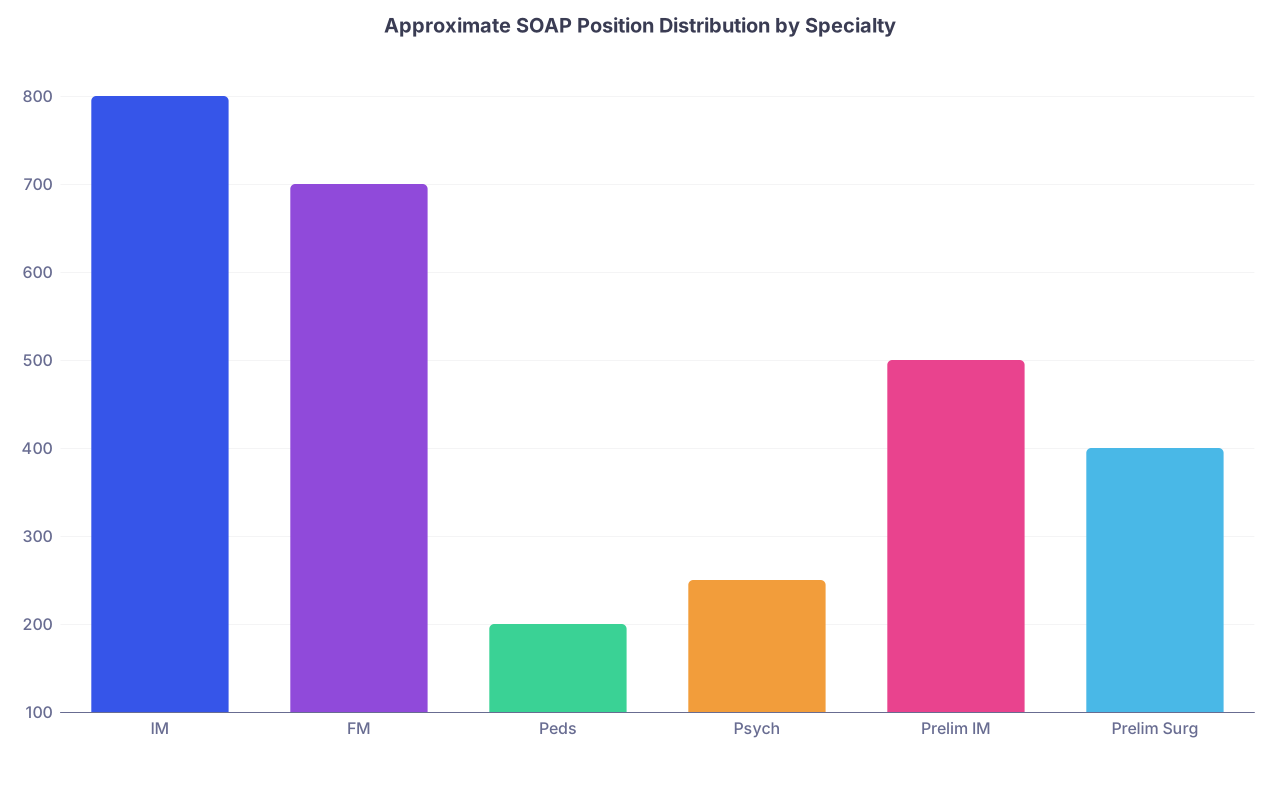
| Category | Value |
|---|---|
| IM | 800 |
| FM | 700 |
| Peds | 200 |
| Psych | 250 |
| Prelim IM | 500 |
| Prelim Surg | 400 |
You are not trying to be perfect. You are trying to avoid wasting the first SOAP hour Googling phone numbers.
Step 6: Map your competitiveness within backups
At this point you should be honest again: within your backup specialty, are you mid‑range or marginal?
For each backup specialty, flag yourself:
- Green – Competitive for many SOAP‑level programs
- Yellow – Borderline, need strong story / geography flexibility
- Red – Risky even in SOAP (for example, serious professionalism issues)
Use:
- Your Step 2 vs that specialty’s usual SOAP pool (ask advisors who sit on committees; they know)
- Any red flags (course failures, LOA, leaves, major gaps)
Then rank your programs by:
- How likely they are to SOAP
- How realistic they are for your profile
- How much you could actually tolerate living and working there
10–14 Days Before Match Week: Application Materials Rebuild
SOAP has a brutal rhythm: very short windows, pre‑set application materials, and little time to think. People who do well have pre‑written, specialty‑specific materials ready to upload.
At this point you should be rewriting, not writing from scratch.
Step 7: Write backup‑specific personal statements (2–3 days)
You need at least two backup personal statements:
- One for your primary backup specialty (IM / FM / Peds / Psych etc.)
- One for your “bridge year” options (prelim IM, prelim surgery, TY)
Rules:
- Do not trash your original specialty. Ever.
- Do show a coherent thread: skills, patient population, values that clearly align with the backup.
- Do not write like a hostage letter: “I always loved every specialty equally.” No one believes that.
Example structure for a surgery‑to‑IM pivot PS:
- Brief opening clinical story that shows deliberate, thoughtful care (not “I love procedures”)
- One paragraph acknowledging your exploration of surgery but discovering that you value longitudinal relationships, diagnostic complexity, or systems‑level thinking more
- One paragraph tying past concrete experiences to IM (sub‑I, complex medicine patients, ICU)
- One paragraph on career goals that fit IM (hospitalist, cards, pulm, etc.)
For your prelim/TY PS, center on:
- Desire for solid clinical foundation
- Work ethic and reliability
- Willingness to support the team and handle high volume
- Openness about eventual career goal without sounding like you are using them as a stepping stone (this is a thin line, but you can walk it)
7–10 Days Before Match Week: LOR Strategy and Communication
At this point you should lock down who will vouch for you in your backup field.
Step 8: Secure aligned letters of recommendation (1 week buffer)
You cannot change what is already uploaded, but you can add.
Ask for:
- 1–2 letters from attendings in your backup specialty (IM, FM, Peds, Psych, etc.)
- 1 letter from a sub‑I or acting internship in that specialty, if you have it
- If you lack that, then a strong, generic “work ethic and team player” letter from any inpatient rotation
Be very clear in your ask:
- Tell them you may be participating in SOAP.
- Tell them which specialties you might be applying to.
- Ask them to avoid making your letter “EM‑only” or “Derm‑only” if possible.
You want:
- Letters that emphasize: reliability, teachability, communication, clinical reasoning, team fit.
- Minimal “this student is destined to be a neurosurgeon” language if you are pivoting to IM.
1 Week Before Match Week: SOAP Logistics and Communication Plan
Now you build the operational side. The mechanics of SOAP can wreck otherwise solid candidates.
At this point you should be treating SOAP like a high‑stakes, time‑boxed project.
Step 9: Understand the SOAP timeline cold
Pull your school’s SOAP schedule and NRMP’s official times. Then map out your week.
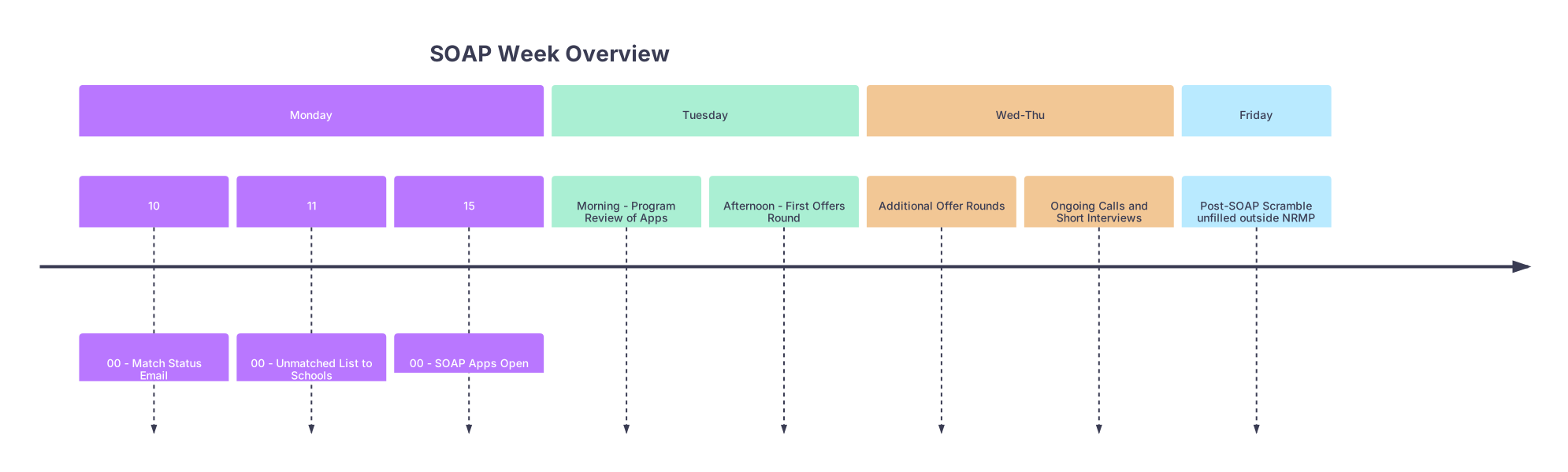
| Period | Event |
|---|---|
| Monday - 10 | 00 - Match Status Email |
| Monday - 11 | 00 - Unmatched List to Schools |
| Monday - 15 | 00 - SOAP Apps Open |
Know:
- Exactly when you will learn if you are unmatched / partially matched
- When SOAP applications open
- When offer rounds occur
- How many applications you can send per SOAP round (usually limited)
Block your calendar. Cancel everything unnecessary. If you have clinical duties, tell your clerkship director now that you may need sudden time off that week.
Step 10: Draft your communication scripts
During SOAP, dozens of short, awkward conversations happen very fast:
- Emails to PDs
- Phone calls to coordinators
- Two‑minute “micro‑interviews” on Zoom or phone
At this point you should have templates ready:
Intro email to PD / coordinator
- Who you are
- Why their program + specialty
- 2–3 concrete strengths
- Attached CV (have a SOAP‑ready CV in PDF)
30‑second verbal pitch
- “I was originally applying in X. Through that process I realized Y. I have strong experience in Z that I believe fits your program because…”
Answer to “Why this specialty now?”
- Clear, honest, not panicked, no bitterness toward your original field.
Write them. Practice them. You should not be improvising with the PD of a program that has 200 SOAP applicants for 3 spots.
3–5 Days Before Match Week: Final Backup Alignment and Mental Rehearsal
At this point you should finalize the list of what you will prioritize if you do not match. No more “I’ll see how I feel.”
Step 11: Lock in your priority tree
Make a one‑page document with:
Scenario A – Fully Unmatched
- Top priority: [Backup Specialty A] programs with historically unfilled positions
- Secondary: Bridge years (prelim IM/surgery, TY)
- Tertiary: Last‑resort categorical (FM, IM, etc.)
Scenario B – Partially Matched (advanced but not prelim or vice versa)
- If you have an advanced position but no prelim: heavy focus on prelim IM/surgery/TY in SOAP
- If you have a prelim but no advanced: decide if you are willing to keep it and reapply or pivot to categorical backup now
Scenario C – Geographic deal‑breakers
- Think through how far you will go (rural, very small town, extremely cold/remote) before you say no
You must decide beforehand where your line is between:
- Any residency is better than no residency
- This specific situation would be so miserable that I would rather retool and try again
There is no universally correct answer, but “I will decide in the moment” is how people panic‑accept something they regret for years.
Match Monday Morning: Live Execution Using Your Pre‑Built Plan
It is Monday, 10:00 a.m. Eastern. Your email says “We are sorry, you did not match.” Your pulse spikes. Everyone else is either cheering or crying in the hallway.
This is the moment you built this entire plan for.
At this point you should:
- Take 30–60 minutes away from the crowd.
- Pull up your priority tree and program spreadsheet.
- Meet with your dean / advisor as soon as they get the SOAP list.
Step 12: Rapid alignment with the real SOAP list
Compare:
- Your predicted SOAP programs vs the actual SOAP list.
- Your prewritten backup specialty priorities vs what fields actually have seats.
With your advisor:
- Identify the highest‑yield programs in your primary backup specialty first.
- Cross off any places with clear deal‑breakers (visa, DO/IMG restrictions, minimum scores you do not meet).
- Fill up your first SOAP round applications with the best mix of:
- Primary backup specialty
- Bridge prelims/TY
- Last‑resort categoricals (if you are willing to go that far in Round 1)
Because you pre‑built this, you are making strategic tweaks, not starting from zero.
Step 13: Deploy your prewritten materials
As soon as applications open:
- Upload the correct personal statement for each specialty bucket.
- Confirm your LOR setup is appropriate (at this point, you will live with what is there).
- Start your email/phone reach‑outs using your templates, prioritized by:
- Programs you genuinely want
- Programs where you have any connection
- Programs with a history of being responsive during SOAP (ask older classes)
You are now executing. Not improvising.
What You Should Be Doing Right Now (If You Are 4–6 Weeks Out)
If you are reading this and Match Week is still a dot on the calendar, here is your immediate checklist:
- Tonight – Do a risk assessment: scores, interviews, advisor opinion. Admit if SOAP is a real possibility.
- Within 3 days – Pick 1–2 realistic backup specialties plus any bridge options. Write down a short, honest rationale for each.
- Within 1 week – Build a spreadsheet of likely SOAP‑available programs in those fields. Start with past unfilled programs.
- Within 10 days – Draft at least 2 new personal statements (backup specialty + prelim/TY).
- Within 2 weeks – Ask targeted letter writers to upload more general or backup‑friendly letters.
- Before Match Week – Map the SOAP schedule, clear your calendar, and rehearse your 30‑second pitch for each backup path.
You will not regret having done this work. You might be thrilled on Match Day and delete all of it. Fine. That is the best‑case scenario.
But if the email says “You did not match,” you will not be one of the people staring at a blank screen, trying to figure out what “Family Medicine” actually does while the first SOAP round clock runs out.
Key Takeaways
- You build a strong SOAP backup plan weeks before results, not on Monday at 10:01 a.m.
- Pick specific backup specialties and bridge options you can credibly explain, then pre‑write targeted statements and communication scripts.
- The goal is simple: when the status email hits, you are not deciding what to do. You are executing a plan you already thought through calmly.