
It is mid-February. Your last interview ended a week ago. ERAS is closed. The NRMP rank list deadline is staring you in the face.
Your problem is not the top of your list. You know your #1–#5. The problem is the bottom.
You are asking yourself:
- Do I keep only my dream specialty and risk going unmatched?
- Do I add a true backup specialty?
- Is it too late to adjust anything?
This is “rank list month.” At this point you are not “applying” anymore. You are managing risk. Your backup strategy now can decide whether you start residency this July or spend next year scrambling.
Let’s walk through this in time order: what you should do in the 4–6 weeks before the rank list deadline, week by week, then the final days and hours.
4–6 Weeks Before Rank Deadline: Reality Check and Data Pass
At this point you should stop guessing about your odds and get specific.
Step 1: Quantify Your Risk Profile (Days 1–3)
You start with an honest assessment. No fluff, no “my friend matched with less.” Just data.
List out:
- Specialty you are targeting
- Number of programs interviewed at
- USMD / DO / IMG status
- Step 2 score (or CK if Step 1 is pass/fail)
- Class rank / AOA / any red flags (leave, fail, probation, late scores)
Now anchor yourself against something objective.
| Profile | Specialty | Interviews | Risk Level |
|---|---|---|---|
| A | Internal Medicine | 18 | Low |
| B | General Surgery | 10 | Moderate |
| C | Dermatology | 5 | Very High |
| D | Anesthesiology | 7 | Moderate-High |
| E | Orthopedics | 6 | Very High |
I have seen people with “B” type profiles match fine. I have also seen people with “C” profiles end up unmatched even with apparently “great” interviews.
Rough rule of thumb that actually tracks with experience:
- Non-competitive specialties (IM, Peds, FM, Psych):
10–12 interviews → generally safe - Mid-range (EM, Anesthesia, OB/Gyn, General Surgery community-heavy list):
12–14 interviews → safer, under 8 → risk - Hyper-competitive (Derm, Ortho, ENT, Plastics, Neurosurg, Rad Onc):
Under 8 interviews → you are in genuine danger of not matching
Not gospel. But if you are under those numbers, you need to think backup, not “manifesting.”
Step 2: Map Your Specialty to Realistic Backup Options (Days 3–5)
If you did not build a formal backup specialty during application season, you are in cleanup mode.
Some common, realistic backup pairings:
| Primary | Common Backup |
|---|---|
| Ortho / Neurosurg | General Surgery, Transitional Year |
| Derm / Rad Onc | Internal Medicine, Prelim Medicine |
| ENT / Plastics | General Surgery, Prelim Surgery |
| EM | Internal Medicine, Family Medicine |
| Anesthesia | Internal Medicine, Prelim Medicine |
| General Surgery | Prelim Surgery, IM |
Now the unpleasant truth:
Rank month is too late to apply to a second specialty. That ship sailed with ERAS.
But you still have three levers you can pull:
- How you rank programs within your primary specialty (aim for safety vs prestige)
- Whether you include prelim / TY options as partial backup
- How you prepare for SOAP if you do go unmatched
So your “backup strategy” now is less “new specialty” and more “how do I avoid an unnecessary zero on Match Day.”
3 Weeks Before Rank Deadline: Sort Programs by Safety, Not Ego
At this point you should stop arguing with yourself about whether Program X “feels” good and start sorting based on match likelihood.
Step 3: Triage Your Interviewed Programs (Days 1–3 of Week 3)
Open a spreadsheet. One row per program. Four extra columns:
- Competitiveness tier (Reach / Reasonable / Safer)
- Geographic desirability (High / Medium / Low)
- Your interview gut feeling (Strong / Neutral / Weak)
- Program type (University, University-affiliated, Community, Prelim/TY)
Be ruthless:
- “Reach” = top academic places, highly desirable cities, or programs that usually fill with AOA / 260+ scores
- “Safer” = community-heavy, mid-tier university, less popular locations, historically fill lower on their list
You are creating your personal risk map, not a US News ranking.
Now count:
- Reaches
- Reasonable
- Safer
If you are in a competitive specialty and your list is 80% reach, you are setting yourself up for a bad March.
At this point you should:
- Accept that the rank algorithm favors your true preference order
- But also accept that if you rank 12 ultra-competitive programs and 0 community or prelim spots, the algorithm cannot pull a rabbit out of a hat for you
Step 4: Decide Your Personal Risk Tolerance (Days 3–5 of Week 3)
This is not theoretical. Write this down in one sentence:
- “I am willing to risk going unmatched if I cannot be in [specialty X] at [type of program].”
OR - “I would rather match somewhere in [primary specialty] than risk unmatched.”
OR - “I must be in [geographic region] even if it means preliminary / different specialty later.”
If you are:
- Couples matching
- Visa needing
- Non-US grad
- Carrying significant loans and family responsibilities
You have less room to be heroic. Whether you like that or not.
Once you have that sentence, it becomes your filter for tough choices lower on the list.
2 Weeks Before Rank Deadline: Structuring Your List, Top to Bottom
Now you have data and an explicit risk tolerance. At this point you should put programs in actual order instead of endlessly “thinking about it.”
Step 5: Anchor the Top Third of Your List (Days 1–2 of Week 2)
Top third = programs you would be thrilled with. Do not get cute here.
Order these based on:
- Training quality for your goals
- Program culture fit
- Geography for you (and your partner if couples matching)
- Mentorship and fellowship opportunities if you care about subspecializing
Ignore speculation like “I think I was lower on their interview day” or “the PD did not email me.” I have seen people convince themselves a program would never rank them high and then match there.
Rank these purely by preference. Let the algorithm do its job.
Step 6: The Middle Third – Where Backup Strategy Actually Lives (Days 3–4 of Week 2)
Here you blend preference with risk.
This block should be a mix of:
- Reasonable academic and strong community programs
- Less desirable geography you would still genuinely attend
- Programs where your chances are higher than your top tier
If you are in a high-risk category (few interviews / hyper-competitive specialty):
- Push your “safer” programs higher into this middle third
- Accept that a medium city you did not love is better than a gap year you will hate
For example:
- Ortho applicant with 6 interviews at mixed programs
- Top 3: your favorite academic places
- Middle 3: strong community programs and any program that seemed especially enthusiastic about you
That middle block is where you can avoid SOAP.
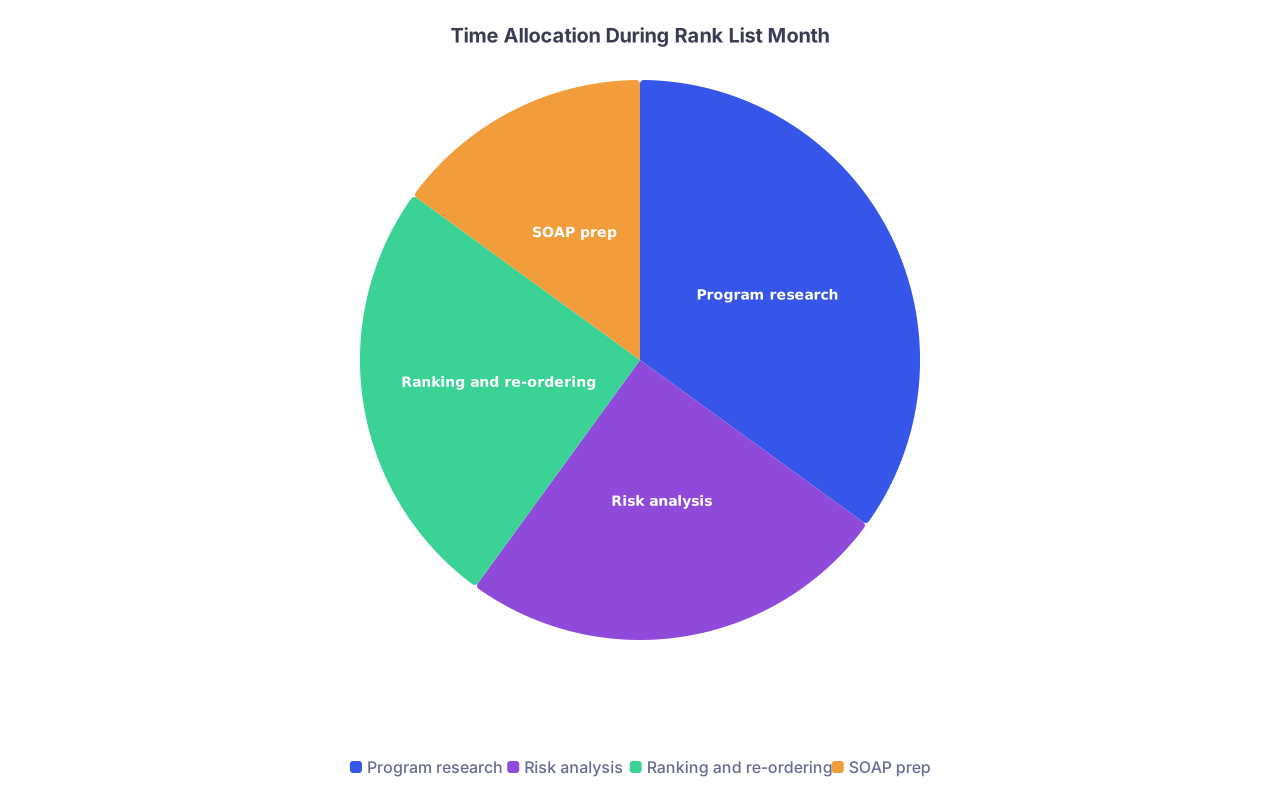
| Category | Value |
|---|---|
| Program research | 35 |
| Risk analysis | 25 |
| Ranking and re-ordering | 25 |
| SOAP prep | 15 |
Step 7: The Bottom Third – True Backups and Prelims (Days 4–6 of Week 2)
This is where people blow it.
You should be asking: “If I get my #18 instead of going unmatched, am I okay with that?”
If the honest answer is “no,” remove it. Never rank a program you are not willing to attend.
For backup structure:
- In primary specialties with prelim options (surgery, anesthesia, derm, etc.):
- Rank categorical programs first
- Then prelim/TY programs you interviewed at that keep doors open for re-application
- In non-procedural fields (IM, Peds, Psych, FM):
- Usually less about prelims, more about including lower-desirability geography or smaller community programs
At this point, if you are extremely worried about not matching:
- Consider pushing a few of your safest programs above some “sexy” but very risky programs you were lukewarm about
- I have seen people put 8 reach programs above 3 solid community programs, then be shocked when they matched nowhere. The algorithm cannot save you from your own ranking.
1 Week Before Deadline: Stress Test and SOAP Backup
Now your list exists in draft form. At this point you should try to break it.
Step 8: Do a “Regret Test” Scenario Run (Days 1–2 of Final Week)
Imagine two email subject lines on Match Monday:
- “Congratulations, you matched at [Program #16].”
- “We are sorry, you did not match to any position.”
For each program from the bottom up, mentally compare:
- Would I prefer unmatched + SOAP chaos + reapplication?
- Or this actual program for the next 3–7 years?
If you would honestly choose unmatched over that program, delete it from your list.
This is not hypothetical. I have seen PGY-1s spend a full year miserable because they ranked programs they never actually wanted, “just in case.” That “just in case” turned into reality.
Step 9: Quietly Prepare a SOAP Plan (Days 2–4 of Final Week)
You hope not to use this. You might still need it. Preparing now does not “jinx” anything; it just makes you less desperate.
Tasks:
- Draft a 1–2 paragraph generic SOAP personal statement for your likely backup field (IM/Prelim/Transitional, etc.)
- Update CV to be SOAP-ready (PDF and Word)
- Make a short list of faculty who can upload letters quickly if needed
- Read your school’s SOAP protocol (many have detailed Match Week playbooks—know where they are)
You are not applying yet. You are just removing 12 hours of panic work from a week that is already brutal.
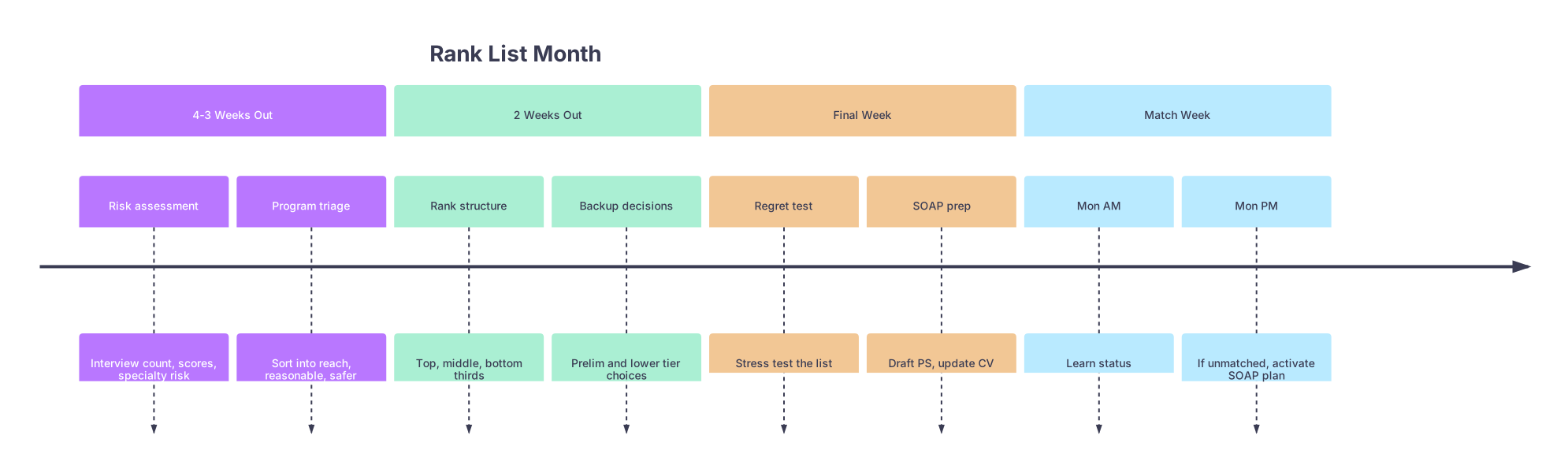
| Period | Event |
|---|---|
| 4-3 Weeks Out - Risk assessment | Interview count, scores, specialty risk |
| 4-3 Weeks Out - Program triage | Sort into reach, reasonable, safer |
| 2 Weeks Out - Rank structure | Top, middle, bottom thirds |
| 2 Weeks Out - Backup decisions | Prelim and lower tier choices |
| Final Week - Regret test | Stress test the list |
| Final Week - SOAP prep | Draft PS, update CV |
| Match Week - Mon AM | Learn status |
| Match Week - Mon PM | If unmatched, activate SOAP plan |
Final 72 Hours Before Rank List Deadline: Locking It In
Now you are in the danger zone where overthinking does more harm than good.
Step 10: Last Faculty / Advisor Review (72–48 Hours Before)
At this point you should get one or two experienced eyes on your list.
Good choices:
- Specialty advisor in your chosen field
- Dean of student affairs / residency advisor
- Trusted resident in your specialty who is willing to be blunt
Send them:
- Your full rank list
- Your interview count, scores, and risk profile
- Your written risk tolerance sentence
Ask them one clear question:
“Given my risk profile and priorities, does this list expose me to unnecessary risk of going unmatched?”
If they say “yes,” listen. Especially if they point to:
- Too many reaches at the top for your stats
- Under-ranking reliable community programs
- No prelims / TY spots in procedural specialties
Do not crowdsource this on Reddit or group chats. They know nothing about your actual file.
Step 11: Technical Sanity Check (48–24 Hours Before)
The dumb mistakes are predictable. And avoidable.
Go into NRMP and verify:
- Every program on your list is the correct NRMP number (people mix up categorical vs prelim often)
- Categorical programs are ranked before their corresponding prelims if both are needed
- Couples match links are correct and you understand how the pairings work
Take screenshots or print your final list. Just in case.
Step 12: Final Emotional Pass – Then Stop (24–0 Hours Before)
Last day. You are going to feel like moving things around “just to optimize.” This is where people sabotage themselves.
Your job now:
- Read your list top to bottom once.
- Ask yourself: “From #1 down to the last, is this the true order in which I would want to match?”
- Make only major corrections (a program you completely forgot about, a clear mis-order you suddenly recognize).
- Re-certify the list.
Then walk away. No midnight revisions. No changing it from your phone in line at the grocery store. I have seen last-minute “gut feelings” destroy well-thought-out lists.
Special Cases: When Backup Strategy Has to Be Aggressive
A few situations where you should deliberately bias hard toward safety.
Case 1: Very Few Interviews in a Competitive Specialty
Example: USMD, Step 2 = 245, applying Derm, 4 interviews total.
At this point, your “backup strategy” is not another specialty on the rank list. It is:
- Ranking all 4 derm programs in true preference order
- Accepting that odds are not great
- Being very ready for SOAP (likely in IM or TY) and re-application with a strong research / PGY-1 year
Do not pretend 4 derm interviews = high safety. They do not.
Case 2: Strong Candidate but Extreme Geographic Limits
Example: You refuse to leave one metro area because of family / custody / dual-career issues.
Be honest with yourself:
- If there are 3–4 programs total you are willing to attend, your “backup” is actually a career / life decision, not a specialty one
- Rank all acceptable programs in true order
- Then be very prepared emotionally and logistically for the unmatched + re-apply or alternative path outcome
Backup strategy here may include non-NRMP options next year, research fellowships, or changing fields entirely.
Case 3: Red Flags (Failures, Leaves, Major Gaps)
If you have a Step failure, extended LOA, or professionalism issue, you are not in the same risk bucket as your classmates with similar scores.
Your list should:
- Include more community and lower-competition programs high on the list
- Possibly include prelims / TY if in a procedural specialty
- Be reviewed by someone who has actually helped red-flagged students match before
I have watched red-flagged students match safely because they ranked realistically, while “clean” applicants unmatched because their lists were fantasy football.
Key Takeaways
- Rank month is not about being bold. It is about aligning your true preferences with your actual risk profile, then living with that choice.
- The bottom third of your list is where backup strategy lives. Never rank a program you would rather not match at all than attend.
- Quiet SOAP preparation before the deadline is not negativity. It is professionalism.