The worst time to decide your backup specialty is after ERAS opens.
You need to start this work in MS3 spring. Not in some vague “I’ll figure it out later” way. In a structured, time-bound, week-by-week way.
Below is exactly when and how to start seriously planning backup specialties from MS3 spring through ERAS submission.
Big Picture Timeline: When Backup Planning Actually Matters
At this point you should understand one thing: backup planning is not optional in competitive fields. It is risk management.
Here is the rough calendar reality for a typical 4th-year application cycle:
| Phase | Typical Timing |
|---|---|
| MS3 Spring | Mar–May |
| MS3 Late Summer/Fall | Aug–Nov |
| Dedicated Step 2 CK | Late MS3 / Early MS4 |
| ERAS Opens | June |
| ERAS Submission | Sept |
Backup specialty planning needs to start in MS3 spring and be essentially decided by mid–late July at the latest. Anything later than that and you will be scrambling for letters, rotations, and a coherent narrative.
Let me walk you month by month.
March–April of MS3: Quiet Reconnaissance, No Drastic Moves Yet
At this point you should stop pretending everything will magically work out and start gathering honest data.
Week 1–2: Reality Check and Competitiveness Snapshot
You should take a hard look at:
- Step 1 result (if scored) or pass/fail + school reputation
- Clinical evaluations so far
- Any red flags (LOA, remediation, professionalism comments)
- Current specialty interest(s) and how competitive they are
Do this in one sitting. No multitasking. Pull up your transcript, exam scores, and a blank document.
Ask yourself three direct questions:
- What is my current top-choice specialty?
- How competitive is it nationally?
- Do my metrics so far align with recent matched applicant data?
Use NRMP Charting Outcomes and program websites, not rumor from classmates.
If you are aiming for anything in this list, you should assume you will need a backup plan:
- Dermatology
- Orthopedic surgery
- Plastic surgery
- Neurosurgery
- ENT
- Ophthalmology
- Integrated vascular / CT surgery
- Some high-demand programs in EM, radiology, anesthesia, or OB/GYN, depending on your school/metrics
You do not need to abandon your dream now. But you do need to admit whether you are in the “solid shot,” “borderline,” or “long shot” group.
Week 3–4: Start Building a Shortlist of Plausible Backups
At this point you should generate 3–4 backup specialty options, not to commit to yet, but to investigate.
Filter using:
- Lifestyle tolerance (call, nights, clinic vs procedure balance)
- Overlap with your primary specialty
- Training length you can live with
- Geography flexibility (are you willing to move anywhere for a less competitive field?)
| Primary Goal | Common Backups |
|---|---|
| Ortho | PM&R, IM |
| Derm | IM, Pathology |
| Neurosurgery | Neurology, IM |
| ENT | IM, FM |
| EM | IM, FM |
| OB/GYN | FM, IM |
You are not promised any of these. But these pairings tend to leverage similar interests and are believable in a personal statement.
Action steps for this month:
- List 3–4 backup specialties in a document.
- For each, write 3 bullet points: “Why this makes sense for me.”
- Flag 1–2 that seem most realistic and not miserable to you.
May of MS3: Serious Exploration, Not Casual Daydreaming
By May, you should move from “ideas” to data collection by contact with real humans.
First Half of May: Targeted Conversations
At this point you should schedule 30-minute meetings with:
- Your school’s specialty advisor for your primary choice
- At least one faculty member in each potential backup specialty
- Your Dean’s office / career advisor
You are not asking, “Can I match?” You are asking:
- “Given my current performance, should I plan a dual-application strategy?”
- “If I apply to [X] as primary and [Y] as backup, what does my 4th-year schedule need to look like?”
- “What have successful dual applicants at our school actually done?”
I have watched students walk into these meetings in August. That is late. You want this done by end of May.
Second Half of May: Early Structure for MS4
By now you should have one of three conclusions:
No backup specialty needed
- Reasonable competitiveness for a non-hyper-competitive specialty
- No major red flags
- Strong faculty advisor saying “single application is reasonable”
Soft backup plan (apply broadly in your primary, plus a true backup specialty if things deteriorate)
- Borderline for primary, but with some upside (research, strong letters)
True dual application plan (two specialties from the start)
- Clearly mismatched metrics vs primary (e.g., 210 Step 1 trying for neurosurgery)
- Or late switch interest in a competitive field without a portfolio
At this point you should outline 2–3 possible 4th-year schedules that include:
- At least 2 audition/away rotations in your primary specialty
- 1–2 home or away rotations in your backup specialty if dual applying
- One block for Step 2 study / exam
You do not need final dates yet. But you must know what categories of rotations you need.
June (End of MS3): Make the Backup Decision, Not Later
This is the anchor month. By the end of June, you should have:
- A decided primary specialty
- A decided plan regarding backup specialties:
- No backup, or
- Soft backup, or
- Full dual application
Waiting beyond June guarantees rushed letters and incoherent narratives.
Week 1–2 of June: Hard Commit on Strategy
At this point you should sit down—again—with your key advisor and say:
- “I am planning [single / dual] application between [Specialty A] and [Specialty B].”
- “I will prioritize these rotations: [list]. Does this align with what your successful applicants did?”
Then, document your plan:
- Primary specialty: ___
- Backup specialty (if any): ___
- Planned number of programs for each: ___ / ___
- Required letters for each: ___ vs ___
- Rotations needed for each: ___ vs ___
This is boring spreadsheet work. Do it anyway.
Week 3–4 of June: Secure Rotations and Letter-Writers
At this point you should actively:
- Lock in home rotations for both specialties if dual applying
- Identify 3–4 potential letter writers in your primary, 2–3 in your backup
- Tell those faculty your realistic plan
You say something like:
“I am primarily pursuing ENT but, given my metrics, my advisors have also recommended IM as a backup. I wanted you to be aware early, since I may request a letter for ENT and might also need guidance if I end up committing to IM.”
Nobody is offended by honesty. They are annoyed by last‑minute panic in September.
July (Early MS4): Align Your Story and Paperwork with the Plan
By July, at this point you should be executing, not still “deciding.”
Early July: Draft Two Parallel Narratives (If Dual Applying)
You cannot use the same personal statement for neurosurgery and neurology. Programs can smell generic fluff.
You should outline:
- A distinct personal statement arc for each specialty
- A consistent explanation for why each field fits you
- A non‑neurotic explanation for why there is overlap
Example scripts:
- For primary: “I have always been most drawn to ___ because ___.”
- For backup: “Across my clerkships I found that what I enjoyed most was ___, which I see deeply in [backup specialty].”
Avoid the pathetic-sounding, “I did not think I could match into X so I’m applying to Y too.” That never needs to be on paper.
Mid–Late July: Concrete Application Prep Checklist
At this point you should have the following items started or scheduled:
- CV updated with activities clearly relevant to both fields
- Personal statement draft for each specialty (if dual)
- ERAS experiences tagged / worded to support both directions
- Step 2 CK scheduled with enough buffer to retake if disaster strikes (for some)
If you are dual applying, color-code your tasks:
- Blue = primary specialty
- Green = backup specialty
- Red = shared (works for both)
The biggest mistake I see: people build a beautiful ortho CV and forget to give IM any evidence they care about medicine beyond bones. Do not do that.
August: Fine-Tuning Risk and Letters
By early August, at this point you should already have:
- Verbal commitments from letter writers
- A clear list of which letters will go to which specialty
Letters Strategy by Early August
If you are single specialty:
- 3–4 strong letters, at least 2 from that field
- Chair / PD letter if your field expects one
If you are dual applying:
- 2–3 letters in your primary
- 2 in your backup
- 1–2 “universal” letters (e.g., IM hospitalist talking about reliability, work ethic, teaching)
You do not need completely separate letter sets for each. But each specialty needs to feel like you have actually lived in their world.
At this point you should email each writer:
- The specialty (or specialties) you are using their letter for
- Bullet points of cases or moments they saw you in
- Your updated CV
- A clear deadline (2–3 weeks before you plan to hit submit)
September: Application Submission and Backup Execution
By September, the planning is over. You are now executing the backup plan you created months ago.
Your primary decisions at this point:
- How many programs to apply to in each field
- How you will respond when interview patterns emerge
Before Submitting ERAS
At this point you should:
- Finalize personal statements for each specialty
- Double-check that each program sees the correct statement and letter set
- Ensure your program list reflects your risk tolerance:
- If primary extremely competitive: apply more broadly and more heavily to backup
- If borderline: moderately broad in primary, realistic but not overwhelming number in backup
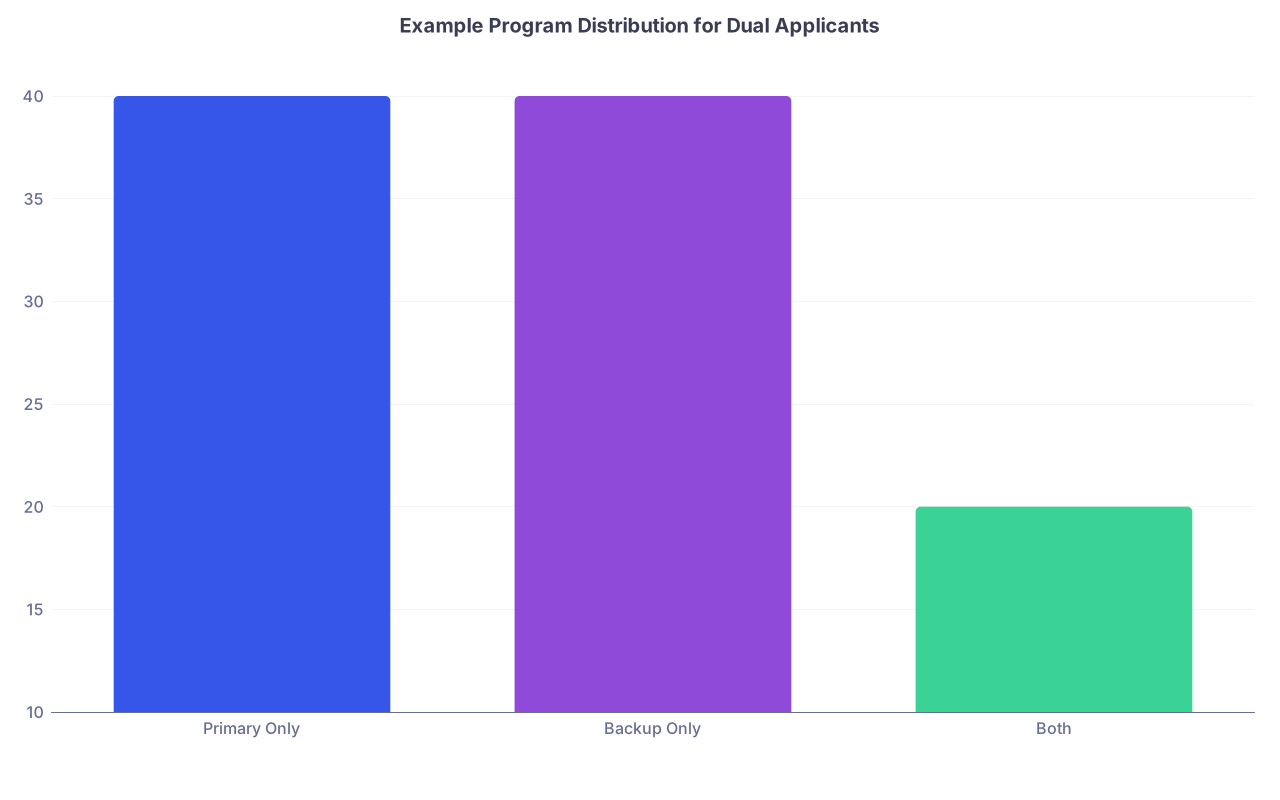
| Category | Value |
|---|---|
| Primary Only | 40 |
| Backup Only | 40 |
| Both | 20 |
This kind of split (40 primary, 40 backup, 20 both) is common for truly dual applicants. Your numbers may be different, but the concept holds.
How to Know You Are Waiting Too Long
Let me be blunt. You are late if:
- It is July and you still “haven’t decided” whether to have a backup
- It is August and you have zero backup letters
- It is September and you are editing a second specialty personal statement for the first time
Backup specialty planning is not something you “add on” in the last month. The entire point is to design your MS4 year so that either outcome (primary or backup) looks credible.
Quick Reference: Month-by-Month Backup Planning
Here is the condensed timeline you can tape above your desk.
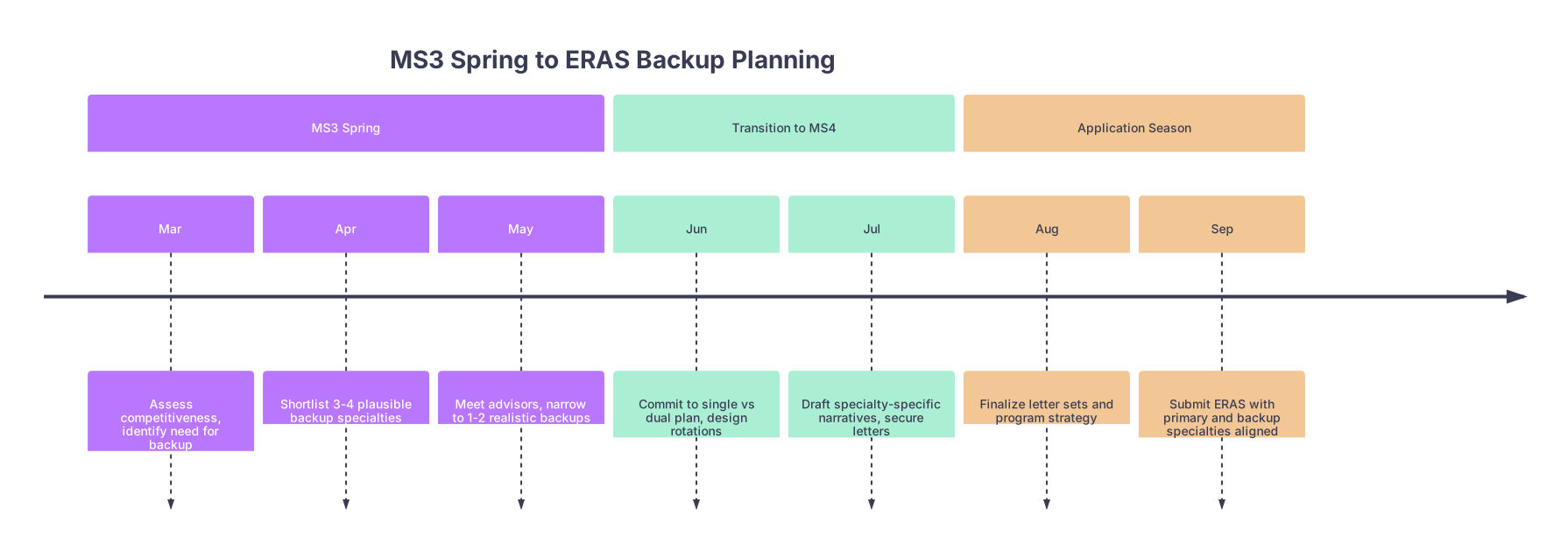
| Period | Event |
|---|---|
| MS3 Spring - Mar | Assess competitiveness, identify need for backup |
| MS3 Spring - Apr | Shortlist 3-4 plausible backup specialties |
| MS3 Spring - May | Meet advisors, narrow to 1-2 realistic backups |
| Transition to MS4 - Jun | Commit to single vs dual plan, design rotations |
| Transition to MS4 - Jul | Draft specialty-specific narratives, secure letters |
| Application Season - Aug | Finalize letter sets and program strategy |
| Application Season - Sep | Submit ERAS with primary and backup specialties aligned |
What You Should Do Today
You are presumably in or near MS3 spring if you are reading this.
Today, you should do exactly this:
- Open a blank document called “Backup Specialty Plan – [Your Name].”
- Write:
- Your current top specialty
- Your Step 1 status and any red flags
- 3–4 plausible backup specialties
- Email one person (faculty, dean’s advisor, or specialty advisor) and ask for a 30-minute meeting this month to review that list.
That is the first real step. Do not “think about it.” Send the email.