
The way you sequence your fourth-year rotations can quietly kill your backup plan. Or make it bulletproof.
If you are serious about a competitive specialty and you want a credible backup, your calendar is not neutral. Months, weeks, even which clerkship goes first — all of it affects letters, skills, perceived commitment, and ultimately where you match.
I am going to walk you month-by-month and then week-by-week through how to build a rotation sequence that protects both your dream field and your backup. With concrete calendars, not vague “do it early” nonsense.
Step 0: Define Your Primary and Backup – 12–15 Months Before Graduation
At this point you should be brutally honest with yourself.
Timeline: January–March of MS3 (or ~15–18 months before graduation).
You should:
- Decide your probable primary specialty (e.g., Derm, Ortho, ENT, Rad Onc, Plastic, Ortho, EM in some markets).
- Identify 1–2 realistic backup fields (e.g., IM, FM, Prelim Medicine, TY, Path, Psych, Pediatrics, Anesth depending on interests and board profile).
- Talk to at least:
- 1 advisor in your primary field
- 1 advisor in your backup field
- Your dean / academic advisor
The key question to ask them:
“If I applied to only your specialty with my current stats, how worried would you be?”
You are trying to sort yourself into:
- Group A – Strong for primary: Backup is truly a backup, probably not used.
- Group B – Borderline: Backup is likely needed; you may dual-apply.
- Group C – Unlikely for primary: Backup becomes “co-primary” and needs nearly equal priority.
Your rotation sequencing will differ a bit depending on which group you fall into. I will call that out as we go.
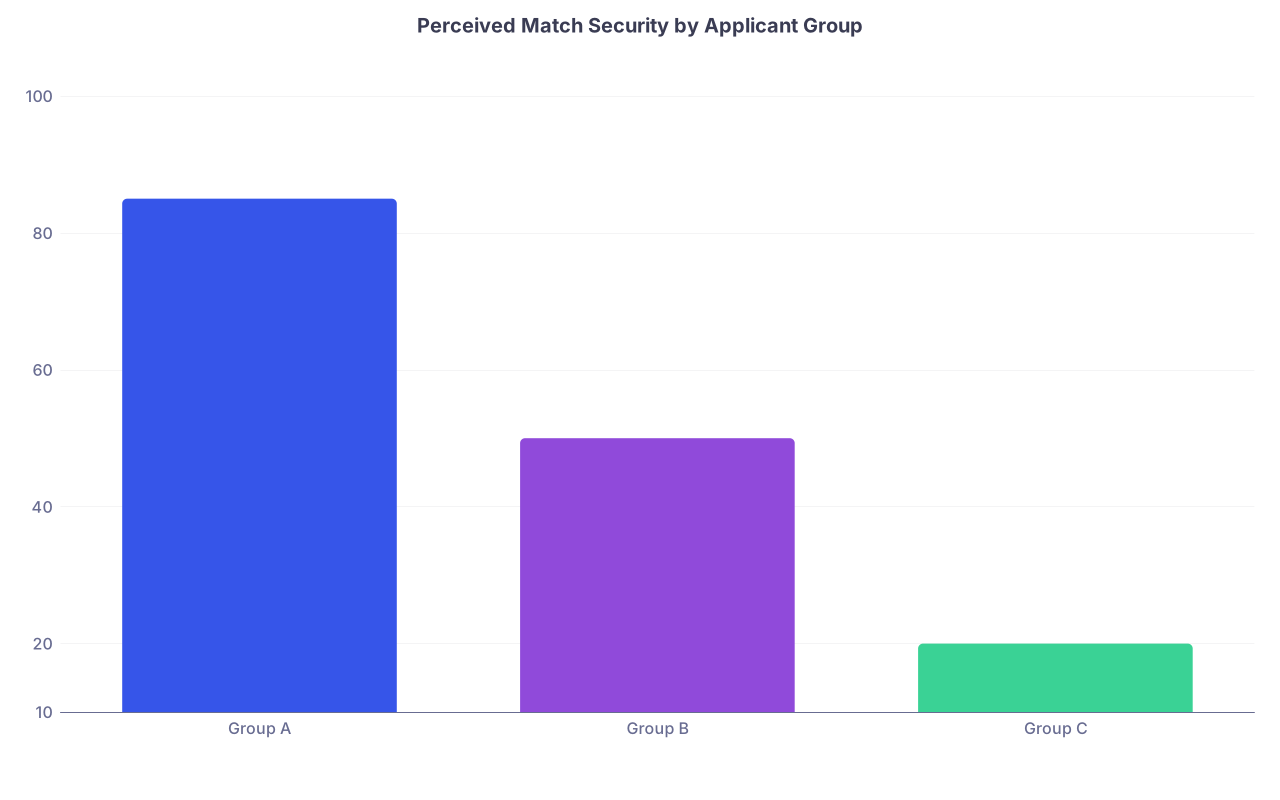
| Category | Value |
|---|---|
| Group A | 85 |
| Group B | 50 |
| Group C | 20 |
Step 1: Anchor the Non‑Negotiables – 10–12 Months Before Graduation
At this point you should lock down the big rocks before you fiddle with details.
Timeline: March–May of MS3 (when most schools build MS4 schedules).
You must reserve slots for:
- Required Sub‑Is / Acting Internships
- Key Away Rotations (if relevant)
- Backup‑field audition time
The timing pivots around two constraints:
- ERAS opens/applications submitted: Typically September.
- Interview season: October–January.
The Golden Rule of Sequencing
For anyone considering a backup:
You need at least one strong letter in your primary and one strong letter in your backup, both ready by early September.
Your calendar has to make that possible. Here is the high-level positioning:
- Primary specialty home Sub‑I:
- Ideal: June–July
- Acceptable: May–June
- Primary specialty away(s) (if using them):
- Ideal: July–August
- Backup specialty rotation / Sub‑I:
- Ideal: July–August (at the latest early September)
- Do not push all backup time to October or later.
You should sit down with a blank July–June grid and block these first.
| Rotation Type | Best Months | Latest Safe Month |
|---|---|---|
| Primary Home Sub‑I | June–July | August |
| Primary Away #1 | July–August | September |
| Primary Away #2 (if any) | August–September | September |
| Backup Sub‑I / Elective | July–August | September |
If your school uses blocks (e.g., 4‑week blocks), sketch them like:
- Block 1 (May/June): Primary Sub‑I (home)
- Block 2 (June/July): Primary or Away
- Block 3 (July/Aug): Backup Sub‑I
- Block 4 (Aug/Sep): Flex — additional primary or backup, or research
Now we go through the year chronologically.
Step 2: Build the Early MS4 Foundation – April–July of MS4
At this point you should be setting up your letters and your story.
April–May (late MS3 / very early MS4)
If your school allows an early Sub‑I:
- Group A (strong applicant):
- Consider an early primary Sub‑I in May if you want more time for a second away.
- Group B/C (borderline or unlikely):
- I prefer May for a backup Sub‑I or core IM month to secure at least one rock‑solid general letter.
Your goals by end of May:
- You know:
- Which attendings seem letter‑friendly.
- Whether your performance on intensive rotations tracks with your board scores (or not).
- You have:
- One non‑specialty letter (IM, surgery, etc.) lined up.
June: First Big Decision Month
At this point you should do your primary specialty home Sub‑I if at all possible.
Why June?
- You are still relatively fresh off core clerkships.
- Faculty know you; less “cold” than an away.
- Letters from June rotations can be:
- Requested end of June
- Written in July
- Uploaded by August
- In ERAS by early September
What you focus on during June:
- Identify 1–2 letter writers in your primary.
- Tell them explicitly:
“I am applying to [Primary] with [Backup] as a possible backup. I would like a strong letter focused on [Primary].”
You do not need to hide that you are considering a backup. Attendings have seen this movie.
July: Split Focus — Primary vs Backup
July is where people sabotage their backup unintentionally.
Bad pattern I see constantly:
June–Sept stuffed with primary aways, backup delayed until October. Then in September they panic that they have no credible backup letters.
Do this instead:
Option 1 – Primary Home in June, Backup in July (my default recommendation):
- July = Backup Sub‑I or heavy elective in the backup field at your home institution.
- This gives you:
- One primary letter from June
- One backup letter from July
- Both ready well before ERAS.
Option 2 – If your primary absolutely requires early away rotations:
- June = Primary Home Sub‑I
- July = Away #1 in primary
- August = Backup Sub‑I
- You are still okay, but you are tight. You must push letter writers hard in late August.
At this point you should have your Step 2 / Level 2 date slotted as well. Ideal window:
- Test in late June or July.
That way you are not trying to do a Sub‑I and high‑stakes exam in the same exact month.

Step 3: Pre‑ERAS Finalization – August–September
At this point you should be polishing, not scrambling.
August: Last Chance for a Pre‑Application Rotation
Use August strategically:
- If you are Group A (strong primary):
- August can be:
- Another primary away, or
- Research/Step 2 study, or
- Second backup elective if you want more credibility.
- August can be:
- If you are Group B/C (borderline/weak primary):
- I strongly prefer:
- Second backup rotation (even if just an elective, not a Sub‑I).
- This gives you:
- A second backup letter if needed.
- Evidence of real engagement in backup field.
- I strongly prefer:
By the end of August you want:
- 2–3 letters for primary ready or requested.
- 1–2 letters for backup ready or requested.
- Specialty‑specific CV sections updated (research, presentations).
Early September: ERAS Submission
ERAS opens, applications go in.
At this point you should:
- Have:
- At least one uploaded letter from your primary.
- At least one uploaded letter from your backup.
- Be prepared to:
- Assign letters strategically — not all letters go to all programs.
- Example:
- Derm applications: Derm letters + strong IM letter.
- IM backup applications: IM letters + generic academic letter, not Derm‑heavy ones that scream “plan B.”
- Example:
- Assign letters strategically — not all letters go to all programs.
Do not wait for the mythical “perfect” letter that is “almost done.” Programs read what is in your file early. A strong but slightly earlier letter beats a “perfect” one that arrives in November.
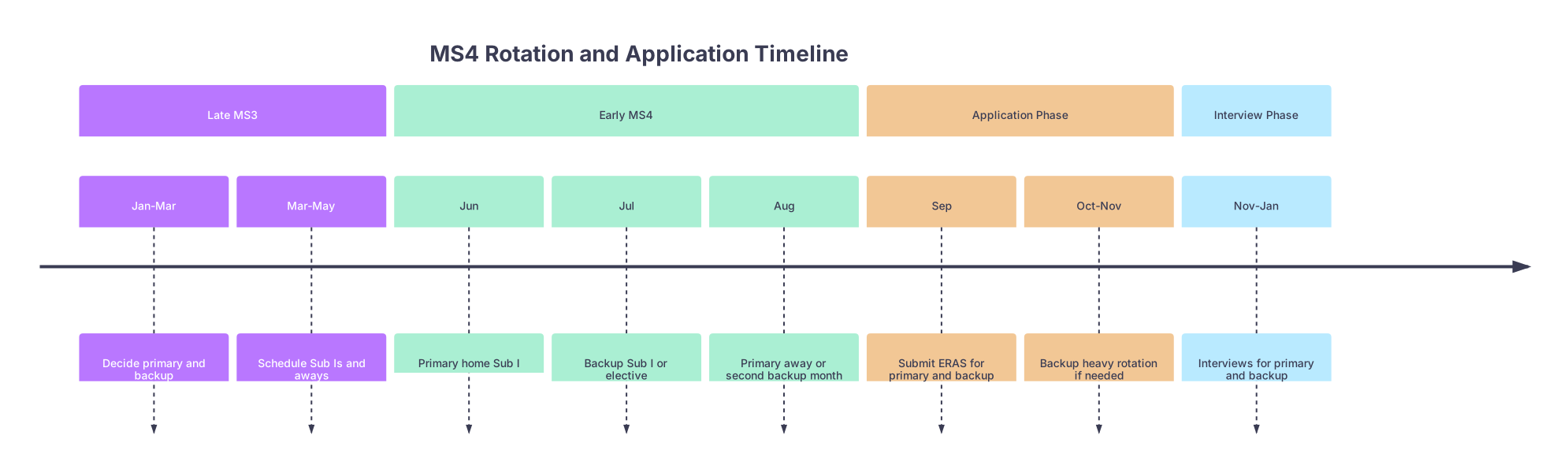
| Period | Event |
|---|---|
| Late MS3 - Jan-Mar | Decide primary and backup |
| Late MS3 - Mar-May | Schedule Sub Is and aways |
| Early MS4 - Jun | Primary home Sub I |
| Early MS4 - Jul | Backup Sub I or elective |
| Early MS4 - Aug | Primary away or second backup month |
| Application Phase - Sep | Submit ERAS for primary and backup |
| Application Phase - Oct-Nov | Backup heavy rotation if needed |
| Interview Phase - Nov-Jan | Interviews for primary and backup |
Step 4: Post‑Application Rotations – October–January
At this point you should be consolidating your image in whichever field looks more promising.
Now your strategy branches based on what happens after applications go out.
Scenario 1: You Get Solid Primary Invites Early (October)
If by late October you have, say:
- 8+ interviews in a moderately competitive field, or
- 4–5 in a very competitive field plus strong backup options lined up,
then you can lean rotations toward:
- More primary exposure (for sanity and interest).
- Or neutral electives (ICU, cards, etc.) without stressing backup optics.
In this case, doing a late backup rotation in November is not mandatory. It can still help if:
- You want to keep backup doors open in case rank lists go sideways.
- You are truly on the fence about career satisfaction in primary vs backup.
Scenario 2: Primary Invites Are Weak, Backup Looks Stronger
This is where sequencing before October saves you.
If by late October:
- You have very few interviews in your primary, but
- Backup programs are responding well,
then:
- You pivot your November–December rotations more heavily into backup.
- Another Sub‑I in backup (if school allows).
- Away in backup if you suspect you may fully redirect.
- You send update letters to backup PDs stating:
- Renewed interest
- Additional backup rotations completed
- Clarified long‑term goals in that field
Rotation optics in this phase matter. If your last 4 months are all your primary field and ICU, with zero backup exposure, PDs in the backup field might reasonably think you are a half‑hearted applicant.
Scenario 3: No One Is Calling Much (Primary or Backup)
It happens. Especially in weird match cycles.
Your goal from November to January:
- Stack:
- General medicine
- ICU
- Emergency
- Or targeted backup rotations
- So you end MS4 as employable and “rebrandable” as possible.
That means you do not waste November and December on hyper‑niche primary electives once it is obvious that field is unlikely. I have watched people stubbornly do three more Plastics months in January–March with zero plastics interviews. They then have neither a match nor a strong general skill set.
Backup fields like IM, FM, Psych, Peds do appreciate late‑year rotations that show you ultimately committed to them, even if you were late to the party.
How to Sequence When Your Backup is Very Different From Your Primary
Let’s deal with the tricky combinations.
Example 1: Derm (Primary) + Internal Medicine (Backup)
Goal: Avoid looking disinterested in IM while still being a serious Derm applicant.
Sample sequence:
- June: Derm Sub‑I (home)
- July: IM Sub‑I (wards)
- August: Derm Away #1
- September: Research / lighter Derm elective + interview prep
- October: IM consult elective (cards, rheum)
- November: ICU or another IM month
- December: Off / interviews
- January: Mixed elective (Derm/IM overlap like rheum or heme/onc)
Key details:
- Your IM Sub‑I in July gives you a legitimate IM letter.
- October or November IM‑heavy month reassures IM programs you will show up and do the work.
- You can still have two Derm LORs and one IM LOR for Derm apps; flip the ratio for IM apps.
Example 2: Ortho (Primary) + General Surgery or TY (Backup)
Sample sequence:
- June: Ortho Sub‑I (home)
- July: Gen Surg Sub‑I or heavy Surg elective
- August: Ortho Away #1
- September: Ortho Away #2 or research
- October: Gen Surg again or ICU
- November: Ortho clinic / sports / MSK imaging
- December: Off / interviews
- January: Gen Surg / ICU
Here the “backup” (Gen Surg or TY) wants to know you are not a procedurally helpless Ortho applicant who hates nights. So at least two serious general surgery/ICU rotations — one early (July) and one late (Oct/Jan) — help.
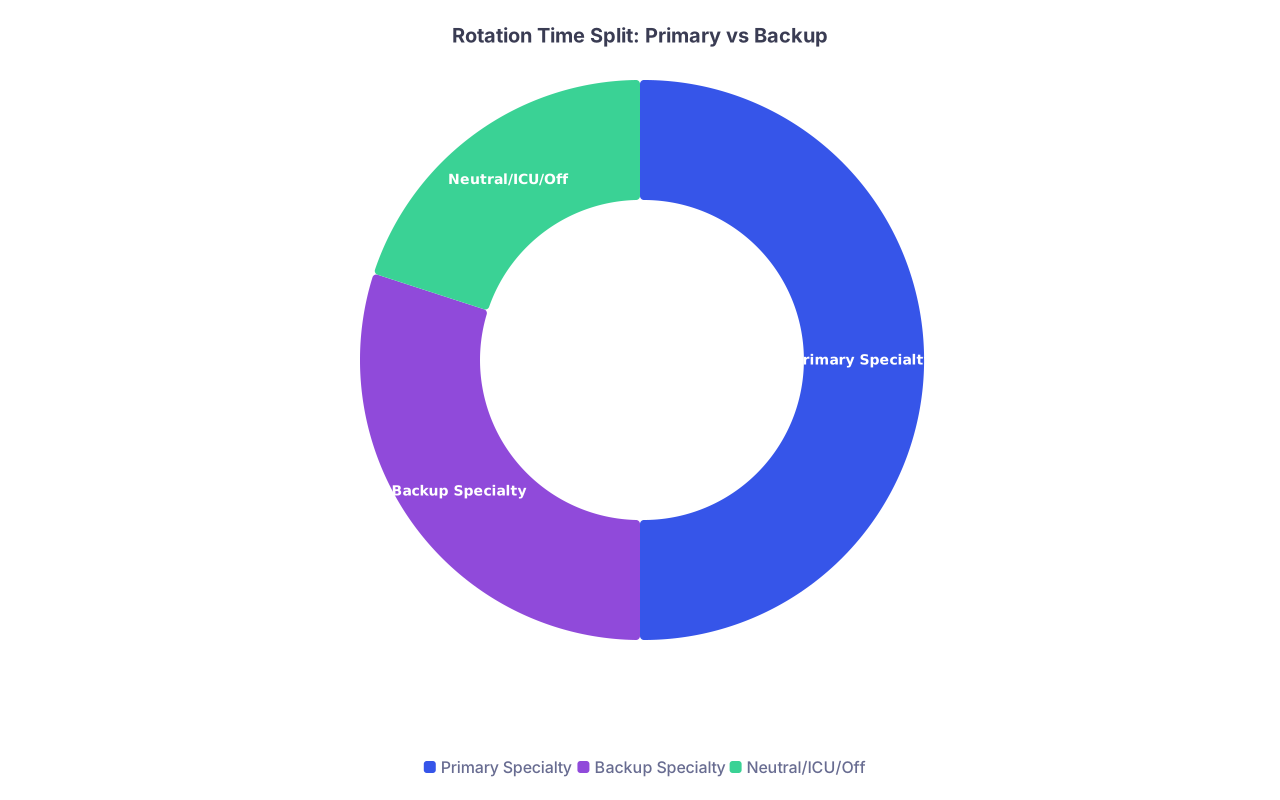
| Category | Value |
|---|---|
| Primary Specialty | 50 |
| Backup Specialty | 30 |
| Neutral/ICU/Off | 20 |
Example 3: EM (Primary) + IM (Backup) in a Competitive Market
EM has been volatile. Smart students keep IM as a backup.
Sequence:
- June: EM Sub‑I (home)
- July: IM Sub‑I
- August: EM Away #1
- September: EM elective / Ultrasound
- October: IM wards or ICU
- November: EM at community site (if you still need EM letters)
- December: Mostly off for interviews
- January: IM wards
This is one of the most forgiving pairings: both EM and IM like ICU/ED/wards months. Just do not push all IM to after November if you are truly dual‑applying.
Week‑by‑Week and Day‑to‑Day: How to Work Rotations for Letters
Macro‑sequencing is useless if you fumble the micro.
During Each Key Rotation (week‑by‑week)
Week 1–2
At this point you should:
- Identify 2–3 attendings you work with repeatedly.
- Signal interest early:
- In primary rotations: “I am strongly considering [Primary].”
- In backup rotations: “I am also applying to [Backup], and I take this seriously as a career.”
Week 3
- Ask:
“Do you feel you know my work well enough to comment on it in a strong letter?” - If they hesitate, that is a no. Find someone else on the same rotation.
Week 4 (end of month)
- Hand them:
- CV
- Draft of your personal statement (even if it is rough)
- List of programs (if they ask)
- Clarify usage:
- “I will likely send this letter to both [Primary] and [Backup] programs, if you are comfortable with that.”
Day‑to‑Day During Backup Rotations
Your attitude on a backup rotation is what sells it.
Bad behavior I have seen:
- Constantly comparing backup unfavorably to primary.
- Announcing to everyone, “My real interest is X, but I am here in case that does not work out.”
Do this instead:
- Focus on what you genuinely like about the backup:
- Longitudinal care (FM, IM)
- Procedures (Anesthesia, EM)
- Lifestyle and team culture (Psych, Path)
- Ask residents privately:
- “What do you wish applicants understood about this field?”
You are not faking. You are exploring a real second option with respect. That shows up in your letters.

Common Sequencing Mistakes and How to Avoid Them
You can avoid 80% of self‑inflicted wounds by not doing the following.
Loading July–September with only primary aways.
- Fix: Insert at least one backup Sub‑I/elective into that period.
Leaving backup exposure to November–January.
- Programs see it as desperation or lack of genuine interest.
- Fix: Have a pre‑ERAS backup month (July/August).
Using the same hyper‑specialty letters for both primary and backup.
- An ENT‑only letter sent to Psych says “I had no one in Psych who liked me.”
- Fix: Get at least one field‑specific letter for your backup.
Ignoring how rotation grading works.
- Some schools grade early Sub‑Is pass/fail and later ones for honors.
- Fix: If your school is like this, place your stronger field where honors are possible.
Studying for Step 2 during a Sub‑I.
- It shows. You look tired and distracted.
- Fix: Take Step 2 just before or right after an easier elective, not mid‑Sub‑I.
A Sample Year Calendar: Dual Applicant Template
Here is a generic template you can adapt. Assume graduation in May, year starts in June.
| Month | Rotation Focus | Primary vs Backup Impact |
|---|---|---|
| June | Primary Home Sub I | Primary letter, skills |
| July | Backup Sub I | Backup letter, credibility |
| August | Primary Away | Extra primary letter, exposure |
| September | Research / Light Elective | Application polish, Step 2 study |
| October | Backup Elective / ICU | Strengthens backup file |
| November | Primary or Neutral Elective | Keeps primary identity |
| December | Off / Interviews | Travel, rank list thinking |
| January | Backup or ICU/IM | Final reassurance to backup PDs |
Adjust based on local block calendars, but keep the structure:
- At least one primary month pre‑ERAS.
- At least one backup month pre‑ERAS.
- Reinforcing backup months after you see how interviews fall.

Final Checks: 3–4 Months Before Match Day
By January–February, you are mostly done with rotations. But how you wrap things up still matters.
At this point you should:
- Review:
- How many credible letters you have in each field.
- Where your interviews actually materialized.
- Align:
- Last 1–2 rotations with the field you are leaning toward ranking highest.
- Leaning backup? Make your final month in that field or a close cousin (ICU for IM, etc.).
- Last 1–2 rotations with the field you are leaning toward ranking highest.
- Confirm:
- Your story is coherent:
- “I explored X seriously, found what I liked, and here is why I am ranking Y first.”
- Your story is coherent:
Program directors read your calendar as a narrative. Not just as a list.
The 3 Takeaways
Sequence rotations so that both your primary and your backup have at least one strong, field‑specific letter in ERAS by early September. No exceptions.
Front‑load one backup month into July or August, then add another backup‑heavy month in October–January once you see how interviews shake out.
Treat your backup as a real career, not a consolation prize. Your rotation choices, timing, and day‑to‑day behavior must show that, or programs will not believe your backup story — and the calendar will give you away.