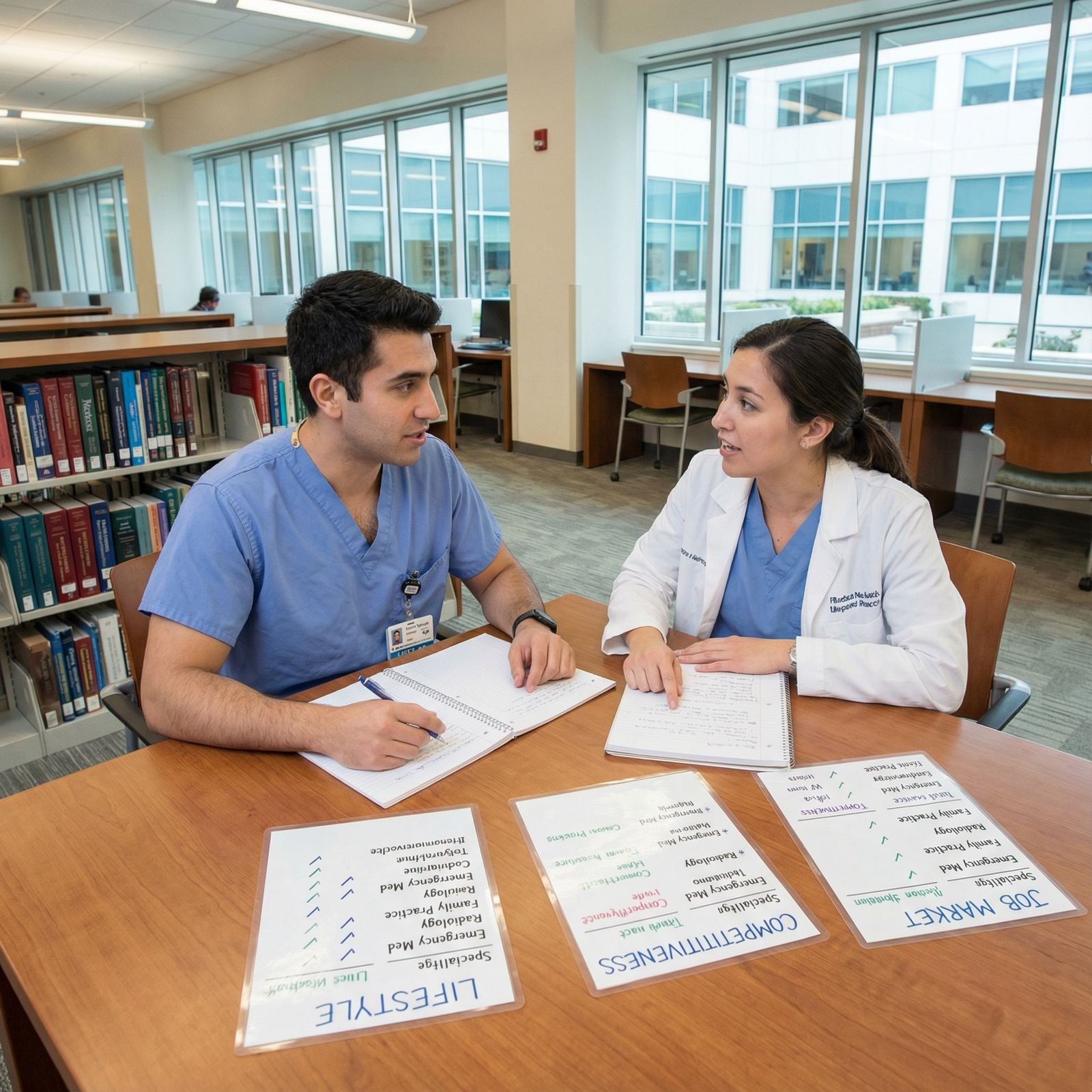
The worst ERAS mistakes do not happen in September. They happen in June and July when people lie to themselves about risk.
You’re an early MS4. You’ve got a primary specialty you care about—and you’re starting to wonder if you need a backup. Good. You’re asking the right question at the right time. But if you bolt on a backup specialty without a plan, you can absolutely sabotage both.
Here’s the timeline that keeps your primary specialty intact while adding insurance that actually works.
Early June: Reality Check Before You Touch ERAS
At this point you should not be opening ERAS first. You should be opening your score report and your CV.
Step 1 (Week 1 of June): Brutal Risk Assessment
Sit down with three things in front of you:
- USMLE/COMLEX scores (or pass/fail status + Step 2 if you have it)
- Your specialty choice and competitiveness tier
- Your actual application components: grades, research, letters, red flags
Now, in the first week of June, you must answer:
What is your primary specialty and tier?
- Example high-risk: Derm, Ortho, Plastics, ENT, Ortho + 220 Step 2, no research.
- Example moderate-risk: EM, Anesth, Radiology with average scores.
- Example low-risk: IM, Peds, FM with solid scores and decent letters.
What do your numbers look like compared to matched data?
Pull up recent NRMP Charting Outcomes (yes, actually open it). If your Step 2 is:- 10–15+ points below the matched mean for your chosen specialty, or
- You have a failed exam, LOA, or major professionalism issue
…you do not get to skip backup planning.
Who’s giving you honest feedback?
In the first 7–10 days of June, you should:- Meet with your home program advisor in your primary specialty.
- Meet with your school’s dean or career advising office.
- Ask one straight question:
“If you were me, would you apply to a backup specialty? And which one?”
If two independent people say “Yes, you need a backup,” believe them. I’ve seen too many people ignore this and then scramble for SOAP in March.
Mid–Late June: Choosing Which Backup Without Blowing Up Your Primary
By the middle of June, at this point you should be deciding on one backup specialty, not three. Half-committing to multiple backups is how you end up matching nowhere.
Week 2–3 of June: Pick a Backup That Actually Fits
You’re choosing a plausible alternate career, not just a “less competitive” box to click.
Use this quick mapping as a starting point:
| Primary Specialty | Common Backup | Risk Fit |
|---|---|---|
| Derm, Plastics | Internal Med | Strong |
| Ortho, ENT | PM&R | Moderate |
| Radiology | IM, Neuro | Strong |
| EM | IM, FM | Strong |
| Anesthesia | IM | Strong |
| Gen Surg | IM, FM | Moderate |
This isn’t holy scripture, but it’s realistic. A few rules:
- Don’t pick a backup you’d hate. You might actually match there.
- Don’t pick a backup that requires a completely different persona.
(e.g., “I’m 100% rural primary care focused” in FM and “I only care about high-acuity resus” in EM. People talk.) - Aim for logical overlap:
- Similar clinical interests (procedures vs cognitive vs outpatient)
- Similar patient populations you enjoy
- Some shared rotations/letters
Week 3–4 of June: Decide Your Application Strategy
By the last week of June, you should have answered:
Single-track vs dual-track?
- Single-track: Apply to one specialty only.
Use this if you’re reasonably competitive (or if no backup makes sense and you accept the risk). - Dual-track: Apply to primary + backup.
Use this if:- You’re below average in a competitive field, or
- You have serious red flags, or
- Your advisors are nervous.
- Single-track: Apply to one specialty only.
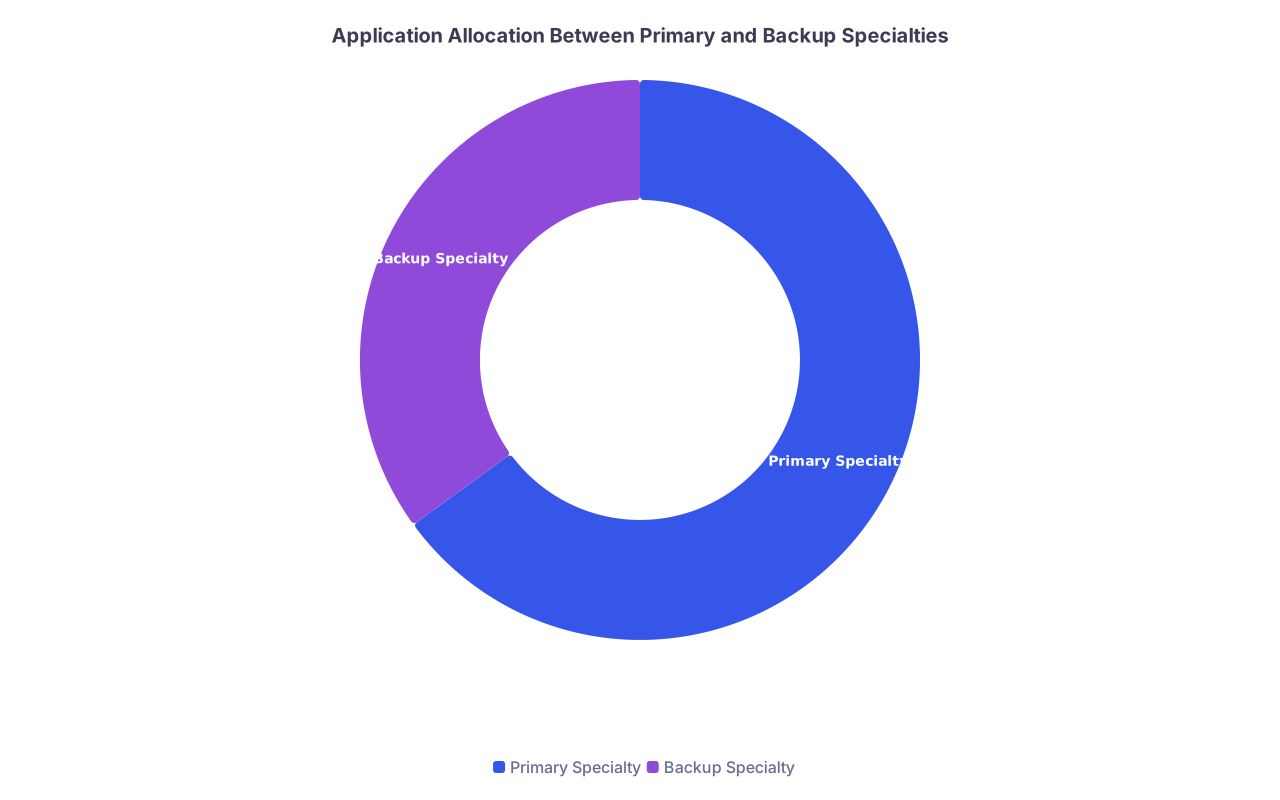
What’s your target split of applications?
Approximate starting template:
| Category | Value |
|---|---|
| Primary Specialty | 65 |
| Backup Specialty | 35 |
Adjust the numbers, not the logic. Your primary gets the majority, but your backup cannot be token.
For most dual applicants:
- ~45–70 programs in primary (depending on competitiveness)
- ~25–50 programs in backup
The key is that your backup list is large enough to be real.
July, Week 1: Lock Your Schedule and Letters
Now we shift from “Should I have a backup?” to “What must I do in July so my backup is viable without tanking my primary?”
Confirm Your Rotations
At this point you should:
- Confirm your primary specialty away/sub-I’s are set in stone for July–September.
- Identify 1 rotation that can support both specialties or your backup:
- Inpatient IM month that gives a letter usable for IM or many backups
- ICU month valuable to EM, Anesthesia, IM, even Surgery-adjacent paths
- Strong general medicine sub-I at your home institution
If your schedule is garbage for your backup (e.g., all derm and no IM for a derm→IM backup), July is your last real chance to swap something.
Letters of Recommendation: Two-Track Strategy
Week 1 of July, decide your LOR goals:
-
- Aim for 2–3 strong letters in your chosen field.
- These should already be in progress from cores, sub-I’s, or aways.
Backup specialty or “generalist” letters:
- Aim for 1–2 letters that work for both:
- Medicine ward attending
- Program director from a core rotation
- Research mentor (if clinically relevant)
- Aim for 1–2 letters that work for both:
At this point you should email likely letter writers and say, clearly:
“I’m applying primarily in [X] but also in [Y] as a backup. Would you be comfortable writing a letter that could work for both applications?”
You’re not the first person to have that conversation. Don’t be weird about it.
July, Week 2: Message Discipline and Personal Statements
This is where people derail themselves: trying to write one Frankenstein personal statement for two specialties. Do not do this.
Two Statements, One Coherent Story
By mid-July, at this point you should be drafting:
Primary specialty personal statement
- Deep dive into why that field.
- Concrete experiences, continuity of interest, specialty-specific goals.
Backup specialty personal statement
- Still honest, not obviously “second choice.”
- Focus on qualities + experiences that apply to both fields.
- Lean toward the more general aspects of your story: patient care, team work, certain patient populations, etc.
Behind both, you keep one core spine of your narrative:
- Who you are as a clinician
- What kind of problems you like solving
- The patients you’re drawn to
You’re not inventing a new personality for each specialty. You’re tilting the same person toward two slightly different futures.
July, Week 3: ERAS Configuration Without Mixed Signals
This is the nuts-and-bolts week. At this point you should be inside ERAS, setting up program lists and documents.
Configure Docs by Program
ERAS lets you assign:
- Different personal statements
- Different LOR combinations
- Different experiences highlighted
Use that power. Intentionally.
For primary specialty programs:
- Use primary PS.
- Use 2–3 specialty-specific letters + 1 generalist letter.
- Feature experiences that clearly signal commitment to that field.
For backup specialty programs:
- Use backup PS.
- Use 1–2 letters from backup-friendly attendings + 1 strong general letter; you can often include 1 letter from your primary field if it emphasizes general clinical strength rather than hyper-specific “future neurosurgeon” talk.
- Feature broader medicine/procedural experiences relevant to the backup.
Critical rule:
No program should open your application and feel like they’re obviously your afterthought. If a backup PS reads “I always wanted to be an orthopedic surgeon but…” you’re done.
July, Week 4: Final Reality Check and Adjustments
Last week of July is your “no more denial” period. ERAS submission is looming in August and programs see applications early September.
At this point you should:
Re‑review your competitiveness with updated info
- Any new grades?
- Any new red flags?
- Any Step 2 score that just came in below expectations?
Adjust your program counts If new data worsens your odds in the primary:
- Increase the number of backup programs.
- Add some geographic flexibility in the backup.
- Consider dialing back the top-tier reach in the primary.
Get a second pair of eyes on your two PS drafts Send them (separately) to:
- A trusted resident or faculty in each specialty.
- Your dean’s office or advisor.
Ask one question:
“Reading this, do I sound like a serious future [specialty] resident, or like someone bailing into this field?”
If they hesitate, fix it.
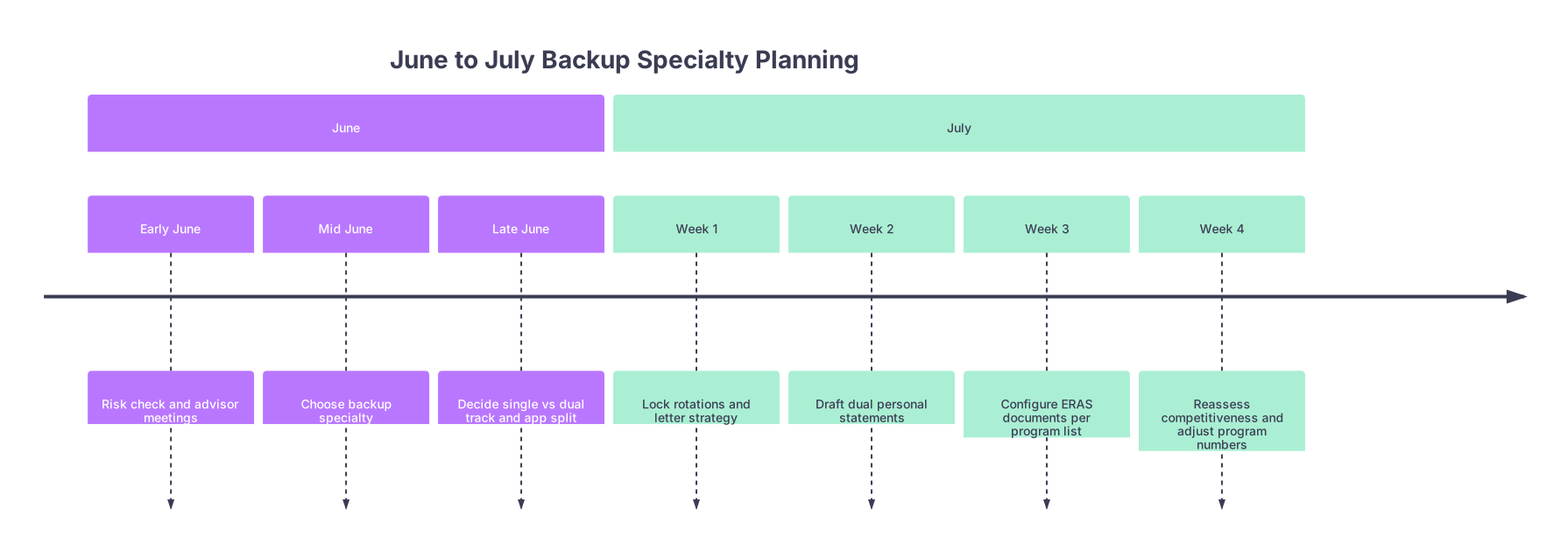
Micro-Timeline: What Each Week of June–July Should Look Like
Here’s the stripped-down version.
| Period | Event |
|---|---|
| June - Early June | Risk check and advisor meetings |
| June - Mid June | Choose backup specialty |
| June - Late June | Decide single vs dual track and app split |
| July - Week 1 | Lock rotations and letter strategy |
| July - Week 2 | Draft dual personal statements |
| July - Week 3 | Configure ERAS documents per program list |
| July - Week 4 | Reassess competitiveness and adjust program numbers |
Tape that to your wall if you need to.
Common Backup Pitfalls (and How the Timeline Avoids Them)
By this point in the summer, here’s what tends to go wrong—and how this structure blocks it.
1. The “Too Late to Pivot” Disaster
Pattern I’ve seen:
Student insists they’re “fine” for Ortho with mid-220s. Skips backup planning in June. Rotates only in Ortho July–October. Realizes in November that interviews are thin. Now it’s basically too late to build an IM application.
Timeline fix:
- You assessed in early June.
- You added IM as a backup by late June.
- You had an IM-friendly sub-I early enough to get a usable letter.
- So even with weak primary interviews, you’re not headed for SOAP.
2. The Identity Crisis Application
Second pattern:
Application reads like three different people: one for EM, one for Anesthesia, one for IM. Programs see this lack of clarity and get nervous.
Timeline fix:
- You chose one backup by mid-June.
- You kept a consistent core narrative, just angled two ways.
- Letters and PS stay coherent; you look like a stable human, not a pinball.
3. The Backup That Isn’t Actually a Backup
Third pattern:
Student does Derm ➝ IM backup. Applies to 20 IM programs total, all in one cool coastal city. That is not a backup. That’s wishful thinking.
Timeline fix: By late July, you:
- Compared your numbers to IM averages.
- Built a list of realistic IM programs with enough volume.
- Accepted that a backup only works if you’re willing to match where it’s available, not just where you dream.
Quick Reference: When You Definitely Need a Backup
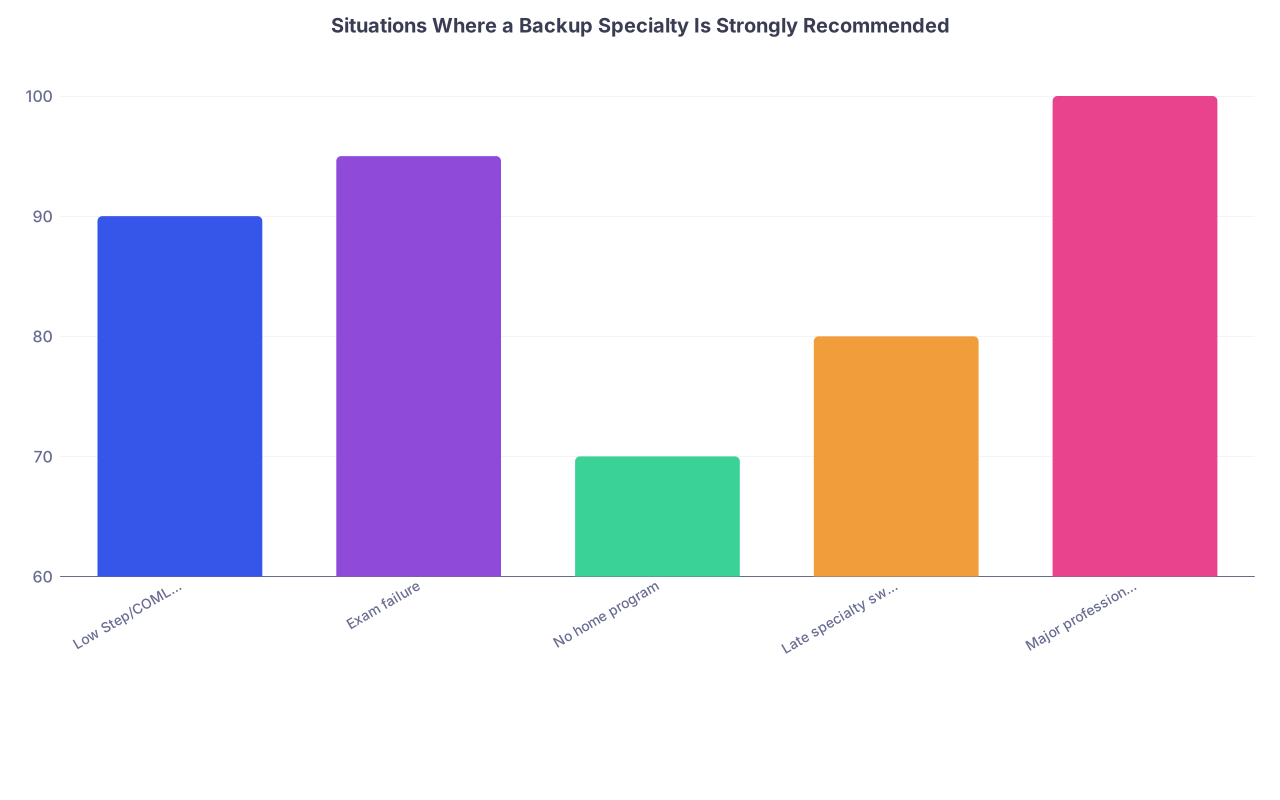
If in early June you check any of these boxes, your default should be “Yes, I’m adding a backup” unless a very experienced advisor convinces you otherwise:
| Category | Value |
|---|---|
| Low Step/COMLEX for field | 90 |
| Exam failure | 95 |
| No home program | 70 |
| Late specialty switch | 80 |
| Major professionalism issue | 100 |
Translation:
- Low score for your field (well below matched mean): near-automatic backup.
- Exam failure on Step/COMLEX: strong argument for backup even in moderate specialties.
- No home program in a competitive field: higher risk, especially if no strong away letters yet.
- Late specialty switch after third year: often underdeveloped application, backup can be wise.
- Documented professionalism issue: programs will be wary; extra safety net smart.
FAQs
1. Should I tell programs I’m applying to another specialty?
Generally no. You don’t need to walk into an interview and announce, “You’re my backup.” That said, if asked directly—especially in fields like EM or IM where dual-applying is common—give a concise, honest, non-neurotic answer. Something like:
“I’m primarily drawn to [X] because of [reasons], and that’s been my main focus. I also applied to [Y] because I genuinely enjoy [overlap reason] and I wanted to make sure I’d be able to train in a setting where I could do that well.”
Never trash your other specialty choice in the process.
2. Can I use the same personal statement for both specialties?
You can. It’s just usually bad. One generic statement that could apply to anything signals lack of direction. Use shared core themes, but write separate statements that clearly speak to each field. It’s extra work in July but pays off when PDs feel like you actually want their job, not just a job.
3. When is it reasonable to skip a backup entirely?
You can skip a backup if:
- Your scores and CV match or exceed the median for your primary specialty.
- You have no major red flags.
- You have strong specialty-specific letters from a home program.
- Multiple experienced advisors agree your risk is acceptable.
If any of that is shaky and you’re applying to a competitive field, skipping a backup is not “confident.” It’s reckless.
Key points to leave with:
By early June, you should have an honest risk assessment. By late June, you should have chosen a single, coherent backup if you need one. By the end of July, your ERAS should be configured so each program sees a clear, committed applicant—whether they’re your dream specialty or your safety net.