
It's March 1st of your M3 year. You just finished an IM rotation you liked more than you expected, and anesthesia surprised you in the OR in a good way. Your friends are “all in” on one specialty. You are firmly not. You’re torn between two realistic backup specialties and you know you cannot drift for another year.
Here is what you do. Month by month, week by week. So by the time ERAS opens and interviews start, you are not that applicant rambling through a confused “why this specialty” answer.
Big Picture: Your 12‑Month Game Plan
You are managing three problems at once:
- Figure out which of the two specialties fits you better.
- Keep both options viable on paper (letters, experiences, scores).
- Decide, in time, how you will actually apply and rank (dual apply or not).
The rough structure:
- Mar–May (M3 late): Clarify, explore, and plan away rotations strategically.
- Jun–Aug (early M4): Build letters and experiences for both paths.
- Sep–Oct: ERAS strategy, dual‑apply logistics, and interview positioning.
- Nov–Feb: Rank list decisions and “which backup is primary now” reality check.
I will assume you are torn between two reasonable backup or mid‑competitive specialties, like:
- IM vs Anesthesia
- IM vs Neurology
- Psych vs FM
- FM vs EM (yes, still a thing in many regions)
Not Ortho vs Derm. Different universe.
March–May (Late M3): Clarify and Set Up the Board
At this point you should stop vague hand‑waving about “keeping options open” and actually structure your next year around an A path and a B path.
Week 1–2 of March: Reality Check and Specialty Comparison
Sit down with concrete data. Not vibes.
Make a brutally honest comparison of the two specialties:
- Your Step/COMLEX scores vs recent matched data.
- Your clinical performance so far (honors vs passes, narrative comments).
- Your geographic preferences (less competitive regions can rescue a weaker app).
- Your lifestyle tolerances (call, nights, procedures, psych load, etc.).
Put it in a simple table. Something like:
| Factor | Specialty A (e.g., IM) | Specialty B (e.g., Anesthesia) |
|---|---|---|
| Score fit | Strong | Borderline |
| Letters available | 1 strong, 1 medium | 0 strong |
| Away rotations | Easy to arrange | Limited |
| Geographic spread | Many programs | Fewer in desired region |
| Interest level | 8/10 | 7/10 |
If one column looks clearly better on paper and you like it more, good. That is your primary. The other is the true backup.
If it is still a toss‑up, fine. But write it down. You need a working “Primary A / Backup B” designation even if it changes.
Week 3–4 of March: Talk to Humans, Not Reddit
Schedule:
- 1 meeting with a faculty advisor in Specialty A.
- 1 meeting with faculty in Specialty B.
- 1 quick session with your school’s dean or advising office.
Your script is simple:
“I am genuinely split between [A] and [B]. Here are my scores, my evals, and what I like about each. If you were me, how would you structure M4? Would you dual apply? Which field does my application fit better?”
You are not fishing for generic encouragement. You want them to:
- Comment on your competitiveness.
- Suggest letter writers.
- Flag any deal‑breakers (e.g., “With this Step, anesthesia will be tough unless you apply very broadly and include community programs.”).
Capture these opinions in a one‑page planning document. This seems excessive. It is not. You will forget what people actually told you.
April–May (End of M3): Lock Rotations and Targeted Exposure
At this point you should:
- Finalize next year’s core M4 schedule
- Plug in at least one audition / away in your primary field
- Add one short “test” rotation in your secondary if you still feel confused
Structuring Rotations
Minimum setup if you’re torn:
- 2–3 rotations clearly in Specialty A (one at home, one away if relevant).
- 1–2 rotations in Specialty B (ideally early enough to get a letter if needed).
- 1–2 flexible electives you can point either direction later (ICU, cards, pulm, heme/onc, palliative care, ED, etc. depending on combo).
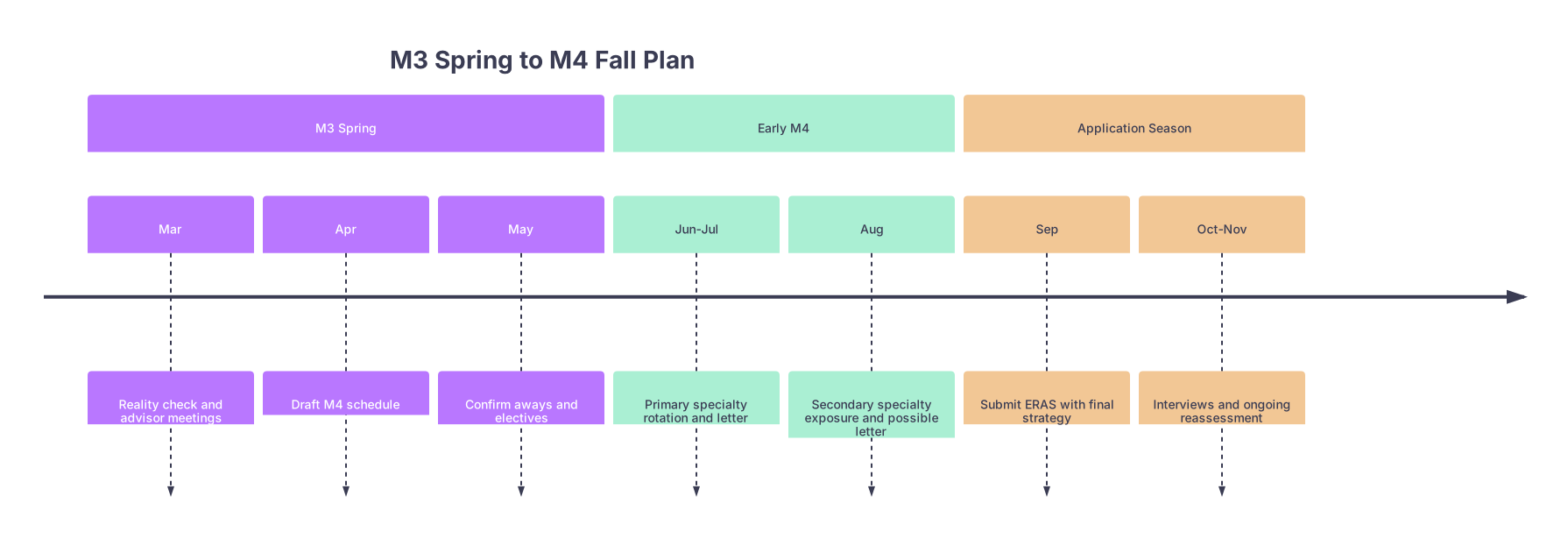
| Period | Event |
|---|---|
| M3 Spring - Mar | Reality check and advisor meetings |
| M3 Spring - Apr | Draft M4 schedule |
| M3 Spring - May | Confirm aways and electives |
| Early M4 - Jun-Jul | Primary specialty rotation and letter |
| Early M4 - Aug | Secondary specialty exposure and possible letter |
| Application Season - Sep | Submit ERAS with final strategy |
| Application Season - Oct-Nov | Interviews and ongoing reassessment |
If you cannot get ideal aways (happens a lot), then you double down on:
- Strong home rotation performance.
- Research / QI / case reports that can “swing” toward either field.
June–July (Early M4): Build Letters for Your Primary While Keeping B Alive
At this point you should be working like you have already chosen your primary field. Because programs will not be impressed by “I was deciding between two specialties all year.”
June: Primary Specialty Rotation – Go All In
On your first real M4 specialty‑specific month (say IM or Anesthesia):
- Identify 1–2 potential letter writers in week 1.
- Tell them early: “I am strongly considering [A] as my main specialty and may also apply to [B] as a backup. I would love to work closely with you for a letter.”
Your goals by the end of June:
- At least one strong “I want to be a [specialty]” letter for A.
- Clear sense whether you actually like the day‑to‑day enough to commit.
Pay attention to:
- Do you look forward to these days?
- Do attendings say things like “you think like an internist/anesthesiologist/psychiatrist”? I have heard this exact phrasing more times than I can count. It matters.
July: Start Building Optionality for B
Now pivot briefly toward Specialty B without sabotaging your primary.
Options in July:
- A formal 4‑week rotation in B
- A 2‑week elective or consult service related to B
- Or at minimum, shadow days + clinic time if scheduling is tight
At this point you should:
- See if B still feels viable and interesting.
- Decide if you will need a letter in B for a true dual‑apply.
You do not need three glowing letters in B to keep it as a backup. You usually need:
- 2–3 solid letters in A
- 1–2 letters that can either be generic (“great future resident in any field”) or lightly tailored to B
- Possibly 1 specialty‑specific letter in B if the field expects it (psych, EM, anesthesia often do).
August: Decide Your Application Strategy (Single vs Dual Apply)
This is the month where procrastinators blow it. You cannot push this decision to September.
Week 1–2 of August: Brutal Competitiveness Assessment
Gather:
- Your updated transcript
- Step/COMLEX scores
- Evaluation comments from your main specialty rotation
- Any research, poster, or leadership updates
Now compare for both specialties:
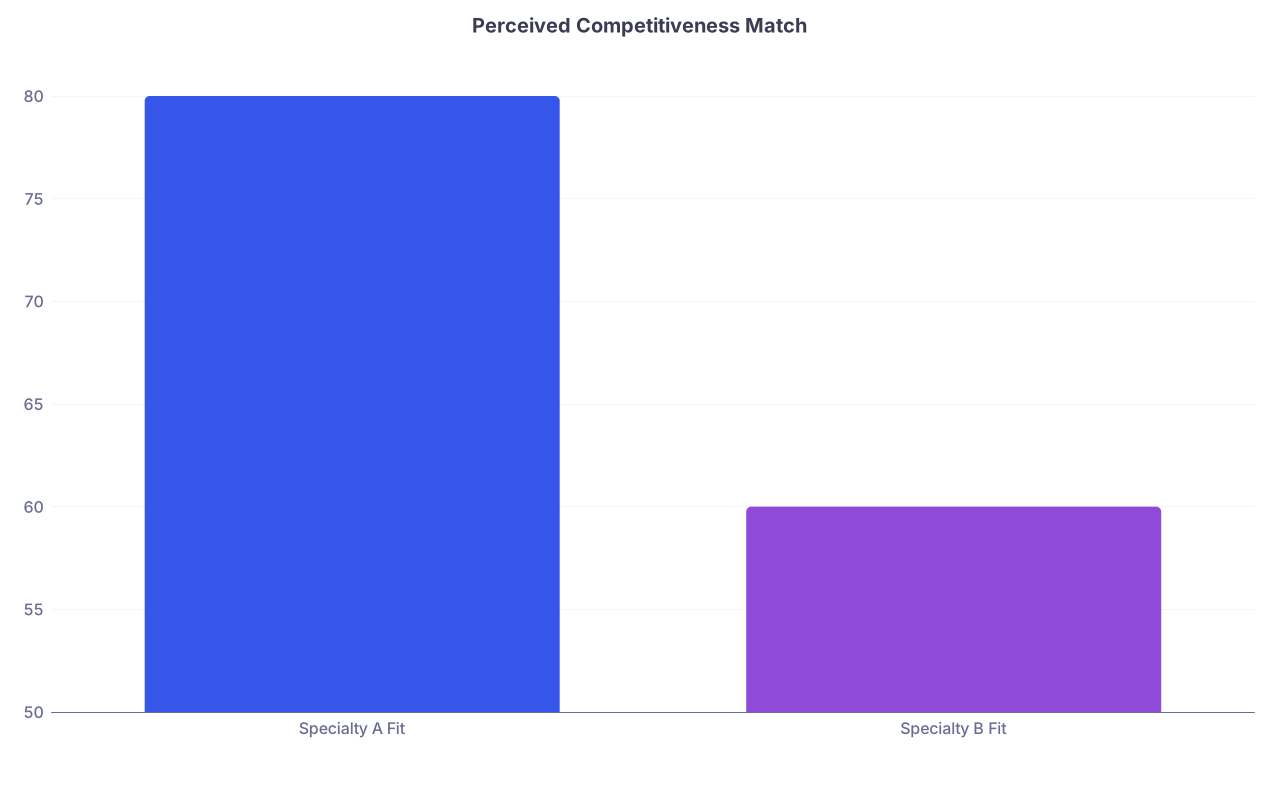
| Category | Value |
|---|---|
| Specialty A Fit | 80 |
| Specialty B Fit | 60 |
(Think of those numbers as “rough percent confidence you can match if you apply smartly,” not exact statistics. If A is a 40 and B is a 45, that is a different conversation.)
Rules of thumb I have seen play out:
- If you are clearly competitive for your preferred primary A and B is only slightly safer, leaning single‑apply is reasonable.
- If both are moderately competitive and you would be content in B, dual apply is often rational.
- If A is risky and B is truly safer and acceptable, you seriously consider centering B and keeping A as the “reach,” not the other way around.
Week 3–4 of August: Draft Two Personal Statement Variants
At this point you should write:
- A primary personal statement for A.
- Either:
- A fully separate statement for B, or
- A generic but honest “I love medicine and patient care” version that can be used by both if they are similar (e.g., IM vs FM).
Do not write a single statement that screams “I am torn and might leave your field later.”
Also:
- Start listing programs in both specialties.
- For dual‑apply, think in tiers: reach, solid, safety for each specialty.
September: ERAS Submission – Commit to a Strategy
This is the execution month. No more theoretical talk.
Week 1: Final Decision – How Are You Actually Applying?
At this point you should be able to state in one line:
- “I am applying primarily to [A], with a smaller but real set of applications to [B].”
or - “I am truly dual‑applying to [A] and [B] and would be content matching either.”
If you cannot say either, you are stalling. Ask one advisor you trust to force a decision with you.
Week 2–3: Build Your Application Lists
For dual‑appliers especially, you need structure, not chaos.
| Category | Specialty A (Primary) | Specialty B (Backup) |
|---|---|---|
| Reach | 10–15 programs | 5–8 programs |
| Solid | 25–35 programs | 10–20 programs |
| Safety | 10–20 programs | 10–15 programs |
Numbers vary, but the pattern is consistent: more programs in your primary, a meaningful but smaller number in the backup.
Week 4: Submit ERAS
At this point you should:
- Submit ERAS on time or early.
- Ensure letters are correctly assigned:
- Strong A‑focused letters → A programs.
- Generic / flexible letters → both.
- B‑oriented letters → B programs.
If you truly hate one specialty, do not apply “just to see.” Interviewing at a field you have no intention of ranking is a waste of time and money and frankly a bad look.
October–December: Interview Season While Torn Between Two Fields
Now the messiest part: you start getting interview invites. And your feelings may not match your original plan.
October: Track Invites and Reassess
At this point you should keep a simple log:
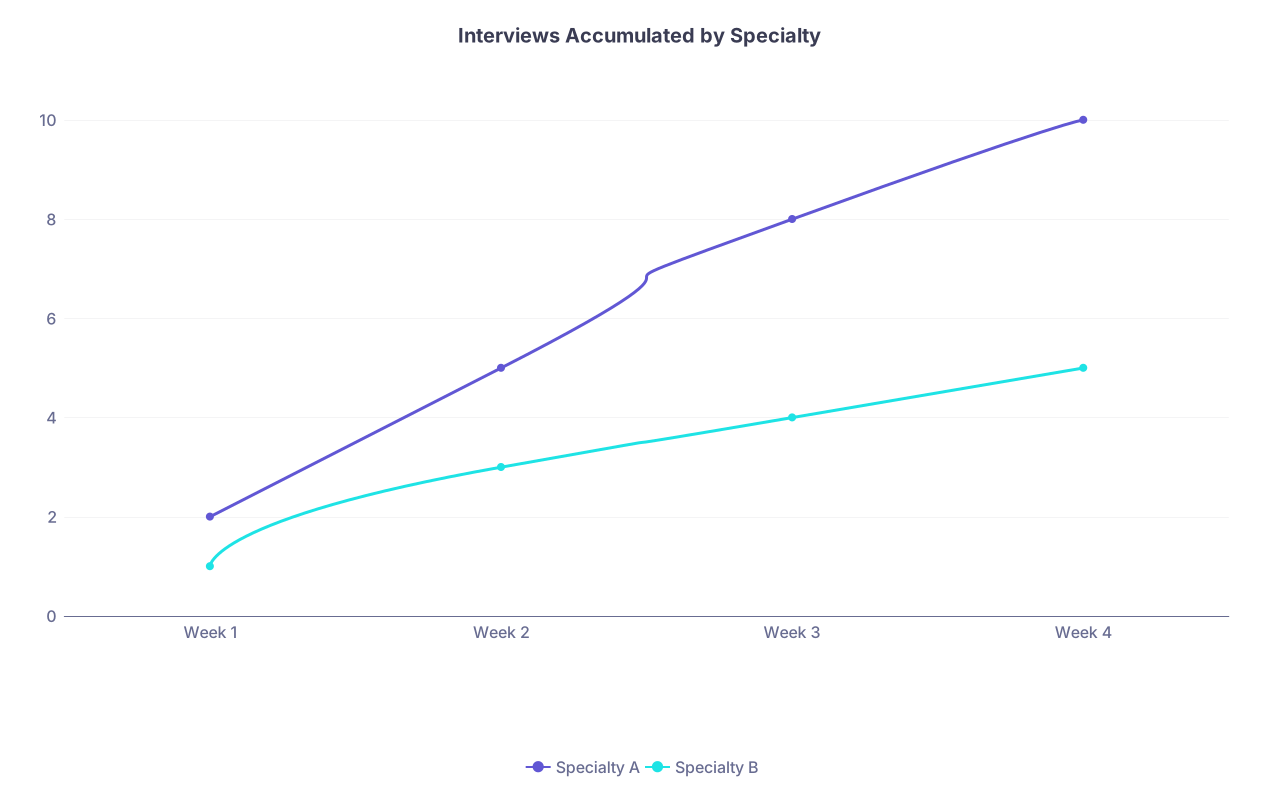
| Category | Specialty A | Specialty B |
|---|---|---|
| Week 1 | 2 | 1 |
| Week 2 | 5 | 3 |
| Week 3 | 8 | 4 |
| Week 4 | 10 | 5 |
If by late October:
- A is lagging badly in invites,
- B is filling up your calendar,
then you quietly shift your mindset: B is not just “backup,” it might be your actual landing zone. That is not failure. That is matching.
Re‑check with advisors if needed:
“I currently have 3 A interviews and 8 B interviews. If this pattern holds, how should I think about my rank list?”
November–December: Interview Behavior When Dual‑Applying
Key rule: You do not tell programs they are your backup. Obvious, but I have watched people come close.
On interviews:
- You answer “Why this specialty?” as if you are fully committed to it.
- You do not volunteer that you are applying in another field unless explicitly asked.
- If asked directly, you answer cleanly, not defensively:
“Earlier in training I was also exploring [other field], but over the past year my clinical experiences and mentorship have moved me strongly toward [field I’m interviewing for]. I am only ranking programs where I can genuinely see myself training.”
That line is honest, and programs have heard some version of it many times.
January–February: Rank List Month – Final Decision Time
At this point you should stop thinking like an applicant in limbo and think like someone who will be practicing one of these specialties for decades.
Early January: Lay Out Your Options Side by Side
Construct a simple personal ranking framework:
- Location (family, partner, cost of living)
- Training quality (fellowship options, procedure volume, board pass rates)
- Lifestyle (call burden, culture, support)
- Future flexibility (fellowships, ability to shift roles later)
Then for each specialty and each program:
| Factor | IM Program X | Anesthesia Program Y |
|---|---|---|
| Location fit | High | Medium |
| Program vibe | Strong | Unclear |
| Fellowship options | Broad | Moderate |
| Lifestyle | Moderate | Better |
| Gut feel | 8/10 | 6/10 |
You will notice a pattern pretty fast. One specialty will start to look like the life you actually want, not just the one you theorized about on paper.
Late January–February: Build and Lock the Rank List
Your final decisions:
Ordering within a specialty.
Straightforward: rank by where you see yourself happy and well trained.Interleaving specialties.
This is where people freeze. Example pattern when A is still truly preferred:- A1
- A2
- A3
- B1
- A4
- B2
- B3
- A5
- B4…
Or, if you have essentially converted to B as your effective primary:
- B1
- B2
- A1
- B3
- B4…
The algorithm will honor your actual preferences. The real question is: are you brave enough to rank your true #1 first, even if it is in your “backup” specialty?
You should be.
A Quick Visual: Emotional vs Practical Fit
One last mental model to sanity‑check yourself:
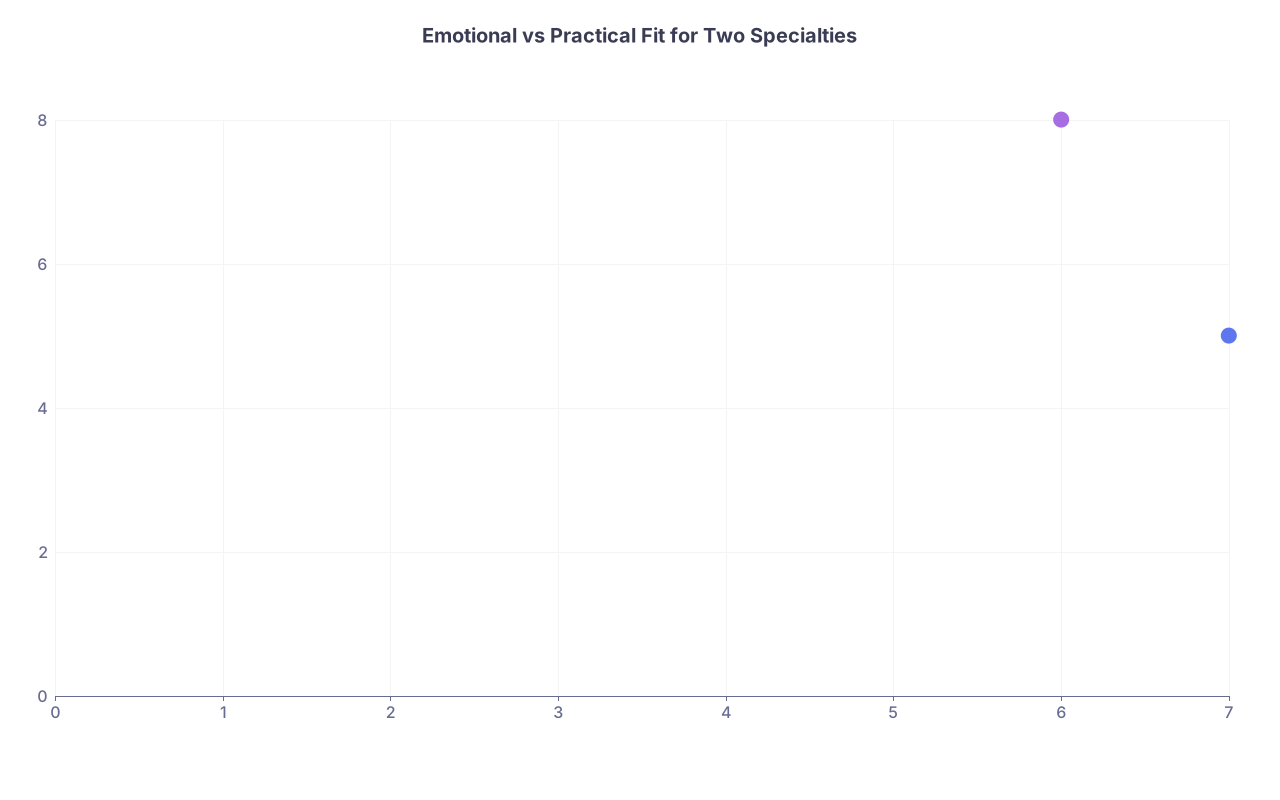
| Category | Value |
|---|---|
| Specialty A Today | 7,5 |
| Specialty B Today | 6,8 |
- X‑axis (first number): emotional pull (1–10)
- Y‑axis (second number): practical fit (competitiveness + jobs + lifestyle)
When B starts living in the upper‑right (solid emotion, high practicality) and A is drifting toward the middle, that is your answer. Even if your M3 self had a different picture.
Key Points to Walk Away With
- Decide early and explicitly which is primary and which is backup, even if it is provisional. Then structure M4 around getting strong letters and rotations for both.
- Use August and September as your hard decision checkpoints: single vs dual apply, program list balance, and personal statement strategy. No drifting past ERAS submission.
- Let interview patterns and gut feel from real program visits reshape your idea of “backup” when you build the rank list. Rank the life you actually want, not the identity you thought you were supposed to have.