
The worst mistake after a rough Match is pretending it was just “bad luck.”
If you do not dissect this cycle’s data and systematically adjust your backup strategy, you are volunteering to repeat the same pain.
Below is your post‑Match, time‑structured playbook for using this cycle’s numbers—yours and the NRMP’s—to refine future backup specialties. Month by month. Then week by week. Then down to the actual work sessions.
0–2 Weeks After Match Day: Stabilize, Then Capture Reality
At this point you should not be making big decisions. You should be capturing data before it disappears.
Days 1–3: Emotional triage, then hard copy download
You are either:
- Delighted but uneasy (“I matched, but just barely, and my backups were chaos”), or
- Scrambling post‑SOAP, or
- Unmatched and staring at the ceiling at 3 a.m.
Regardless of group, the next steps are the same.
By Day 3 you should:
Download and save every document from this cycle
- ERAS application PDF
- Personal statements (all versions, all specialties)
- LoR PDFs or texts (if you have them)
- Program list(s) exported from ERAS or your spreadsheet
- Interview tracker (even if incomplete)
- Rank list screenshots or exports
Write a quick “cycle snapshot” while memory is fresh Open a single document titled:
Match_20XX_Cycle_Notes.In it, bullet out:
- Number of programs applied to by specialty
- Number of interview invites by specialty
- Where interviews actually occurred
- Any red flags you heard directly from faculty or PDs
- Any obvious late changes (e.g., “Switched to EM in October, weak home SLOEs”)
Do not edit or analyze yet. Just capture.
Weeks 2–4: Build a Clear Data Picture of This Cycle
Now you move from “vibes” to numbers.
Week 2: Personal metrics and simple ratios
By the end of Week 2 you should have a one‑page summary of your own applicant profile.
Create a table with:
- Step 1: Pass / Fail
- Step 2 CK: exact score
- COMLEX (if applicable): Level 1/2 scores
- Class rank / quartile / AOA / Gold Humanism
- Research: # of pubs / abstracts / posters
- Specialty‑specific extras (SLOEs for EM, ACGME surgery cases, etc.)
Then, for each specialty you applied to (including backups):
- Programs applied
- Interview invites
- Interviews attended
- Rank length
- Match outcome (Matched / SOAP / Unmatched)
At this point you should calculate yield per specialty:
[ \text{Interview Yield} = \frac{\text{Invites}}{\text{Programs Applied}} ]
| Specialty | Programs Applied | Invites | Yield (%) |
|---|---|---|---|
| Derm | 65 | 4 | 6.2 |
| IM | 40 | 14 | 35.0 |
| FM | 25 | 10 | 40.0 |
| Neuro | 30 | 3 | 10.0 |
This alone often exposes the fantasy. A “backup” with <10% yield is not a backup. It is another reach.
Week 3: Overlay NRMP data on your numbers
Now you align reality with national data.
Pull the latest:
- NRMP “Charting Outcomes in the Match” for MD and/or DO
- NRMP Program Director Survey
- The main Match Data and Results PDF
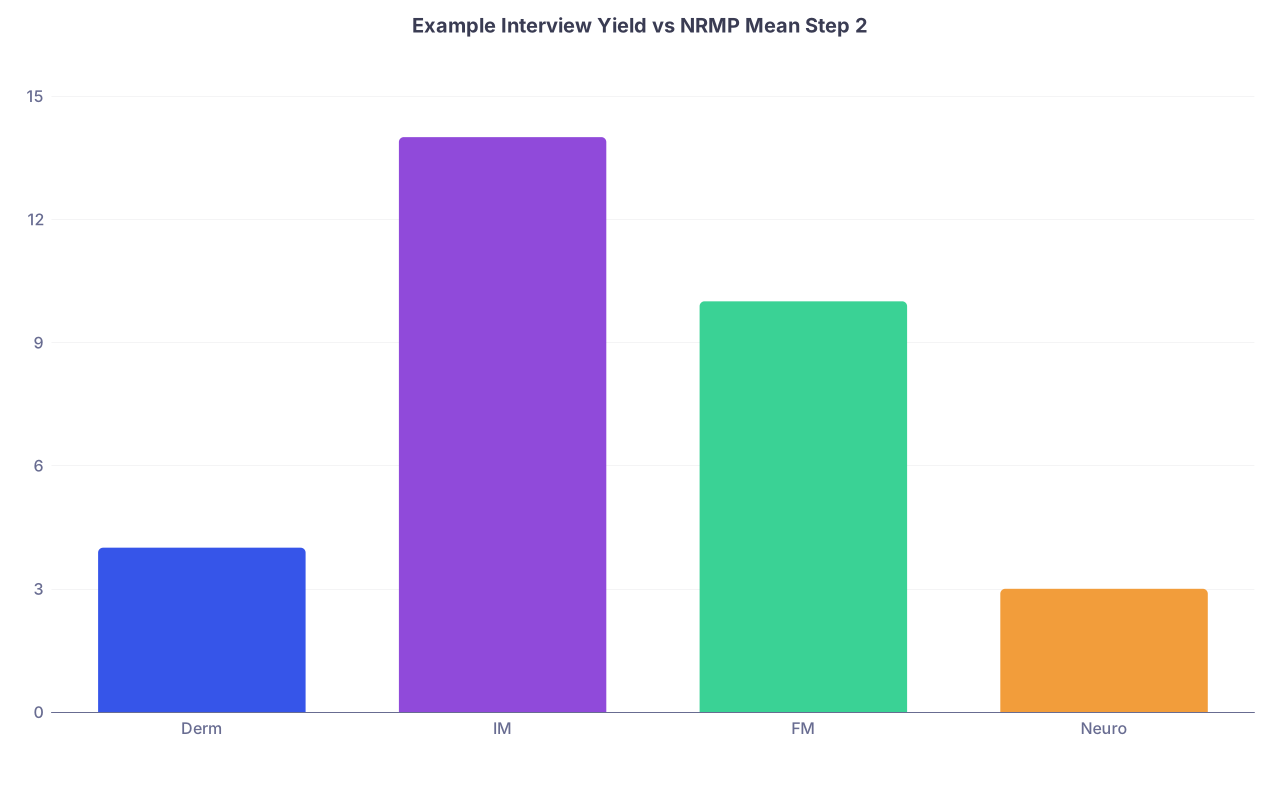
| Category | Value |
|---|---|
| Derm | 4 |
| IM | 14 |
| FM | 10 |
| Neuro | 3 |
By the end of Week 3 you should have for each specialty:
- Your Step 2 vs:
- Mean for matched applicants
- 25th percentile for matched applicants
- Your research vs specialty averages
- Your AOA / honor status vs typical matched cohort
- Your IMG status vs that specialty’s IMG match rate (if relevant)
This is where you stop telling yourself stories.
Example:
You: Step 2 = 229, DO, no AOA, 2 abstracts.
Derm: Mean matched US MD step 2 ~ 252, extremely research heavy.
Your derm “backup”: not real. Just magical thinking.
Week 4: First Pass Redefinition of “Backup”
At this point you should write down a working definition of “backup specialty” for you, not for idealized applicants.
A realistic backup specialty for a future cycle must:
- Have match stats where your Step 2 and portfolio are at or above the mean for matched applicants, or at least above the 25th percentile.
- Have enough program volume that you can apply broadly (ideally >100 programs nationwide, unless you have tight geographic limits).
- Accept your degree type and visa status in meaningful numbers (DO / IMG / visa‑requiring applicants take note).
- Offer a career you can actually tolerate for decades.
Write a brief, blunt sentence for each candidate backup:
- “IM: I am slightly below mean Step 2, but above 25th percentile, solid research, many programs. True backup.”
- “Neuro: way below mean Step 2, few interviews this year, fewer programs. Not a backup for me.”
- “FM: I am above mean metrics, high interview yield this cycle. Strong backup.”
Months 2–3: Deep Post‑Match Audit and Scenario Planning
Now you move from describing what happened to engineering a different outcome next time.
Month 2, Week 1: Specialty‑by‑specialty post‑mortem
At this point you should set aside one focused 2–3 hour block for each specialty you applied to (primary and backups).
For each, answer:
Did my application volume match my competitiveness?
- If you were below average for that specialty, did you apply to 70–100+ programs?
- If yes and interviews were still <5, this specialty may be a stretch, not a backup.
Was my application targeted correctly?
- Did you waste apps on extremely competitive academic programs while skipping mid‑tier community programs?
- Did you apply late (September/October) to programs that review in July?
Were specialty‑specific boxes checked?
- EM: enough SLOEs from academic sites?
- Surgery: sub‑I evaluations and letters from surgeons?
- Psych: any red flags like failed step or major leave?
Capture this in a simple grid:
| Specialty | My Competitiveness | Volume Adequate? | Targeting Quality | Realistic Backup Next Time? |
|---|---|---|---|---|
| Derm | Far below avg | Yes | Poor | No |
| IM | Slightly below avg | Yes | Good | Yes |
| FM | Above avg | Moderate | Fair | Strong Yes |
| Neuro | Below avg | No | Poor | No |
If you cannot honestly mark “Yes” in the last column, that specialty has no business being your primary backup next cycle.
Month 2, Week 2: Identify true backup shortlist
By now you should be able to name 2–3 realistic backup specialties, in order.
For each, you must know:
- Rough national match rate
- Typical Step 2 / research profile
- Whether they are friendly or hostile to your degree type / IMG status
- Lifestyle you would be signing up for (call schedule, fellowship dependency, etc.)
Stop with vague categories like “non‑surgical” or “primary care.” Name specific fields: Internal Medicine, Family Medicine, Psychiatry, Pediatrics, Pathology, etc.
This is also where you kill the “low‑probability cousins”:
- EM as a backup for Ortho? Not anymore.
- Anesthesia as a backup for Derm with a 205 Step 2? No.
- Rad‑Onc as a backup for anything? That era is gone.
Month 3: Design next‑cycle application structure (primary + backups)
At this point you should commit to a tiered application plan on paper.
Think of it as a pie chart of where your applications will go next time.
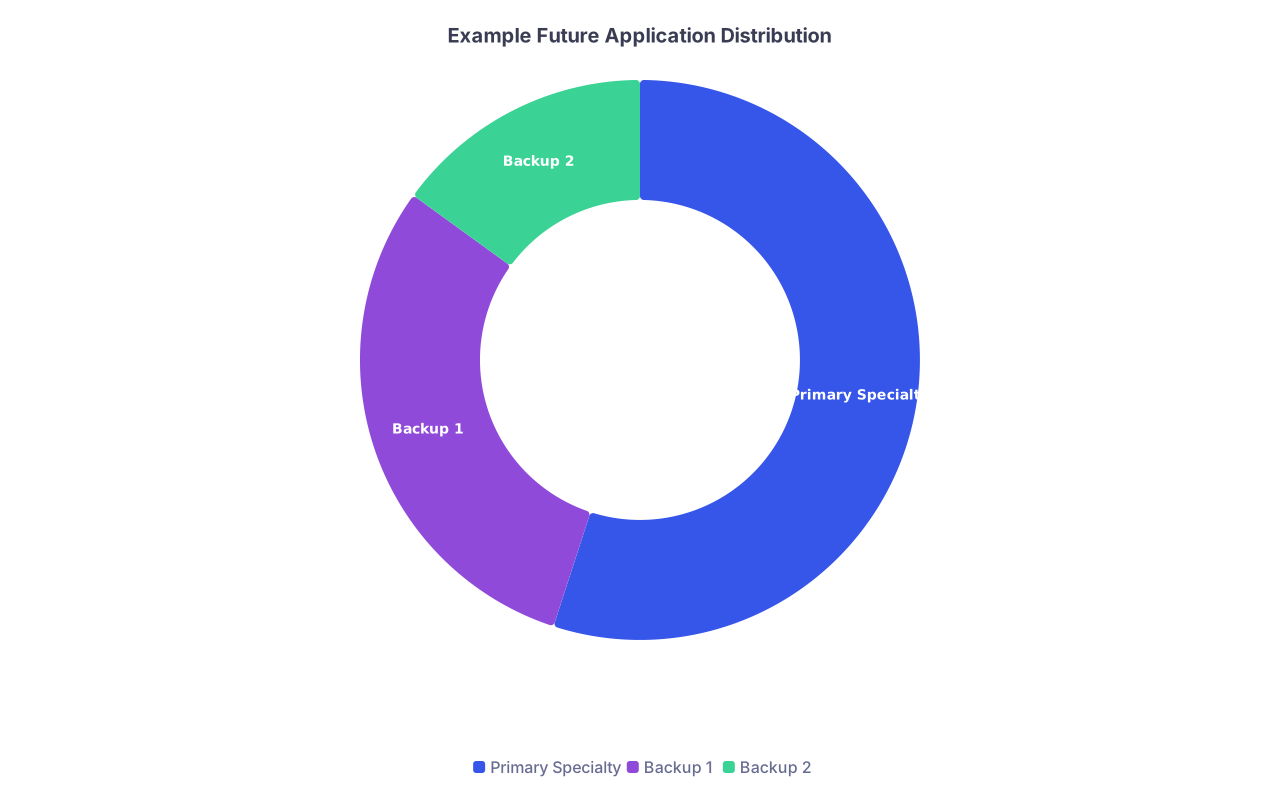
| Category | Value |
|---|---|
| Primary Specialty | 55 |
| Backup 1 | 30 |
| Backup 2 | 15 |
Example for a reapplicant who failed to match into Ortho:
- 0–10%: Ortho (if you insist on re‑trying, and your mentors agree it is not delusional)
- 60–70%: Internal Medicine (true backup)
- 20–30%: Family Medicine or Psychiatry (safest backup for your profile)
Write this as explicit numbers:
- “Total programs next cycle: ~220
- Ortho: 20–25
- IM: 130–150
- FM: 50–60”
If you matched this cycle but barely, the calculation is different. You are not reapplying, but you are future‑proofing for fellowship or a potential transfer. You still need clarity on what fields would be acceptable if you had to change course (bad health, burnout, future second residency).
Months 3–6: Concrete Gap‑Filling for Chosen Backups
Now you know your realistic backups. Next question: How do you become above‑average in them before the next app opens?
Clinical year planning (if still in school)
At this point you should:
- Slot in auditions / sub‑Is in your backup specialty, not only your reach field.
- Get at least one strong letter from your backup field.
- Schedule Step 2 timing so that a stronger score hits ERAS before programs review.
For example, if IM is your backup:
- Take an IM sub‑I early, get a letter from a core faculty member.
- Do a community IM rotation if your goal is community‑based programs.
Gap year or reapplicant year
If you are reapplying, your calendar needs structure.
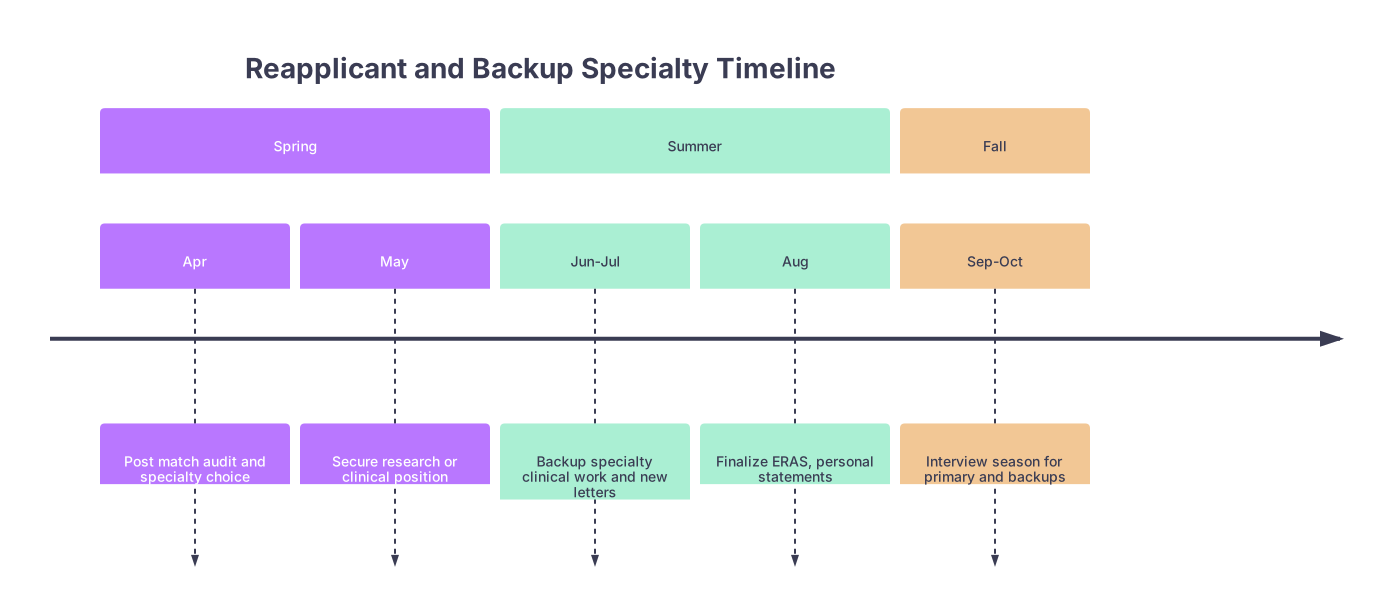
| Period | Event |
|---|---|
| Spring - Apr | Post match audit and specialty choice |
| Spring - May | Secure research or clinical position |
| Summer - Jun-Jul | Backup specialty clinical work and new letters |
| Summer - Aug | Finalize ERAS, personal statements |
| Fall - Sep-Oct | Interview season for primary and backups |
Your focus across this year should be:
Backup‑relevant clinical work
- Hospitalist assistant / prelim year / transitional year with robust IM exposure
- FM clinic work if FM is the target, etc.
At least one new, strong, field‑specific LoR
- “I supervised this applicant in an IM role for 6 months” is vastly more powerful than “Great med student 2 years ago.”
Addressing obvious holes
- Failed Step 1 → strong Step 2 and explanation.
- Weak professionalism comments → excellent, documented performance in new role.
- No research in Psych → one small but real project with your future backup mentor.
ERAS Season (Next Cycle): Week‑by‑Week Execution
Assume you are reapplying. Your backup work now has to show up coherently on ERAS.
June–July (ERAS opens, but before submission)
At this point you should:
Draft separate personal statements:
- One tailored for your primary competitive specialty
- One tailored for your main backup
- Optional third for your “super safe” backup if different
Adapt your experiences:
- For IM backup: emphasize longitudinal patient care, ICU/ward roles, data‑driven decision making
- For Psych: highlight communication, counseling, chronic disease management, mental health exposure
Confirm LoRs:
- At least one backup‑specialty letter uploaded, clearly titled (e.g., “Internal Medicine Letter – Dr Smith”).
Do not send an Ortho‑focused letter to a Psych program. That screams “I am not staying here.”
August: Finalizing lists and backup logic
By the end of August you should have:
- A final program list with counts per specialty that match the distribution you planned after your post‑Match review.
- A clear rule set, for example:
- “If I receive <5 interview invites in Ortho by October 15, I will apply to an extra 40 IM programs and 40 FM programs during the cycle.”
- “If backup interviews are strong, I will rank every program where I could survive 3 years.”
Interview Season: Real‑Time Adjustment Using This Cycle’s Data
Now you are mid‑cycle again, but smarter.
Early Interview Season (Oct–Nov)
At this point you should monitor:
- Invite counts per specialty
- Proportion of invites from reach vs backup vs super‑safe backup
If your primary specialty interviews are collapsing, you already know from your data audit what to do:
- Expand backup applications early
- Actually attend all backup interviews
- Stop fantasizing that a late‑season miracle in Derm or Ortho will save you.
Rank List Phase (Feb)
Here is where many people sabotage themselves again.
You should rank backup specialties honestly according to:
- Where you can finish residency without burning out or harming patients.
- Realistic fellowship and job prospects afterward.
- Geography and support systems that matter for your mental health.
Do not:
- Bury solid Family Medicine or IM programs under fantasy ranks in a hyper‑competitive field where you clearly underperformed.
- Rank programs you would never attend “just to see.” That is how you end up scrambling with no plan again.
Quick Reality Check: Backup Specialties by Competitiveness
This is not perfect, but it gives a rough sense of where backups usually live.
| Category | Typical “Primary” Fields | More Realistic Backups For Many |
|---|---|---|
| Hyper-competitive | Derm, Ortho, Plastics, ENT, IR | IM, FM, Psych, Path |
| Mid-competitive | Anesthesia, EM, Gen Surg | IM, FM, Peds, Psych |
| Lower barrier | FM, IM (community), Psych, Peds | Same field but broader geography |
Use your actual NRMP charts, not this table alone, but do not pretend that Plastics is anyone’s backup.