
The worst backup plan in residency applications is picking a specialty you do not actually understand.
The Hidden Disaster Behind “I’ll Just Add a Backup Specialty”
Let me be blunt: choosing a backup specialty you’ve never rotated in is how strong applicants quietly tank their entire Match year.
On paper, it sounds efficient:
- “I’ll apply categorical internal medicine and throw in some psych ‘just in case.’”
- “I want ortho, but I’ll list PM&R as a backup. They’re similar enough, right?”
- “If anesthesia doesn’t work, I’ll just do family med.”
I’ve watched people do exactly this. I’ve also watched:
- PDs openly question their judgment in rank meetings
- Advisors scramble to throw together last-minute letters for a specialty the student barely knows
- Applicants end up matching into their “backup” and hating their life 4 months into intern year
Not because the specialty is bad. Because they had absolutely no idea what they were signing up for.
Let’s walk through the traps so you do not become that cautionary story.
Why “Backup Without Rotation” Is Such a Dangerous Move
You’re not just picking a list of programs. You’re declaring:
- “I understand the day-to-day of this specialty.”
- “I know what this residency training actually looks like.”
- “I’ve seen enough to know I can do this for decades.”
If you haven’t rotated in it? You’re lying. To yourself and to programs.
Trap 1: Your Application Will Scream “I Don’t Belong Here”
Program directors are not dumb. They read hundreds of applications at 1 a.m. They have pattern recognition down to a science.
Here’s exactly what they see when you pick a backup specialty you’ve never rotated in:
- No home rotation in the field
- No away rotations in the field
- No letter from a physician in that specialty
- Personal statement full of generic nonsense
They don’t think, “What a flexible applicant!”
They think, “This person is panic-applying and will leave or burnout.”

Common giveaway mistakes:
- A personal statement that could be used for three different specialties with minor edits
- Research in ENT + surgery + ortho, and suddenly the applicant “always wanted” psych
- ERAS experiences list with zero meaningful contact in the backup field
- LoRs from all in one specialty, claiming you’re passionately dedicated to another
Programs rank people they can picture as colleagues. If your story doesn’t line up, you drop to the bottom of the list fast.
Trap 2: Interviewers Will Expose You in 90 Seconds
You will not get through a residency interview without facing some version of:
- “So tell me, what do you enjoy most about [backup specialty] in your clinical experiences?”
- “What experiences on your rotations made you choose this field?”
- “What did you like least about [backup specialty] when you worked with us?”
If you have never rotated in the field, everything you say will sound:
- Vague
- Secondhand
- Scripted
I’ve seen applicants crumble on questions like:
- “What surprised you about [specialty] compared to what you expected?”
- “What patient encounter in [specialty] stuck with you most?”
If your answer starts sounding like a Step 2 CK question stem instead of something that actually happened to you on the wards, they know.
And once they know, you’re done.
The Most Common Backup Specialty Mistakes (And Why They Backfire)
Let’s call out the classic failure patterns.
1. The “Similar Enough” Fallacy
“I’m applying EM but I’ll list IM as a backup. They’re both hospital-based. It’s fine.”
No. It’s not fine.
Those specialties have:
- Different patient flow
- Different culture
- Different workflows and personalities
- Different expectations for continuity, procedures, lifestyle
Same with:
- Ortho → PM&R
- Surgery → Anesthesia
- EM → FM
- Neurology → Psychiatry
Superficial overlap ≠ informed choice.
You’re not backing up to “a similar job.” You’re signing up for:
- A different training structure
- Different boards
- Different clinic vs procedure mix
- Different call burden, nights, weekends
If you haven’t seen that specialty up close, you’re guessing. And guessing your career is reckless.
2. The “Low Competitiveness” Mirage
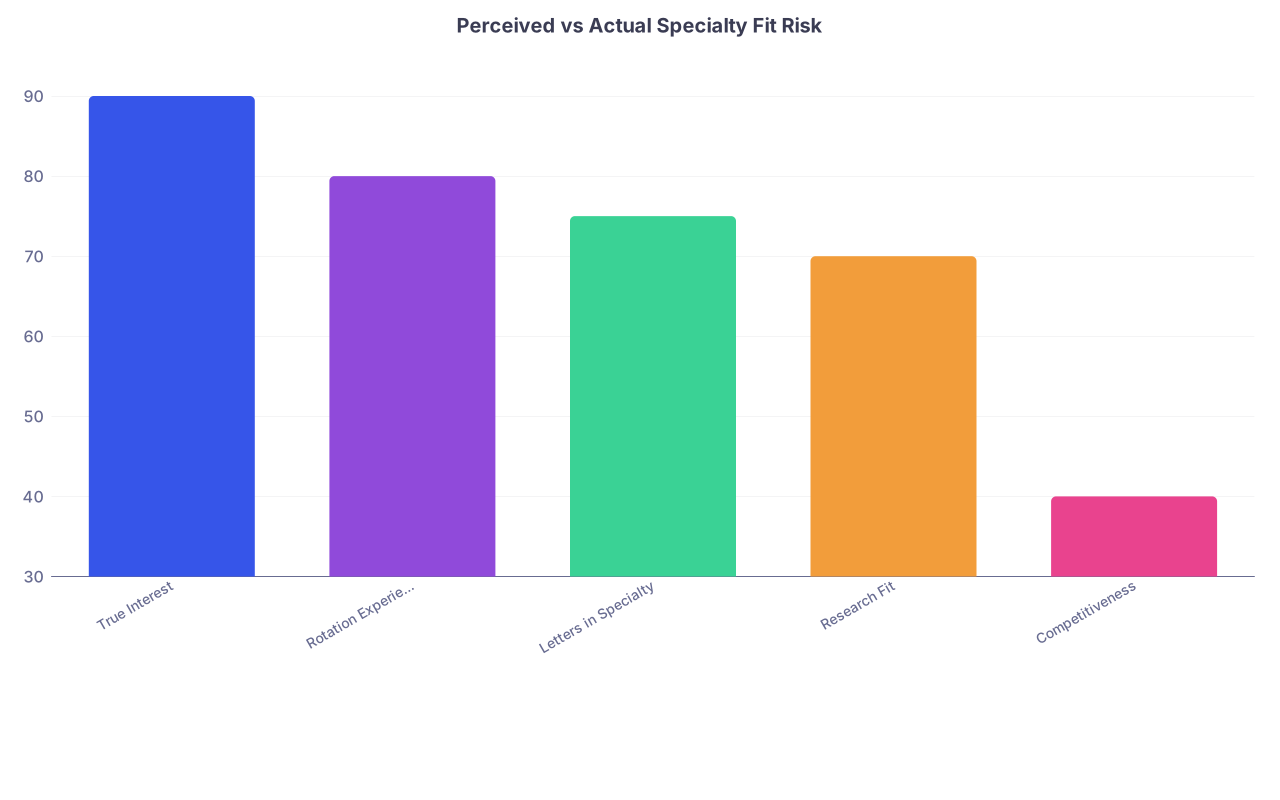
| Category | Value |
|---|---|
| True Interest | 90 |
| Rotation Experience | 80 |
| Letters in Specialty | 75 |
| Research Fit | 70 |
| Competitiveness | 40 |
Way too many students pick backup specialties like this:
- “What’s less competitive?”
- “Where can I ‘just match’ somewhere?”
They filter by fill rates and Step averages. Then they drop 30 applications into a field they’ve never touched.
The problem:
- Low competitiveness for the average applicant does not save a badly targeted applicant.
- You’re now competing against people who:
- Actually rotated in the field
- Have letters from well-known attendings there
- Can talk in detail about day-to-day work
You? You have none of that.
Programs are not desperate to fill with anyone who can fog a mirror. They want people who actually want their specialty. Your lack of rotation screams the opposite.
3. The “I’ll Just Say I’m Flexible” Story
I’ve heard students say this with a straight face:
- “I’ll tell EM programs I love fast-paced acute care.”
- “I’ll tell FM programs I love continuity of care and long-term relationships.”
- “I’ll just tailor my story to the specialty.”
Here’s the mistake:
Your entire CV has to back that story up. Not just your mouth on interview day.
If everything on paper says “Surgery, surgery, surgery,” and now your backup is psych with zero corresponding experience, your “flexible narrative” just looks like indecision and desperation.
How Backup Specialties Actually Blow Up Your Match
You think you’re hedging your risk. Often, you’re shifting it to something worse.
Risk 1: You Undercut Yourself in Your Primary Specialty
You only have:
- One MSPE
- One transcript
- A limited number of aways
- A limited number of strong LoRs
When you add an untested backup:
- You dilute your messaging
- You split limited interview days
- You spend time writing another personal statement instead of tightening your main one
- You may accidentally look noncommittal to both fields
Program directors absolutely notice when:
- Your personal statement feels generic
- Your LoRs are from people obviously in another specialty
- Your ERAS experiences lean heavily away from their field
Trying to chase two specialties, when you don’t actually understand one of them, often results in being unconvincing in both.
Risk 2: You Actually Match Your Backup
This is the part everyone pretends won’t happen.
It does.
And then:
- By October intern year, you’re Googling “how to switch specialties after starting residency”
- You’re exhausted in a field that doesn’t fit your brain or personality
- You’re now trying to explain to a second set of PDs why you want out of the first specialty you “loved”
Best-case scenario: you successfully jump fields, wasting time, money, and emotional energy.
Worst-case: you’re stuck in a specialty that slowly drains you.
Picking a backup you haven’t rotated in is basically saying:
- “I’m willing to risk committing my 30s and a huge chunk of my mental health to something I’ve never actually tried.”
That’s not a backup plan. That’s playing roulette with your future.
How PDs Read Your Backup Specialty Choices
Let me show you how programs interpret this situation, because that’s the part students regularly get wrong.
| Application Pattern | PD Interpretation |
|---|---|
| No rotations, no letters in backup specialty | Not serious, panic applying |
| Late personal statement in new specialty | Last-minute switch, unstable decision |
| Strong primary specialty CV, weak backup story | Good candidate in wrong field |
| Many specialties applied to simultaneously | Identity crisis, poor career counseling |
| Backup specialty only at prelim/TY-heavy places | Just trying to get a spot anywhere |
PDs aren’t offended by backups. They’re wary of:
- People who will quit
- People who will be miserable and infect the program culture
- People who will reapply elsewhere as soon as they can
No rotation in the field is a huge red flag for exactly those problems.
When a Backup Specialty Can Make Sense (And How to Avoid Screwing It Up)
Backup specialties aren’t inherently dumb. The way most students use them is.
Safe Rule #1: If You Haven’t Rotated in It, Don’t List It
Harsh? Yes. Necessary? Also yes.
At minimum, before you call something a backup, you should have:
- One meaningful inpatient or outpatient rotation in the specialty
- Ideally one letter from that field
- At least a few real patient stories to talk about on interview day
No rotation = no application. Full stop.
Safe Rule #2: Make Sure Your Story is Coherent
Your backup specialty should:
- Be something you can genuinely see yourself doing long-term
- Have real, visible threads from your existing experiences
Examples that make sense:
- EM primary → IM backup, with a real IM rotation and letter
- Surgery primary → anesthesia backup, after a solid anesthesia rotation and strong interest in physiology and critical care
- Psych primary → neurology backup, with neuro rotations and faculty support
Examples that do not:
- Ortho primary → psych backup, with zero psych experiences
- Derm primary → OB/GYN backup, no OB/GYN letters, minimal OB time
- Radiology primary → FM backup, no primary care experience
You need to be able to sit across from an interviewer and explain, credibly:
- Why this specialty fits you
- Why you’d still be satisfied here if your primary plan fell through
- Why your record already reflects that interest, not just in the last 3 weeks
What To Do If You’re Already Late and Panicking
Some of you are here because:
- You aimed at a hyper-competitive specialty
- Your Step scores or class rank came back lower than you hoped
- You’re scared you will not match without a backup plan
Fine. Panic is human. Bad decisions are not inevitable.
Here’s what not to do:
- Do not spontaneously pick a random “less competitive” field you’ve never touched
- Do not fire off a brand-new personal statement in 24 hours for a specialty you barely understand
- Do not email attendings in that field begging for last-minute letters when they’ve never supervised you
Instead, step back and make an actual plan.

| Step | Description |
|---|---|
| Step 1 | Primary Specialty Target |
| Step 2 | Do not apply in that field |
| Step 3 | Consider but be cautious |
| Step 4 | Build coherent narrative |
| Step 5 | Apply strategically |
| Step 6 | Reconsider primary list and program range |
| Step 7 | Any rotation in backup? |
| Step 8 | Letter available? |
Concrete moves that actually help:
Expand your primary specialty list:
- Add more community programs
- Add more geographically flexible options
- Consider prelim + reapply pathways where appropriate
If you absolutely must add a backup:
- Prioritize something you’ve at least rotated in once
- Talk to mentors in both specialties and get brutally honest feedback
- Make sure your personal statement is specific, and your interviews are honest about your path
How to Quickly Pressure-Test Whether a Backup Is Even Reasonable
Use this quick checklist. If you fail more than one line, it’s not a real backup. It’s wishful thinking.
| Question | If Your Answer Is “No” |
|---|---|
| Have you done a full rotation in this specialty? | You do not understand the workflow |
| Do you have at least one faculty advocate in it? | Nobody can vouch you belong there |
| Can you describe 2–3 real cases from it? | Interviews will expose your inexperience |
| Would you be OK doing this for 30 years? | You are gambling future happiness |
| Does your CV show *any* alignment? | PDs will view you as a panic applicant |
If your honest answers are mostly “no,” your problem is not lack of backup. Your problem is lack of strategy.
The Psychological Trap: Fear Masquerading as Flexibility
A lot of students tell themselves:
- “I’m just keeping my options open.”
- “I’m being smart and flexible.”
- “I don’t want to put all my eggs in one basket.”
No. Often you’re just:
- Too anxious to commit
- Too scared to really examine your actual competitiveness in your primary field
- Too rushed to get real exposure to a reasonable backup
True flexibility means:
- You’ve actually explored multiple fields
- You’ve built relationships in more than one specialty
- You can realistically see yourself satisfied in more than one direction
Listing a specialty you’ve never rotated in is not flexibility. It’s avoidance.
What You Should Do Today
Do not add a backup specialty you’ve never rotated in “just in case.” That’s the lazy move everyone regrets.
Here’s your concrete step for today:
Open your current specialty list and, for each “backup” you’re considering, answer this in writing:
- “What specific rotation, attending, and patient encounter convinced me I could be happy in this field?”
If you can’t name a rotation, a real human faculty member, and a specific patient story for that specialty, you have no business calling it your backup. Remove it from your list and re-focus on strengthening a path you actually understand.