
The way most applicants pick backup specialties is lazy and dangerous. “I’ll just toss in some FM and IM apps and see what happens.” That is not a backup plan. That is gambling with your career.
You need a tiered backup system: primary, stretch, and safety specialties that fit your profile, your scores, and your tolerance for risk. And you need to build it with the same discipline you used for Step studying.
I am going to walk you through exactly how to do that.
Step 1: Stop Thinking “Dream vs Backup.” Start Thinking “Portfolio of Risk.”
Residency matching is not about your “one true specialty.” It is about constructing a risk-balanced portfolio across:
- Competitiveness of specialty
- Competitiveness of individual programs
- Your objective profile (scores, class rank, research, visas, etc.)
- Your personal non‑negotiables (geography, lifestyle, visa, couples match)
Think like an investor:
- Primary specialties = your core holdings
- Stretch specialties = higher risk / higher upside
- Safety specialties = low risk / high probability of matching
If your entire list is dermatology, plastics, and orthopedic surgery because “that’s what I really love,” you are not a planner. You are a future SOAP participant.
You want a structure like this:
- 1–2 Primary specialties: realistic targets where you are near or above average
- 0–1 Stretch specialties: more competitive than your profile, but not completely out of reach
- 1 Safety specialty: a field where, if you apply broadly and strategize correctly, you should almost certainly match
You will then scale how many programs you apply to in each tier based on your risk tolerance and profile.
Step 2: Get Real About Your Profile Before You Pick Anything
You cannot design a backup plan until you understand exactly how competitive you are. Not vibes. Data.
Here is the minimum competitive snapshot you must create:
USMLE / COMLEX
- Step 1: Pass/Fail but PDs still care if you failed
- Step 2 CK: This is your primary numerical screen
- Any failures or large score gaps matter
Class performance
- AOA / Gold Humanism / top quartile
- Repeated courses, professionalism issues, leaves of absence
Research
- Total number of pubs/posters/abstracts
- Specialty‑specific research vs generic / unrelated
Clinical signals
- Honor grades on core clerkships
- Sub‑I performance and letters (especially in target specialty)
- Away rotations and how strong those letters are
Other factors
- IMG vs AMG (US MD / DO vs US‑IMG vs non‑US IMG)
- Visa needs (J‑1 / H‑1B)
- Couples match
- Geographic limitations (partner job, kids, family obligations)
If this sounds like a lot, good. This is exactly the level of clarity PDs already have about you when they look at your file. You may as well see it yourself.
Step 3: Understand How Risky Each Specialty Actually Is
Some specialties are brutally competitive. Some are only “competitive” at the top programs but very reasonable overall. Others are almost pure numbers games if you apply widely.
You should be thinking in these terms:
| Tier | Examples | General Risk Level |
|---|---|---|
| Ultra-Competitive | Derm, Plastics, Ortho, ENT, Neurosurgery | Very High |
| Competitive | Anesthesia, EM, Gen Surg, Rad Onc, Urology | High |
| Mid-Tier | IM (categorical), OB/GYN, Neurology, PM&R | Moderate |
| Less Competitive | FM, Peds, Psych, Pathology | Lower |
This is not perfect, and it changes over time (EM has been in flux, for example), but you get the idea.
Now pair this with your profile. You are not an “average” applicant. You are you with your own mix of strengths and weaknesses.
Here is a simple sanity check:
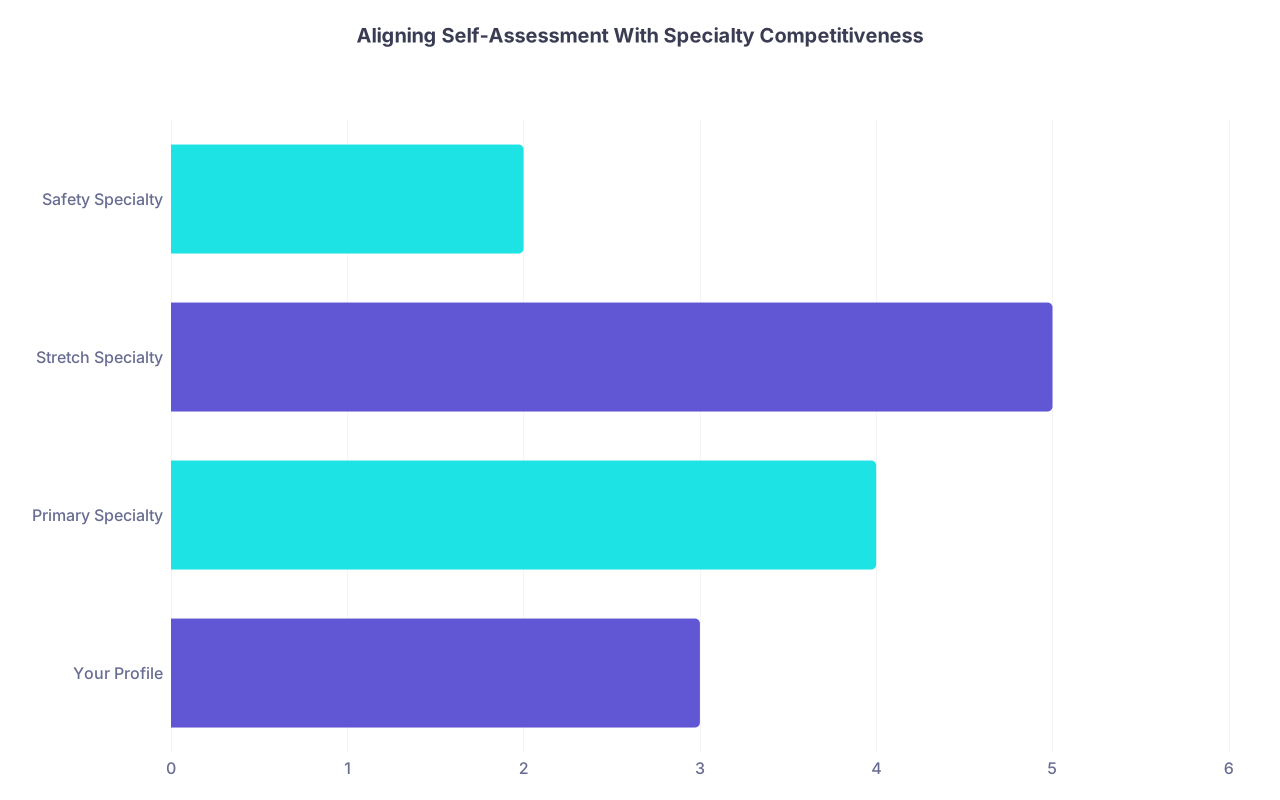
| Category | Value |
|---|---|
| Your Profile | 3 |
| Primary Specialty | 4 |
| Stretch Specialty | 5 |
| Safety Specialty | 2 |
Scale: 1 = weak, 3 = average, 5 = very strong. If your self‑rating is a 3 and your “primary” specialty is a 5 in competitiveness, that is not a primary. That is a stretch or a fantasy.
Step 4: Define Your Three Tiers Correctly
You are going to label specialties, not programs, as:
- Primary
- Stretch
- Safety
Later, each specialty will get a mix of safer vs reach programs, but first you lock the specialty tiers.
4.1 Primary specialties: Your realistic workhorses
Primary specialties are where:
- Your Step 2 score is near or above the matched median
- Your research and letters are at least respectable
- There are enough programs that you can apply broadly
- You would be genuinely okay spending your career here
Examples:
- US MD with Step 2 245, some research: Primary = Internal Medicine or Anesthesia
- US DO with 230, solid clinicals: Primary = Family Medicine or Pediatrics
- Non‑US IMG with 240, no US research, needs visa: Primary = Psych or IM (community‑heavy, wide net)
Your primary specialty is not your “consolation prize.” It is the backbone of your match strategy.
4.2 Stretch specialties: Your calculated long shot
A stretch specialty checks these boxes:
- Statistically more competitive than your profile
- You have at least some credible angles: a strong mentor, niche research, a home program willing to support you
- You are willing to absorb the risk that this might not work out, even with a good application
Do not pick a stretch that is completely detached from your CV. Example:
- You: no research, 230 Step 2, mid‑tier school, no ortho exposure
- Stretch: Plastics
- That is not a stretch. That is self‑sabotage.
A reasonable stretch might be:
- You: 250 Step 2, 4 ENT-related abstracts, ENT mentor, solid clinicals
- Stretch: ENT
- Primaries: IM, Anesthesia
- Safety: FM or Psych
4.3 Safety specialties: Your insurance policy, not your dumping ground
The safety specialty is where:
- Your profile is clearly above the median for that field overall
- There are many programs, including community and lower‑tier academic
- If you apply big‑net, your risk of going unmatched becomes very low
- You can actually live with doing that job for 30 years
This is where people make their biggest mistake: they pick a safety they secretly hate. Then they apply in a half‑hearted, sloppy way. Programs smell that instantly.
A good safety specialty for you is:
- Logistically safer (numbers, slots)
- Conceptually acceptable (you can imagine being content, even if it is not your first love)
- Something you are willing to rotate in, collect letters in, and write believable PSs for
Step 5: Map Your Three-Tier Structure to Your Exact Situation
Here is how the three‑tier design looks in real, common scenarios.
Scenario A: US MD, mid‑pack, wants Ortho
Profile:
- US MD, mid‑tier school
- Step 1: Pass, Step 2: 238
- 1 ortho abstract, no AOA, average clinical comments
Reality: Ortho is a stretch, arguably a fantasy, but let us be generous and call it stretch.
Plan:
- Stretch: Orthopedic Surgery
- Primary: Categorical General Surgery or Anesthesia
- Safety: Family Medicine or Internal Medicine (community‑heavy, wide net)
Application volume (rough guide):
- Ortho: 30–50 programs (if you have real mentorship and signals)
- Gen Surg / Anesthesia: 40–60 programs
- IM or FM: 30–40 programs
If you refuse to send a serious number of applications to your primary and safety, you’re just choosing to gamble.
Scenario B: US DO, strong clinically, modest scores, wants EM
Profile:
- US DO
- Step 1: Pass, Step 2: 232
- Strong SLOEs from EM, solid clinicals, no major red flags
EM right now is weird, but historically competitive. Treat it as between primary and stretch.
Plan:
- Primary: Emergency Medicine
- Safety: Family Medicine or Internal Medicine (both with an eye toward hospitalist or urgent care down the line)
- Optional micro‑stretch: EM‑heavy IM programs / combined EM‑IM if available and you have support
Volume:
- EM: ~40–60 programs
- Safety specialty: ~30–40 programs
Scenario C: Non‑US IMG, 1 attempt on Step 1, wants IM
Profile:
- Non‑US IMG, needs J‑1 visa
- Step 1: Fail → Pass; Step 2: 230
- 2 publications, 2 US LORs in IM, 1 US observership
IM is not your “safety.” For you, IM is your primary and stretch combined. You need a true safety.
Plan:
- Primary: Internal Medicine (heavy emphasis on community, IMG‑friendly, visa‑friendly)
- Safety: Family Medicine or Psychiatry
Volume:
- IM: 120–150+ programs
- Safety: 60–80 programs
Does that sound excessive? Ask anyone who went unmatched from this profile whether it was.
Step 6: Use a Four‑Box Matrix: Specialty Tier × Program Competitiveness
Tiering specialties is not enough. Inside each specialty, you need to spread risk across program types:
- Top‑tier academic
- Mid‑tier academic
- Community with strong reputation
- Pure community / smaller / newer programs
What you do not do is apply to:
- 20 ultra‑competitive academic programs in your primary
- 5 mid‑tier
- 0 community
…then call that a solid plan.
Here is how I tell people to structure it for each specialty:
| Specialty Tier | Program Type Focus | Suggested Mix (Approx) |
|---|---|---|
| Stretch | Mostly mid-tier + some top | 20% top / 50% mid / 30% community |
| Primary | Heavy mid + community | 10% top / 40% mid / 50% community |
| Safety | Dominantly community | 0–5% top / 20% mid / 75% community |
These are not hard rules. They are guardrails to prevent the classic “I only applied to famous hospitals” disaster.
Step 7: Build the Actual List – A Concrete Process
Enough theory. Here is the exact workflow you should use.
7.1 Pull your data and match it to specialty targets
- Print your USMLE/COMLEX transcript
- Write down your class rank / quartile if you have it
- List number of pubs, abstracts, posters with specialties
- Note any red flags (failed exams, leaves, professionalism)
Now, for each specialty you are considering, look up:
- NRMP Charting Outcomes for your applicant type
- NRMP Program Director Survey (what they care about)
- Specialty-specific match data (e.g., SF Match, AUA for Urology)
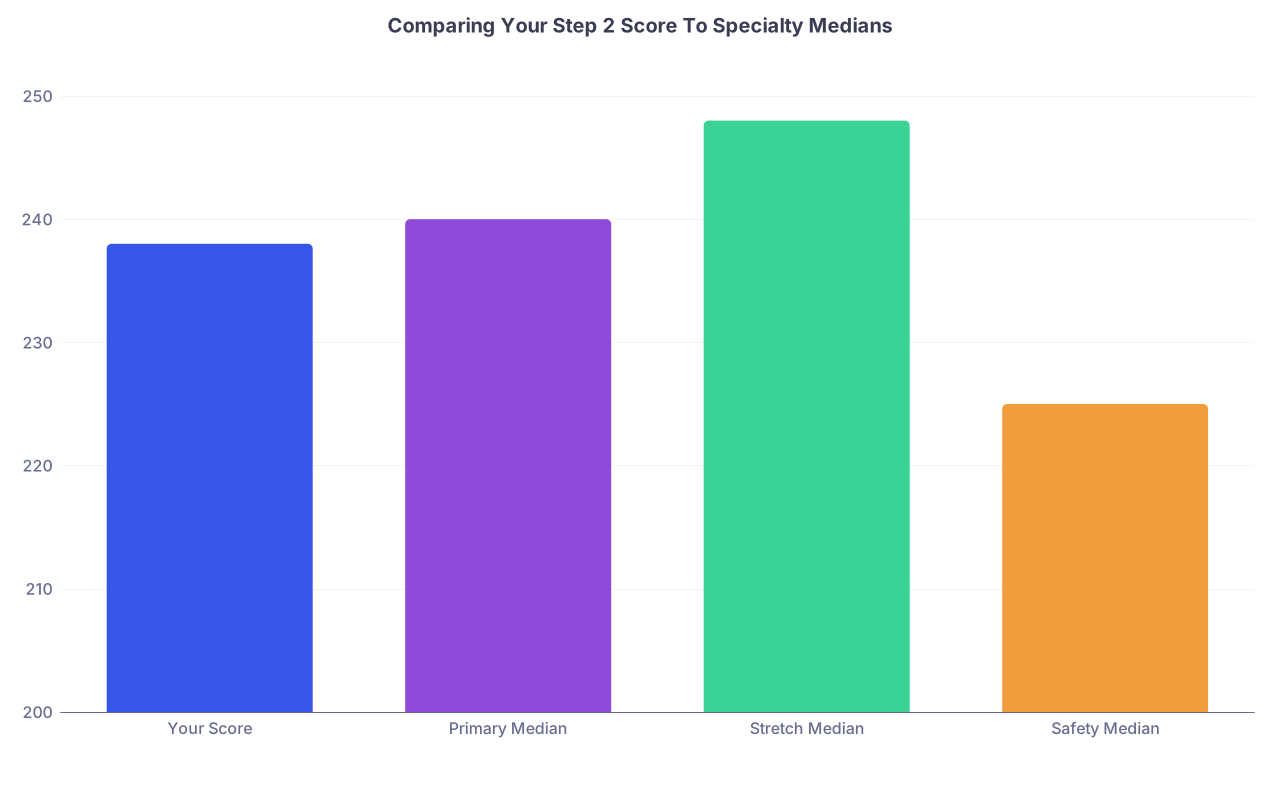
| Category | Value |
|---|---|
| Your Score | 238 |
| Primary Median | 240 |
| Stretch Median | 248 |
| Safety Median | 225 |
Your score relative to those medians should largely determine where the specialty lands: primary, stretch, or safety.
7.2 Lock in 1–2 primaries, 0–1 stretch, 1 safety
Do not get cute here. You are not picking 4 stretches and calling two of them “primary.”
Rules:
- If your goal specialty is ultra‑competitive and your profile is average → it is a stretch.
- You must have at least one specialty where your scores are above typical matched medians. That is your safety.
- You do not need a stretch if the risk terrifies you. You can be a grown adult and say: “I prefer a 95% match chance in a realistic field over a 50% shot at a shiny one.”
7.3 Decide rough application numbers by tier and risk
A practical framework for most US MDs / DOs (not IMGs, they need higher counts):
If you are strong for a field:
- Primary: 25–40 programs
- Safety: 15–25 programs
If you are average:
- Primary: 40–60 programs
- Safety: 25–40 programs
- Stretch (if used): 20–40 programs
If you are below average or have red flags:
- Primary: 70–100 programs
- Safety: 40–60 programs
- Stretch: optional, and only if you can afford the risk and cost
Yes, this is expensive. The alternative—going unmatched and losing a year of income—is more expensive.
Step 8: Write Coherent Application Materials for Each Tier
This is where most “backup” plans die. Your PS says:
“I have always dreamed of being a neurosurgeon,”
…but you are applying to FM, Psych, and Pathology as backups. Programs read that and toss your file.
You need coherent narratives for each specialty tier:
Unique personal statement per specialty, not per program:
- One for your stretch
- One for each primary
- One for your safety
No copy‑pasted “I just love helping people” generic sludge.
-
- Stretch: maximum number of letters from that specialty
- Primary: at least 2 letters in that field, or 1 field + 1 strong medicine letter if relevant
- Safety: 1–2 letters specifically from that specialty, even if it is your backup
Avoid obvious conflict
- Do not have your stretch‑specialty letter writers say: “This student has always wanted field X” when you are applying in three other directions.
Ask them to keep it focused on your skills and fit, not your undying passion exclusively for that one field.
- Do not have your stretch‑specialty letter writers say: “This student has always wanted field X” when you are applying in three other directions.
Step 9: Create a Contingency Path Within Each Specialty
You are not done once you say “Safety = Family Medicine.” You also need:
- Plan A: Match FM straight → done.
- Plan B: If I do not match FM, what then?
- Plan C: How will I use a gap year if I go unmatched?
For each tier, outline this in brutal, practical terms:
For Stretch
- If I do not match stretch but do match primary/safety → accept that reality and move on. No “I’ll just reapply to derm from my prelim surgery spot” fantasies without talking to real people in that field.
For Primary
- If I do not match primary but do match safety → commit fully to safety. Stop fantasizing about reapplying every year. Build a life, then reassess in 3–5 years if still truly motivated.
For Safety
If you do not match your safety specialty, your plan was flawed or your red flags are major. Your next step is not “try the same thing again and pray.”
You need a structured backup of the backup:
- Extra research year in your primary / safety field
- Prelim / transitional year with aggressive networking and performance
- Targeted Step/COMLEX retake if failures dragged you down
- Honest discussion with mentors about long‑term realistic options
Do this before Match Day:

| Step | Description |
|---|---|
| Step 1 | Before ERAS Submission |
| Step 2 | Define Stretch Primary Safety |
| Step 3 | Build Program Lists |
| Step 4 | Submit Applications |
| Step 5 | Match Result |
| Step 6 | Proceed With Training |
| Step 7 | Commit To Safety Path |
| Step 8 | SOAP or Research Year |
| Step 9 | Reassess Specialty Tiers |
Step 10: Sanity-Check With Someone Who Has Actually Seen Match Data
You are biased. Your friends are biased. Your parents are wildly biased. Get at least one reality check from:
- A PD or APD who knows you (ideal)
- Your school’s advising dean
- A senior resident in your target specialty with recent match experience
Show them:
- Your scores and CV
- Your proposed primary / stretch / safety specialties
- Your approximate program counts and mix
Then ask bluntly:
“Where is this plan unrealistic?”
“Where am I under‑ or over‑applying?”
If three different people all tell you, “Derm as a stretch with a 230 Step 2 and no research is not a stretch, it is impossible,” believe them.
Concrete Example: Building a Tiered Plan From Scratch
Let me walk through one composite case end‑to‑end.
Profile:
- US MD, mid‑tier
- Step 1: Pass, Step 2: 244
- No failures, middle‑upper third of class
- 1 anesthesia paper, 1 gen surg poster
- A in IM, B+ in Surgery, solid comments
- No geographic restriction
Initial desire: “I kind of like surgery stuff, maybe anesthesia or general surgery. I want something procedural, not clinic heavy.”
Process:
Data vs specialties:
- Anesthesia: matched Step 2 medians ~245–248 (varies, but close) → borderline primary/ stretch
- General Surgery categorical: slightly more competitive, more variability → stretch leaning
- IM: lower bar than current profile → clear primary or safety depending on program mix
- FM: clear safety
Decide tiers:
- Stretch: General Surgery
- Primary: Anesthesia, Categorical IM
- Safety: FM
Application numbers:
- Gen Surg (stretch): 25–35 programs (heavily mid + community, not 30 brand names)
- Anesthesia: 40–50 programs (mix of mid and community-heavy academic)
- IM: 30 programs (mostly mid + community with some academic)
- FM: 15–20 programs
Materials:
- 4 PS versions: Surg, Anes, IM, FM
- Letters:
- 1 surgery attending → used for Gen Surg and maybe Anes
- 1 anesthesia attending → Anes primary letter
- 1 IM attending → IM and FM
- 1 faculty who knows them well, general medicine → can be flexed as fourth letter
Contingency:
- If matched Gen Surg → done.
- If no Gen Surg interview traction but strong Anes traction → lean into Anes/IM rankings, FM as true safety lower on the list.
- If match FM only → accept and build a procedural niche (OB, sports, urgent care) over time.
This is what a grown‑up tiered plan looks like.
Final Tight Summary
- Treat specialties like a risk portfolio: 1–2 realistic primaries, at most 1 calculated stretch, and 1 true safety where your profile is clearly above average.
- Use real data—scores, match medians, research, IMG/visa status—to decide which field belongs in which tier, then spread applications across program competitiveness within each specialty.
- Back each tier with coherent narratives, targeted letters, and a brutally honest contingency plan, so that if the stretch fails and only the safety hits, your career still works rather than collapses.
That is how you build a backup plan that actually protects you. Not wishful thinking. A system.