
Last week a classmate told me, “I’m only ranking derm. I’d rather SOAP or reapply than ‘sell out’ into something else.” I nodded like I understood… then went home and stared at my own half-finished rank list, with a “backup” specialty folder that made me feel like a traitor to my dream.
Because that’s the fear, right? If you pick a backup, it means you didn’t really believe in yourself. Or worse—you settled. Forever.
Let’s talk about that. For real, not in the fake “follow your heart, it’ll all work out” way people toss around between OSCEs and pre-rounding.
The ugly thought you’re probably having but not saying out loud
If you’re reading this, I’m guessing some version of this sentence keeps looping in your head:
“I love [insert dream specialty]. If I apply to something else, it means I didn’t try hard enough. It means I quit.”
Maybe your “dream” is ortho, derm, plastics, ENT, rad onc, EM in certain regions, or just a super-competitive academic IM program. The details don’t really matter. The emotional math is the same.
You see classmates planting their flags:
- “I’m all in on ortho.”
- “It’s plastics or nothing.”
- “If I don’t match ophtho I’m just going to research another year.”
And you think: maybe they deserve it more because they’re brave enough to risk not matching. Meanwhile you’re over here making spreadsheets: what if I dual apply? What if I don’t match? What if I rank X above Y—will I regret it for life?
And beneath all of that:
If I choose a backup, am I admitting I’m not good enough?
Here’s the uncomfortable truth I’ve seen over and over:
People who act like having a backup is “weak” rarely have actually sat with what it feels like to not match. They’re talking bravely with no skin in the game yet—or a safety net they’re not mentioning (money, connections, willingness to take extra research years).
You? You’re actually thinking. Which feels like anxiety, but it’s also just… reality.
Backup ≠ “settled” — it just means your risk tolerance is human
Let me be blunt: loving your dream field is not the same thing as being entitled to match into it.
And planning for that reality doesn’t make you a coward. It makes you a functioning adult.
Programs look at numbers. They look at trends. They look at letters and institutional prestige and timing and pure dumb luck. Loving a specialty doesn’t override any of that.
Here’s what’s actually true:
- You can be absolutely in love with a field
- You can still choose to apply more broadly or to a backup
- Your love for the field doesn’t shrink just because you also love paying rent and not having to explain “I didn’t match” 200 times
That feeling of “If I really believed in myself, I wouldn’t need a backup”?
That’s shame talking. Not logic.
A lot of residents I’ve talked to who “ended up” in their backup didn’t “settle” the way we imagine. The arc is more like:
Rage → grief → cautious acceptance → “Huh… I actually like this work” → “I can’t believe I almost torched my life because 24-year-old me thought not matching would be romantic and noble.”
Does everyone end up loving their backup? No. I’m not going to lie to you. Some people genuinely reapply or lateral later. But most don’t view a backup as failure. It’s just… the path their life took, and it still leads to being a doctor.
How risky is your dream, actually? (You need to get brutally honest)
Before you can even answer “Do I need a backup?” you have to stop hand-waving your chances.
You know the line: “Stats aren’t everything.”
True. But they’re not nothing either.
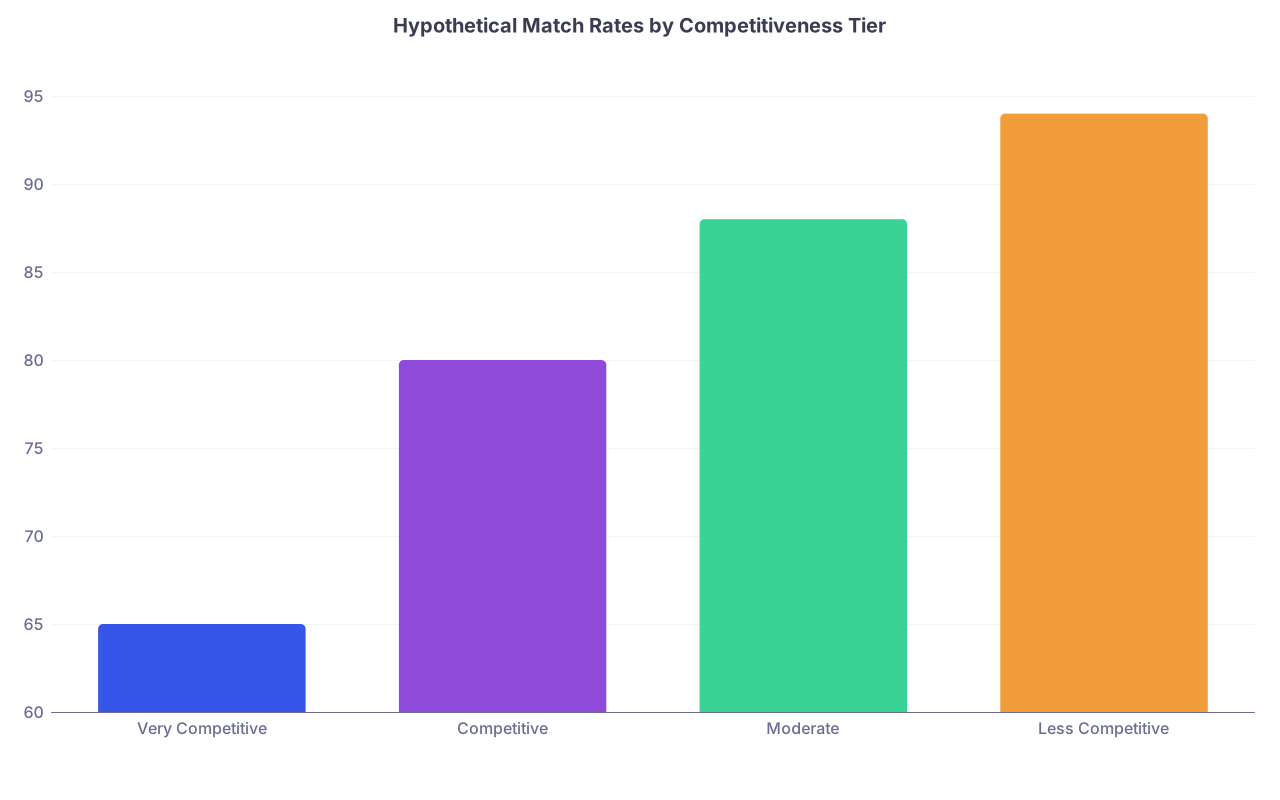
| Category | Value |
|---|---|
| Very Competitive | 65 |
| Competitive | 80 |
| Moderate | 88 |
| Less Competitive | 94 |
That’s overall. Not for people with:
- Below-average Step 2 scores
- A red flag (leave of absence, remediation, professionalism issue)
- Late decision with only one short away rotation
- A rushed personal statement and generic letters
If any of that sounds like you, it doesn’t mean “give up.” It just means: don’t live in a fantasy where your dream specialty is 90% when you’re actually walking into a 40–60% situation for your specific profile.
And then ask the question nobody wants to say out loud:
If I woke up on Match Day and I didn’t match at all… could I live with that?
Like actually live with it. The hit to your self-esteem, the financial mess, the emotional crash, the scramble decisions during SOAP when you’re not thinking clearly.
If the honest answer is “No, that would wreck me,” a backup isn’t “secret settling.” It’s emotional triage.
What “settling” really looks like (and what it doesn’t)
Settling is not:
“I loved derm, but I also liked IM, and my chances in derm were 30% with my app. I dual-applied and matched IM at a solid program, and I’ve built a niche in rheum/derm overlap. I still sometimes wonder ‘what if,’ but my day-to-day life is good.”
Settling is more like:
“I blindly followed prestige, picked something I actively disliked because it looked impressive, and I ignored that sick feeling I had on rotations. Now I dread going to work and I feel trapped.”
See the difference?
You’re not “secretly settling” just because you recognize you could be happy in more than one specialty. That’s not disloyal. That’s just acknowledging you’re a complex human being, not a cartoon character whose entire identity is “future neurosurgeon.”

What actually predicts regret isn’t “I chose a backup.”
It’s “I didn’t think honestly about what matters to me day-to-day.”
- Do you hate or tolerate call?
- Are you okay with 6–7 years of surgical training?
- Do you care deeply about lifestyle and flexibility?
- Is geographic location non-negotiable because of family, partner, kids?
If your dream specialty badly clashes with your actual non-negotiables, then not having a backup isn’t brave. It’s self-sabotage.
Dual applying vs single-application: you’re not weak for hedging
There’s this weird macho energy around the Match. Like you’re supposed to slam your app into one specialty and scream, “Do or die.”
But dual applying—or having a seriously-considered Plan B—isn’t weak. It’s strategy.
| Approach | Pros | Cons |
|---|---|---|
| Single only | Full focus, clear story | Higher risk of not matching |
| Dual apply | More safety, options | More work, must explain narrative |
| Backup only | Highest chance of match | Possible long-term 'what if' |
Here’s the part people don’t say: you can tell a coherent story that includes two specialties. I’ve seen applicants pull this off.
The key is honesty without self-sabotage. Something like:
“I was initially drawn strongly to [Dream Specialty] and pursued rotations and research there. Over time, I realized that what I loved most was [specific aspect: longitudinal care, procedures, patient relationships, diagnostic puzzles]. I found that [Backup Specialty] allowed me to focus on these aspects while also offering [X lifestyle/setting/procedural mix] that fits my long-term goals. I would be genuinely excited to train in [Backup Specialty] and build a career centered on [insert consistent theme].”
Is that a little “narrative massaging”? Sure. But is it a lie? Not if you’ve actually thought it through. Your heart can have more than one lane.
The quiet truth: tons of attendings didn’t match their “dream”… and are fine
Nobody advertises this on pre-interview dinners, but over and over, I’ve heard some version of:
“I thought I’d die if I didn’t match into [X]. I ended up in [Y]. Honestly? 5 years later, I’m really glad it went this way.”
Or:
“I went all-in on my dream, didn’t match, did a prelim year, reapplied, finally got it. Was it worth it? Yes for me—but I also had no debt safety net, a supportive partner, and no kids. I underestimated how much that cushion mattered.”
The thing nobody tells us is: on the other side of Match, the world gets bigger again. You start caring less about the name of the field and more about:
- Are my co-residents decent humans?
- Do I get to sleep sometimes?
- Can I see myself doing this at 45, not just at 28 when I’m trying to impress everyone?
The “settling” fear is very loud right now because all your identity is tied up in “future [insert specialty].” That’s not your fault—you’ve basically been trained to answer “So what specialty?” like it’s your entire personality.
But once you’re in practice, patients don’t care what you were “meant” to match. They care if you listen, if you’re competent, if you call them with results, if you don’t brush off their pain.

You can do that in a lot of specialties. More than your panicked brain is allowing right now.
How to decide if your backup is real… or just fear in disguise
Here’s the real question to wrestle with:
Do I genuinely see a version of my life where I’m [backup specialty], and I’m okay—maybe even happy?
Not “would I brag about it on social media.”
Not “what will my classmates think.”
Just: could I build a good life there?
If your answer is an honest “yes, I could see that,” then picking a backup isn’t surrender. It’s giving yourself two shots at becoming a doctor you can actually stand to be.
If your answer is a hard “absolutely not, I’d be miserable and I know myself,” then maybe you:
- Accept the higher risk
- Apply only to the dream
- Have a real plan if you don’t match (research year, prelim year, SOAP strategy)
- Actually talk to mentors who will be honest, not just encouraging
Just don’t lie to yourself either way. Self-delusion is way worse than “settling.”

| Step | Description |
|---|---|
| Step 1 | Love Dream Specialty |
| Step 2 | Apply Dream Only |
| Step 3 | Dual Apply |
| Step 4 | Apply Mostly Backup |
| Step 5 | Train and Build Career |
| Step 6 | SOAP or Reapply Plan |
| Step 7 | Risk Tolerance |
| Step 8 | Match? |
You’re not weak for caring about that “H” branch.
The narrative in your head vs the reality you’ll live
Right now, your brain is running these scripts:
- “If I pick a backup, everyone will know I wasn’t strong enough.”
- “I’ll always secretly wonder if I sold out.”
- “The people who go all in are better, braver, more committed.”
Most of that is shame dressed up as “principle.”
Nobody is handing out medals in 10 years for “most committed to derm at age 26.” They’re just trying to get through clinic and go home to their families.
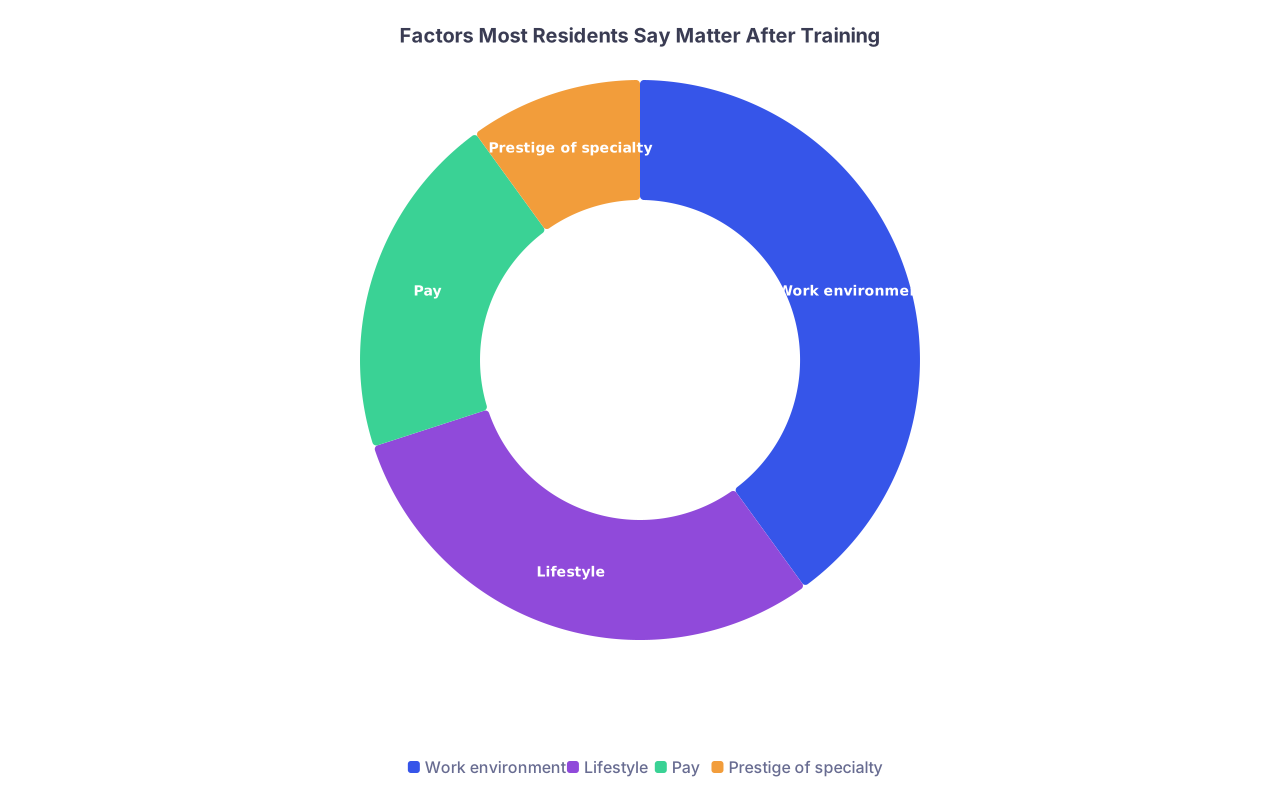
| Category | Value |
|---|---|
| Work environment | 40 |
| Lifestyle | 30 |
| Pay | 20 |
| Prestige of specialty | 10 |
By the time you’re out, the things that feel huge right now—“backup,” “settled,” “dream field”—shrink a lot. You’ll care more about:
- Can I practice in the city I love?
- Can I afford my loans and still have a life?
- Do I hate Mondays or am I mostly okay?
A backup doesn’t erase your dream. It just acknowledges that the Match is not a moral sorting hat. It’s a messy, numbers-driven system that doesn’t always reward “love” the way we wish it did.
You’re allowed to protect yourself in that system.
Quick gut-check questions to ask yourself tonight
If you’re spiraling, grab a scrap of paper and answer honestly:
- If I don’t match at all, how will that affect my mental health, finances, and relationships this year?
- What parts of my dream specialty do I actually love (not just the flex)? Procedures? Relationships? ICU-level acuity? Outpatient rhythm?
- Which other specialty can genuinely give me at least 60–70% of those things?
- If I woke up in 5 years as a happy, competent [backup specialty], would that really feel like failure—or is that just my ego today talking?
If your answers show that backup-you is still a real, full version of you? Then no, you’re not secretly settling. You’re just refusing to bet your entire future on a system you don’t completely control.

FAQ (exactly 4 questions)
1. Will programs in my dream specialty see me as less committed if I also apply to a backup?
Not automatically. Most PDs are not naïve; they know the match numbers and they know which fields are risky. If your application clearly shows genuine interest in their field—solid letters, meaningful rotation, reasonable research or relevant experiences—they care far more about that than whether you also sent applications somewhere else. Don’t announce “I’m dual applying” in your personal statement. Focus that on why you’d be a good fit for their specialty. Then craft a separate, honest-but-positive narrative for your backup specialty.
2. What if I match my backup and regret it forever?
The “forever” part is your anxiety talking. Yes, you might grieve the path not taken. That’s normal. But people are far more adaptable than they think in med school. You’ll grow into the identity you actually live every day. You can also carve out niches—procedural clinics, subspecialty fellowships, academic focuses—that scratch some of the itches your dream field would’ve scratched. And in rare but real cases, people do laterally switch or re-train. Your first match isn’t a prison sentence.
3. Is it better to go all-in on my dream and risk not matching, or choose a safer backup from the start?
It depends on two things: your actual competitiveness for the dream field, and your true risk tolerance. If your numbers, letters, and experiences are clearly below the typical range, and the idea of not matching would wreck you, then “all-in” isn’t noble—it’s reckless. On the other hand, if your app is legitimately strong and you know you’d rather take an extra year than ever do your backup, then you might accept that higher risk. The mistake is pretending it’s a purely romantic decision. It’s not. It’s a probability and life-consequence decision.
4. How do I know if I really like my backup or I’m just scared?
Look at how you feel when you imagine yourself as an attending in that field, not as a med student comparing prestige. Picture your day: clinic, OR, wards, patients, colleagues, schedule. Do you feel dread? Numbness? Or a quiet, “Yeah… I could see that life”? If it’s the last one, that’s real interest, even if it’s overshadowed by the intensity of your dream right now. Fear screams; calm, genuine fit is quieter. Don’t confuse volume with truth.
Key takeaways?
Loving your dream specialty and choosing a backup are not mutually exclusive. You’re not secretly “settling” just because you refuse to gamble everything on a brutal, numbers-driven system. Your job isn’t to prove you’re fearless—it’s to build a life you can actually stand to live.