How Attendings Quietly Steer Students Toward Certain Backup Fields
It’s late November of your fourth year. You’re on a sub-I in your dream specialty. You just checked your email again—no new interview invites. Your Step scores are fine, your letters are good, but the invite trickle has slowed to a drip.
Your attending pauses after sign-out and says, “Hey, can we chat for a minute about your plans?”
You already know what’s coming.
The “so what’s your backup?” talk.
Let me show you what’s actually happening in that conversation—and all the smaller conversations that started months before you even realized you might need a backup.
Because attendings rarely say, “You should give up on this and do Family Med instead.”
They steer. Softly. Repeatedly. Intentionally.
You feel like you’re choosing your own backup specialty. Often, you’re not. You’re being guided toward specific safety nets that make sense to them, their department, and their mental model of “where students like you end up.”
I’ve watched this play out for years in committee rooms, hallway chats, and “quick check-ins.” Let me walk you through how it really works.
The Hidden Agenda: Why Attendings Push Certain Backup Fields
Start with the motive. Attendings are not neutral observers. They have a few agendas running in the background, even when they genuinely care about you.
I’ll be blunt.
They hate watching students crash in the Match.
A no-match email is traumatic—for you and for them. Nobody wants to sit in a March remediation meeting explaining how “we really thought she had a shot in plastics.” So they gravitate to backup plans that are safe, predictable, and clean.They are pattern-recognition machines.
After 10+ years, they can tell who’s actually competitive and who’s playing pretend. They’ve seen the 250 Step, AOA student not match ortho because of terrible professionalism. They’ve seen the 220 average applicant slip into anesthesia at a mid-tier program. Those memory banks drive their steering.They care about their specialty’s reputation.
Departments don’t want a parade of “failed dermatology applicants now in our Internal Medicine program” if they think those people will be bitter and disengaged. So they quietly nudge you toward backups that fit your temperament—and don’t poison their hallway.They know which specialties are losing ground.
Certain fields are desperate for bodies. Others are tight but still accessible. Attendings talk about this in conference rooms and faculty meetings: “We had four unmatched grads last year. We need to push the borderline ones toward safer options.”
So when your surgical attending says, “Have you considered anesthesia?”
What they actually mean is: “I’ve seen this movie. With your stats and your current interview list, I don’t like your odds in surgery. But I know five anesthesiologists who would be happy with your file.”
The Soft Signals: How Steering Actually Sounds
Most students expect a blunt conversation. “You should back up with X.” That’s not how it starts.
It starts months earlier, in little throwaway lines.
Here’s what it sounds like in real life:
1. The “Personality Match” Comment
You’re on neurosurgery. It’s 10 p.m., everyone’s wiped. The attending turns to you and says:
“You know, you’d actually be fantastic in anesthesia or radiology. You’re calm, you think ahead, you don’t seem to need constant chaos.”
Feels like a compliment.
It is. It’s also an early redirect.
When I hear that line from a neurosurgery or ortho attending, I know what they’re doing. They’re giving themselves permission—months down the line—to say, “Remember how we talked about anesthesia for you?” They planted a seed.
2. The “Exposure” Offer
You’ll hear:
“Hey, if you’re unsure, I can introduce you to our colleagues in [IM / FM / Anesthesia / Path / Psych]. Could be useful to see a day in their life.”
You think: “Nice, networking.”
They think: “Time to give this kid an exit ramp.”
Those “just-shadow-them-one-day” invites are not random. They usually go to students whose primary choice looks shaky on paper.
3. The “Reality Check” Wrapped in Concern
This shows up on email or in a quick office chat:
“I’m not worried, but I do want you to have a robust plan B. The Match is weird lately. Have you thought about including some [X] programs as a safety net?”
Translation: “I am, in fact, worried.”
If they mention a specific field by name—more than once—that’s not casual. That’s directional.
Why Certain Backup Fields Get Used Over and Over
Not all specialties are created equal as backups. Attendings tend to funnel students into the same short list of “safe” options.
Let me break down the quiet hierarchy a lot of faculty have in their heads. This is rarely said out loud but very much active during advising.
| Primary Dream Field | Typical Steered Backup | Why Attendings Like It |
|---|---|---|
| Ortho / Neurosurg / Gen Surg | Anesthesia | OR-adjacent, solid lifestyle, still “procedural” |
| Derm / Radiology | Internal Medicine | Academic options, fellowships, broad landing pad |
| Plastics / ENT / Urology | General Surgery | Same ecosystem, shared skillsets, familiar culture |
| EM (when market is bad) | IM or FM | Job security, real need, broad scope |
| Competitive IM subspecialties | Categorical IM at lower tiers | Minimizes risk, preserves subspecialty shot later |
There are also “catch-all” fields that repeatedly show up as backup dumping grounds: Family Medicine, Psychiatry, Pathology, sometimes PM&R.
Why those?
Family Medicine
This is the ultimate safety net. Programs everywhere. Need is high. Academics quietly see it as:
- Forgiving on Step scores and class rank
- Broad enough to sell to almost any student: “You’ll keep doors open”
- A fast way to move someone off the “might not match anything” list
You won’t often hear an attending say bluntly, “You may not match, so do FM.”
Instead you’ll hear:
“You like continuity, you’ve talked about work-life balance, and you seem great with patients. You’d be phenomenal in FM.”
They’re aligning a narrative you can swallow with a risk they’re afraid of.
Psychiatry
Psych gets used more than you think as a soft landing spot for students who:
- Struggle with pace and acuity
- Are bright but slower processors
- Have weaker clinical evaluations in chaotic settings
Faculty will say:
“You’re very thoughtful and reflective. Have you ever thought about psych? You see the whole person.”
But in those closed-door meetings, they’ll say, “He’s not going to survive EM or surgery. Psych would suit him better and he’d actually be happy.”
Pathology & Radiology
These get floated when:
- Clinical performance is mediocre but test performance is strong
- The student seems disengaged on wards
- There’s concern about bedside manner but not intellect
Attending shorthand:
“Strong brain, weak presence.”
You won’t hear that phrase to your face. What you’ll hear is:
“You have a really analytical mind. Have you explored more diagnostic fields where that’s central to the work?”
That’s steering.
The Timeline: When Steering Intensifies
The closer you get to the Match, the more active and less subtle this becomes.
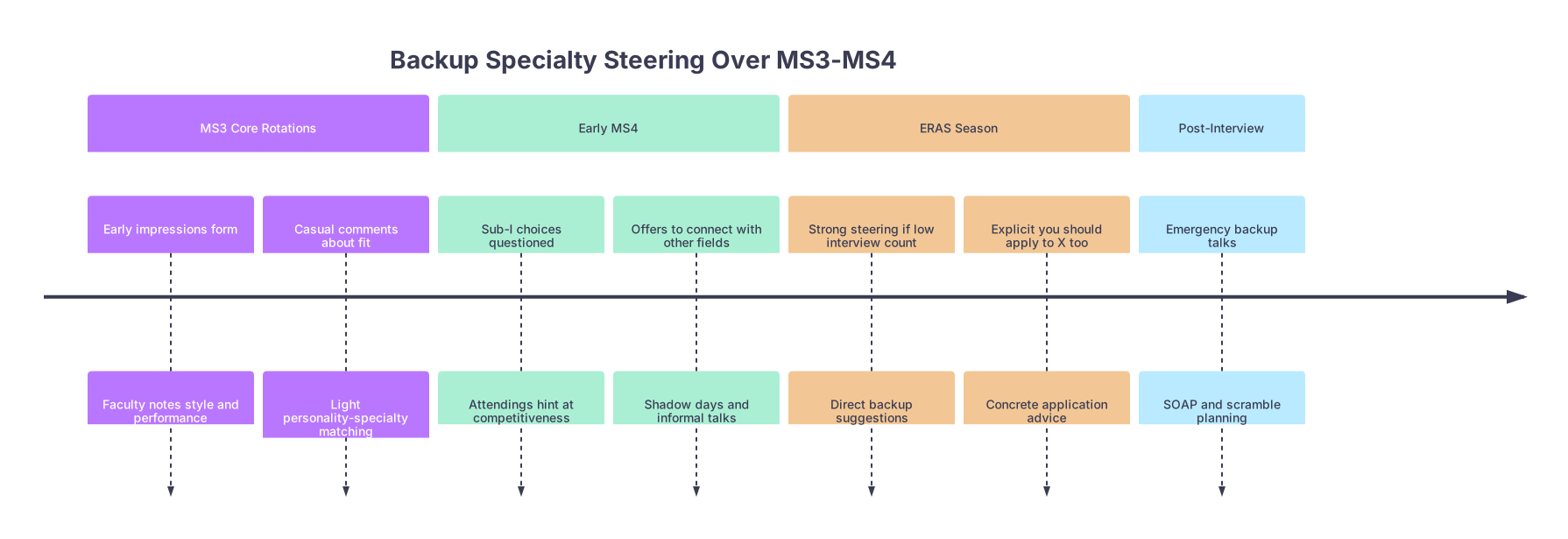
| Period | Event |
|---|---|
| MS3 Core Rotations - Early impressions form | Faculty notes style and performance |
| MS3 Core Rotations - Casual comments about fit | Light personality-specialty matching |
| Early MS4 - Sub-I choices questioned | Attendings hint at competitiveness |
| Early MS4 - Offers to connect with other fields | Shadow days and informal talks |
| ERAS Season - Strong steering if low interview count | Direct backup suggestions |
| ERAS Season - Explicit you should apply to X too | Concrete application advice |
| Post-Interview - Emergency backup talks | SOAP and scramble planning |
Here’s how it tends to play out:
MS3: Soft, Almost Invisible
You think everyone is just “getting to know you.” They’re actually sorting you mentally:
- “Probably fine for competitive stuff”
- “Solid but not stellar”
- “Borderline—will need a safety plan”
They log your performance, your pace, your demeanor on call. They talk in resident work rooms after you leave. By the time you’re an MS4, many attendings already have a short list of fields they’d back you for—and ones they absolutely would not.
Early MS4: Testing the Waters
You say you want ortho. Your Sub-I evals come back fine but not glowing. You’re not the worst. You’re not the star.
That’s when the comments start:
“Ortho’s gotten very competitive. You know that, right?”
“Make sure you’ve got a strategy in case interviews don’t roll in like you expect.”
Notice: nobody says, “You can’t do ortho.”
They’re probing your insight, your flexibility, your ability to hear bad news.
ERAS Season: The “We Need To Talk” Moment
This is where the soft steering turns into a push.
You’ve got 2 interviews in a field where a safe number is 8–12. Your advisor has your ERAS list in front of them.
They’ll say things like:
“I’d feel more comfortable if you had at least 5–10 [IM/FM/anesthesia] programs on this list.”
“I think you’d be an outstanding anesthesiologist. Honestly, with your letters, I think ‘good-but-not-top-tier’ anesthesiology is safer than ‘pray-and-hope’ surgery.”
The words “I’d feel more comfortable if…” are a massive red flag. That’s attending-speak for: “We think you’re playing with fire.”
The Real Criteria Attendings Use When Pushing a Backup
You think it’s just Step scores and class rank. That’s only part of it. When attendings discuss which backup to push you toward, the private conversation sounds more like this:
- “How does she handle fatigue and chaos?”
- “Is he liked by nurses and residents, or tolerated?”
- “Could she function safely in EM nights? Or better in a clinic-based field?”
- “Is he coachable or rigid?”
- “Would this person sink or swim if dumped into a 28-bed ICU night float?”
They’re not just matching competitiveness. They’re matching risk.
A student with:
- 240 Step 2
- Decent but not stellar letters
- “Great team player, reliable” comments
might get pushed toward:
- IM at mid-tier places
- Anesthesia if they show interest
- FM as a safety net if interview invites are slow
Another student with:
- 260 Step 2
- Brilliant test scores
- Comments like “cold,” “aloof,” “difficulty with feedback”
might get quietly steered toward:
- Radiology
- Pathology
- Occasionally anesthesia
You’ll never see those labels in writing. But they absolutely drive how hard someone advocates for you in certain fields vs others.
How to Tell When You’re Being Steered (And Not Just “Advised”)
You’re not powerless here. You can detect when the advising crosses from general guidance into clear steering.
Here are the tells:
You keep hearing the same 1–2 backup fields from different people who do not usually coordinate.
Your surgery attending, your advisor, and a random IM faculty all separately say, “You’d be great in anesthesia.” That’s not coincidence. That’s consensus.People stop answering, “Do you think I can match X?” directly.
Instead, they say, “I think you’d be excellent in Y, and Y would give you a great career.” They’re dodging.They offer to “connect you” with specific programs in the backup field.
That means they’ve already mentally shifted you into that lane.You get more questions about your geographic flexibility than your passion.
“Would you be open to going anywhere for IM? Community programs too?”
They’re triaging your chances, not exploring your dreams.
When you see this pattern, you’re no longer just in “career exploration” territory. You’re on a guided track. Whether you admit it or not.
How To Respond Without Getting Railroaded
Here’s what you do if you don’t want to wake up one day matched into a field that was never truly yours.
Step one: drop the fantasy that saying “I’m passionate about X” will magically fix your competitiveness. Attendings respect data.
You need two conversations:
1. The Data Conversation
Sit with someone who actually knows the numbers—your specialty advisor, not random faculty.
Ask directly:
- “Given my current interview count and this year’s competitiveness, what are my actual odds of matching [dream field]?”
- “How many students with my profile have matched this field from our school in the last 3 years?”
- “If I apply to both [dream field] and [backup], what have you seen happen?”
Push for numbers, not vibes. If they hesitate, say: “I’d rather hear hard truth now than be reassured into a no-match.”
2. The Intent Conversation
Then you make them commit with you.
“I’m willing to take some risk, but I do not want to blindside myself. Help me design a real backup strategy where I could actually be happy, not just matched.”
This changes the tone. Now you’re not the delusional applicant they need to rescue. You’re a rational adult asking for a portfolio plan.
You might walk out with:
- A realistic primary shot (smaller list of dream programs)
- A robust backup list (another field you can live with)
- A true emergency plan (SOAP targets if all else fails)
You can still say, “I’m not ready to back up with FM yet. Can we talk about anesthesia or IM as the first safety layer?” Negotiate. Once faculty see you’re not ignoring reality, they’re more willing to meet you halfway.
How Steering Shows Up in the Match Data (That You Never See)
Departments look at their outcomes every year. I’ve sat through these debriefs.
They go case by case:
- “She aimed only at derm, refused to apply IM. Unmatched. Now what?”
- “He backed up with anesthesia, matched there, doing great.”
- “She dual-applied EM and IM, ended up in IM and is thriving.”
Over time, patterns harden:
- “If someone has profile X and ignores backup Y, odds of no-match go way up.”
- “When we push PM&R or Psych as a backup for type-Z student, they usually land and do fine.”
Next year? They steer harder and earlier.
That’s why sometimes you’ll feel like nobody takes your derm dream seriously unless you pre-commit to IM backup. They’ve already lived through last year’s version of you. They know how that story ended.
The Fields That Are Rarely Offered As Backup (Even When You Ask)
One more quiet truth: some specialties almost never get suggested as backups, even if technically they’re less competitive.
Why? Culture mismatch and training risk.
Examples:
- Neurosurgery – No one uses this as a backup. Too long, too brutal, too high-risk for a student already borderline.
- CT Surgery – Usually entered through general surgery; nobody’s going to tell a shaky student, “Sure, go seven brutal years then subspecialize.”
- OB/GYN – Used occasionally, but attendings are wary of placing someone there who clearly does not like acute care, nights, or high emotional load.
- EM (right now) – In some regions, EM is oversaturated. Smart advisors are actively steering away from EM as backup these days, not toward it.
If you keep asking to back up derm with radiology, or plastics with neurosurg, you’ll feel resistance. Not because they’re gatekeeping your dream. Because they think you’d crash and burn or not match either.
Quick Reality Check Table: What Attendings Are Thinking
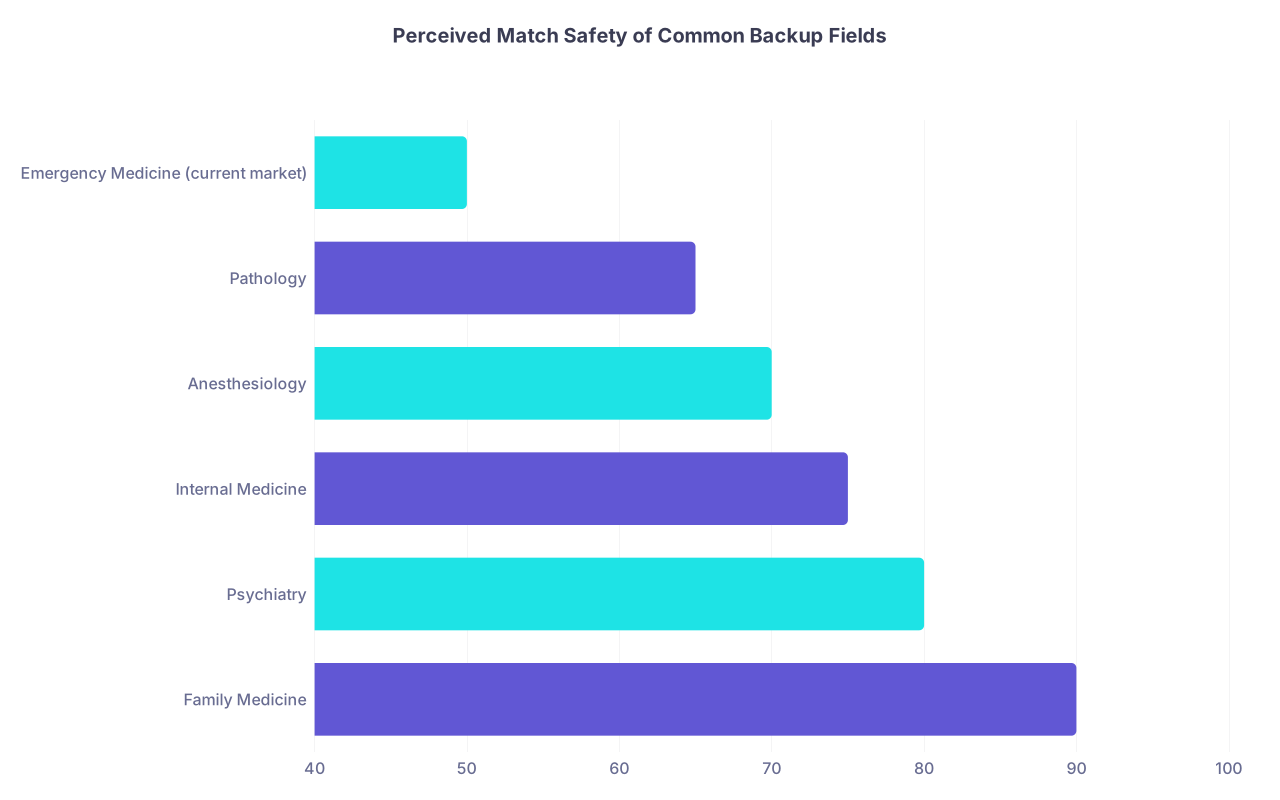
| Category | Value |
|---|---|
| Family Medicine | 90 |
| Psychiatry | 80 |
| Internal Medicine | 75 |
| Anesthesiology | 70 |
| Pathology | 65 |
| Emergency Medicine (current market) | 50 |
Those percentages are not official NRMP numbers. That’s roughly how safe or risky many faculty emotionally perceive these as backup destinations for a borderline applicant:
- FM feels like a 90% parachute.
- Psych/IM are “pretty safe” with variability by region.
- Anesthesia/Path are middle-ground—good for the right profile, not universal.
- EM right now? Feels like a coin flip in certain markets.
This is the mental math behind their steering.
Final Thought
Years from now, you will not remember every attendings’ exact words. You’ll remember the feeling: did I choose my path, or was I nudged into it?
Backup specialties are where a lot of people surrender agency without realizing it. The steering is subtle, the concern is real, and the system absolutely has patterns it prefers.
Your job is not to fight every suggestion. Your job is to understand what’s underneath the suggestions—risk management, pattern recognition, liability fear—and then decide, eyes open, how much risk you are willing to hold yourself.
The Match will come and go. What stays is the life you build in the field you end up in. Make sure that field is one you chose on purpose, not just the one everyone else quietly picked for you.