
Low research with strong clinical skills is not a liability. It is a design constraint. If you treat it that way, you can build a smart, realistic backup strategy that actually matches.
This is the stuff no one teaches clearly: how to pick backup specialties that fit your profile, not some imaginary Step-270, six-first-author unicorn. You have strong clinical evaluations, maybe decent Step scores, but your CV is light on publications and big-name research mentors. You want a competitive or mid-tier specialty, but you are not delusional—you want a solid safety net.
Here is how to build that safety net properly.
1. Get Clear on Your Starting Point (No Fantasy CVs Allowed)
You cannot design backups until you have an honest baseline. That means no “my school is pass/fail so they do not care about grades” mythology and no “my research is ‘in progress’” inflation.
Break your situation into four buckets:
- Scores
- Research
- Clinical strength
- Institutional leverage
1.1 Score reality check
You are trying to pick backups. That means we care about how competitive you look on paper to strangers who will spend 30 seconds on your ERAS page.
Make a quick grid of your scores:
- Step 1: Pass / numerical (if applicable)
- Step 2 CK: exact score
- Any failures / repeats: yes or no
Now place yourself roughly in this frame:
| Tier | Step 2 CK Range | Interpretation |
|---|---|---|
| High | ≥ 255 | Strong for most non-derm/ortho/ENT |
| Upper-mid | 245–254 | Competitive for many fields |
| Solid | 235–244 | Viable with right strategy |
| Risk zone | 225–234 | Needs careful backup planning |
| Red flag | < 225 | Must be very strategic |
You do not need a 260 to have options. You do need to stop comparing yourself to the gunner in your class with six publications.
1.2 Research: define “low” correctly
“Low research” does not mean “I am worthless.” It means your application will not win in a research arms race.
You are “low research” if:
- No publications or submitted manuscripts
- Maybe 1–2 posters / local presentations
- Projects are small, retrospective, or QI without big names
- No multi-year, sustained research with strong mentorship
You are not “research-strong” just because:
- “I helped with data collection”
- “My name is somewhere on a big project but I do not know the PI”
- “We are planning to write it up”
Treat your research honestly. The PD reviewing your file will.
1.3 Clinical strength: where you actually shine
This is your leverage. If you are reading this, it is probably your main selling point.
Pull out:
- MS3 clerkship evaluations
- Narrative comments (especially “top 10%,” “outstanding,” “would work with again”)
- AOA / Gold Humanism status (if applicable)
- Any awards specifically for clinical excellence or teaching
You are clinically strong if:
- Consistently high ratings across core rotations
- Multiple comments emphasizing work ethic, team skills, reliability, patient communication
- Attendings volunteered to write strong letters without you begging
If your comments say things like:
- “Makes the team better”
- “Functioned at an intern level”
- “Sought out feedback and incorporated it rapidly”
Then you have a real asset. We are going to design backups that let that shine.
1.4 Institutional leverage
You may have more power than you think based purely on where you sit:
- Home programs in a specialty give you:
- Easier audition rotations
- Home letters
- Built-in program familiarity
- Regional reputation matters:
- A “no name” med school in its own region may actually be well-known and respected by local residency PDs
- Mentors who know PDs personally matter more than your single poster
Write down:
- Home programs you have
- Any really invested mentors (not just people who said “happy to help”)
- Regions where your school has historically matched well
Now we can design something reality-based.
2. Know Which Specialties Punish Low Research (and Which Don’t)
Some fields are research-obsessed whether you like it or not. Others care more about, “Would I want this person on my call schedule?”
Here is a blunt breakdown.
| Category | Examples | Research Weight |
|---|---|---|
| Research-heavy, hyper-competitive | Derm, Plastics, ENT, Ortho, Rad Onc | Very High |
| Competitive, research helps | Radiology, Anesthesia, EM, GI, Cards (fellowships) | Moderate–High |
| Clinically focused with research bonus | IM, Peds, Neurology, OB/GYN, Psych | Moderate |
| Mostly clinical, research minor | FM, PM&R (outside top programs), Path | Lower |
If your primary specialty is something like dermatology or plastics and you have almost no research, you are already in high-risk territory. Backup specialties will not fix magical thinking at baseline. But they can keep you from going unmatched.
On the other hand, if you are aiming for internal medicine or pediatrics at very competitive academic centers, your low research will hurt there too. You can still match in the field, just maybe not at UCSF, MGH, CHOP, etc.
3. Build a Backup Strategy Around Your Specific Profile
You are not just picking a “less competitive field.” You are designing a portfolio of options that match:
- Your clinical strengths
- Your realistic geographical flexibility
- Your score band
- Your risk tolerance
3.1 Decide what “backup” actually means for you
There are three flavors:
In-field tier backup
Same specialty, less competitive programs and locations.Adjacent specialty backup
Different field with overlapping skills that still fits what you like.True safety net specialty
Much more forgiving field that you would genuinely accept doing.
You probably need at least two of these categories, unless your primary is already in the low- to mid-competitiveness range and your scores are solid.
3.2 Use your Step 2 and research level to choose backup category
Here is a practical mapping:
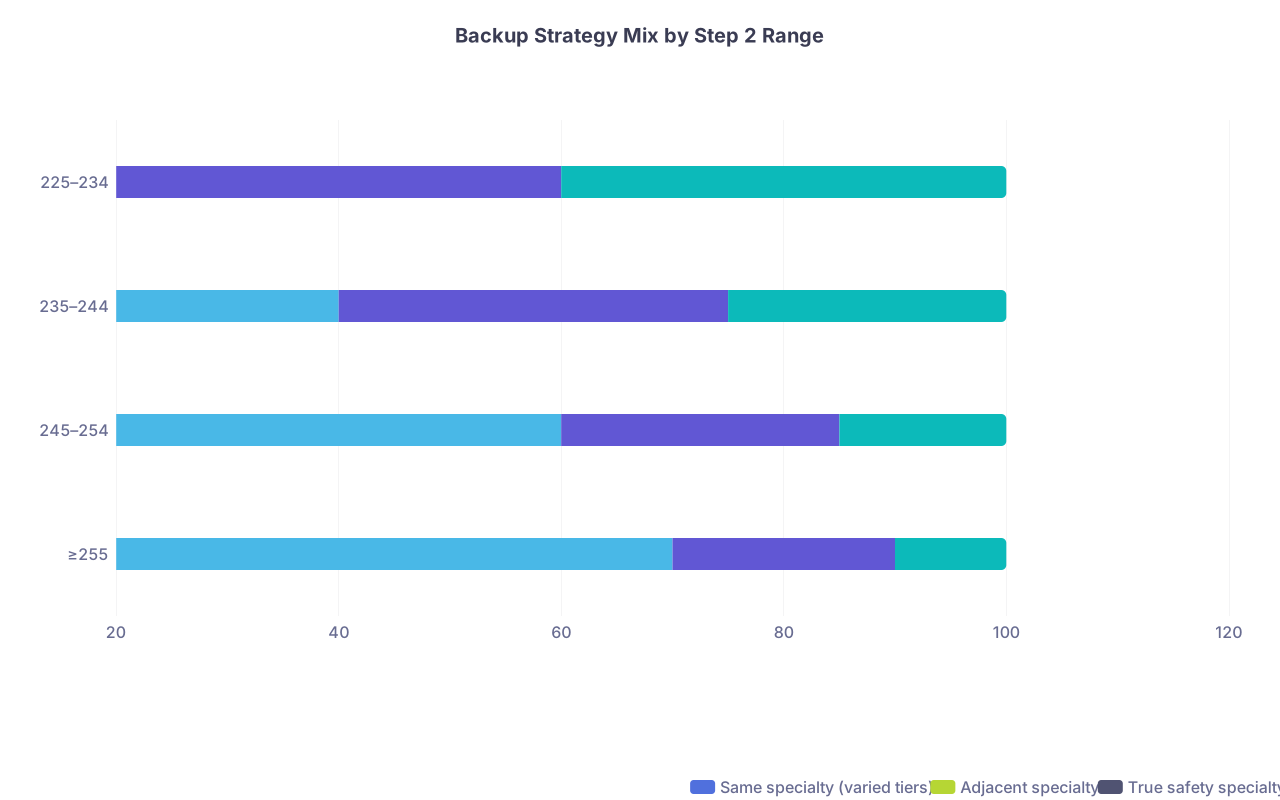
| Category | Same specialty (varied tiers) | Adjacent specialty | True safety specialty |
|---|---|---|---|
| ≥255 | 70 | 20 | 10 |
| 245–254 | 60 | 25 | 15 |
| 235–244 | 40 | 35 | 25 |
| 225–234 | 20 | 40 | 40 |
Interpretation:
Step 2 ≥ 255 with low research
You can still swing for your desired field heavily. Backup is mostly in-field tiers + maybe one adjacent.Step 2 245–254
Competitive but not bulletproof. Mix in:- 60% target field (including community/smaller programs)
- 25% adjacent field
- 15% true safety if your primary is very competitive and research-light
Step 2 235–244
This is where people get burned. You must:- Apply broadly in your primary (if not hyper-competitive)
- Have a serious adjacent plan
- Include true safety options if aiming high initially
Step 2 225–234
Backup is not optional. You should likely:- Consider flipping primary vs backup if chasing a hard field with no research
- Treat an adjacent or safety specialty as co-primary, not afterthought
4. How to Actually Pick Smart Backup Specialties
Let me be blunt. “I like working with my hands, so maybe I’ll back up with anesthesia or EM” is lazy thinking. You need to be more strategic than vibes.
4.1 Start from what your strengths actually show
Your clinical comments usually fall into patterns. These patterns point to fields that will “get” you.
Look at your narratives. Do they emphasize:
Patient communication, empathy, family meetings, rapport?
You fit well with:- Family medicine
- Pediatrics
- Psychiatry
- Palliative-focused IM
Procedural enthusiasm, comfort with lines, suturing, OR time?
Good fits:- Anesthesia
- EM
- OB/GYN (if you tolerate the lifestyle)
- PM&R with interventional interest
Complex medical reasoning, ICU cases, sick patients?
Think:- Internal medicine (especially academic)
- Neurology
- EM
Systems thinking, QI, teaching, team organization?
Strong in:- IM
- FM
- Neurology
- Hospitalist pipelines
You want at least one backup that aligns with the documented story your evaluations already tell.
4.2 Smart pairings: common primary + backup combos that actually work
These combinations assume low research, decent clinicals, and will vary by score. I have seen each of these work in real cycles.
| Primary Target | Smart Backup Option(s) |
|---|---|
| Dermatology | Internal Medicine, Pathology |
| Ortho | PM&R, General Surgery (community) |
| ENT | General Surgery, Anesthesia |
| Radiology (diagnostic) | Internal Medicine, Neurology |
| Anesthesia | Internal Medicine, EM |
| EM (competitive regions) | FM, IM |
| OB/GYN | FM with women’s health focus, IM |
| Neurology | IM, PM&R |
| IM academic | IM community, FM |
| Pediatrics academic | Peds community, FM |
The key pattern:
Backups should share enough overlap that your story still makes sense.
If your PS is all about ICU / sick patients, backing up with pathology looks bizarre. If your narrative screams “outpatient continuity, long-term relationships,” and you back up with a procedural, shift-based field, a PD will sense the mismatch.
5. Tactical Design: Numbers, Programs, and Timing
Picking a backup specialty is not just “I clicked an extra box on ERAS.” You need a plan for:
- How many programs in each specialty
- How you split audition rotations
- How you handle letters and personal statements
- How early you commit
5.1 Program numbers by risk level
Here is a rough framework that works for most US MD students without major red flags:
| Risk Profile | Primary Specialty | Backup(s) Total |
|---|---|---|
| Low risk (≥255, moderate field) | 30–40 | 0–10 |
| Moderate risk (235–254, moderate field) | 40–60 | 15–25 |
| High risk (<235 or hyper-competitive) | 20–40 | 30–60 |
For DO and IMG applicants, those numbers usually need to be increased, and the backup strategy must be even more aggressive.
If your primary is hyper-competitive (derm, plastics, ENT, ortho) and you have low research, do not kid yourself. You should:
- Treat backup as co-primary
- Apply broadly in both
- Consider whether you are actually willing to do the backup for life. If the answer is no, you are not applying in good faith.
5.2 Rotations: how to split your audition time
You cannot do 5 away rotations in two completely different fields and expect either to love you. Over-splitting is how people end up with many “meh” letters instead of a few killer ones.
Basic rule:
If your primary is not hyper-competitive:
- 2–3 rotations in primary field (home + 1–2 aways)
- 0–1 rotations in backup (usually home if available)
If your primary is hyper-competitive and your profile is weak for it:
- 1–2 rotations in primary field
- 1–2 rotations in backup field where you could realistically match
- Make at least one backup rotation intentionally “audition-level” enthusiastic
You want at least 3 strong letters in any specialty you apply to seriously. That is the minimum threshold.
5.3 Letters: do not send the wrong signal
Common mistake: sending letters from specialty A to specialty B because “they are really strong letters.”
Sometimes that works. Often it raises questions like, “So why is this great future internist applying to EM?”
Rules of thumb:
For each specialty you apply to:
- Aim for 2–3 letters in that field
- You can add 1 medicine or surgery letter if it is truly exceptional and shows your clinical strength
For hyper-competitive field + backup:
- Primary field: 2–3 letters from that specialty
- Backup field: 2–3 separate letters directly from physicians in that specialty
Do not rely on “general” letters. PDs can smell generic.
6. Messaging: Aligning Your Story Without Lying
Here is the tension:
You like Specialty A. You also need Specialty B as a backup. You cannot write “I have wanted to be an EM physician since birth” and then apply to FM and IM and think PDs will not notice.
You need two coherent narratives:
- Why you would be great in Specialty A.
- Why you would be great in Specialty B. Even if you discovered that interest later.
6.1 Personal statements: write separate, honest versions
Do not recycle the exact same personal statement with only the word “internal medicine” swapped out for “family medicine.” People can tell.
Instead:
Identify shared themes:
- Love of acute care
- Longitudinal relationships
- Procedures
- Teaching
- Team-based environments
For each specialty, emphasize:
- The subset of your experiences that match that field best
- Concrete examples from rotations in that specialty
- How your clinical strengths (from evals) would show up day to day there
It is fine if your backup PS sounds like, “On my third-year rotations, I expected to go into X, but working with [field B] teams, I found I was most energized by…”
That is real. PDs see that progression all the time.
6.2 ERAS application details: align without contradicting
Two places people sabotage themselves:
Experience descriptions
They slant every single experience to their dream specialty, then send the same ERAS to the backup field.Program signals / geographical preferences
They cluster every signal around a single type of program or region, leaving backups looking like an afterthought.
Fix it:
When describing experiences, include:
- A mix of patient care, teamwork, teaching
- Not only specialty-specific detail; focus on transferrable skills (clinical reasoning, communication, reliability)
For geographic and program preference answers:
- Do not box yourself into “I only want large academic centers in California” if your backup options are mainly community programs in the Midwest
- You do not need to lie; you do need not to self-sabotage
7. Risk Management: Worst-Case Scenarios and How to Protect Against Them
The real reason you are reading this is fear: “What if I swing for my favorite field and go unmatched?” Let us build a contingency plan.
7.1 Use data, not vibes, to estimate your match risk
PDs and advisors use simple mental math like this:
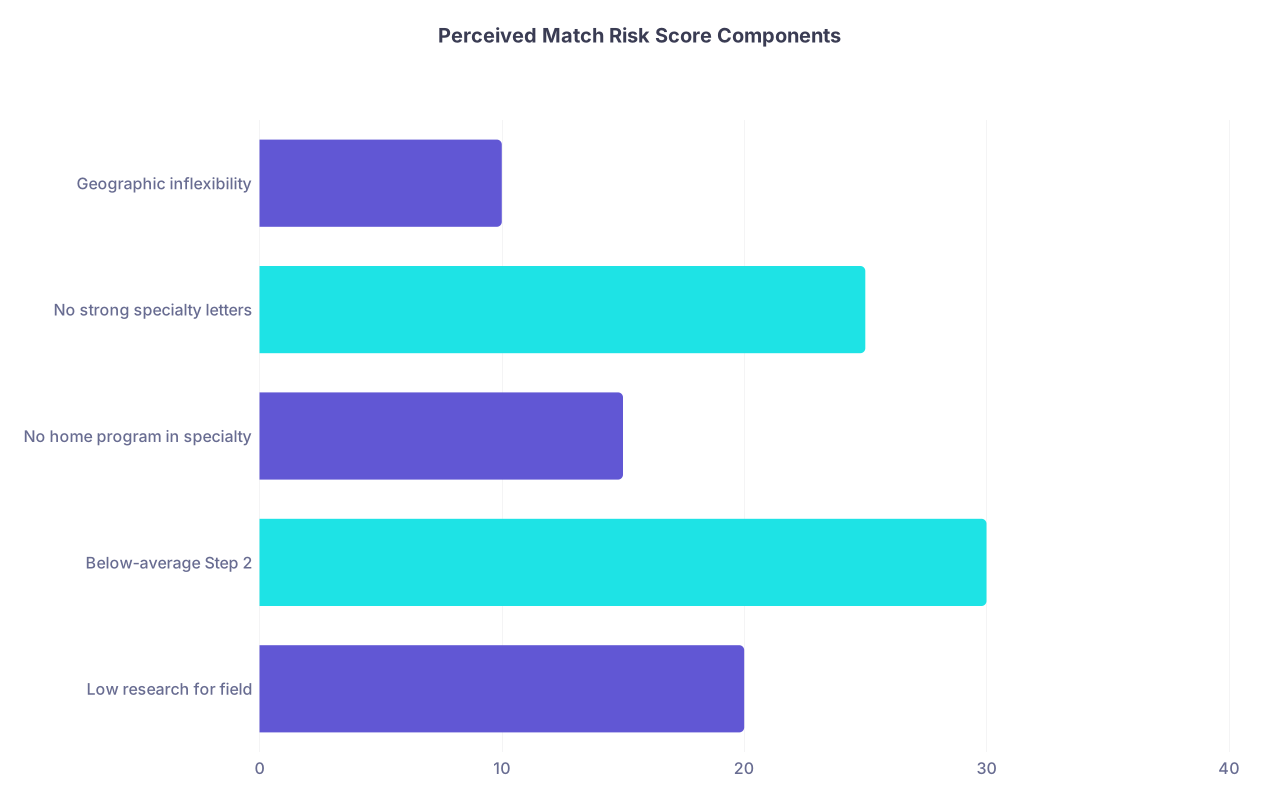
| Category | Value |
|---|---|
| Low research for field | 20 |
| Below-average Step 2 | 30 |
| No home program in specialty | 15 |
| No strong specialty letters | 25 |
| Geographic inflexibility | 10 |
If you stack several of these risk factors together and still have no backup specialty, that is how you end up scrambling.
Be honest about where you are:
- Low research in research-hungry field: +1 risk
- Step 2 below your specialty’s median: +1 risk
- No home program in that field: +1 risk
- No strong mentorship or specialty letters: +1 risk
- Only applying to “top 30” branded programs: +1 risk
- Refusing to move from one or two regions: +1 risk
Score ≥ 3? You must have a real backup.
7.2 SOAP and reapplication: design with failure in mind (quietly)
You do not need to announce this to anyone. But you should privately answer:
- If I go unmatched in my primary and backup this year, what would I do next?
- Prelim year and reapply?
- Research year?
- Categorical in a different field?
Structuring your backup choice with this in mind is smart:
Choosing a backup field where:
- A PGY-1 there can give you flexibility later (IM, TY, prelim surgery)
- You would not hate staying if you never escape
Avoiding backups that:
- Box you into very narrow future options unless you are truly happy with them forever
8. Concrete Step-by-Step Plan: From “I’m Unsure” to “I Have a Backup Strategy”
Here is the actual protocol. If you follow this sequence, you will not be the one panicking in February.
Step 1 – Inventory (1–2 days)
Write down:
- Step scores and any red flags
- Research output (actual, not promised)
- Clinical strength evidence (honors, comments, awards)
- Home programs and strong mentors
Classify yourself:
- Score band (from the earlier table)
- Research: low / moderate / strong (yours is likely low)
- Primary specialty competitiveness
Step 2 – Risk rating (1 day)
Assign yourself 0–5 risk points based on:
- Research mismatch with field
- Score below specialty median
- No home program
- Weak or few specialty letters
- Geographically rigid
If ≥ 3: you will design a dual-field strategy.
Step 3 – Identify 1–2 logical backups (2–3 days)
Use:
- Your clinical comments
- Rotations you genuinely enjoyed
- Overlap with your primary’s skill set
Pick:
- 1 adjacent specialty that matches your skills / interests
- 1 true safety if your primary is very competitive or your risk score is high
Step 4 – Rotation and letter planning (within next 1–2 months)
Schedule:
- Enough time in each specialty to earn 2–3 strong letters
- At least one rotation in the backup field treated as “primary-level effort”
Meet with:
- At least one mentor in each specialty to confirm your plan and get program list suggestions
Step 5 – ERAS structure (2–3 weeks before submission)
- Draft two separate personal statements.
- Tag letters appropriately for each specialty.
- Build a program list using:
- Mix of academic and community
- Multiple regions
- Higher volume in your backup if your risk is high
Step 6 – Interview season adjustments
If you get:
- Many interviews in primary and few in backup → attend a safe mix, but still nurture backup options.
- Few in primary and more in backup → consciously shift your mental “primary” to the field that is actually interested in you.
Do not treat backup interviews like consolation prizes. PDs can tell.
9. The Hard Truth: Commitment Beats Pretending
I have watched students match into their “backup” and end up thrilled. I have also watched students sabotage their backup because they never fully committed to the idea that they might actually do it.
Designing smart backup options when you have low research but strong clinical strength boils down to three non-negotiables:
Be honest about your profile and your field’s expectations.
Stop pretending low research in a research-obsessed specialty is a minor issue.Pick backups that align with your real strengths and stories.
Use your clinical evaluations as your compass, not Reddit gossip.Treat backups like real options, not a shameful Plan B.
Rotations, letters, program lists, and interview performance must reflect genuine engagement.
If you do those three things, your low research does not define you. Your clinical strength and strategic planning do.