
It’s November. Your ERAS is in, interviews are trickling (or… not), and you’re staring at your backup list thinking:
“Okay, but what if I match… and it’s to something that isn’t impressive enough? What if people see my white coat and it doesn’t scream ‘top tier’? What if I lock myself into being ‘average’ forever?”
You’re not just afraid of not matching. You’re also afraid of matching somewhere, to something, and feeling quietly ashamed of it.
That’s the part no one really says out loud. So let’s say it.
You’re worrying:
- That your backup specialty doesn’t sound “elite” enough.
- That your school will judge you.
- That your family will brag less.
- That your future colleagues will assume you “couldn’t hack it.”
- That you’re permanently closing doors.
And under all of that? Status anxiety. The feeling that your worth is about to be frozen at whatever name ends up on your Match letter.
Let’s untangle that.
The Ugly Thought You’re Probably Having (But Won’t Admit)
Here’s the real script running in your head:
“I like [backup specialty]. I could see myself doing it. But it doesn’t sound as cool as [dream specialty]. If I end up there, everyone will just assume I failed.”
You see the residency equivalent of “tiers” in your brain:
- “Prestige specialties”: derm, plastics, ortho, ENT, ophtho, IR, some fellowships.
- “Good but not fancy”: IM at academic places, gen surg, EM (depending on who you ask).
- “Soft”: FM, psych, peds, maybe neuro depending on your circle.
You won’t say it out loud because it sounds snobby and gross. But the thought is still there, and it’s driving your anxiety about backups.
Let me be blunt: you’ve been marinating in this hierarchy for years.
Attendings drop comments like, “Well, he went into derm, so you know he was sharp.”
Students whisper: “Oh, she had a 260+ and did ophtho at [Big Name].”
People say, “I just want to keep as many doors open as possible,” but what they really mean is “I want to be high status enough that no one can ever look down on my choice.”
You hear that enough and it rewires your brain. Suddenly it’s not:
“Will I be happy in this backup specialty?”
It’s:
“Will other people think I downgraded?”
And that is exactly how you end up sabotaging your own safety net.
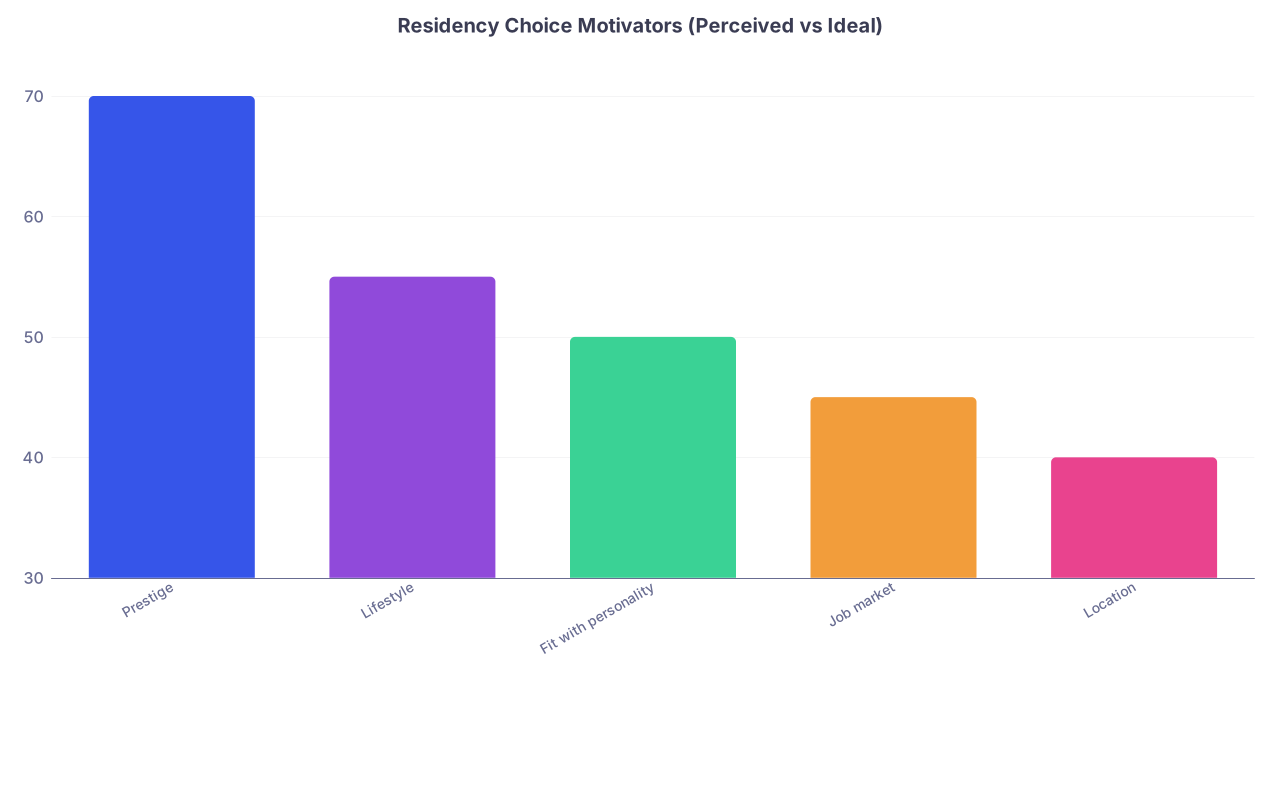
How Status Anxiety Warps Your Backup Plan
| Category | Value |
|---|---|
| Prestige | 70 |
| Lifestyle | 55 |
| Fit with personality | 50 |
| Job market | 45 |
| Location | 40 |
When your brain is in “status panic” mode, you start making some pretty bad strategic calls. I’ve watched this happen way too often.
Things like:
You pick a “backup” that… isn’t actually a backup
You tell yourself, “If I don’t match ortho, I’ll do general surgery as a backup.”
Cool. Except gen surg at solid academic programs is still very competitive, and your Step and letters may not carry the same weight there. You don’t really have a backup. You just have a slightly shifted version of the same risk.
You reject realistic specialties because they feel “too low”
Family med, psych, peds, PM&R, pathology, even anesthesia at some places — they could be perfect fits. But your ego screams, “What will people think if I go from ‘I’m applying gas’ to ‘I’m applying FM’?” So you don’t even seriously consider them, and your list stays razor-thin.
You frame your backup as a failure before you even apply
“I mean, I’m applying IM as a backup, but I’ll never be just a hospitalist, I’ll probably try cards or GI later.”
So you’re already telling yourself: “This is step one of Plan B, but I’m still chasing the ‘real’ status later.” It’s exhausting. And it makes you hate your backup before you even match into it.
You sabotage your application to the backup
This one hurts to watch: people send half-hearted personal statements, generic letters, uninterested interviews — because deep down they’re hoping, “I don’t really want to match here, so I’ll just do the minimum.” Then March comes around and… yeah. SOAP.
You over-apply to “reach” programs, under-apply to realistic backups
So your list is 70% prestige or bust, 30% backup, and your “backup” list is still selective academic coastal places. No community, no mid-tier, nothing unsexy. You’re trying to get status and safety at the same time. That’s not how statistics work.
This is how people with decent applications still end up unmatched.
Not because they weren’t strong enough. Because they refused to build a backup plan that threatened their ego.
Reality Check: How Much “Prestige” Actually Matters Long-Term

I know you’ve heard “prestige doesn’t matter that much in the real world” and rolled your eyes. Because inside the med school bubble, it clearly does matter.
But let’s separate out what people think matters from what actually affects your life 5–10 years from now.
I’m going to oversimplify a little, but you need someone to just say this plainly.
Prestige matters most for:
- Hyper-competitive fellowships (like certain advanced cards/onc/surg subspecialties).
- High-paying, hype subspecialty jobs in major coastal academic centers.
- Flexing in very specific circles: med school reunions, academic CV contests, the crowd obsessed with rankings.
Prestige matters way less for:
- Whether you like your day-to-day work.
- Your actual salary in most non-super-niche jobs.
- Whether patients trust you.
- Whether your kids know you.
- How mentally wrecked or stable you feel at 40.
I’ve seen:
– A derm attending at a big-name place absolutely miserable, stuck in bureaucracy and publishing pressure.
– A community FM doc in the Midwest with a flexible, sane life, earning well and genuinely liking clinic.
– A psych resident who was initially “ashamed” to drop from neuro to psych, now saying, “Yeah no, this was 100% the right call, I actually like my patients now.”
Your brain is over-weighting the first 2–5 years (when everyone still cares where you matched) and under-weighting the 30 years after.
Also, outside of medicine, nobody knows or cares. To 99% of the world, “I’m a doctor” already maxes out the prestige meter.
Untangling the Fear Behind “Not Prestigious Enough”
This isn’t just about reputation. It’s about identity. It feels like:
“If I end up in my backup, I will be locking in that I was never good enough for the big thing I wanted.”
So let’s pick apart a few lies your brain is feeding you.
Lie #1: “Matching into a less prestigious specialty = I failed”
No. It means in a rigged system, in a specific year, with your stats and your application and vibes and pure randomness, you didn’t land in one specific bucket. That’s it.
You know who “failed”? The system. Where actually good, hardworking people can end up unmatched because one letter came in late or one PD didn’t vibe with them.
Lie #2: “Everyone will judge me”
In med school? Some people will. They’re the same ones obsessively refreshing Charting Outcomes PDFs. They’ll move on to fellowship gossip soon enough.
Most people? Will be relieved you matched and then get busy with their own lives.
Attending world? They care whether you show up, do good work, and don’t make their day worse. I’ve heard attendings say “good for them” about students who “chose happiness” and “didn’t chase the prestige trap.”
Lie #3: “I’ll be stuck forever”
You won’t be stuck in one specific hospital or niche job forever unless you want to be. People retrain. People switch gears. People do fellowships. People change practice settings. It’s not seamless, but it’s not impossible either.
The worst trap is not a non-prestigious specialty. The worst trap is waking up every day hating what you do but feeling too proud to change.
Building a Backup That Won’t Destroy Your Soul (Even If It’s “Lower Status”)

| Step | Description |
|---|---|
| Step 1 | Pick dream specialty |
| Step 2 | Assess competitiveness honestly |
| Step 3 | Apply broadly within specialty |
| Step 4 | Identify true backup |
| Step 5 | Shadow and rotate in backup |
| Step 6 | Apply seriously to backup |
| Step 7 | Pick different backup |
| Step 8 | High risk of no match? |
| Step 9 | Can I see myself here? |
Here’s the uncomfortable truth: a real backup only works if you’d actually choose to do it rather than go unmatched.
That’s the line.
So ask yourself:
If it’s March, and it’s:
– Match into this “non-fancy” field
vs.
– Sit in SOAP or take an extra year and reapply from scratch
Would you take the backup?
If your honest answer is: “I don’t know, maybe I’d rather risk SOAP than end up in [backup specialty],” then that is not a backup. That’s just a comfort fantasy to reduce anxiety right now.
Backups need three things:
- You could realistically match.
- You can picture yourself actually doing the job.
- You’re willing to say “yes” on Match Day if that’s the envelope you open.
If #3 isn’t true, it doesn’t matter if it’s “prestigious enough.” It’s not real.
You don’t have to love your backup the same way you love your dream specialty. You just have to respect it enough that if you land there, you’ll give it a real shot instead of treating it as a prison sentence.
Status vs Sanity: Tradeoffs You’re Actually Making

Let’s be brutally honest about the tradeoffs.
Prestige-heavy path might mean:
- Longer training.
- Higher burnout risk in some fields.
- More pressure to publish, hustle, network.
- Likely more “imposter syndrome” if you’re constantly surrounded by ultra-hyper-achievers.
Less “prestige,” more grounded path might mean:
- More control over where/how you practice.
- More flexibility in your schedule long-term.
- Less external validation, more internal “do I like this?” questions.
Neither is automatically better. The problem is: right now, status is screaming so loudly in your ear that you can’t even hear the other variables.
Here’s a trick:
Imagine specialties had no reputations at all. No one knew which ones were competitive. You never knew anyone’s Step scores or where they matched. Money was normalized. Would your ranking change?
If your backup would secretly climb your list in that alternate universe, that’s a massive red flag that you’re being controlled by other people’s expectations, not your own judgment.
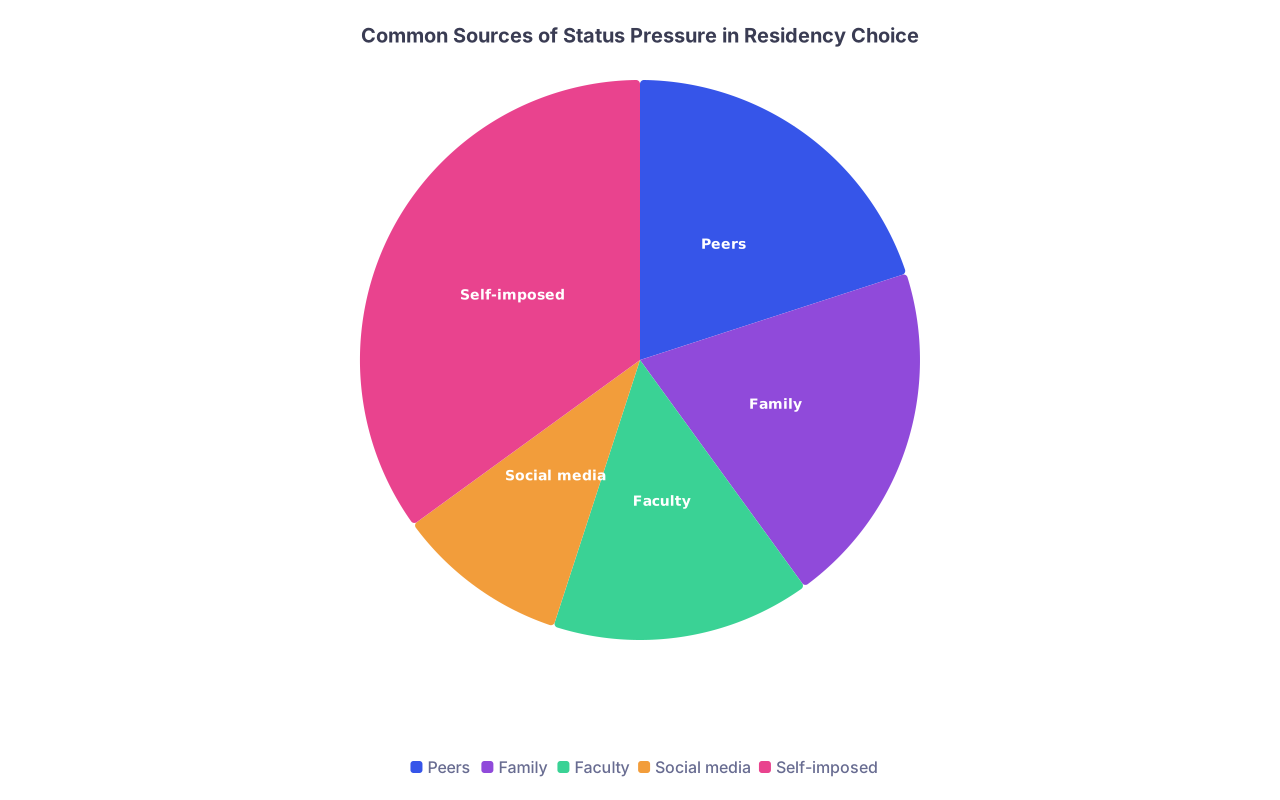
How to Handle the “What Will People Think?” Spiral
| Category | Value |
|---|---|
| Peers | 20 |
| Family | 20 |
| Faculty | 15 |
| Social media | 10 |
| Self-imposed | 35 |
You’re not wrong that some people will judge. Plenty of people are status-obsessed and weird about it. But you can at least prepare for the sting and neutralize some of it.
Peers
Some will say things like, “Oh, I didn’t realize you were going into [backup]. I thought you wanted [prestige thing]. What happened?”
Practice your line now:
“Yeah, I did. But I realized I actually liked [backup] more and it fits the life I want better.”
Are you lying a little? Maybe. Or maybe it is true and status just made you forget.
Family
Some families only know 3 specialties: surgeon, cardiologist, and “not a real doctor.”
You can say:
“I’ll be a board-certified physician caring for [population], with a stable job and solid income. This is the specialty where I can actually see myself not burning out.”
Also: they don’t understand the match algorithm or competitiveness. They’ll adapt.
Faculty
You’ll get some subtle shade. “Oh, you’re only applying to [backup]? Not [dream field]?”
You can answer:
“I was initially aiming there, but after looking at the numbers and what I want long term, this felt like the more sustainable choice.”
Which, honestly, is a more mature choice than chasing clout until you hit the SOAP wall.
Your own inner critic
This is the loudest one. That voice that says:
“You settled.”
“You weren’t good enough.”
“You lied to yourself about your potential.”
You can’t completely mute it right now. It’s too wired in. What you can do is not let that voice make your strategic choices for you. Let it scream in the background while you still submit a real, solid backup application.
Very Practical: How to Decide If Your Backup Is “Good Enough”

If you’re still stuck in the “not prestigious enough” loop, here’s a concrete filter:
Ask these questions about your backup specialty:
- On your worst call night imaginable, would you still rather be doing this work than being unmatched and starting over?
- Can you name at least 2–3 specific things about this field that genuinely interest you? Not “it’s chill,” but things like: patient population, procedures, continuity, diagnostic thinking, psych elements, etc.
- Do you know at least one resident or attending in that field who seems like a person you could see yourself becoming and not hating that future?
- If nobody knew the competitiveness or salary, would this feel more okay — maybe even appealing?
If you’re getting mostly yes’s, your backup is probably “good enough” in every way that actually matters. Even if it doesn’t wow the prestige-obsessed people.
If you’re getting mostly no’s?
That’s not a prestige issue. That’s a fit issue. You may need a different backup, not a higher-status one.
FAQ (Exactly What You’re Afraid to Ask Out Loud)
1. What if I match my backup and wake up every day regretting I didn’t fight harder for my dream specialty?
You probably will go through a grief phase. That’s normal. It feels like losing a version of yourself you’d been selling to everyone (and to yourself) for years. But people settle into their reality shockingly fast. Within 6–12 months of residency, your daily life will be about your patients, your team, your hours, your call schedule — not what could’ve been. If after really trying you still hate it? People do retrain, switch, or carve out niches within their field that feel more like what they wanted. You’re not being locked into a dungeon.
2. Will going into a “less competitive” specialty close doors forever if later I want subspecialty or academic work?
It might close some doors at the absolute highest-status, narrowest fellowships. Sure. But within most specialties, if you do solid work, get decent letters, maybe produce some research, you can land fellowships and academic roles. You’re not barred from “doing something impressive” just because your base field isn’t flashy. I’ve seen FM docs do sports med and become the local go-to sports person. Psych docs subspecialize in addiction or forensics and become highly sought after. The ladder looks different, but there is a ladder.
3. People at my school low-key look down on my backup choice. How do I not internalize that?
You might not fully avoid internalizing it now. You’re swimming in their fishbowl. But remember: these are people who currently think shelf scores are the height of personal achievement. Two years into residency, the hierarchy shifts. The gunner who flexed their 260 might be drowning on surgery nights, and the “just psych” person might be the only one who seems remotely sane and content. Let them have their opinions. They’re not the ones who have to live your life at 3 a.m. 10 years from now.
4. If I choose a “lower status” backup now, will I always feel like I sold myself short?
You might feel that way if you keep replaying a fantasy where you matched your dream specialty at a top 5 program and your life was perfect. That alternate timeline doesn’t exist. The only real question is: given who you are, your stats, this match year, and all your constraints — did you make a thoughtful choice that protected both your future and your mental health? If the answer is yes, then over time the “sold myself short” feeling usually morphs into “dodged a bullet” or at least “this ended up being fine.” Status anxiety is loud now. It will not be the loudest voice forever.
Key things to walk away with:
- A backup that protects your ego but not your match outcome is not a real backup.
- Prestige feels huge now; fit, sanity, and actual daily work will matter more for the next 30 years.
- You’re allowed to be sad about not landing the fancy thing and still build a backup that you respect enough to live with.