Program directors do not secretly blacklist you just because you applied to two specialties. They penalize incoherence, laziness, and sloppy applications—not the number of specialties.
That’s the part people do not like to hear, because “never apply to two specialties” is a simpler, more comforting rule than “you have to actually do this strategically and well.”
Let’s pull this apart.
Where This Myth Comes From (And Why It Sticks)
You’ve probably heard some version of this:
“If programs see you applied to another specialty, you’re done.”
“You must be 100% committed to one field or PDs will toss your file.”
“Backup specialties scream red flag.”
I’ve heard it from MS3s whispering in workrooms, from residents on night float giving confident but baseless advice, and occasionally from faculty who trained before ERAS even existed.
The problem: almost none of this is supported by data, and a lot of it is logically inconsistent with how the match actually works.
Let’s start with the basic facts of the NRMP world you’re operating in.
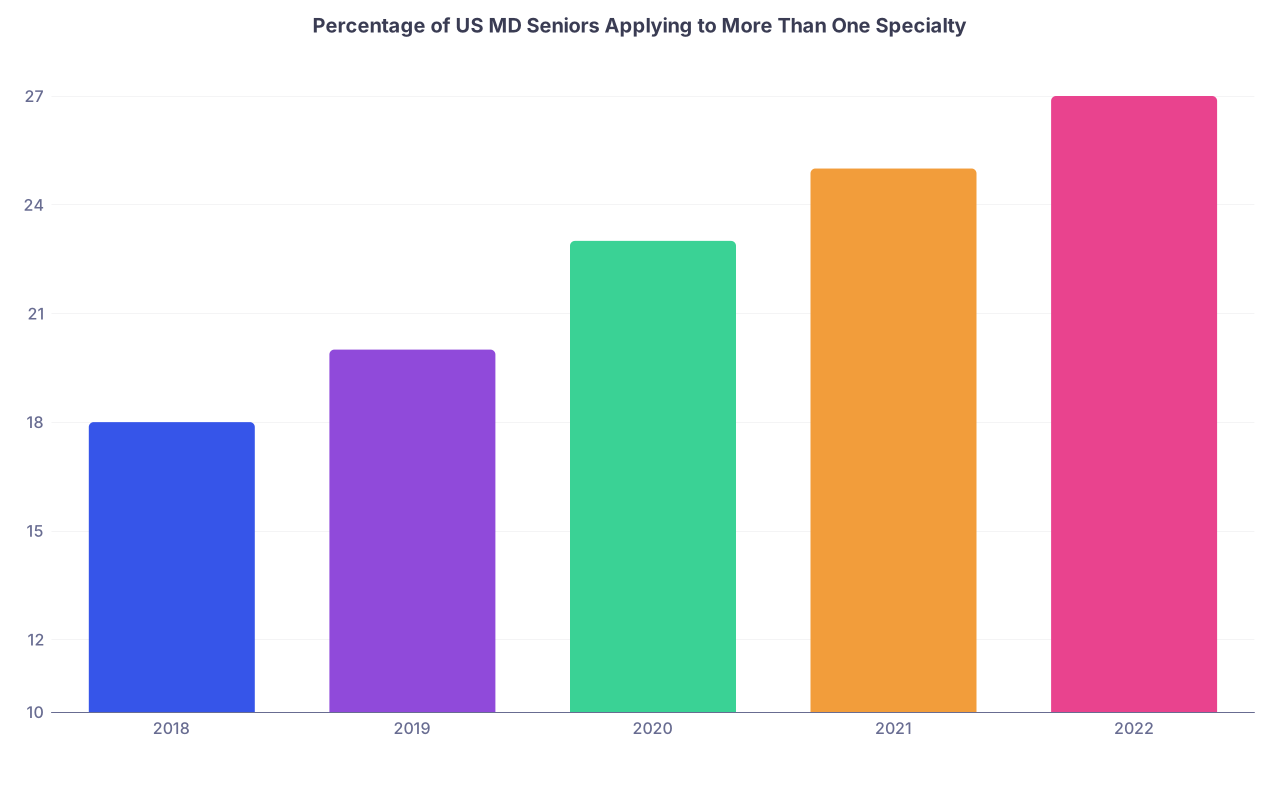
| Category | Value |
|---|---|
| 2018 | 18 |
| 2019 | 20 |
| 2020 | 23 |
| 2021 | 25 |
| 2022 | 27 |
Multi-specialty applicants are not some rare, scandalous category. They’re a growing part of the applicant pool. The NRMP’s “Charting Outcomes” and “Program Director Survey” reports make that clear: significant chunks of applicants either re-apply, switch fields, or strategically use backup pathways.
So if “applying to two specialties = automatic rejection” were actually true, match rates would look very different than they do.
They don’t.
What Program Directors Actually Care About
I’ll be blunt: program directors care about filling their program with residents who will (1) show up, (2) not burn out or implode, and (3) make the program look good.
Everything else is noise.
How do they approximate that from paper?
They look for:
- Evidence you understand their specialty
- Evidence you can handle the workload and exams
- Evidence you’re not a walking professionalism problem
Where do people get into trouble when they apply to two specialties? Right here:
Not because they dared to apply to two fields, but because their application stops making any sense for at least one of them.
A PD does not reject you because you also applied to anesthesia. They reject you because:
- Your personal statement to internal medicine reads like a last-minute copy-paste of your anesthesia statement
- Your letters are obviously written for a different field
- Your experiences show zero engagement with their specialty
- Your interview answers are vague, non-committal, or contradictory
That is what they penalize. Not the raw fact that you clicked “apply” to something else.
Reality Check: How Much Do PDs Actually See?
A lot of the fear is built on an incorrect assumption: that PDs can see your entire application strategy across specialties.
In practice:
- They see the version of your ERAS application you send them
- They see the experiences and personal statement you assign to their specialty
- They see your letters that you designate to their programs
- They do not get a dashboard labeled “also applied to: EM, Anes, Ortho, Rads”
Unless you tell them in an interview, explicitly, they’re not automatically handed your multi-specialty history.
Now, can they infer it? Sometimes.
Here are the main ways programs figure out you’re applying to more than one specialty:
- Your letters are obviously from another field (“She will make an outstanding emergency physician…” in an internal medicine file)
- Your experiences scream a different identity (four ortho sub-Is, one IM elective, and a generic IM personal statement)
- You say it in your interview
- You applied to their preliminary-only spots but not categorical, or vice versa, in a weird pattern
But notice the theme. They’re not punishing the existence of a backup. They’re reacting to what looks like a lack of fit for their field.
That’s a different problem.
What the Data and Surveys Actually Say
Since you’re reading this, you likely know the NRMP publishes the Program Director Survey regularly. PDs rank factors that influence interview offers and rank lists. You’ll see:
- USMLE/COMLEX scores
- Clerkship grades
- SLOEs or specialty-specific letters
- Personal statement quality
- Perceived commitment to specialty
What you won’t see in those ranked factors: “Applied to only one specialty” as a top variable.
What does appear? “Perceived commitment to specialty.”
That’s where people get confused and build a myth. They collapse “perceived commitment” into “must only apply to one field.” That’s lazy reasoning.
You can absolutely demonstrate strong, convincing commitment to a specialty on paper while still using a rational backup strategy, if you’re deliberate.
Let me give you a real-world pattern I’ve seen over and over:
- Applicant applies to EM and IM
- They have two EM rotations, an EM-specific personal statement, and 2–3 strong EM letters
- They also have meaningful IM work, an IM-specific statement, and at least one IM letter from a respected attending
- They tailor applications, don’t send EM letters to IM, don’t send IM letters to EM
What happens? They get interviews in both fields. PDs in each field evaluate their version of the application and move on.
Compare that to:
- Applicant says: “I’m applying to EM and IM”
- Has four EM SLOEs, zero IM letters, and an IM statement that reads like “I like everything and IM keeps things broad…”
- Minimal IM-specific experiences
What happens? IM PDs see someone who clearly built their identity around EM and tossed IM on as an afterthought. Not because of two specialties, but because the IM application is hollow.
The problem is not the two-specialty strategy. The problem is the half-built application.
The Real Risks of Applying to Two Specialties
Now I’m going to say something you may not want to hear: applying to two specialties can hurt you, but not for the reasons you’ve been told.
The risks are logistical, not moral.
First: time and quality dilution. You’re writing two sets of personal statements, managing two sets of letters, scheduling two types of interviews, sometimes across different geographies and timelines. Many applicants just do not execute at a high level in both lanes. One gets the leftovers.
Second: signaling confusion on paper. If your experiences and letters are 80% weighted to one field and you slap on a backup with a vague PS and a token rotation, that backup will smell like desperation. Again, not because backup = evil, but because lazy backup = obvious.
Third: interview performance. I’ve sat next to PDs reading notes after an interview: “Nice but vague about why IM vs EM.” If you can’t clearly articulate why you’re sitting in that interview room, you look uncommitted—even if you swear you “really like both.”
None of these risks are inherent to applying to two specialties. They’re consequences of poor planning and half-hearted execution.
When Two Specialties Actually Make Sense
Let me be very direct: for a large number of applicants, a two-specialty plan is not only reasonable, it’s rational risk management.
It makes sense in at least three common scenarios:
You’re applying to a highly competitive specialty with clear risk factors.
Example: borderline Step scores, no home program, limited research, aiming at derm, ENT, plastics, ortho, or EM in certain markets. Pretending a single-specialty application is “commitment” when your odds are poor is not admirable. It’s self-sabotage.You genuinely like two related fields and could see yourself happy in either.
Think IM vs Neuro. IM vs EM. Pediatrics vs Med-Peds. Anesthesia vs IM. If you can make a coherent case for both, you’re not lying to anyone.You’re restricted geographically and can’t scatter 80 applications nationwide.
If you can only apply in a small radius for family reasons, hedging across two fields sometimes increases your available interview pool in that region.
In those cases, the “never apply to two specialties” rule is just bad risk management wrapped in performative purity.
How PDs View Backup Specialties (The Honest Version)
Here’s the uncomfortable truth: PDs are adults with lives, not jealous partners demanding exclusive devotion.
They know:
- The job market varies wildly by specialty and year
- Students get inconsistent mentorship
- Some schools push everyone into the same few fields
- Economic and family pressures are real
Some PDs will absolutely prefer to see single-specialty applicants. Especially in ultra-competitive fields where they can safely be picky. Others are neutral. A few actively like seeing evidence you’ve worked in different settings and still came back to their field.
What they almost all care about, though, is this:
“When this person ranks us, are they likely to actually show up here, work hard, and not regret it 6 months in?”
If your application answers “yes” clearly and credibly, you’re fine—even if somewhere else in ERAS-land, you also answered “yes” to another field.
They don’t have time to play detective on your love life with other specialties. They barely have time to rank their own interview list.
How to Apply to Two Specialties Without Shooting Yourself in the Foot
If you’re going to do the two-specialty thing, do it like an adult, not like someone panic-applying at 11:59 pm the day before ERAS opens.
There are a few non-negotiables:
You need truly separate personal statements. Not a global “I love medicine and patient care” essay that you upload to everything. One statement should read like it could only belong to someone genuinely interested in that specialty. Different stories, different focus, different mentors.
You need at least one strong letter for each field that explicitly endorses you for that field. Stop sending “He will be a great emergency physician” letters to IM. Yes, PDs notice. No, they don’t like it.
You need some experiences that anchor each specialty. That might mean:
- An away rotation or sub-I in each field
- A small research project or QI in each
- Leadership or longitudinal experiences that align with each field’s culture
You need consistent interview answers. If you tell IM: “I realized I’m drawn to longitudinal relationships and complex chronic disease management,” but you’re telling EM: “I don’t want clinic or chronic disease management,” you’re not clever. You’re transparent.
Done correctly, your two applications each look like you’re committed to that path. Because in the moment you submit each one, you are.
Reality: The Bigger Red Flags Have Nothing To Do With Two Specialties
Let me be blunt again. If a PD is on the fence about you, it’s usually because of:
- Questionable professionalism comments
- Mediocre or vague letters
- Weak clerkship narrative evaluations
- Poor Step/COMLEX performance relative to their norms
- Awkward or inconsistent interview behavior
Not because you once thought about anesthesia.
I’ve seen applicants who applied to three different specialties over two cycles match into competitive programs because by the time they interviewed, their story made sense and their application aligned.
I’ve also seen single-specialty, “fully committed” applicants go unmatched because nothing on paper or in the room showed they understood the work or could handle it.
Commitment is not about how many specialties you clicked. It’s about how compelling and coherent your case is for each one you actually present.
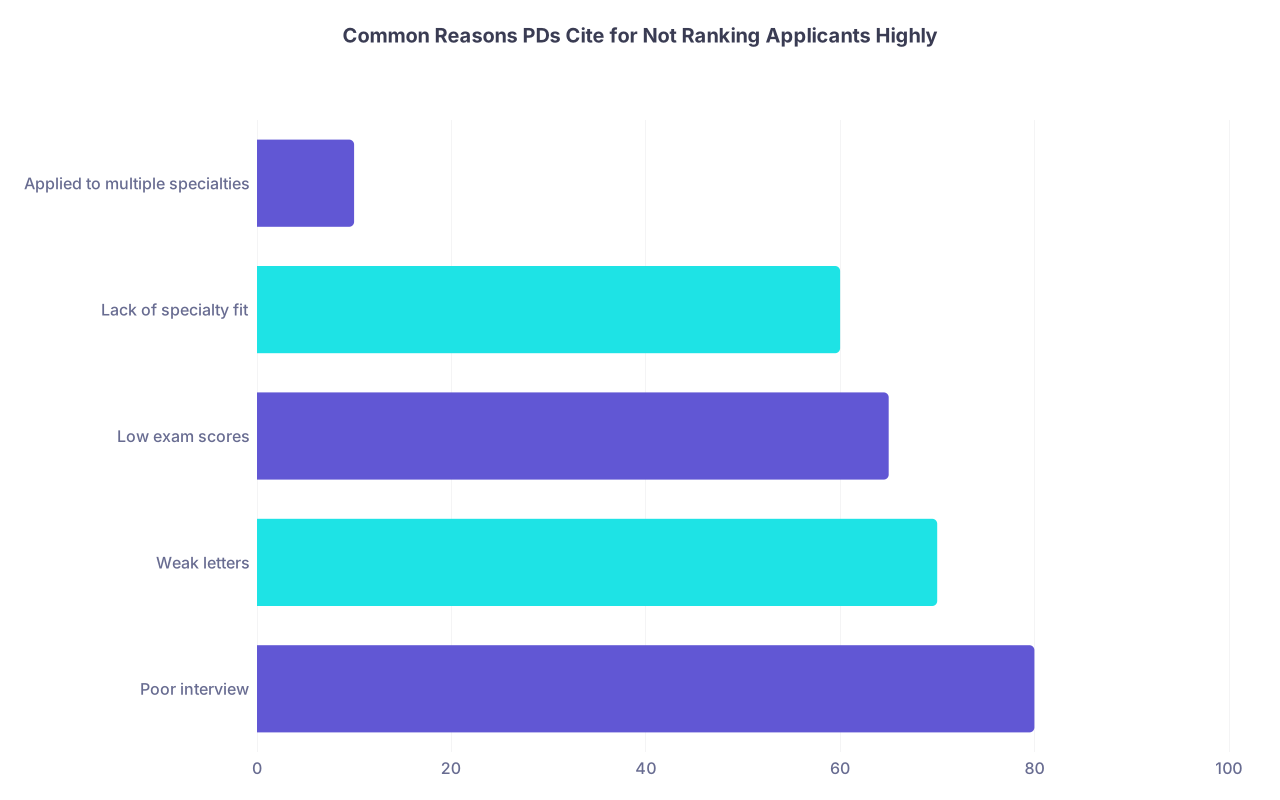
| Category | Value |
|---|---|
| Poor interview | 80 |
| Weak letters | 70 |
| Low exam scores | 65 |
| Lack of specialty fit | 60 |
| Applied to multiple specialties | 10 |
If you think “applied to multiple specialties” is what’s killing most people, you’re ignoring what the people holding the rank lists actually tell you.
So, Should You Use a Backup Specialty?
Here’s the clean version.
Using a backup specialty is smart when:
- Your primary field is significantly more competitive than your overall application
- You can honestly picture yourself content in the backup
- You’re willing to do the work to build two real, coherent applications
It’s dumb when:
- You slap it on in September because you panicked on Reddit
- You refuse to adjust your rotation schedule or strategy to make the backup believable
- You treat the backup as “beneath you” and it leaks into your tone, statements, or interviews
Program directors are not punishing you for risk management. They’re punishing laziness, arrogance, and incoherence.
If you avoid those three, you’re not getting “penalized” for having two specialties on your radar. You’re behaving like a rational adult in a probabilistic system.
Key points:
- PDs do not automatically penalize you for applying to two specialties; they penalize weak, incoherent, or obviously secondary applications.
- “Perceived commitment” comes from tailored statements, appropriate letters, and credible experiences, not from pretending you never considered a backup.
- A two-specialty strategy works when you build two real applications and can clearly explain why each path would make sense for you—not when you tack on a backup at the last minute and hope nobody notices.