
Most of what you’ve heard about using a Transitional Year (TY) as a “safe backup” is wrong.
Programs know exactly what you’re trying to do. The match data doesn’t support the fairy tale. And a lot of applicants treat TY like a magic reset button for a risky application strategy, then are stunned when they end up unmatched or stuck.
Let’s pull this apart properly.
What Transitional Year Really Is (And Is Not)
Transitional Year is not a free extra year to “figure it out.” It is a one‑year, mostly broad-based clinical internship designed to precede certain advanced specialties: radiology, radiation oncology, anesthesiology, dermatology, ophtho, PM&R, etc.
The “backup plan” myth goes like this:
“I’ll apply to my dream advanced specialty plus a bunch of TY programs. If I don’t match my dream, I’ll at least match TY, buy a year, then reapply stronger.”
Sounds clever. Reality is uglier.
Here is how NRMP actually treats this:
- TY is a separate PGY‑1 category, often linked to or favored by specific advanced programs.
- Most desirable TYs (cush, lighter call, big-name hospitals) are not charity spots. They fill with high‑stats advanced applicants: DR, gas, rad onc, derm, ophtho, etc.
- TY is not a categorical specialty. At the end of that year, unless you have an advanced spot lined up, you’re unemployed with an intern-level CV and more questions than answers.
You’re not the first person to think “I’ll game the system with TY.” Programs have seen this movie.
The Match Data: TY Is Not the Easy Backup You Think
Let me be blunt: TY is not the “easy match” alternative to categorical Internal Medicine or Family Medicine.
Recent NRMP data (ballpark numbers, but this is the pattern across years):
- Transitional Year fill rate: usually 99–100%
- Vast majority filled by US MD seniors
- Many programs rank very few applicants per spot
Compare that with categorical Internal Medicine and Family Medicine, which have lower fill rates and more IMGs, DOs, reapplicants, and non-traditional routes.
So if you think, “I’ll apply to 10 derm programs and 25 TYs and I’ll be fine,” that’s fantasy-level planning.
Let me visualize it for you.
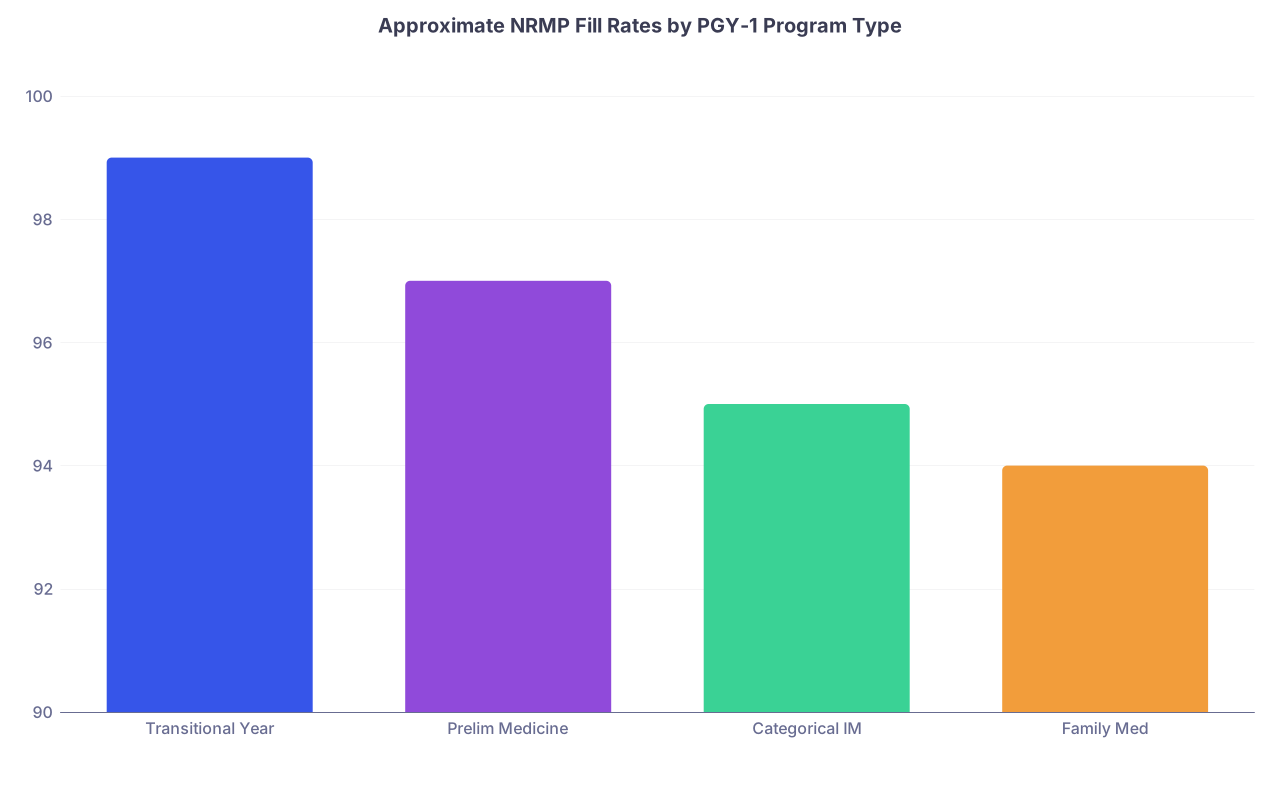
| Category | Value |
|---|---|
| Transitional Year | 99 |
| Prelim Medicine | 97 |
| Categorical IM | 95 |
| Family Med | 94 |
Those are fill rates. Now imagine you’re competing for those TY spots against:
- Radiology applicants with Step 1 > 240 (back when it was scored) or strong Step 2 CK now
- Anesthesia folks with honor society memberships and strong letters
- Derm or ophtho applicants pairing their advanced dreams with attractive TYs
This is why the “TY is my backup” logic breaks as soon as you actually look at the numbers.
The Three Big Myths About TY as a Backup
Let’s dismantle the three most common myths I hear on this.
Myth 1: “If I don’t match my advanced specialty, I’ll at least match TY.”
No. That’s not how the algorithm—or the reality—works.
The NRMP algorithm favors your true preferences, not your “safety” illusions. If you rank advanced programs high and TYs low, it’ll try to match you where you ranked them. If your advanced list is too competitive and your TY list is too ambitious or too short, you can absolutely go entirely unmatched.
I’ve watched this happen in real life:
- Applicant aiming for DR at high-tier places.
- Scores fine but not stellar.
- Ranked ~12 advanced DR programs.
- Ranked ~10 well-known, cush TYs in big cities, all popular with rads and gas applicants.
- Result: Unmatched. Both advanced and TY. Ended up in SOAP scrambling for a prelim medicine spot in a place they never would have voluntarily chosen.
The problem wasn’t that they “took a risk.” It was that they pretended TY was a safety when, statistically and competitively, it wasn’t.
Myth 2: “TY gives me a year to reapply stronger to my dream specialty.”
Maybe. Sometimes. But usually not the way people imagine.
What does a TY actually add?
Pros:
- You get real clinical experience and possibly stronger letters, especially if you’re targeting IM, FM, EM, or hospitalist work later.
- You may be able to demonstrate professionalism, reliability, and growth if you had concerns before.
Cons (and they’re big):
- If you don’t strategically pick a TY at a place with your target specialty (and faculty who know and like you), you’re basically just another intern somewhere, reapplying cold.
- Time is tight. ERAS opens soon after you start. You won’t have a full year of performance under your belt.
- If you’re reapplying to a hyper-competitive field (derm, ortho, plastics, ENT, ophtho, neurosurg), one year of generic TY doesn’t magically erase why you didn’t match the first time.
You do get another cycle. That’s true. But the idea that “TY transforms me into a competitive derm applicant” or “this will fix my red flags” is fantasy unless you’re doing very targeted, strategic work (research, networking, faculty sponsorship) on top of 60–80‑hour workweeks.
Myth 3: “Programs will see TY on my CV and be impressed I ‘worked hard’ for a year.”
Programs are mostly asking one brutal question when they see a reapplicant:
“What changed?”
If the answer is:
- Same scores
- Same research (no new pubs)
- Same letters recycled
- One generic TY year with nothing clearly aligned to the specialty
then all you’ve proven is that you can survive internship. That’s not a differentiator. It’s the minimum for everyone already in their field.
If, however, they see:
- New, strong letters from faculty in that specialty
- Concrete new output (papers, presentations, niche skills)
- Powerful advocacy from someone in the field
- A coherent narrative that explains what went wrong and why you’re now a safer bet
then yes, TY can help. But that is not automatic. It’s work, and you need a plan before you even start the year.
When TY Can Be a Rational Part of a Backup Strategy
Now the more nuanced truth. TY is not useless. It’s just misused.
There are situations where TY actually makes sense.
Scenario 1: You Have a Linked or Strongly Affiliated Advanced Spot
Classic: You match advanced DR or Anesthesia at Hospital X for PGY‑2 and pair it with a TY at Hospital X or a close partner.
Here TY is not your backup. It’s part of your main plan. You’re using it the way it was designed: a bridge year with broad clinical exposure before your field.
Scenario 2: You’re Applying to Competitive Advanced + Real Categorical Backups
This is the grown‑up version of “backup planning.”
Example: You love radiology. Your profile is borderline. You’re realistic.
You do this:
- Apply broadly to DR advanced spots.
- Apply to categorical Internal Medicine at a range of programs you’d genuinely be willing to attend.
- Optionally apply to some TYs, but you do not treat them as your only lifeline.
You construct your rank list so that if you don’t match DR, you are likely to match a categorical IM program and still have a full residency to graduate from, sit for boards, and build a career.
Where does TY fit? As a conditional, secondary path. Not the only parachute.
Scenario 3: You’re Dead-Set on a Narrow Field and Accept the Risk
I’m not going to pretend everyone is rational.
If you’re absolutely willing to risk going unmatched or SOAPing into something unplanned because you only want, say, derm or ophtho, then yes, you might pair those advanced applications with some TYs.
But now we’re talking about values, not “smart strategy.” You’re consciously trading safety for chasing the dream. Fine. Own it. Just don’t lie to yourself and call TY a “safe” backup.
TY vs Categorical vs Prelim: What’s Actually Safer?
The safer backup almost always has one word in it: categorical.
Let’s compare.
| Path Type | Length | Leads to Board Eligibility? | Typical Use Case |
|---|---|---|---|
| Transitional Year | 1 year | No | Before advanced spots |
| Prelim Medicine | 1 year | No | Before advanced or unmatched |
| Categorical IM | 3+ yrs | Yes | Full internal medicine |
If your true concern is, “What if I don’t match my dream field—how do I still end up a practicing doctor?” then betting everything on TY is irrational.
Categorical IM or FM:
- Gives you a guaranteed full residency path.
- Lets you pivot later (fellowships, hospitalist, primary care, admin, etc.).
- Still leaves doors open for some advanced transitions if you network and perform extremely well (e.g., getting into cards, GI, pulm/crit, or even sometimes switching to rads/gas early if positions open).
Prelim/TY:
- Leaves you with no automatic next step.
- Forces you to reapply under time pressure.
- Puts you in a crowded pool of interns asking for a second chance.
If you want a realistic backup, categorical is almost always safer than TY.
The Residency Director Reality Check
Here is what PDs actually think when they look at your rank list and your application game:

| Step | Description |
|---|---|
| Step 1 | Applicant Strategy |
| Step 2 | Viewed as realistic and mature |
| Step 3 | Perceived as gambling or naive |
| Step 4 | Lower enthusiasm |
| Step 5 | Has categorical backup? |
| Step 6 | Prioritize for interview? |
| Step 7 | High risk for SOAP? |
Programs do not want to invest in you only to have you blow up in SOAP because you over-gambled and now you’re angry, stressed, and publicly disappointed.
When they see you built no meaningful categorical backup and leaned on a handful of shiny TYs that everyone wants, they correctly infer you might be the kind of applicant who misjudges risk. That doesn’t help you.
How to Use TY Wisely (If You Insist)
If despite all this, you’re still considering TY, here’s how to do it without delusion.
- Anchor yourself with a categorical backup. If you want any real safety net, rank categorical programs in a field you could actually live with.
- Apply broadly and realistically. Do not only apply to ultra‑cush TYs in coastal cities and then act surprised when they all fill with rads/anesthesia keeners from top institutions.
- Target TY programs with meaningful connections. If your dream is gas, a TY at a hospital with a strong anesthesia department that knows you and likes you is meaningfully better than a random community TY where nobody does your field.
- Have a reapplication plan before Match Day. If you land TY but not your field, what are the specific steps in the first 3–6 months? Which faculty will you talk to? What research will you join? What letters can you upgrade?
Let me be direct: If you can’t articulate that plan now, you’re not using TY as a strategic tool. You’re using it as a security blanket.
Mental Bandwidth and Burnout: The Hidden Cost of TY
Intern year is not a sabbatical. TYs can be lighter than prelim medicine at malignant places, but you’re still:
- Taking call
- Managing admissions
- Juggling scut, notes, and pages
- Adjusting to being the real doctor at 3 a.m.
Trying to simultaneously rebuild a failed application—writing new personal statements, arranging away rotations, scheduling interviews, producing research—on top of that is not trivial. I’ve watched interns flame out doing exactly this.
You need to factor in:
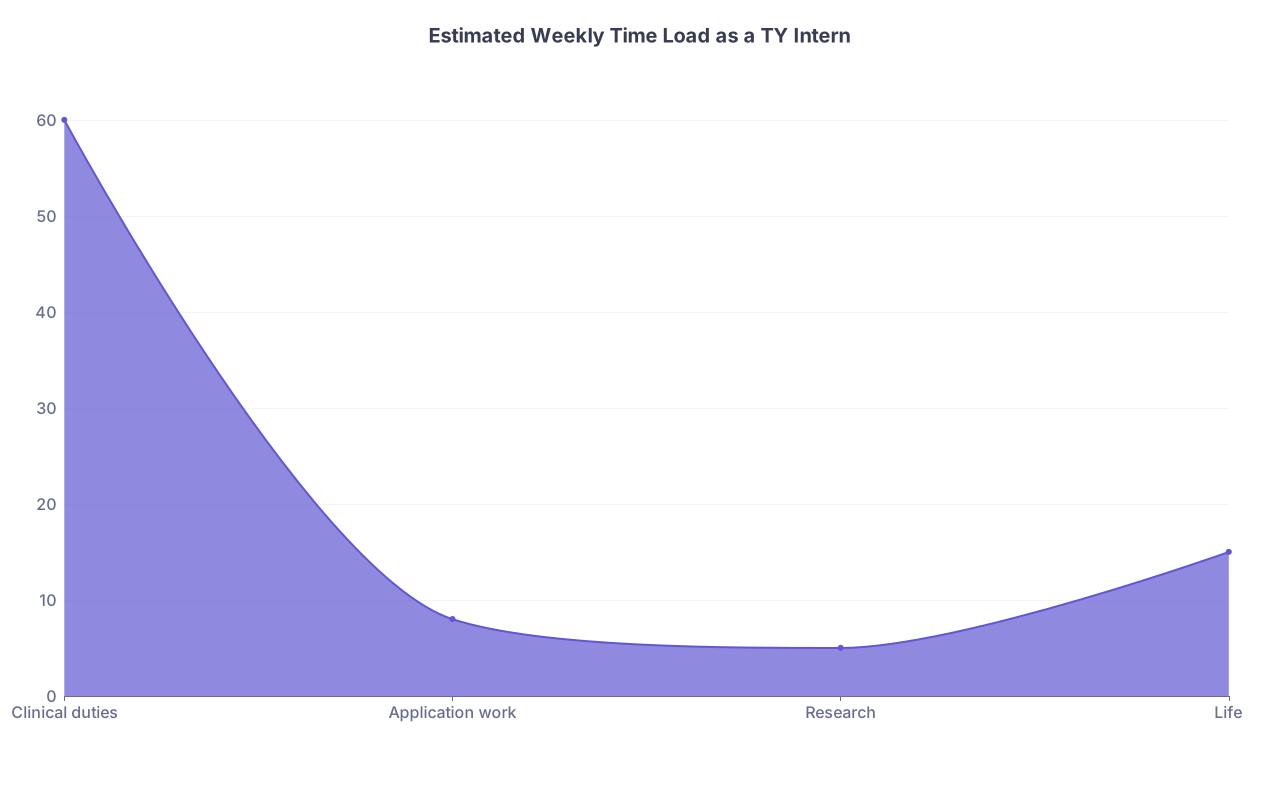
| Category | Value |
|---|---|
| Clinical duties | 60 |
| Application work | 8 |
| Research | 5 |
| Life | 15 |
You don’t magically get “free time” during TY. You carve it out of sleep, sanity, or relationships.
Where TY Actually Shines
To be fair, I don’t hate TY as a concept. In the right setting, it’s fantastic:
- For advanced specialties that require or strongly prefer it.
- At institutions that integrate TY interns into the culture and give them exposure to their future field.
- When it’s part of a matched package (advanced + linked TY).
Using it as the lone parachute for an overreaching application strategy though? That’s the part that’s broken.
Quick Recap: The Real Truth About TY as a Backup
Let me strip it down to the essentials.
- TY is not an easy match. It’s one of the most competitive PGY‑1 categories and heavily targeted by high‑performing advanced applicants.
- TY alone is not a safe backup. A real backup plan almost always includes categorical programs in a field you can live with.
- TY can help a reapplication only if you use it deliberately: targeted program choice, aligned mentors, new output, and a very clear plan.
- If you’re dead-set on a single dream field, TY doesn’t fix the risk; it just rearranges it.
Use it as a tool, not a fantasy.