
Family medicine is not your trash bin specialty. And treating it like one is how people quietly wreck their careers.
Let me be direct: the idea that “If everything fails, I’ll just do family medicine” is lazy, statistically wrong, and dangerous for both you and your future patients. It’s also not how the Match actually works anymore.
You’re in the residency application phase, trying to pick backup specialties. You’ve probably heard some version of:
- “Shoot for derm, back up with family.”
- “If ortho doesn’t work out, there’s always FM.”
- “FM always has spots, you’re safe.”
That narrative is outdated. The data do not support the fantasy that family medicine is an automatic safety net for any applicant in any situation.
Let’s walk through what the numbers, the trends, and real applicant behavior actually show.
Myth #1: “Family Medicine Always Has Tons of Easy Open Spots”
Not anymore. And definitely not for everyone.
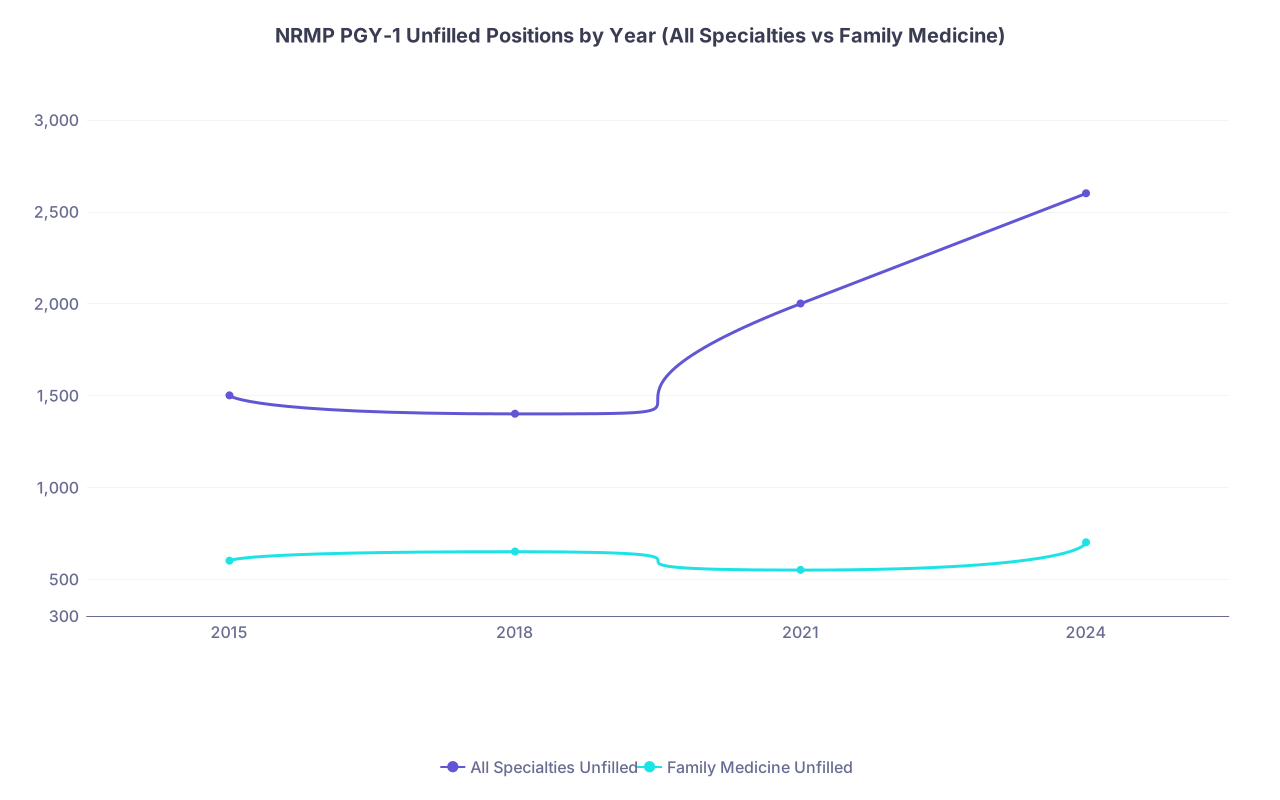
| Category | All Specialties Unfilled | Family Medicine Unfilled |
|---|---|---|
| 2015 | 1500 | 600 |
| 2018 | 1400 | 650 |
| 2021 | 2000 | 550 |
| 2024 | 2600 | 700 |
Even if you do not have exact NRMP numbers in front of you, the trend is clear from recent cycles:
- Many FM programs fill completely, especially at strong academic centers or in desirable metro areas.
- The majority of unfilled FM spots cluster in specific regions and community programs.
- International medical graduates (IMGs) and DOs are increasingly competitive in FM, and they are filling a lot of those “backup” seats.
The key mistake: confusing “some unfilled FM spots exist” with “I personally will easily get one.”
Those leftover positions are often:
- In geographic areas you never planned to live in.
- In small community hospitals with limited specialty support.
- In programs that may be struggling with staffing, accreditation pressure, or reputation issues.
If your career plan is, “If my competitive specialty doesn’t work, I’ll just SOAP into FM,” you are playing roulette with your location, training quality, and job satisfaction.
SOAP into anything is a backup of last resort, not a rational “Plan B.” Treating it as a strategy is how people end up cross-country in a program they never researched, wondering what just happened.
Myth #2: “Any Competitive Applicant Can Easily Match FM if They Want To”
Another oversimplification. There are at least three big problems with this idea.
1. Program Fit Actually Matters
FM is not a dumping ground for failed surgeons. Program directors know when somebody is just “passing through.”
Red flags they see all the time:
- Applications with 90% surgery/ortho/EM letters and one generic FM letter.
- Personal statements that basically say, “I wanted X, but I guess FM is fine.”
- ERAS full of no primary care, no continuity clinic, no outpatient focus, zero longitudinal.
Family medicine, more than a lot of fields, cares about:
- Longitudinal relationships
- Outpatient care
- Behavioral health
- Community work and underserved populations
If your entire record screams “proceduralist who hates clinic,” you’re not a slam dunk for a solid FM program.
2. Geographic and Program Tier Still Apply
You do not magically bypass geography realities just because you click “Family Medicine” on ERAS.
Urban, coastal, and university-affiliated FM programs can be quite selective. They triage based on:
- Academic record
- Genuine FM interest
- Local ties
- Diversity of experience
- Commitment to primary care
The “I’ll just do FM in a big city I love” plan breaks quickly when you realize multiple strong applicants with clear FM commitment, local connections, and targeted letters are also applying.
3. Competitive Applicants Aren’t Automatically Good FM Fits
I’ve seen this scenario more times than I can count:
- Step scores: 250+
- Tons of bench research in ortho/ENT/neurosurg
- Zero outpatient continuity, minimal primary care exposure
- Personal statement pivot to “I love holistic care and long-term relationships” written 3 days before ERAS
Programs can read. They can see the story does not add up.
Could this person still match FM somewhere? Probably. But is it guaranteed, and in a location/program they like, with one quick application tweak? No.
Myth #3: “FM Is the Best Backup for Every Competitive Specialty”
Flat-out wrong. Backup must match both:
- Your real-world skills and personality, and
- Your application’s existing architecture—what you’ve already built.
For many specialties, more logical backups exist than FM.
| Primary Target | Common (But Misguided) Backup | More Coherent Backup Options |
|---|---|---|
| Ortho | Family Medicine | General Surgery, IM (hospitalist focus) |
| Dermatology | Family Medicine | Internal Medicine, Pathology |
| EM | Family Medicine | Internal Medicine, FM *only if documented interest* |
| Radiology | Family Medicine | Internal Medicine, Transitional Year |
| Neurosurgery | Family Medicine | General Surgery, Neurology |
Why these make more sense:
- Ortho → General Surgery: similar OR environment, acuity, patient flow, and your letters likely come from surgeons.
- Derm → Internal Medicine: more aligned with medicine-style thinking, inpatient/outpatient mix, better match with IM-style letters and research.
- Radiology → Transitional Year or IM: more procedure-friendly, easier to pivot back toward imaging-related fields later.
Family medicine can be a rational backup. But only if:
- You’ve done FM or primary care rotations with good evaluations.
- You can sincerely sell outpatient, continuity, and broad-scope care.
- You’re willing to train where the unfilled risk actually is (often not your dream city).
If none of that is true, FM is not your backup. It’s your fantasy.
What the Evidence Actually Shows About FM Competitiveness
No, FM is not derm. But it’s not a free-for-all either.
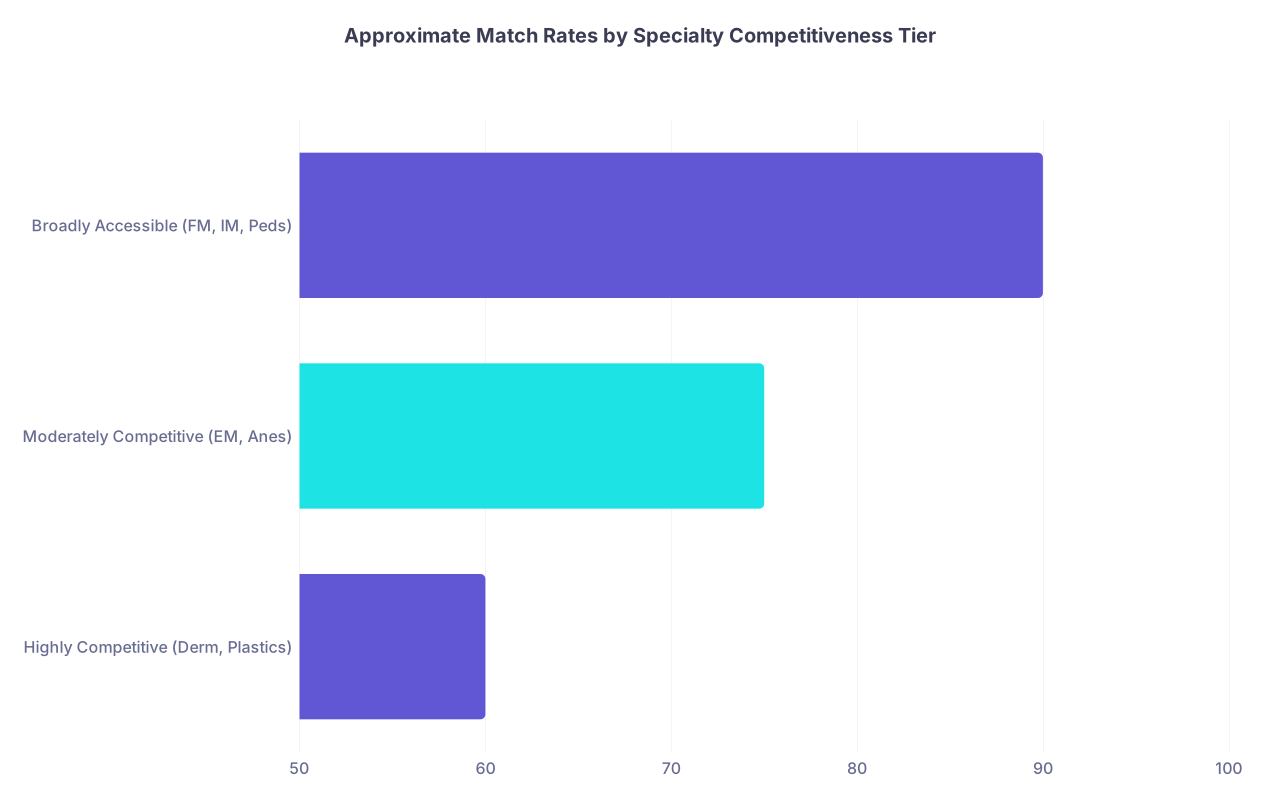
| Category | Value |
|---|---|
| Highly Competitive (Derm, Plastics) | 60 |
| Moderately Competitive (EM, Anes) | 75 |
| Broadly Accessible (FM, IM, Peds) | 90 |
FM usually sits in the “broadly accessible” tier:
- Match rates are high for US MD/DO seniors who actually target FM.
- Programs often rank more applicants to match than more selective specialties.
- There are more total positions relative to applicants than in many fields.
But high match rate ≠ guaranteed personal outcome.
You still see:
- Failed matches for US grads who “panic-pivoted” to FM with weak fit.
- Applicants who only applied to a handful of FM programs “just in case” and got burned.
- SOAP outcomes where the only remaining FM spots are in locations the applicant never thought seriously about.
The pattern is consistent: those who treat FM as a real specialty and plan accordingly do well. Those who treat it as a late-game escape hatch often do not.
How to Use Family Medicine Intelligently as a Backup (If It Actually Fits)
If you’re honestly open to a career in FM, you can absolutely use it strategically. But do it like an adult, not like someone tossing in a lottery ticket.
1. Decide Early If FM is on the Table
If you’re even 30–40% serious, act like it:
- Schedule an FM sub-I or acting internship.
- Get at least one strong FM letter from someone who can talk about your outpatient and continuity skills.
- Join the FM interest group or do a brief community project that actually reflects FM values.
This does not lock you into FM. It simply gives you options that are real instead of imaginary.
2. Apply with a Coherent Strategy
If you’re dual-applying (say EM + FM or IM + FM), you cannot just send the same application everywhere.
- Write a separate, FM-specific personal statement that does not read like recycled surgery prose.
- Allow ERAS to filter letters—FM programs should see at least 1–2 FM/primary care letters.
- Build a realistic program list: urban academic FM is not the same competitiveness as smaller community FM, especially in underserved regions.
Serious FM backup strategy might mean:
- More total applications than you planned.
- Accepting that your geographic filters need to widen.
- Actually talking to FM advisors, not just your derm or surgery mentor.
3. Be Honest About What You’d Actually Be Happy Doing
Here’s where people lie to themselves.
If you:
- Hate outpatient clinic
- Love only procedures and OR time
- Dread the idea of chronic disease management and 15-minute follow-ups
- Get bored by talking about lifestyle, prevention, social determinants
You will likely be miserable in FM. Even if you “succeed” in matching.
FM is not “slightly less glamorous internal medicine.” It’s structurally different: continuity, breadth over depth, heavy psychosocial load, and a lot of non-glamour care.
Choosing it only because you missed plastics is a fast track to burnout.
Better Way to Pick Backup Specialties (Not Just FM)
Let’s step back from defending or attacking FM and talk about what you actually should do for backup planning.
Here’s a cleaner framework:
Map your real interests and tolerances.
Inpatient vs outpatient. Procedures vs cognitive. Acute vs chronic. Breadth vs depth.Map your existing application.
What do your letters, research, leadership, and rotations actually say about you?Find backups that are adjacent on both maps.
Adjacent in day-to-day work, and adjacent in what your record already supports.Check the competitiveness gap.
Your backup should be meaningfully easier to match than your primary—otherwise, you’re just dual-applying to two hard things.Decide if you’d be proud to introduce yourself with that title in 10 years.
“Hi, I’m a family physician.” If that sentence makes you cringe, do not use FM as your backup. Same for “psychiatrist,” “hospitalist,” “pathologist,” whatever it is.
If FM survives that filtering—great. Then treat it as a legitimate option. If it doesn’t, stop lying to yourself that “there’s always family medicine.”
FAQs
1. Is it insulting to family medicine to use it as a backup?
It’s insulting if you treat it as the place you “dump” your application at the last minute. Using FM as a backup is fine if you’ve seriously considered it, built some FM-relevant experience, gotten appropriate letters, and would genuinely accept an FM spot without resentment. Backup ≠ garbage can.
2. Can I dual-apply surgery and family medicine?
You can. It’s usually messy. Your application will look schizophrenic unless you carefully separate letters and statements and can convincingly explain your thought process. A more coherent backup for surgery is often general surgery at a broader range of programs or another acute-care field, not FM.
3. Is FM still a good option for IMGs and DOs?
Yes. FM remains one of the more accessible specialties, especially for IMGs and DOs, but “accessible” is not the same as “automatic.” Strong FM letters, real primary care exposure, and geographic flexibility still matter a lot. Many FM programs are DO-friendly and IMG-friendly, but you still need a focused application.
4. If I decide late in the cycle to pivot to FM, is it too late?
Late pivots are tough but not impossible. You’ll need to scramble for at least one FM/primary care letter, rewrite your personal statement, and aggressively expand your program list, especially to community and underserved locations. Just do not assume you’ll hit your preferred city or top-tier academic program with a last-minute pivot.
5. What if I honestly like both EM and FM—how should I choose?
Then you’re in a good spot, because your backup isn’t fake. Get real exposure to both: an EM sub-I and an FM sub-I with continuity clinic. Talk to attendings who’ve done both paths, consider lifestyle (shift work vs clinic schedule), and decide what kind of “hard” you’re willing to live with. If both are truly acceptable, you can dual-apply with a thoughtful, two-track strategy instead of panic.
Bottom line:
- Family medicine is not the universal safety net people pretend it is.
- Backup specialties must align with your actual record and your actual personality, not your wishful thinking.
- If FM is on your list, treat it like a real specialty or do not put it there at all.