
What if your “backup” specialty is actually the thing that tanks your entire Match?
Let’s tear into one of the most persistent myths in residency applications: the idea that you can protect yourself by adding an “easier to match” specialty as a safety net. IM as backup to derm. FM as backup to ortho. Path as backup to radiology. You’ve heard all the clichés.
And a lot of them are flat‑out wrong. Or at least dangerously oversimplified.
The Myth: “Lower Competitiveness = Safer Backup”
The logic sounds clean:
- Some specialties have higher Match rates and lower average Step scores.
- Therefore, if you apply to those as backups, your odds go up.
- Therefore, more “backup” specialties = safer Match.
This is how you end up with a fourth-year telling me: “I’m doing ENT, but I’ll throw in some prelim surgery and maybe FM just in case. Cover my bases.”
Here’s what the actual data and real-world behavior say.
NRMP Program Director Surveys and Match reports show:
- Applicants who apply to multiple unrelated specialties often do worse than similarly qualified peers who commit to one area (or to a tightly aligned pair, like IM + Neuro).
- “Easier” specialties are flooded with last‑minute “backups” who underestimate how obvious their lack of interest looks in the application.
- Programs in these so‑called easier fields are not desperate. They’re selective in different ways: fit, commitment, communication, and likelihood to stay in the specialty.
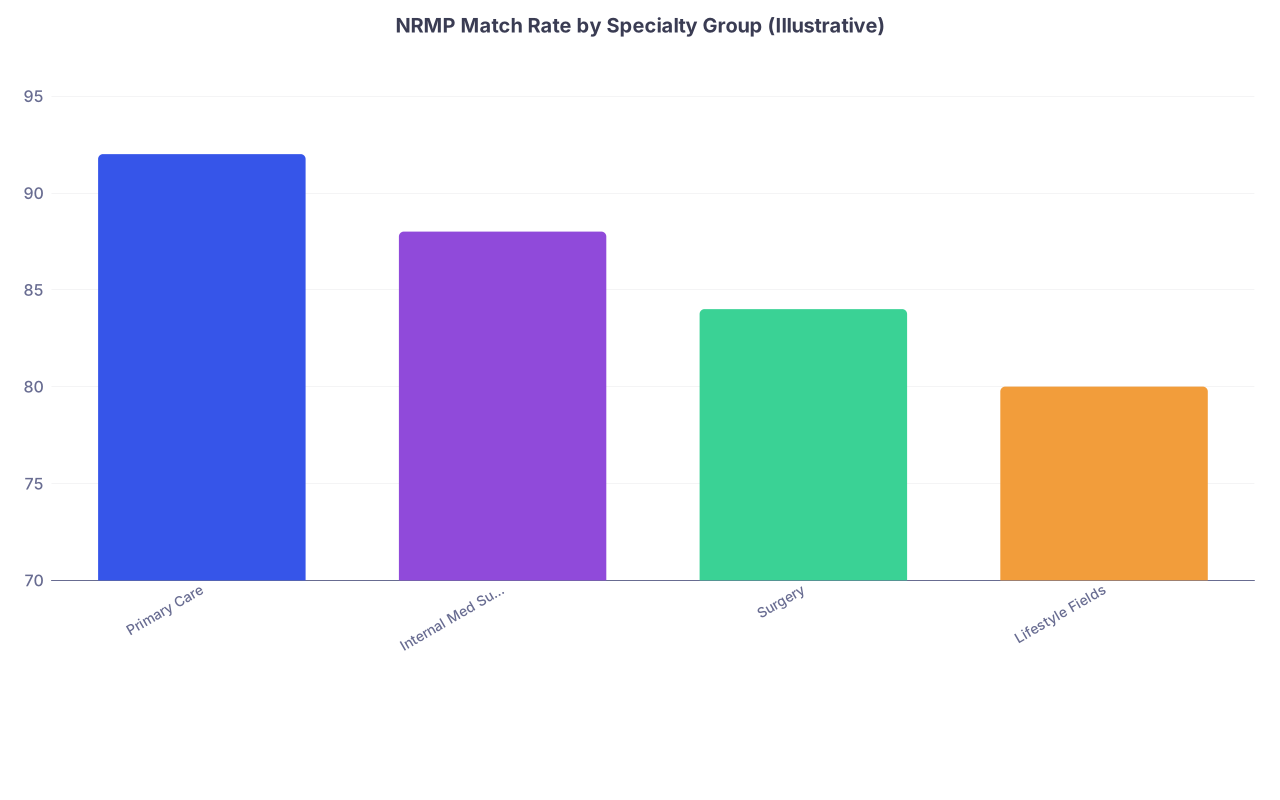
| Category | Value |
|---|---|
| Primary Care | 92 |
| Internal Med Subspecialties | 88 |
| Surgery | 84 |
| Lifestyle Fields | 80 |
The gap between “easy” and “hard” on paper is smaller than people think. And the stuff that actually makes you match—coherent story, strong letters, real clinical engagement—is exactly what gets watered down when you scattershot backup specialties you do not care about.
Problem #1: Programs Can Smell a Backup From Your Application
I’ve sat in meetings where people literally say:
- “This looks like a derm applicant slumming it in IM.”
- “She’s clearly ortho‑or‑bust and dumped a few FM apps on ERAS at the last minute.”
- “Good scores, but his whole application screams surgical. Why is he applying path?”
You think you’re being strategic. They think you’re wasting their time.
Programs are looking for evidence that you:
- Genuinely understand the specialty.
- Have actually done rotations or electives in it.
- Can produce at least one letter from someone in the field who knows you.
- Won’t bail to another specialty after PGY‑1.
If your application reads as “backup,” you’ve already started behind everyone whose first (and only) choice is that “easier” specialty.
Let’s compare two IM applicants to a mid‑tier academic program:
| Factor | True IM Applicant | Derm Applicant Using IM as Backup |
|---|---|---|
| IM letters | 3 strong IM letters | 1 generic IM, 2 derm |
| IM rotation evals | Honors + comments on fit | Pass/Honors, generic comments |
| Personal statement | IM‑focused, specific cases | Derm story with vague IM fallback |
| Research | IM/QI projects | Mostly derm, no IM relevance |
| Interview impression | Knows IM landscape | Talks like they still want derm |
On paper, the derm applicant might have higher scores. In reality, they’re a worse bet for the program. The “easier” specialty is not going to bend over backwards for someone who clearly does not want to be there.
Problem #2: Competitiveness Isn’t Just Step Scores
Another naïve assumption: competitiveness = average Step 2 score and fill rate.
That’s the spreadsheet way of thinking about specialties. Real life is messier.
Some “easier” specialties screen more on:
- Fit with underserved / community‑focused mission
- Willingness to work in specific geographic regions
- Demonstrated interest (continuity clinic, community work, advocacy)
- Communication skills, empathy, team dynamics
You cannot brute‑force that with a 260.
Family medicine is the classic victim here. Students glance at the overall Match rate and assume it’s a soft landing. Then they interview at a mission‑driven FM program whose entire identity is longitudinal care in an underserved area and show up talking like a future radiologist who just wants a “generalist year.”
Instant no.
Same thing for psych programs that care deeply about patient interaction and stigma reduction. Or PM&R programs that want people actually interested in rehab, disability, and function, not folks who missed ortho and just want some MSK-adjacent option.
“I have a high Step score, I’ll be fine” is not a backup plan. It’s hubris.
Problem #3: Split Identity Kills Your Narrative
If you apply to 2–3 truly different specialties, your ERAS suddenly becomes a jigsaw puzzle that doesn’t quite fit.
You get:
- Two personal statements that sort of contradict each other.
- Letters from attendings in totally different fields.
- A CV with research and electives scattered all over the place.
- Interviewers asking: “So… what do you actually want to do?”
You answer that question poorly once or twice at a smaller program, and the word gets around surprisingly fast. Residents talk. Coordinators talk. PDs have group chats and email threads you’ll never see.
The worst thing you can project isn’t “I’m not the top of the class.” It’s “I don’t know what I’m doing and I might leave.”
Backup specialties magnify this if they’re completely disconnected from your main interest. Ortho + FM + Path. Derm + Psych + IM. It looks like panic, not strategy.
Problem #4: Some “Backups” Destroy Your Long‑Term Options
Here’s a fun pattern I’ve seen more than once:
- M4 wants integrated plastic surgery.
- Gets the “you need a backup” talk.
- Adds general surgery prelims plus categorical FM “just for safety.”
- Spreads time and energy across both paths.
- Fails to match plastics, gets a categorical FM spot.
- Is now locked into a 3‑year residency in a field they do not actually want, with much less time / leverage to reapply.
Was that “safer”? Maybe in the narrow sense of avoiding SOAP and unemployment. But if the long‑term goal was plastics, that FM “safety” actually killed their best shot at taking a research year, strengthening their app, and reapplying with a clear surgical story.
You have to decide what you’re actually optimizing for:
- Short‑term: Any job, any specialty, avoid SOAP at all costs.
- Medium‑term: Reasonable odds of reapplying to your dream field if you miss.
- Long‑term: Ending up in a specialty you can tolerate for 30 years.
Different goals require different backup strategies. Copy‑pasting someone else’s “IM is my backup for literally everything” plan is lazy and sometimes harmful.
Problem #5: Backup Apps Dilute the Only Thing That Really Helps—Focus
Every extra specialty you add costs:
- Letters you could have gotten in your main field
- Sub‑I time you could have spent impressing the right PDs
- Interview days you burn on programs you don’t actually want
- Mental bandwidth to tailor personal statements and answer “Why this specialty?” convincingly
Applicants underestimate the drag of this split attention. A month writing two totally different sets of essays is a month you’re not:
- Reading key specialty journals
- Calling programs and mentors
- Polishing your primary specialty story
- Practicing interview questions with actual nuance
You’re doing more work to be a worse candidate. Impressive, in a tragic way.
When a “Backup” Specialty Actually Makes Sense
So does that mean you should never have backups? No. It means you need smart backups, not panic-driven ones.
A backup path is defensible when:
The fields are coherent together
- IM + Neuro + maybe Cards-focused IM
- Gen Surg + Integrated Vascular / CT / Trauma
- Peds + Peds Neuro / Peds Cards
- Psych + Neuro, or Psych + IM with strong psych interest
Your story still makes sense if someone sees your entire ERAS
If a PD saw both sets of personal statements, would they think:
“This person is drawn to X kind of patient/problem, and these two specialties both fit that”
or
“This person is flailing.”You can get real letters in both fields
Not a token half‑hearted “He rotated with us for two weeks and seemed fine.”
I mean: a letter that can stand next to your primary specialty letters without looking like an afterthought.You’re honestly willing to do the backup field for real
As in: if you match there, you won’t immediately start scheming to leave. That matters. To your future happiness and to how you talk about it on interview day.

| Step | Description |
|---|---|
| Step 1 | Primary Specialty |
| Step 2 | Consider adjacent specialties deeply |
| Step 3 | Apply broadly in same specialty |
| Step 4 | Apply to coherent backup |
| Step 5 | Reassess goals or take gap year |
| Step 6 | Have realistic shot? |
| Step 7 | Need backup for geography only? |
| Step 8 | Adjacent field aligns with story? |
If your backup plan doesn’t survive that kind of scrutiny, it’s not a plan. It’s anxiety on ERAS.
How to Use “Easier” Fields Without Sabotaging Yourself
You can absolutely use less competitive specialties in a smart way. Here’s how.
1. Decide Your Priority: Specialty vs Location vs Certainty
Be honest with yourself:
- If specialty is king: You might be better off applying more narrowly, accepting risk, and having a reapply plan rather than stuffing in random backups.
- If avoiding SOAP is king: Then a broad strategy including community programs, smaller cities, or less competitive versions of your main field makes more sense than random-field backups.
- If location is king: You might choose a backup in the same region where you’d be happy long-term, but you must own that tradeoff.
You cannot maximize all three. People who pretend they can usually match into none of their priorities.
2. If You Add a Backup, Commit Hard Enough to Be Believable
No halfway nonsense. For a true backup specialty:
- Do at least one real elective or Sub‑I in it.
- Get at least one strong letter from that field.
- Write a statement that would still feel honest if you actually matched there.
- Know the basics of the field: major issues, training structure, fellowship options.
If you’re not willing to do that, don’t call it a backup. Call it what it is: fantasy insurance.
3. Stop Worshipping Score Cutoffs
I’ll spell it out. A 250+ Step score doesn’t “guarantee” you anything in a specialty you:
- Never rotated in
- Have zero research in
- Have no faculty advocates in
- Talk about like a second‑class consolation prize
Meanwhile, the 230‑score applicant who did two rotations, has three letters, and knows the program director’s research interests will beat you every time in that “easier” field.
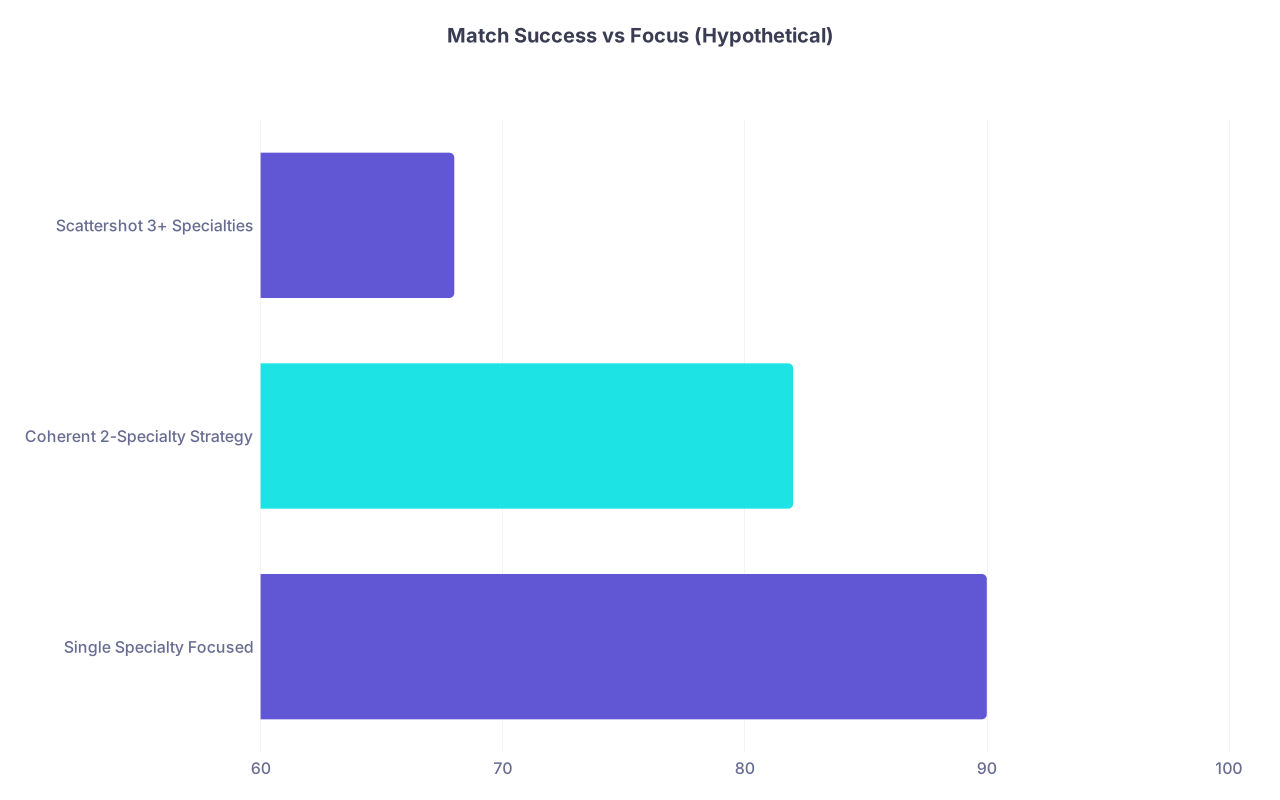
| Category | Value |
|---|---|
| Single Specialty Focused | 90 |
| Coherent 2-Specialty Strategy | 82 |
| Scattershot 3+ Specialties | 68 |
Is that exact number real? No. But the pattern is. I’ve watched it play out year after year.
The Quiet Cost: Burnout and Regret
Let’s say your backup “works.” You match the safer field. You avoided SOAP. Everyone congratulates you.
Now what?
You’re a PGY‑2 psych resident who still stalks ortho forums. Or an FM PGY‑1 who cannot stand clinic, hates chronic disease management, and lives for the one procedure clinic day each month. Or a path resident who misses patient contact so much they’re resentful every time they sit at a scope.
I’ve talked to those people. They’ll tell you: “I thought matching anywhere would feel better than not matching. I was wrong.”
Backup specialties aren’t neutral. They shape the rest of your life. You owe yourself better than a decision driven entirely by fear in October of M4.
So What Actually Is a “Safe” Backup Strategy?
Three principles:
Stay coherent.
If someone laid your entire ERAS out on a table, it should tell one or two clear stories about what kind of doctor you’re trying to become. Not five.Align effort with probability.
Stop spending 40% of your time propping up a backup you don’t even want. Put 80–90% into the field you actually care about. Use the remainder to build a plausible adjacent backup or a reapply plan.Plan for failure like an adult.
That means having:- A clear SOAP plan for your primary field and closely related ones
- A realistic reapplication plan (research year, prelim year in a related field, etc.)
- A threshold where you’d actually walk away from the dream field and commit to something else
Real safety doesn’t come from slapping a low-competitiveness specialty onto ERAS. It comes from knowing what you’re optimizing for, being honest about risk, and accepting that “I’ll do anything as long as I match” is not a plan—it’s surrender.
Key takeaways:
- “Easier to match” specialties are not automatically safe backups; programs can clearly see when they’re being used as consolation prizes and they select against that.
- The more you fragment your application across disconnected specialties, the weaker your primary story becomes—and that usually lowers your overall Match chances, not raises them.
- Smart backup strategies are coherent, effort-backed, and honest about tradeoffs; panic‑adding random specialties is how you end up both matched and miserable.