
The idea that you must hide your backup specialty plan from everyone is nonsense—and it actively hurts applicants.
There is a difference between being strategically discreet and acting like you’re in witness protection. The “never tell anyone your backup” dogma is fear-based, not data-based. And I’ve watched it backfire over and over: weaker letters, incoherent applications, and disastrous rank lists that collapse when reality intrudes.
You’re not gaming a reality show. You’re trying to secure a job in a massive, data-driven system with thousands of moving parts. In that world, smart transparency with the right people is a competitive advantage, not a liability.
Let’s dismantle the myth.
The Myth: “If I Admit I Have a Backup, No One Will Take Me Seriously”
The script goes like this. A third-year says: “I love orthopedics, but it’s competitive, so I’m thinking about PM&R as a backup.” Instantly, some senior or co-student snaps: “Never say ‘backup.’ Programs hate that. Don’t tell anyone.”
That advice is emotionally satisfying. It fits the toxic romance narrative that you should be “all in” for your “dream specialty” and that doubt is betrayal.
It also ignores how the Match actually works.
Programs are not psychic. They don’t know what you’re applying to unless you tell them explicitly. They don’t get a secret report from ERAS listing every specialty you clicked. Yes, they make inferences from your CV and letters—but those inferences can be wrong, and often are.
Meanwhile, the people who can help you—advisors, program directors, letter writers—can’t do their job if you feed them a carefully curated fantasy.
The result?
- You get generic letters that don’t position you well in either specialty.
- You end up with a lopsided application: research in one field, rotations in another, your personal statement in a third universe.
- You submit a panicked rank list because you never had honest, data-based conversations about your odds.
Not saying you should broadcast “I’m hedging my bets” during every interview. But the fear of being honest with anyone about your backup plan is misplaced.
What the Data Actually Shows About Competitiveness and Risk
Let’s ground this in numbers, not superstition.
Every year, NRMP publishes data that might as well be labeled: “Here’s why having a backup specialty is rational.” The Match is probabilistic. You are not entitled to a spot because you “worked hard.” You get a spot because your profile intersects with program needs in a given year.
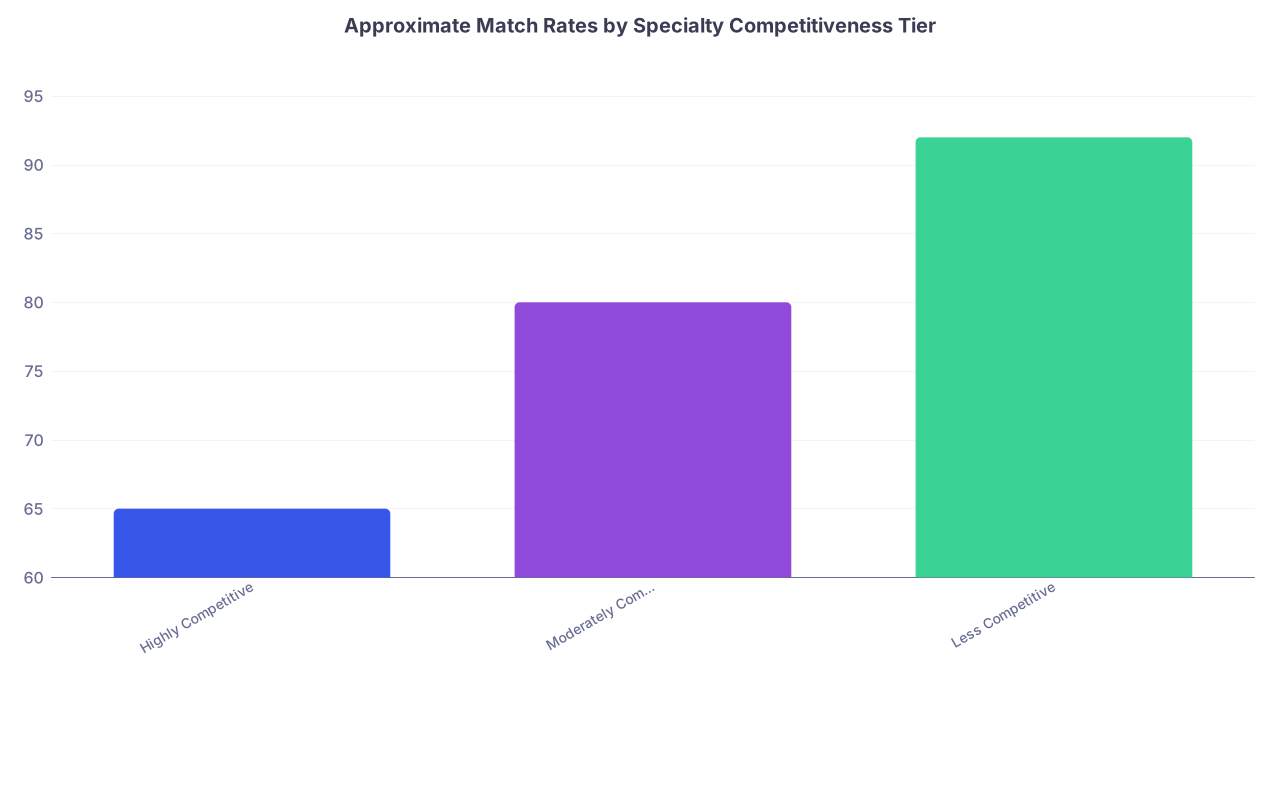
| Category | Value |
|---|---|
| Highly Competitive | 65 |
| Moderately Competitive | 80 |
| Less Competitive | 92 |
Those are ballpark numbers across years for US MD seniors. The specifics move; the pattern doesn’t. Some specialties (plastics, derm, ortho, ENT, neurosurgery, interventional pathways) are blood sport. Even strong applicants miss.
You know who rarely goes unmatched? The applicant who:
- Knows their actual risk profile (Step scores, class rank, research, school reputation, visa status).
- Picks a realistic backup specialty early enough.
- Tells key people the truth so they can help engineer parallel paths.
The “never admit you have a backup” crowd tends to ignore one brutal statistic: the unmatched rate. Every year, thousands of applicants go unmatched or partially matched. Many of them had wishful “I’ll be fine” conversations instead of honest ones.
Who You Should Tell About Your Backup Plan (And Why)
You don’t need to shout your backup from the rooftops. But there are people you absolutely should bring into your confidence. Being cagey with them is self-sabotage.
1. Your primary specialty advisor
If you’re aiming for a competitive field and you’re not discussing a backup with your specialty advisor, you’re doing this wrong.
I’ve sat in those meetings. The good advisors don’t get offended if you say, “I love ENT, but I’m also considering anesthesia or IM as a backup given my Step score.” What they do is:
- Pull out the data: historical match rates from your school into that specialty at your score range.
- Help you decide if you should dual-apply—and how aggressively.
- Tell you if your current CV looks “all in” on one specialty in a way that will confuse your backup field.
They cannot do any of that if you hide your intentions to preserve some imaginary purity test.
This is also where the “but they’ll think I’m not committed” myth dies. Advisors know the landscape. They’ve seen 230 Step 2 scores trying to crack ortho. They don’t sit there clutching pearls because you’d like to avoid unemployment.
2. Your backup specialty advisor
Even more obvious: if you are serious enough about a backup to spend ERAS money on it, you need someone in that field to see your full picture.
Not: “Oh I’m ‘very interested’ in your specialty and totally focused on it.”
Actual truth: “I’m dual-applying with X as my primary. Here are my stats and experiences. Where do applicants like me succeed? What do I need to not look like a last-minute refugee on paper?”
A decent advisor in your backup field will:
- Tell you whether your portfolio can be reframed to make sense for them.
- Help prioritize which rotations, letters, and programs matter in their world.
- Warn you if you are severely under-applying or overreaching.
The fear that an advisor will blacklist you for dual-applying is overblown. Have I seen one or two insecure people react badly? Yes. Then you find a different advisor. You don’t silence yourself across the entire field because Dr. Fragile Ego had feelings.
3. Your letter writers
Here’s where secrecy really hurts people.
Applicants hide their backup plans, ask for letters framed as “This student is 100% committed to [Specialty A],” then try to re-use those letters for Specialty B. It reads badly. Programs in B can smell when they’re the rebound.
Better approach: tell each letter writer where they fit.
For the primary field: “I’m applying primarily to neurosurgery, but I am also applying to neurology as a backup. This letter will be for neurosurgery only.”
For someone in your backup field: “I’m dual-applying to emergency medicine and internal medicine. I’d like your letter to be for EM specifically, but I also need it to not say that EM is my only interest, since programs may know I applied broadly.”
For a general medicine or core clerkship letter: “I’m dual-applying to anesthesiology and IM. Could you focus on my clinical skills, work ethic, and team function without tying it too hard to a single field?”
Yes, you can and should be that explicit. They’re adults; they can handle complexity. Specific guidance lets them write a letter that still feels authentic across contexts instead of painting you into a one-specialty corner.
4. Your dean’s office / student affairs
Many schools use “dean’s letters” (MSPEs) and formal advising structures. These people are your last line of defense against a catastrophic Match. Hiding your backup plan from them is like lying to your surgeon about your drug allergies.
When the dust settles and you have:
- An interview-heavy primary field.
- A neglected backup with weak letters.
- Or zero invites from your dream field and a near-empty interview calendar…
Student affairs is who goes into emergency mode with SOAP strategies, extra applications, last-minute networking.
They do this better if they already know what your backup was supposed to be and what your actual preferences are. They can’t redirect you efficiently if they think you’re “all in on derm” but you quietly applied to psych on the side.
Who You Don’t Need to Tell (And When Silence Is Strategic)
Now, let’s be clear. I’m not saying you should walk into a neurosurgery interview and announce, “If this doesn’t work out I’ll just do neurology, no big deal.”
There are contexts where talking about your backup is dumb.
On the interview trail
On interview day, your job is to answer this question: “Why this specialty and why this program?”
Not: “Rank my overall life plan.”
Not: “Share your actuarial risk analysis.”
Interviewers are there to judge fit and commitment to their field. They are not your therapist. They are not your career counselor. With rare exceptions (like a trusted mentor you already know well), talking about your backup specialty in a live interview is usually unnecessary and occasionally harmful.
If someone directly asks, “Are you applying to other specialties?” you don’t need to panic. You also don’t need to deliver a TED Talk on your entire strategy. A concise, unapologetic answer is fine:
“Yes, I’ve also applied to internal medicine programs. My primary interest is cardiology and critical care, and I see both EM and IM as strong paths into that. That said, I’m very serious about EM, which is why my sub-I and research have been centered here.”
That’s honest, rational, and framed around a coherent story.
What you don’t do is ramble: “Well, I mean, I might not be competitive, so I kind of need a safety, you know?” That’s not honesty. That’s insecurity on loudspeaker.
With random peers and rumor mills
Telling your close friends your backup plan is one thing. Broadcasting it to every anxious classmate who lives on Reddit is another.
Gossip in med school mutates fast. “She’s considering psych as a backup” becomes “Everyone knows she won’t match EM.” You don’t need that noise in your head.
So yes, be choosy about who gets a front-row seat to your strategy. Your core support network? Absolutely. The whole class GroupMe? No.
The Real Problem: Most People Do Backup Plans Backwards
The tragedy isn’t that students have backups. It’s that they design them reactively and in secret.
What I’ve seen too often:
- Student decides on a hyper-competitive field late in third year.
- Ignores all soft warning signs from advisors.
- Applies heavily to that field with a “Hail Mary” strategy.
- Throws in 8–10 applications to some random backup field at the last second, without a coherent story, letters, or rotations.
- Gets 1–2 backup interviews at programs that are obviously bad fits.
- Ends up unmatched, or matched somewhere they actively dislike.
And along the way? They lied by omission to almost everyone who could have intervened.
Picking a backup specialty is not just “pick something easier.” It’s a structured decision: what work do you actually like, where does your record make sense, and what lifestyle/practice settings are acceptable trade-offs.
| Primary | Possible Backup | Shares Skills? | Training Length Similar? |
|---|---|---|---|
| Ortho | PM&R | Yes | Yes |
| Derm | IM | Somewhat | Yes |
| ENT | Gen Surgery | Yes | Yes |
| EM | IM | Yes | Yes |
| Plastics | Gen Surgery | Yes | Yes |
Those pairings work not because someone said “just pick a less competitive field,” but because your experiences, skills, and letters can plausibly translate between them. If your backup is “whatever is easiest” without any thought to fit, you’ll struggle to sell it—and you’ll be miserable if you actually match there.
This is exactly why you need honest conversations with advisors in both fields. To figure out which pairings make sense for you, not whoever is yelling on online forums.

| Step | Description |
|---|---|
| Step 1 | Self assessment |
| Step 2 | Select primary specialty |
| Step 3 | Review competitiveness data |
| Step 4 | Single specialty plan |
| Step 5 | Identify backup specialty |
| Step 6 | Meet primary advisor |
| Step 7 | Meet backup advisor |
| Step 8 | Plan rotations and letters |
| Step 9 | Build integrated ERAS strategy |
| Step 10 | Apply and interview |
| Step 11 | High risk of not matching |
The Psychological Trap: Backup ≠ Failure
Part of why this myth hangs on so tightly is emotional. Students equate “backup” with “giving up.” As if having a Plan B means you’re not “serious enough” for Plan A.
It’s magical thinking. The belief is: “If I confess to a backup, the universe/programs/fate will sense my doubt and punish me.”
Reality is uglier and simpler: the Match doesn’t care how pure your heart is. It cares how your application compares to a pile of others in that year.
The people who do this well don’t treat backups as shameful. They treat them as contingency planning worthy of the amount of time, debt, and training at stake. Pilots have alternate airports. Surgeons have bail-out procedures. You can have more than one acceptable professional path.
There’s also a hard truth: your sense of what’s “dream vs backup” often changes once you’re actually living the work. I’ve watched “backup” residents in PM&R, anesthesia, and EM become fiercely loyal to their fields within a year. Not because they settled, but because they discovered what they actually liked: the day-to-day, not the fantasy.
Being honest about a backup now doesn’t lock you into second-class happiness forever. It just keeps you from being unemployed in March.
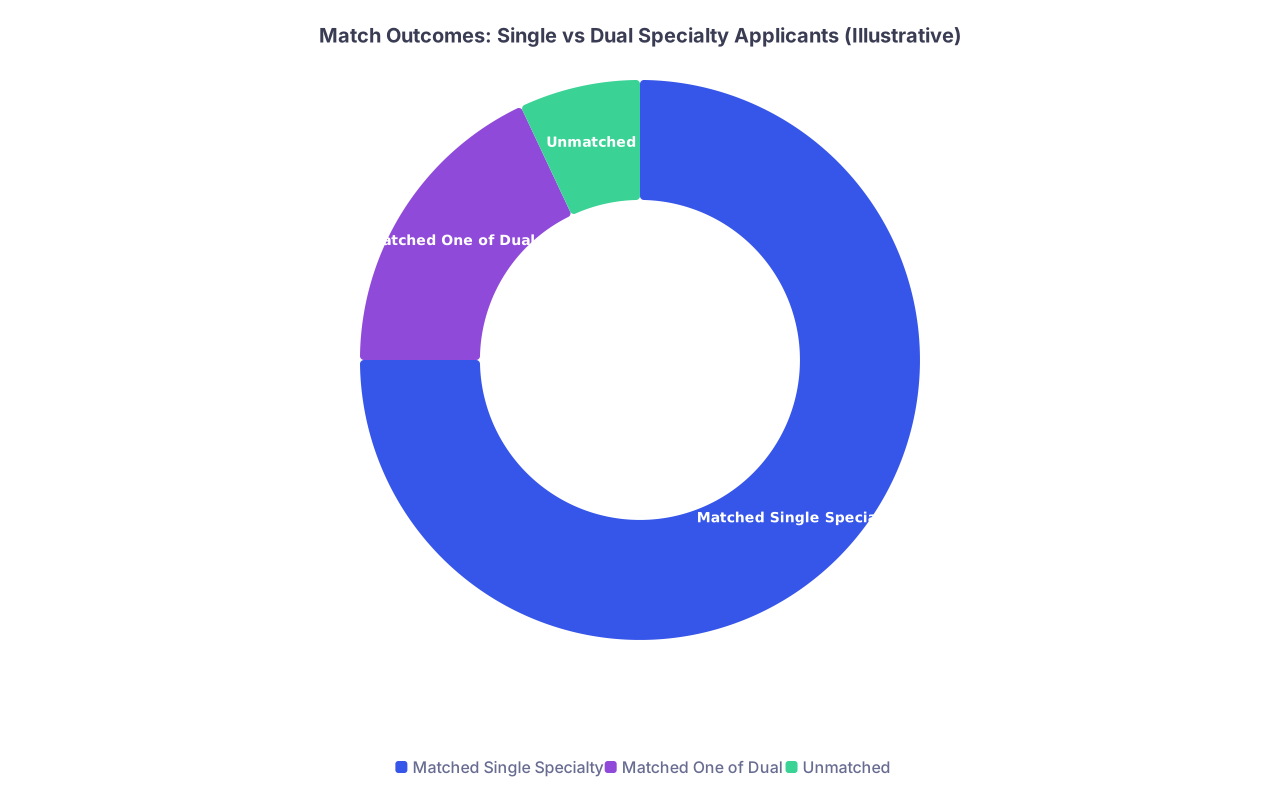
| Category | Value |
|---|---|
| Matched Single Specialty | 75 |
| Matched One of Dual | 18 |
| Unmatched | 7 |
Those proportions aren’t official NRMP numbers; they’re the pattern you see on the ground. Most single-specialty applicants in reasonable fields match. Dual-appliers are often in riskier categories and still end up matched more often than not. The 7% unmatched are routinely the ones who either refused backups or treated them as an afterthought.
How to Be Honest Without Shooting Yourself in the Foot
Since you’re probably still skeptical, here’s the distilled playbook.
First, do your own risk audit early: scores, class standing, research, school history in that specialty. Be brutally honest.
Second, loop in the right people with specific questions: primary advisor, potential backup advisor, and dean’s office. Tell them your numbers and your priorities. Ask for concrete data (“Where have people like me matched?” not “Do you believe in me?”).
Third, structure rotations and letters to give you at least one strong narrative in each field you might realistically match into. That means at least:
- One sub-I / audition in your primary.
- One meaningful rotation + letter in your backup.
- One or two general letters that work across fields.
Fourth, on interviews, focus on the specialty you’re in the room for. If backup questions come up, answer briefly and calmly. Don’t apologize for being rational.
Fifth, before rank list time, go back to your advisors with the actual interview tally in each field. Adjust strategy then, not 48 hours before rank submission in full panic mode.
None of that is rocket science. It’s just professionalism applied to your own career.
The Bottom Line
Three points and we’re done:
- Hiding your backup plan from everyone is not noble, it’s reckless. The people who can help you need the truth to do their jobs.
- You should be honest with advisors, letter writers, and your dean’s office—and selectively quiet on the interview trail and in gossip circles. That’s strategy, not deceit.
- A well-thought-out backup specialty is not a confession of weakness. It’s recognizing that the Match is probabilistic, not a morality test, and protecting your future accordingly.