What actually happens to the people who say, in October of fourth year, “Honestly at this point I’ll just do anything that will take me”?
You already know some of the stories. The intern on psych who clearly wanted ortho and hates every minute. The FM resident who spends three years talking about “maybe doing a pain fellowship” but never actually likes primary care. The prelim medicine intern who thought “I’ll figure it out later” and then doesn’t.
The myth is simple and dangerous:
When your dream specialty feels out of reach, your backup should be “whatever I can match into.”
That’s not a plan. That’s panic.
Let’s dismantle this properly.
The Match Is Not Russian Roulette (And You’re Not Powerless)
The “anything that will take me” mindset comes from fear, not strategy. It assumes the match is random chaos and your only job is “avoid going unmatched at all costs.”
But the data does not support the idea that you must torch your preferences just to match.
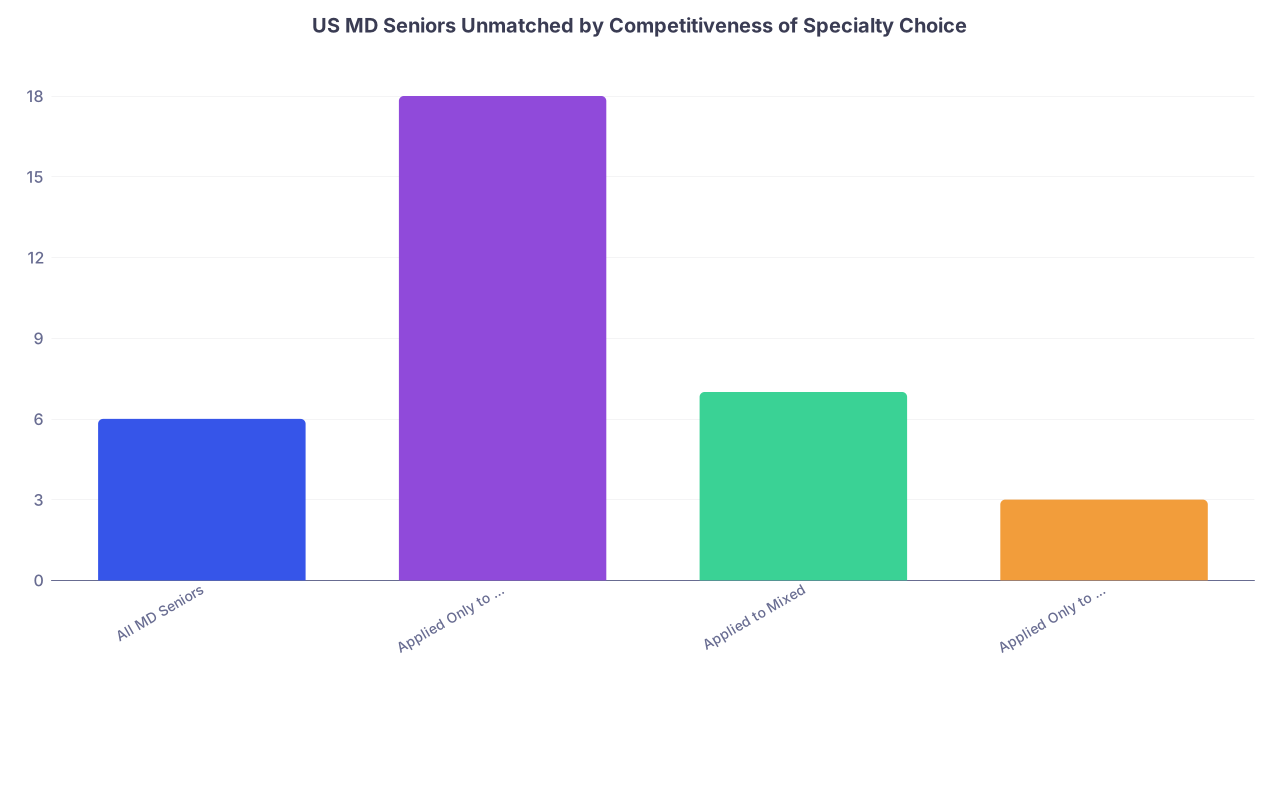
| Category | Value |
|---|---|
| All MD Seniors | 6 |
| Applied Only to Competitive | 18 |
| Applied to Mixed | 7 |
| Applied Only to Less Competitive | 3 |
What this (approximate) pattern shows from NRMP reports:
- Overall US MD senior unmatched rate is usually around 5–7%.
- Those who apply only to highly competitive specialties (derm, plastics, ortho, ENT, etc.) have much higher unmatched rates if they do not add a sane backup.
- Those who mix competitive and less competitive programs or add a realistic backup have much better odds.
But notice something:
“Backup” in the successful group is not “I clicked every box in ERAS.” It’s targeted. Rational. Chosen.
The people who do worst are usually in one of two camps:
- Only apply to ultra-competitive with no backup. Magical thinking.
- Spray “backup” applications without any real engagement with the specialty. Programs can smell that.
The match isn’t perfect. But it is pattern-driven. Backups work when they’re real options you’d actually show up for, not a desperate afterthought on your rank list.
The Hidden Cost of “I’ll Do Anything”
Saying “I’ll do whatever takes me” feels safe in the moment. It isn’t.
There are three major ways this backfires.
1. You underestimate how permanent specialty choice actually is
Can you switch specialties after starting? Yes. People do. But not as many as you think, and it is usually painful.
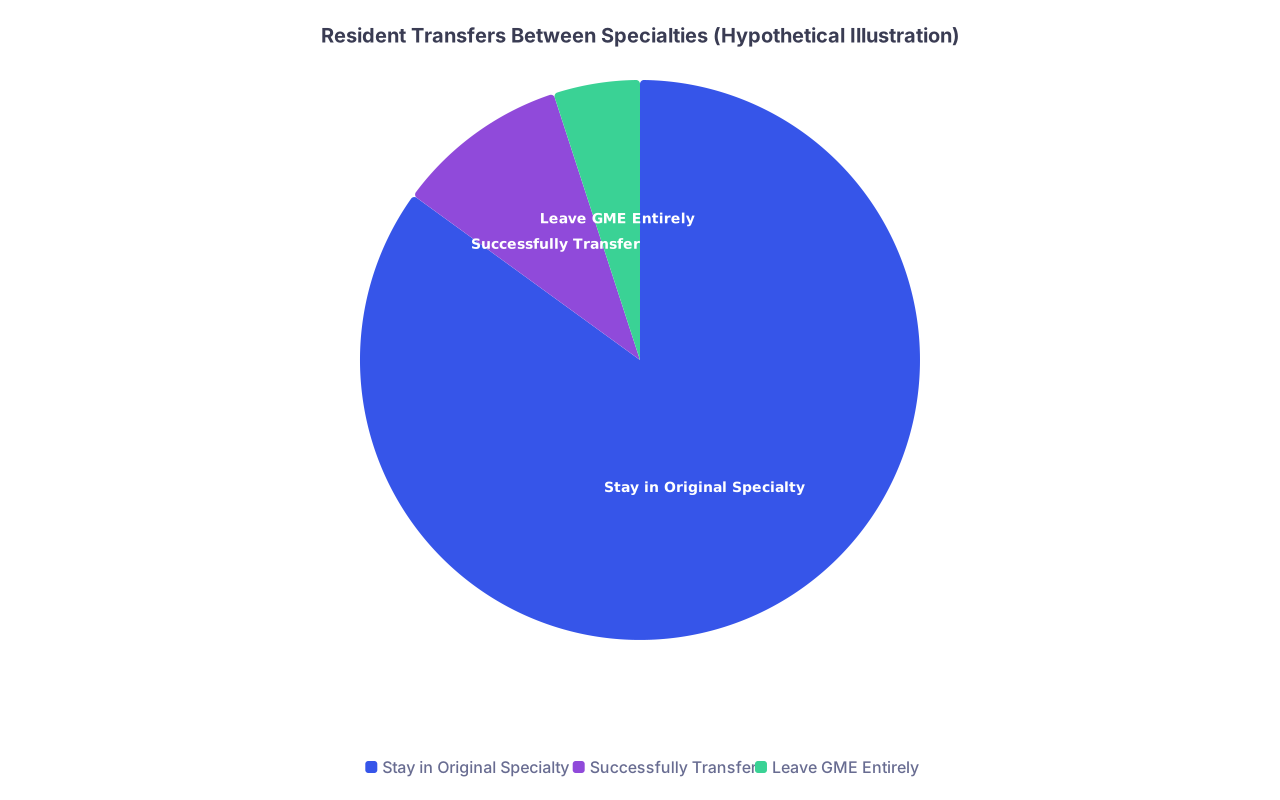
| Category | Value |
|---|---|
| Stay in Original Specialty | 85 |
| Successfully Transfer | 10 |
| Leave GME Entirely | 5 |
Most residents stay where they start. A small fraction successfully move. That “I’ll just switch later” plan relies on:
- An open spot in the specialty you want.
- Timing that matches your PGY level.
- Program directors willing to take a “redo.”
- You having the emotional energy to re-apply while working 70–80 hours/week.
I’ve seen people pull it off. But I’ve seen far more get stuck in specialties they never actually liked, telling themselves “I’ll stick it out, it’s only three more years,” while quietly burning out.
2. Burnout risk is not equal across specialties
If you go into a specialty you actively dislike, you are not just “slightly less happy.” You are at substantially higher risk of depression, burnout, and leaving medicine entirely.
There are huge surveys (Mayo, Medscape, etc.) showing burnout is common across the board. But one thing is consistent: mismatch between personal values and daily work is gasoline on the fire.
A rough comparison helps:
| Situation | Burnout Risk | Comments |
|---|---|---|
| High interest, intense workload | Medium–High | You suffer, but it feels meaningful |
| Low interest, moderate workload | High | Grind with no intrinsic reward |
| Strong mismatch with personality style | Very High | Constant friction, identity conflict |
So no, “I’ll just tolerate it” is not a neutral position. You are trading a short-term reduction in match anxiety for a very real increase in long-term emotional risk.
3. Programs can tell when they’re your dumpster-fire backup
You think you’re subtle. You’re not.
I’ve sat with faculty going through rank lists saying things like:
- “This one clearly doesn’t want family med; everything is surgery-focused.”
- “Their personal statement basically says ‘I didn’t get derm, so here I am.’ Hard pass.”
- “Half of their letters are from anesthesiology and they barely talk about us in the interview.”
Programs don’t want to be your consolation prize. They want residents who are at least plausibly interested in the work. When your entire application screams “I don’t actually care about this, I just need a job,” you’re not safer. You’re less likely to match there.
“Anything that will take me” often leads to a worse backup outcome than a narrower, honest, well-built secondary choice.
Step One: Accept That You Must Actually Choose
Your backup should not be “anything.” It should be one of three:
- A slightly less competitive version of your primary (e.g., academic vs community, big-name vs mid-tier).
- A related specialty with overlapping strengths.
- A genuinely different but still acceptable field that matches at least some of your preferences.
What it should not be:
“Whatever ERAS lets me click.”
So how do you pick something real instead of panicking?
You start from reality, not fantasy.
Look at your actual risk profile
Forget what you “deserve.” Look at the data.
| Factor | Safer Zone | Riskier Zone |
|---|---|---|
| Step/COMLEX scores | At or above recent matched median | Below median or multiple fails |
| Class rank | Top half | Bottom quartile |
| Research for elite fields | Several projects, maybe first-author | Little to no research |
| School type | US MD (typical), strong home program | No home program in your dream field |
If you’re aiming for derm with a 225 Step 2, no research, and no home program, your “backup” cannot just be “more derm programs.” That’s just delusion in bulk.
On the other hand, if you’re a solid internal medicine candidate shooting for cards/onc eventually, maybe your “backup” is just a broader range of IM programs and geographies, not another specialty entirely.
How to Build a Real Backup Strategy (Not a Surrender)
You want something practical. Here it is.
1. Decide if you need a different specialty at all
Some people do not need a “backup specialty.” They need a “backup program tier or region.”
Red flags that you do need a different specialty option:
- Your primary is one of the ultra-competitive “lottery” specialties (derm, plastics, neurosurgery, ENT, ortho, rad onc) and your application is clearly below average for that field.
- Your advisor keeps saying “You really need a backup” and can show you recent match data from your school.
- Past students with your stats applying to your dream specialty often went unmatched.
If you’re aiming for internal medicine with decent scores and decent letters, your backup is more like “widen the net,” not “panic-apply to prelim surgery and psych.”
2. Choose backups that actually share something with your primary
People do this backwards. They sort specialties by “match rate” and pick from the top.
Wrong move.
Start from: what do you actually like about your dream specialty?
- Is it procedures?
- Long-term relationships?
- Acute, high-stakes situations?
- ICU-level physiology?
- Surgery but less intense lifestyle?
- Lots of clinic vs lots of OR vs lots of reading images?
Then find backups that share core features, not just “better odds.”
Some very common pairings that can make sense when done intelligently:
| Primary Goal | Potential Backup(s) |
|---|---|
| Ortho | PM&R, Anesthesia (pain/focused), Radiology (MSK) |
| ENT | General Surgery, Plastics (if realistic), Anesthesia |
| Derm | Pathology (dermpath), IM → rheum, FM with strong derm focus |
| Neurosurgery | Neurology, Radiology (neuro), Anesthesia (neuroanesthesia) |
| EM | IM (critical care aim), FM (rural EM focus) |
No, these are not perfect substitutes. But they at least rhyme with your interests.
Compare that to “I wanted orthopedic surgery, so my backup is psychiatry because someone told me it’s less competitive.” That’s not strategy. That’s flailing.
The Mechanics: How to Actually Apply With a Backup
Here’s where people blow it. They think, “I’ll just throw in a few extra applications.” Programs then see right through the split identity.
You have to commit. Not to giving up your top choice. But to treating the backup like a real, dignified option.
1. You need coherent application narratives for both
If you’re applying to two different specialties, you cannot recycle the same personal statement and experiences section and hope no one notices.
You need:
- A personal statement for specialty A.
- A separate personal statement for specialty B that does not read like “I failed at A.”
When people mess this up, their backup PS reads like:
“I have always been passionate about dermatology… unfortunately I realized late that it is very competitive, and after not receiving an audition rotation I decided to consider family medicine because I value work–life balance.”
This is the kiss of death. FM reads that and sees: “I don’t care about FM. I’m here because I couldn’t get into the club I actually wanted.”
Instead, build a clean, positive frame:
- For the backup, focus on what you like about that specialty.
- Do not talk about how you “ended up” there.
- Do not mention your failure to secure your primary specialty.
Yes, you’re being selective with the truth. That’s called professionalism, not lying.
2. Letters that make sense
If all 4 of your letters are from ortho and you apply to PM&R as a backup, that can work if:
- At least one letter explicitly talks about your suitability for rehab / functional medicine / longitudinal care.
- Your experiences section includes rehab-relevant activities or patients.
If you apply to psych with all letters from CT surgery and vascular? Programs will wonder if you lost a bet.
You don’t need four letters per specialty, but you need enough that a backup PD can plausibly say, “Okay, I see why they might like us.”
3. How to send signals without torching bridges
You’re terrified that if anesthesia knows you also applied to PM&R, they’ll blacklist you. Or that if derm knows you have a path backup, they’ll assume you’ve given up.
Reality: programs all know this game exists.
- Ultra-competitive specialties expect some applicants to have backups.
- Less competitive specialties prefer applicants who see them as a genuine option, not a last-resort dumping ground.
You don’t have to volunteer your entire strategy, but if asked, be honest without self-sabotage:
- “I did apply more broadly, including X, because I’d be very happy in either, and I see them as overlapping in [insert actual common ground].”
- Not: “I’m only here because derm is impossible now.”
When “Backup” Should Be a Different Geography, Not a Different Field
Another myth: if you’re worried about not matching, you must have a backup specialty.
Sometimes, the more rational move is keeping your specialty but loosening constraints you’ve arbitrarily imposed:
- You “must” be in one city.
- You “must” be at a big-name academic center.
- You “must” avoid community programs.
If you’re a perfectly viable internal medicine candidate but you only rank 8 coastal academic programs and go unmatched, that’s not a specialty problem. That’s you confusing “backup” with “ego.”
Your backup might be:
- Community-based IM programs in the Midwest.
- State programs that are less shiny but very match-friendly.
- Military or service-obligation programs if that fits your life.
This path is vastly underused because students quietly equate “good doctor” with “prestige name.” The data on fellowship placement from many “no-name” programs says otherwise.
The Harsh Question You Actually Need to Answer
Ask yourself, without flinching:
“If I matched into this backup, could I realistically see myself doing that work for 20–30 years without resenting my own past self?”
If the answer is “absolutely not,” that specialty is not a backup. It’s self-harm.
Backups are not things you hate less than unemployment. They’re careers you’d be okay waking up for daily, even if they’re not your first love.
This is the grown-up reality of the match:
You cannot guarantee your dream. You can control whether your Plan B is livable or miserable.
Quick Recap: What the Data and Experience Actually Say
- “Anything that will take me” is not safer. It leads to incoherent applications, lower match odds, and higher risk of long-term burnout.
- Backups work when they’re targeted, believable options that share some core features with your actual interests, or when they expand geography/tier instead of blowing up your specialty altogether.
- Programs can tell when they’re your trash-bin backup. You need real narratives, appropriate letters, and at least a minimally honest interest in the work to make a backup specialty viable.
Pick a backup like someone who has to live with the consequences. Because you do.