
The idea that your backup specialty must be totally different from your primary choice is wrong. And believing it has quietly sabotaged a lot of otherwise decent applications.
You’ve probably heard some version of this: “If you’re applying to something competitive, pick a totally different, safer specialty as your backup. That way you don’t confuse programs.” Sounds tidy. Also not how the system—or the data—actually works.
Let’s pull this apart.
How the “Totally Different Backup” Myth Got Started
The myth did not appear out of nowhere. It’s a mashup of three half-truths that get repeated until they harden into dogma.
First: “Programs want to see commitment.” True. They do not want tourists. A PD in ortho, derm, plastics, whatever, wants to know you are not just carpet-bombing ERAS.
Second: “You can’t convince two different specialties that they’re both your #1.” Also true if you write the same bland personal statement twice and hope nobody compares notes.
Third: “If you show interest in another field, the competitive specialty will dump you.” This is where things slide into fiction. There’s almost no evidence for that in aggregate data, and a lot of evidence that it’s more complicated.
Here’s what actually happened: a few people over the years got clumsy advice, wrote disastrous personal statements (“I love radiology, but I’ll settle for family medicine”), programs got annoyed, and the story mutated into “never apply to overlapping fields” or “backup must be totally different so it doesn’t look conflicted.”
That’s lazy thinking. The real issue isn’t “similar vs different.” It’s coherence.
What the Match Data Actually Shows
Let’s get concrete. NRMP data and program surveys tell a more nuanced story than hallway gossip.
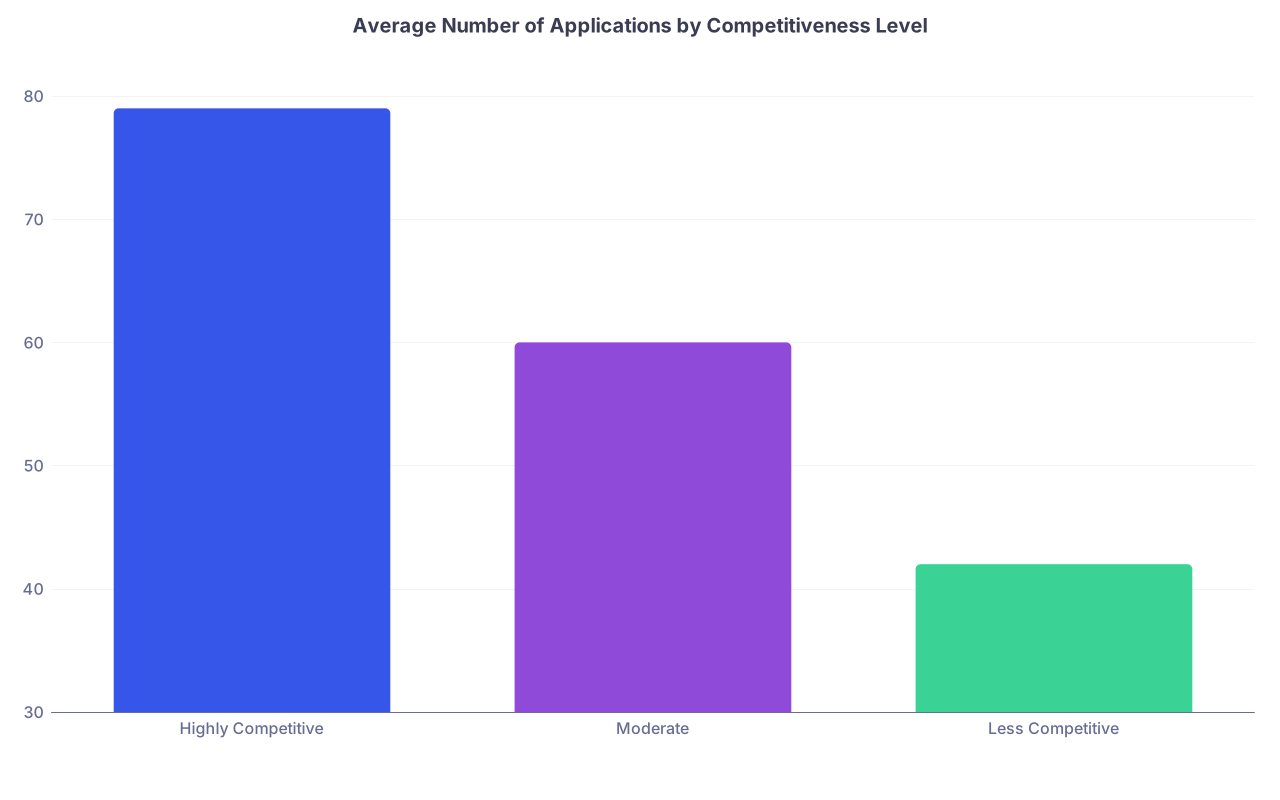
| Category | Value |
|---|---|
| Highly Competitive | 79 |
| Moderate | 60 |
| Less Competitive | 42 |
Applicants chasing competitive specialties already apply broadly and use backups all the time. The question isn’t “backup vs no backup.” It’s how you structure it.
Look at common dual-application patterns people actually use:
| Primary Specialty | Backup Specialty | Overlap Level |
|---|---|---|
| Orthopedic Surgery | General Surgery | High |
| Dermatology | Internal Medicine | Medium |
| Radiology | Internal Medicine | Medium |
| Neurosurgery | General Surgery | High |
| Emergency Med | Family Medicine | Medium |
These pairs are not “totally different fields.” They share organ systems, procedures, patient populations, or work settings.
NRMP Program Director Surveys consistently show things like:
- PDs absolutely care about specialty-specific signals (letters, rotations, PS).
- PDs know applicants sometimes apply to more than one field.
- PDs care far more about whether your application looks intentional than whether you have a “pure” monogamous relationship with their specialty.
You know what the data does not show? A blanket penalty for reasonable, well-executed overlapping choices.
What tanks people is incoherence: generic letters, mismatched experiences, personal statements that read like they were written by a hostage.
The Real Question: Coherence, Not Distance
The core misconception: “To prove I’m serious, my backup must be far away from my main specialty.”
Reality: Programs are looking for:
- A believable story of how you got here.
- Evidence that you understand the day-to-day reality of this field.
- Skills and experiences that actually translate.
None of that requires your backup to be totally different. In fact, being too different can make your application weaker across the board.
Let me make that concrete.
Example 1: Ortho → Gen Surg vs Ortho → Psych
You’re an MS4 aiming for Ortho. Competitive but not a slam dunk: Step 2 in the mid‑240s, 1 home ortho rotation, 2 away rotations, some sports medicine research.
Option A: Backup with General Surgery. Option B: Backup with Psychiatry.
With Gen Surg:
- Your surgical rotations, letters from surgeons, and operative evaluations all transfer.
- Your story—“I know I want to operate; I like acute care and team-based OR work”—is coherent across both fields.
- If a PD peeks at your CV, your trajectory makes sense.
With Psychiatry:
- Your entire application screams “surgery,” but now your backup PS says you discovered an enduring passion for psychotherapy… last month.
- Your letters from surgeons are less relevant.
- It looks less like flexibility and more like desperation unless you have real psych depth.
Yet I have literally heard advisors tell students, “Don’t pick general surgery. It’s too close. They’ll think you’re not serious about ortho.” That’s backwards. The overlap is the asset. It’s what lets you build a believable, skill-focused narrative that works in both places.
Example 2: Derm → IM vs Derm → Pediatrics vs Derm → Path
Derm applicant with strong research, but average Step and limited away rotations.
Derm + Internal Medicine:
- Strong overlap in chronic disease management, immunology, rheum-adjacent things.
- Your derm research in psoriasis, biologics, lupus? IM PDs can actually use that.
- You can honestly say: “I like complex medical problem solving; in derm I focus on skin, in IM I widen the lens.”
Derm + Pediatrics:
- Also defensible if you did a lot of peds derm or pedi rotations. Cohesive if you frame it around longitudinal care and families.
Derm + Pathology:
- Great if you have serious pathology experience, dermatopath exposure, or lab work.
- Horrible if you just heard “path is less competitive” and slapped it on with no prep.
The point: “Similarity” isn’t the enemy. Randomness is.
What Actually Hurts You (And It’s Not What You Think)
Programs don’t reject you just because you applied to two related specialties. They reject you because your application screams “I copied this 14 times at 2am.”
Here are the real red flags I’ve seen PDs and faculty complain about in meetings:
Contradictory personal statements.
For radiology: “I prefer working behind the scenes rather than on the front lines.”
For EM: “I thrive being on the front lines of acute care.”
A human being reading both would roll their eyes. And yes, sometimes PDs talk.Letters that say the quiet part out loud.
The attending who writes, “She is applying to dermatology but would be an excellent internist if that does not work out.” That letter is a problem—not the fact you applied to both.No clear anchor.
You did two rotations in your primary specialty, one elective in your backup, and zero meaningful signals to either field beyond that. Your “backup” then looks like an afterthought and your primary looks under-committed.Sloppy ERAS tailoring.
Same personal statement uploaded for both fields, no filtering or reordering of experiences, CV that still lists “Plastics Interest Group President” as your top item for a Family Medicine app. Lazy hurts. Not overlap.
Programs see conflicting nonsense like this and simply conclude: poor judgment, poor mentorship, or both.
When Overlapping Backups Actually Work Well
Let’s stop hand-waving and talk concrete strategy. There are circumstances where overlapping or closely related fields are not just acceptable, they’re objectively the smarter play.
Scenario: You are “borderline” for a competitive specialty
Think: EM, Anesthesia, Radiology, Gen Surg in a mid-competitive tier. You’re not a washout; you’re just not sure you’ll land enough interviews.
In that case, picking a backup that shares clinical skills and patient types is rational. You already did the work. Your letters align. Your experiences make sense in both ecosystems.
Applications that work well here:
- EM + FM, framed around acute care vs continuity.
- Radiology + IM, framed around diagnostic reasoning.
- Anesthesia + IM, framed around physiology and perioperative medicine.
- Gen Surg + Ortho or another surgical subspecialty, framed around love of the OR and procedural work.
The key is you don’t pretend they’re the same. You explain why each legitimately fits you, drawing from the same underlying strengths.
Scenario: You had an authentic late pivot
You did half of med school convinced you were going into OB/Gyn, then had a revelatory IM sub-I that fit like a glove.
If you have real OB depth—research, leadership, strong letters—it’s not insane to apply OB and IM in the same cycle with a clear story:
- OB statement: focus on surgical aspects, women’s health, operative L&D.
- IM statement: focus on cognitive medicine, complex chronic disease, maybe a women’s health or high-risk OB-med interface.
You do not need to pretend your OB experience disappears. You reposition it as proof you understand interprofessional care, acute situations, and longitudinal follow-up.
When a Totally Different Backup Might Make Sense
There are times when a “far away” backup actually is the smarter move. They’re just narrower than people think.
Your primary specialty experience is weak and lopsided.
If you spent all of medical school doing basic science neurosurg research with almost no bedside experience and suddenly realize clinical surgery is not for you, then yes, your neurosurg-heavy CV may not translate well to something like EM. You might be better off aiming for something where your personality and emerging clinical strengths fit better, even if it looks like a sharp turn.You meaningfully changed as a person.
Not the “I liked my last rotation best” nonsense. I mean major life events, family issues, disability, something that changed what kind of lifestyle, call structure, or physical demands you can handle. Then a far distance between fields can actually match your new reality.Your original story is radioactive.
If your primary specialty includes some very public professionalism issues in that department, or a failed away rotation, trying to leverage that field’s experiences as a foundation may actually hurt you. In that rare case, a cleaner pivot to a different domain can sometimes be safer.
But those are edge cases. They’re not the rule.
How to Build a Smart Backup Strategy (Without Lying)
Let’s talk practical moves that align with what programs actually reward.
First: map your skills, not your fantasies. What do your evals consistently say? “Excellent with procedures”? “Great at longitudinal relationships”? “Strong at complex, multi-problem visits”? That’s your anchor.
Second: pick specialties—primary and backup—that both make sense for that anchor.
Third: tailor ruthlessly. The lazy approach is “change the name of the specialty in my personal statement and call it a day.” The serious approach:
- Two distinct personal statements that share the same core strengths but apply them to different workflows.
- Experiences filtered so the most relevant to each field are at the top.
- Letters chosen deliberately: you do not need all letters to be from the same specialty, but you do need at least a couple that speak credibly to each field.

| Step | Description |
|---|---|
| Step 1 | Choose Primary Specialty |
| Step 2 | Assess Competitiveness |
| Step 3 | Consider Single Specialty |
| Step 4 | Identify Core Strengths |
| Step 5 | Select Overlapping Backups |
| Step 6 | Get Field Specific Letters |
| Step 7 | Tailor PS and Experiences |
| Step 8 | Likely to Match? |
Fourth: sanity-check your narrative. If someone read both applications side by side, would it sound like two reasonable paths for the same human being, or like two different actors sharing a login?
And if your advisor insists “backup must be totally different,” ask them a simple question: “Show me where in the NRMP data or PD survey that’s actually supported.” They won’t be able to.
A Quick Reality Check on PD Paranoia
I’ve been in rooms where PDs compare notes. Here’s what they actually complain about:
- People who clearly didn’t care enough to understand the specialty.
- People who obviously lied (“I have always wanted to be a radiologist since childhood” with zero imaging exposure).
- People whose letters are lukewarm or vaguely apologetic.
You know what they do not obsess over? The theoretical possibility that the same student might also be a good fit for a neighboring field. Medicine is full of people who could have been happy in three or four different specialties. PDs know that. Many of them were those people.
What they care about is this: if we offer this person a spot, are they going to show up, do the work, fit the culture, and not quit?
A coherent, overlapping backup strategy threatens none of that.
The Bottom Line
Two things to remember:
- Your backup specialty does not have to be totally different; it has to be logically connected to who you are and what you’ve actually done. Overlap is not the enemy—sloppiness and incoherence are.
- Programs judge you on authenticity, signal, and fit, not on some imaginary requirement that you swear lifelong monogamy to a single specialty. Build a believable story that works for more than one reasonable field, and you’re playing the real game—not the mythical one people gossip about in the hallway.