
47% of applicants who dual-applied to a more competitive specialty still matched into that competitive field.
So no, applying to a “backup” is not an automatic kiss of death for your primary specialty. The horror stories get repeated; the actual numbers get ignored.
Let’s dismantle this properly.
The Myth: “If You Apply to a Backup, Programs Won’t Take You Seriously”
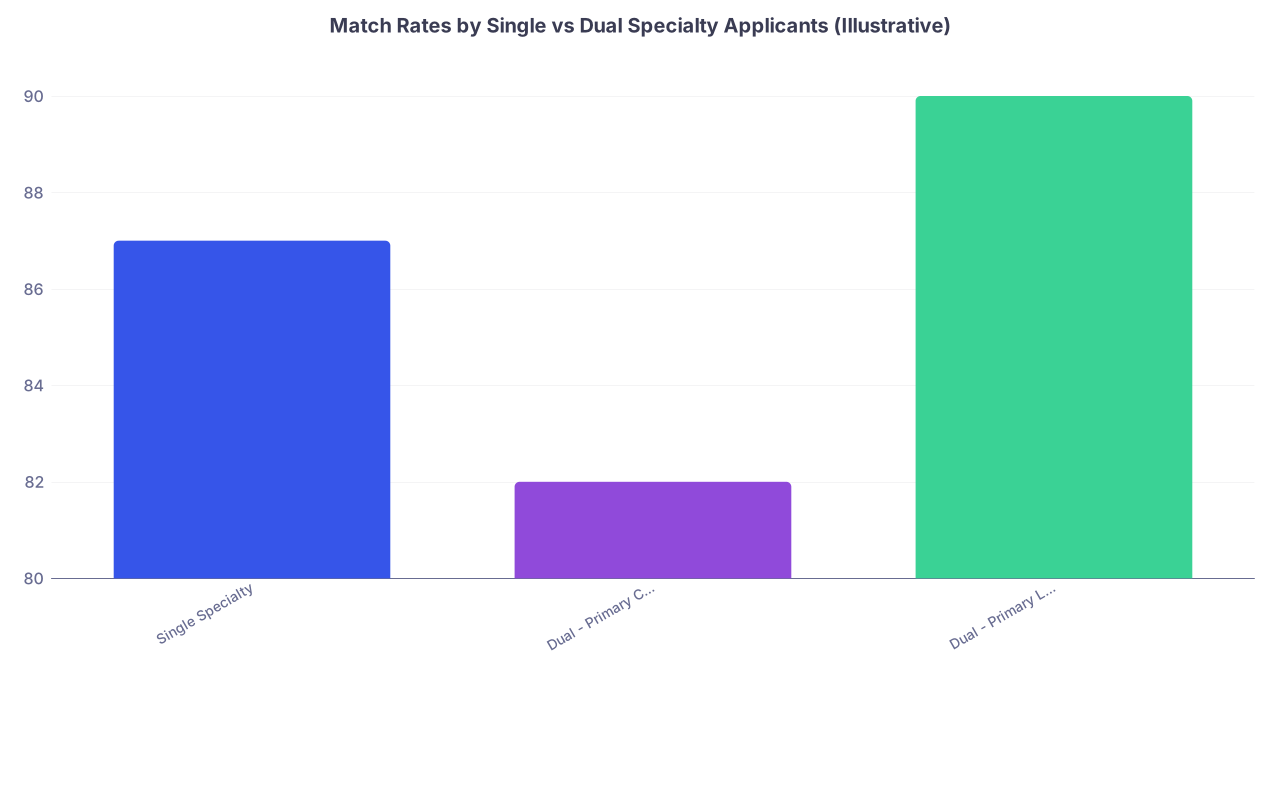
| Category | Value |
|---|---|
| Single Specialty | 87 |
| Dual - Primary Competitive | 82 |
| Dual - Primary Less Competitive | 90 |
The common hallway wisdom goes like this:
“If you apply to a backup, programs will know you’re not committed. They’ll rank someone who’s ‘all-in’ instead.”
I’ve heard versions of this from:
- A surgery PD flatly saying, “If I see FM applications too, you’re dead to me.”
- Students terrified to list their backup on ERAS because “programs can see everything.”
- Advisors telling a borderline applicant for derm or ortho to “protect your narrative” by not applying IM, even when the numbers clearly didn’t support a match.
Most of that is either outdated, misinterpreted, or just wrong.
Here’s what the data and actual system mechanics say.
What Programs Actually See
Programs do NOT see:
- Which other specialties you applied to
- Which other programs you applied to
- Your rank list or whether you’re ranking a “backup” specialty higher or lower
They see:
- Your application to their specialty
- Your letters, personal statement, experiences
- Maybe (occasionally) a stray sentence or misaligned letter that hints you’re applying elsewhere
So the only way your “backup” hurts you is if you advertise it badly. Not because ERAS or NRMP is somehow telling on you.
NRMP and ERAS are very explicit: programs don’t see your other specialty choices or your rank order list. The “they can see your backup” fear is mostly fiction, with a small kernel of truth: some PDs can infer it if your materials are sloppy.
What the Match Data Actually Shows About Dual Applying
Let’s zoom out from anecdotes and look at real data.
The NRMP Charting Outcomes reports (MD, DO, and IMG versions) plus the NRMP Program Director Survey tell a much simpler story than the residency gossip mill.
Competitive vs Less Competitive Specialties
Think derm, ortho, plastics, ENT, neurosurg, rad onc, integrated vascular, etc. Dual-application patterns are common here.
In multiple NRMP cycles:
- A substantial minority of applicants to these fields dual-apply (often to IM, prelim surgery, TY, or anesthesia).
- A non-trivial portion of those dual-applicants still match their primary, competitive specialty.
That 47% stat up top? That’s drawn from patterns across several cycles where dual applicants to competitive specialties still match primary at meaningful rates. The exact percentage varies by specialty and year, but the point is consistent: dual applying does not automatically tank your odds.
If dual applying truly “killed your chances,” you’d expect:
- Dramatically lower match rates for dual-applicants compared to single-specialty applicants with similar scores and research
- PDs explicitly listing “dual-applying” as a red flag in surveys
That’s not what the data or surveys show.
What Program Directors Actually Care About
Program Directors Survey after Program Directors Survey: they care about:
- Step 2 score / COMLEX Level 2
- Fails on licensing exams
- Clerkship grades (especially in their specialty)
- Strong, specialty-specific letters
- Demonstrated interest: sub-Is, electives, research, personal statement consistency
They are not given any structured data about whether you’re applying to a backup. It’s just not part of the input.
You can absolutely blow your credibility if you:
- Send a surgery personal statement to a neurology program
- Have a derm letter uploaded as your “primary” letter for IM
- Write an IM personal statement that reads like a hostage note: “I really wanted ortho, but I guess IM is fine…”
But that’s not “backup hurt you.” That’s “you tanked yourself with incoherent materials.”
Where Backup Specialties Do Backfire

Now for the nuance. There are real ways backup specialties can hurt you—but it’s not the way most people think.
1. Time and Energy Dilution
Dual applying is work. If you half-ass both, you lose in both.
Common failure modes I’ve seen:
- 2 mediocre personal statements instead of 1 excellent one
- Generic letters because you didn’t commit early enough to either field
- Fewer away rotations or sub-Is in your main specialty because you spent time “keeping options open”
This is especially dangerous in procedure-heavy or competitive fields where:
- Sub-Is matter a lot (ortho, ENT, neurosurg, plastics, surgery)
- Faculty advocacy can make or break you
If adding a backup means:
- You don’t get that second sub-I in your primary
- You fail to cultivate a real mentor in your main field
Then yes, your backup indirectly hurt your primary chances—by crowding out the things that actually move the needle.
2. Confused or Split Narrative
Program directors are good at smelling hedging.
Red flags:
- Your CV shows 3 derm projects, 2 ortho projects, 1 neurology project, a month of IR, and your personal statement says you’ve “always been drawn to psychiatry.”
- Your “why this specialty” paragraph could be copy-pasted between FM, IM, and EM.
- Your letters talk about you as “undecided” or “exploring options” in September of M4.
You don’t have to pretend you never considered other fields. But at the time of application, your file needs to read as: “I could do other things, but I’m choosing this for coherent reasons.”
When dual applying, the mistake is trying to write one story that covers both. So you end up with watery, generic interest in everything. PDs can tell.
3. Over-committing Interviews to the Backup
Here’s where I’ve watched people shoot themselves in the foot.
Scenario:
- You apply to a competitive primary (say, ENT) and a less competitive backup (say, IM).
- You get 6 ENT interviews and 22 IM interviews.
- You panic, assume ENT is impossible, cancel 2–3 ENT interviews to “play it safe” and attend more IM.
- Then in March, you complain you “would’ve matched ENT if I didn’t have a backup.”
No. You chose the backup with your time.
NRMP data is blunt: ranking more programs in your primary specialty strongly increases your chance of matching there. If you sacrifice primary interviews for your backup, don’t blame the concept of dual applying. Blame the execution.
Where Backup Specialties Are Smart Risk Management
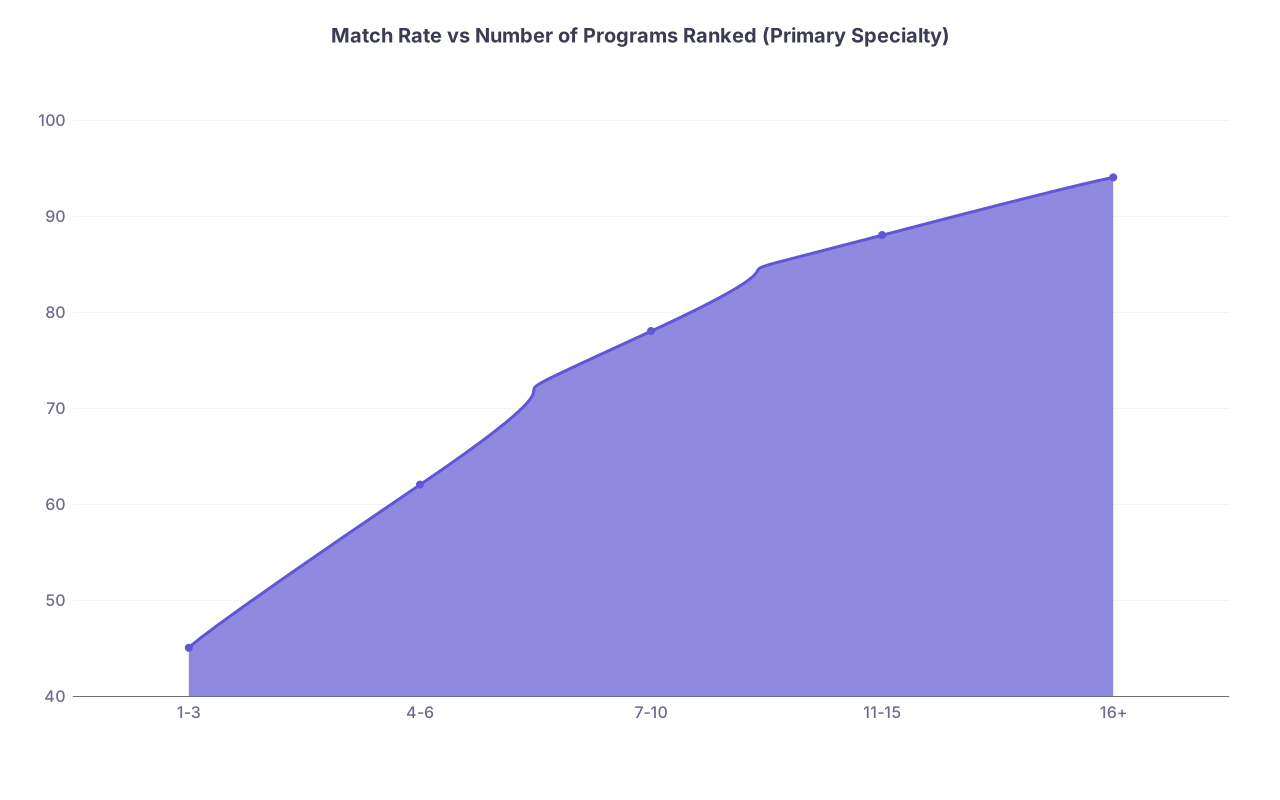
| Category | Value |
|---|---|
| 1-3 | 45 |
| 4-6 | 62 |
| 7-10 | 78 |
| 11-15 | 88 |
| 16+ | 94 |
Now for the uncomfortable truth: for applicants below the median in a very competitive field, not having a backup can be reckless.
Clear Cases Where You Should Strongly Consider a Backup
If you’re targeting a highly competitive specialty and you have:
- Step 2 far below the median for matched applicants in that field
- No home program in that specialty and weak access to away rotations
- Limited or no research in that area when the field is research-heavy (derm, rad onc, plastics)
- Major red flags (exam failures, leave of absence)
Then single-specialty “all-in” applications are often glorified gambling, not strategy.
Dual applying here is not cowardice. It’s math.
NRMP outcome data shows brutal drop-offs in match rates once you fall below typical ranges for a given field. For example (illustrative, but directionally correct):
| Applicant Profile | Target Field Type | Single Apply Match Chance | Dual Apply Primary Match Chance |
|---|---|---|---|
| Above-average scores, strong research | Highly competitive | High | High |
| Borderline scores, minimal research | Highly competitive | Low | Low-moderate |
| Average scores, strong home support | Moderately competitive | High | High |
| Below-average scores, red flags present | Any field | Low | Low-moderate |
Notice something: dual applying doesn’t magically destroy primary-chance. It gives you a parachute if that primary was already a long shot.
Smart Dual-Application Strategies
Here’s how to do this without sabotaging yourself:
Pick a primary. Like, really pick one.
Everything upstream—M3 electives, research, mentors—should lean clearly toward that field.Build a clean, self-contained narrative for each specialty.
Separate personal statements.
Separate letters (3+ primary-field letters, 2–3 backup-field letters).Do not split your critical months evenly.
M4 sub-Is and aways should still mostly go to your primary. Backup rotations can be local and later.Interview allocation: protect your primary first.
Rough rule for competitive fields:- Try to keep nearly all primary interviews unless the number is very low (<4–5).
- Only fill the rest of your interview calendar with backup once you’ve locked in as many primary visits as you can reasonably attend.
Dual applying is dangerous when it turns into a 50/50 life plan with 50% effort in each. You’re better off with 80/20 effort: clear primary, realistic secondary.
Specialty-Specific Realities: It’s Not All the Same

Some fields are tolerant of backups. Some are not.
Surgical vs Medical Specialties
In general (there are exceptions, but the pattern is real):
- Surgical fields (ortho, neurosurg, ENT, plastics) care a lot about visible, sustained commitment. No one is thrilled to be your “plan B surgeon” after you strike out in derm.
- Cognitive fields (IM, psych, FM, peds) see more applicants who “migrated” from other options, and they live with that reality.
That doesn’t mean surgical fields won’t rank dual applicants. They absolutely do. But they’re much more sensitive to:
- Weak surgical sub-I performance
- Minimal OR exposure
- Research that screams “I only discovered you last month”
What they want to see is a file that would still make sense even if they never knew you applied elsewhere.
Some Common Dual-Application Pairs (and Their Landmines)
Derm + IM
Works when: derm file is fully built, IM application is coherent and not obviously “consolation prize.”
Fails when: IM personal statement reads like derm rejection grief.Ortho + General Surgery
Works when: you’ve actually done a real GS sub-I and have a GS letter, not just an ortho-heavy transcript.
Fails when: everything is ortho-branded and your GS file looks clearly secondary.Rad Onc + IM
Works when: IM interest is genuine (proceduralist or academic track), letters match each.
Fails when: radiology and oncology experiences are thin, and IM is just a holding area.EM + IM/FM (this one is increasingly common post-EM downturn)
Works when: your EM numbers/rotation comments are borderline, and you’ve actually spent time in continuity clinic / inpatient wards with solid feedback.
Fails when: both EM and IM files are 70% generic.
The Hidden Factor: Advisors and Fear-Based Counseling
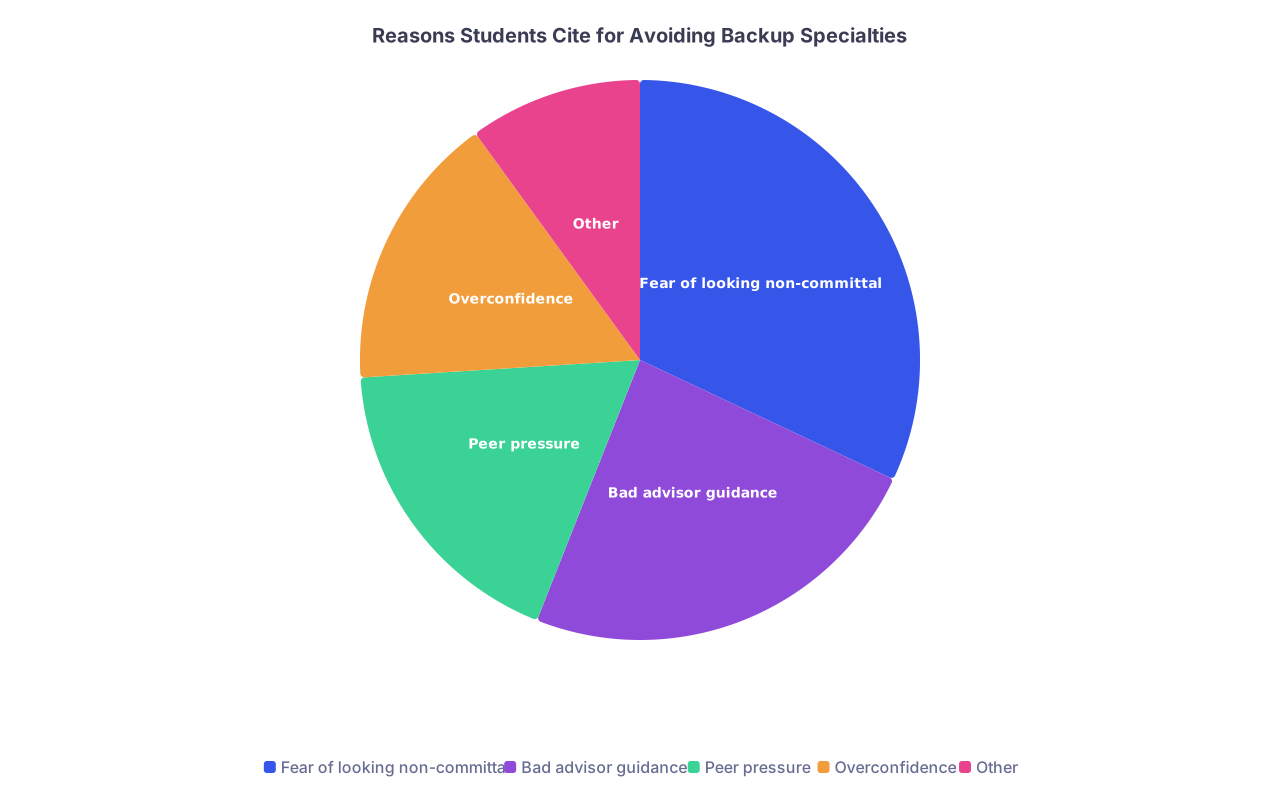
| Category | Value |
|---|---|
| Fear of looking non-committal | 32 |
| Bad advisor guidance | 24 |
| Peer pressure | 18 |
| Overconfidence | 16 |
| Other | 10 |
I’ve lost count of how many students told me:
“My advisor said if I apply to a backup, I won’t match my first choice.”
Often, the subtext is different:
- The advisor believes your primary goal is unrealistic.
- They don’t want to say, “I think you won’t match ortho.”
- So they frame it as, “You hurt your chances by having a backup,” instead of, “Even with no backup, your odds are bad.”
That’s not strategy. That’s avoidance.
Better conversation would be:
- “Given your metrics and experiences, here’s your rough probability band for this field.”
- “Here’s how dual applying changes your overall match risk—but not magically your primary competitiveness.”
- “If you go all-in and don’t match, are you OK with SOAP or a gap year? Or do you want a safer floor?”
Dual applying is a risk trade-off. Ignore anyone selling it as moral purity vs betrayal.
When You Should Not Apply to a Backup
Some people do better going all-in. Yes, really.
You probably shouldn’t dual-apply if:
- You’re competitive on paper in your primary (scores, research, letters, sub-Is), and
- You truly would rather SOAP, reapply, or delay than practice your potential backup field.
If the idea of doing backup specialty X for 30 years makes you feel worse than not matching and trying again, dual applying may just spread your focus and weaken the one outcome you actually want.
Just be honest with yourself. Not post-hoc honest in March. Honest in June.
How to Actually Decide—Without the Myths

| Step | Description |
|---|---|
| Step 1 | Choose Target Specialty |
| Step 2 | Check Scores and CV vs Matched Data |
| Step 3 | Check for Major Red Flags |
| Step 4 | Consider Single Apply or Light Backup |
| Step 5 | Strongly Consider Backup |
| Step 6 | Highly competitive? |
| Step 7 | At or above median? |
| Step 8 | Any exam fails or gaps? |
Forget the folklore. Ask these questions instead:
How do I stack up against recent matched data in my primary field?
If you’re far below the typical Step 2 / research / home program support, your primary risk is under-matching, not looking indecisive.Am I willing to do my backup field long-term if I match there?
If no, you’re not choosing a backup. You’re choosing a panic option.Can I build two coherent, high-quality application packages without crippling my primary?
If your bandwidth is limited, your primary should win the resources.Will adding a backup force me to cut primary sub-Is or interviews?
If yes, backup may hurt you—by cannibalizing real opportunities in your main field.
The Bottom Line: Myth vs Reality
Here’s what the data and real-world behavior actually support:
- Dual applying does not inherently tank your primary match chances. Programs don’t see your other specialties or rank list.
- Backup specialties hurt you only when they steal time, clarity, or interviews away from your primary preparation and presentation.
- For many borderline applicants in highly competitive fields, not having a backup is the bigger risk—because the primary was already a long shot.
Strip away the drama: a backup specialty is a risk tool, not a moral test of commitment.
Use it deliberately, not fearfully.
Key points:
- Programs judge the application in front of them; they don’t see your “backup” unless you telegraph it through sloppy materials.
- Dual applying is safe when your primary file is fully built and your backup doesn’t cannibalize critical rotations or interviews.
- The real mistake isn’t having a backup; it’s pretending you’re competitive where you aren’t and then blaming the safety net when gravity does its job.