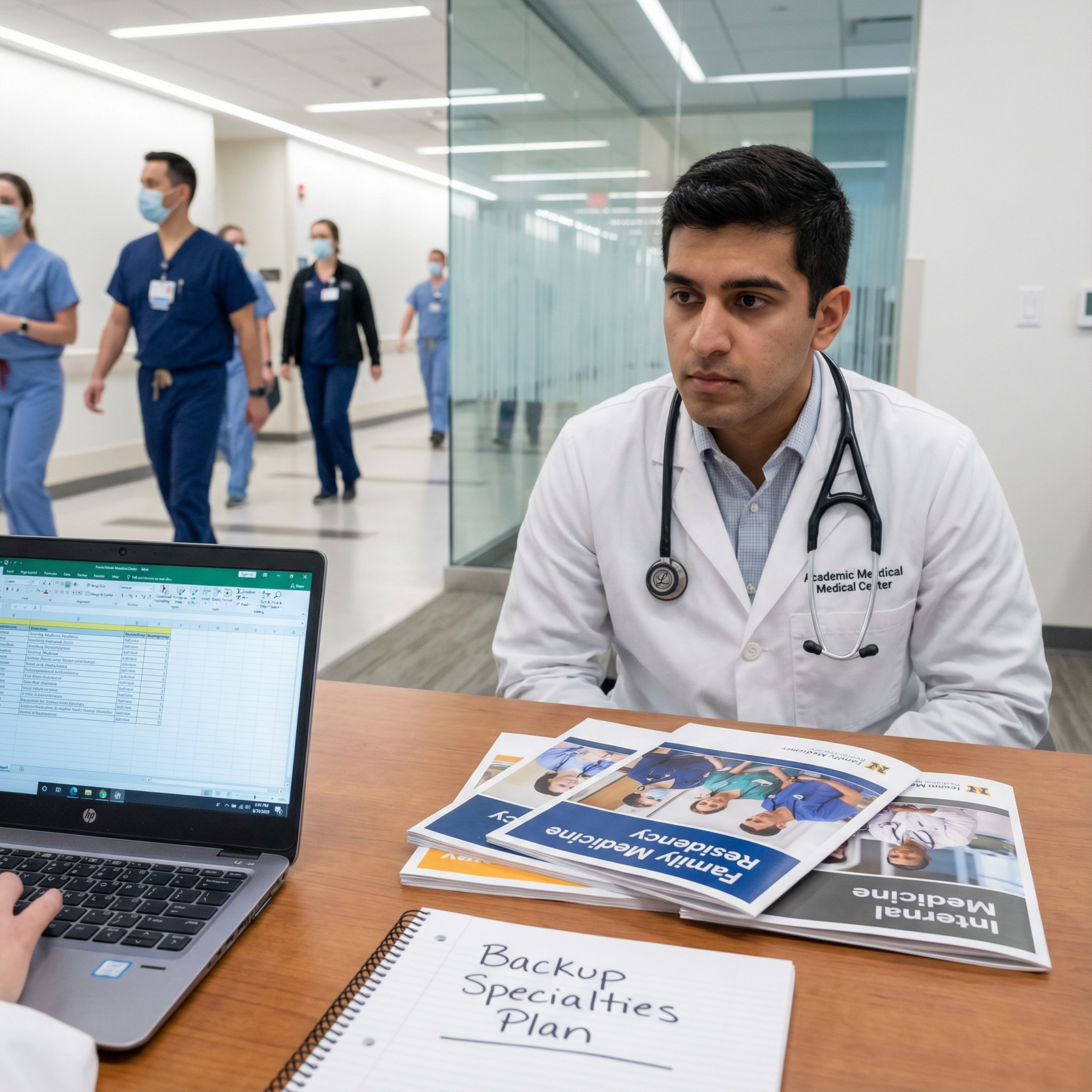
Only 46% of US MD seniors who ranked a single highly competitive specialty with no backup matched into that field in one recent cycle.
Not 90%. Not “almost everyone if you’re strong.” Less than half.
Yet I still hear MS4s say with a straight face: “I’m going all‑in on derm. Having a backup is basically admitting I’m not committed.”
Let me be blunt: that mindset is how people end up scrambling into a prelim year they hate, or worse, going unmatched with $250K of debt and no plan.
You are not a Netflix original. The Match algorithm is not a rom‑com where passion and “manifesting” magically overcome numbers and supply‑demand curves.
Let’s dismantle this.
The Myth: “If I Really Want It, I Shouldn’t Rank a Backup”
You’ve probably heard some version of this in a hallway:
- “My mentor said if I rank IM, programs will smell the lack of commitment to neurosurgery.”
- “Backup lists are for people who aren’t competitive.”
- “I’d rather go unmatched than ‘settle.’”
I’ve watched people actually live that line. And then sit in the med school dean’s office on Match Day afternoon with swollen eyes saying, “I thought if I backed myself fully, it would work out.”
Here’s what the data actually shows.
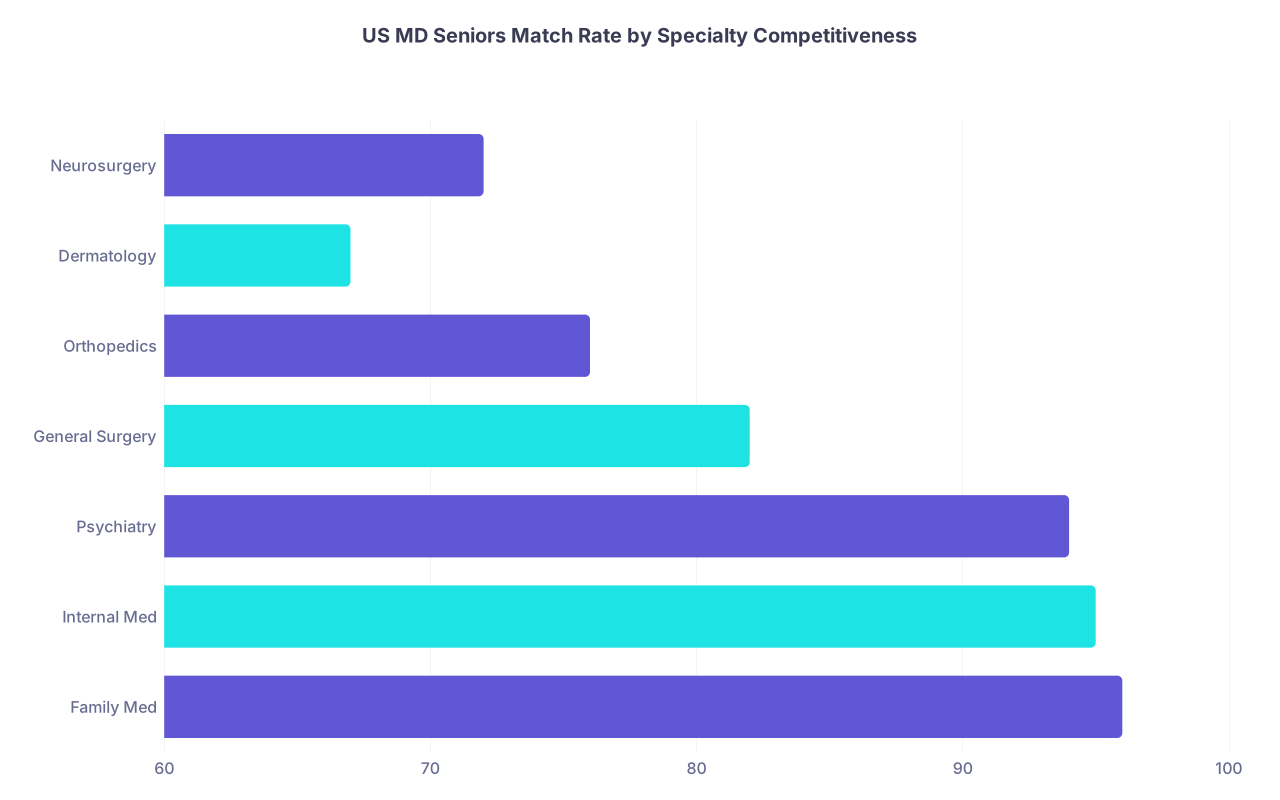
| Category | Value |
|---|---|
| Family Med | 96 |
| Internal Med | 95 |
| Psychiatry | 94 |
| General Surgery | 82 |
| Orthopedics | 76 |
| Dermatology | 67 |
| Neurosurgery | 72 |
Those are approximate ballpark rates, but the pattern is consistent year after year in NRMP data: “lifestyle” and highly competitive surgical specialties have much lower match rates, even for US MD seniors.
Notice something else in NRMP’s Charting Outcomes: unmatched applicants to competitive fields often have objectively strong stats. Step in the 240s–250s. Honors. Research. Good letters.
They didn’t fail because they were lazy or mediocre. They failed because the math is brutal and they didn’t give the algorithm anywhere else to send them.
A backup specialty does not lower your chance in your dream field. The algorithm tries to match you to your first choices first. Ranking anesthesia after EM does not magically make EM programs reject you.
The “no backup shows commitment” story? It’s emotional, not logical.
Programs do not see your rank list. They don’t get a pop‑up that says: “This applicant listed you #1 of 14 vs #1 of 3.” That’s fantasy.
How the Match Actually Works (And Why Backups Don’t Hurt You)
Let’s walk through this once, because a shocking number of MS4s kind of “vibe” their way through understanding the algorithm.

| Step | Description |
|---|---|
| Step 1 | Applicant rank list |
| Step 2 | Try top choice |
| Step 3 | Try next program |
| Step 4 | You tentatively match |
| Step 5 | Compare with lowest ranked match |
| Step 6 | You replace them |
| Step 7 | Move to next applicant |
| Step 8 | Did program rank you? |
| Step 9 | Program full? |
Key points that kill the “backup = giving up” myth:
- The algorithm is applicant‑proposing. It starts with your #1, then #2, etc. It does not start by asking “what’s their backup?”
- Programs never see where they sit on your list. They only see if they ranked you, and where you land in their list if spots are available.
- A backup specialty only becomes relevant if every program in your primary specialty list says “no” or fills with higher‑ranked applicants.
So in practice:
- If you’re competitive enough for your dream specialty, you’ll match there and your backup ranks are irrelevant.
- If you’re not competitive enough, or you get unlucky, your backup ranks determine whether you have a residency position at all.
Having a backup is not Plan B emotionally. It’s Plan A for not being unemployed.
Who Actually Needs a Backup Specialty?
Here’s where people lie to themselves.
They say, “Backup specialties are for weaker applicants,” then quietly omit the context that they’re applying to plastic surgery with a Step 2 CK of 235 and one case report.
The real question isn’t “Am I strong?” It’s “What field am I playing in, and how crowded is it?”
| Primary Specialty | Typical Match Risk for US MD Seniors | Backup Smart? |
|---|---|---|
| Family Med | Low | Usually no |
| Psychiatry | Low–Moderate | Maybe |
| Internal Med | Low–Moderate (categorical) | Maybe |
| EM (current market) | High (job + match uncertainty) | Yes |
| General Surgery | Moderate–High | Yes |
| Ortho, Derm, ENT, Plastics, Neurosurg, Urology, Ophtho | Very High | Absolutely |
If you’re going after:
- Dermatology
- Plastic surgery
- Neurosurgery
- Orthopedic surgery
- ENT
- Urology
- Ophthalmology
…you should assume the Match is not in your favor, even with solid stats. These are supply‑limited fields. There just aren’t enough seats.
People match them every year, obviously. But many strong applicants do not. In some cycles, there are literally fewer spots than fully qualified applicants.
If you’re in a relatively less competitive field (say, categorical internal medicine) and you’ve got a strong, clean application, you may genuinely not need a backup specialty—though you might still need geographic backups and a wide net.
But if you’re in a very competitive field and telling yourself, “I don’t need a backup because I did fine on Step and people like me”? That’s denial dressed up as optimism.
“But a Backup Means I’m Not All‑In” – The Commitment Myth
This one’s cultural, not statistical. It’s the identity stuff.
You spent two years telling everyone you’re going to be an orthopedic surgeon. You joined the ortho interest group. You presented that poster at the Academy meeting. Your Instagram has OR photos.
Now you’re supposed to admit you might also rank anesthesia or general surgery? That feels like betrayal.
I get it. I’ve heard residents say to students, “If you’re thinking back up IM, you’re not a real surgeon.” It’s performative toughness, not smart strategy.
Here’s the reality:
You show commitment to your dream specialty by:
- Doing high‑quality rotations and away electives there
- Getting strong, specialty‑specific letters
- Producing credible research in that field
- Writing a personal statement that actually sounds like you understand the work
You do not show commitment by sabotaging your safety net.

Nobody in a program leadership meeting is saying, “We liked this applicant but we found out they might also like anesthesia, so let’s tank them.”
What they actually say in those rooms:
- “Did anyone work with her on service? How was she in the trenches?”
- “Are we sure he understands the lifestyle?”
- “Great letters. Strong team player. Let’s move her up.”
Your private decision to list a backup specialty does not enter that conversation. You’re giving imaginary weight to something programs literally cannot see.
How to Choose a Backup Without Torching Your Soul
Now the practical part. Because this is where people mess up.
“Fine, I’ll pick a backup.” Then they choose something completely disconnected, unrealistic, or that they actively hate.
The goal is not “any residency.” The goal is “a career you can live with and grow in.”
Here’s a better way to think about backup specialties.
1. Choose a functional backup, not just a numerically easier one
Some fields are easier to match, but that doesn’t mean they’re a good backup for you.
Ask yourself:
- What parts of my primary specialty do I actually love?
- Procedures? Longitudinal relationships? Acute resuscitation? OR? Clinic?
- What parts do I not care if I lose?
Then find specialties that share the core features you like.
Examples:
- Ortho applicant → backup: general surgery, PM&R, maybe anesthesia
- Derm applicant → backup: internal med (with eventual allergy/immunology or rheum), pathology
- ENT applicant → backup: general surgery, maybe anesthesia
- Neurosurgery applicant → backup: neurology, general surgery
These are not perfect equivalents. But they’re closer than “orthopedics or pediatrics, I guess.”
2. Make your backup credible on paper
Half‑hearted backups fail. Programs can smell when you did the bare minimum.
If you’re truly incorporating a backup, you need at least:
- A tailored personal statement for that specialty
- At least 1–2 letters that are acceptable in that field
- A few interview‑ready stories that explain your interest that don’t sound like, “Plan B because my Step score wasn’t enough for plastics”
Which means you can’t decide this on January 15th.
You do not need full‑blown parallel lives. But you do need to show that you’ve thought about and engaged with the backup field at more than a theoretical level.
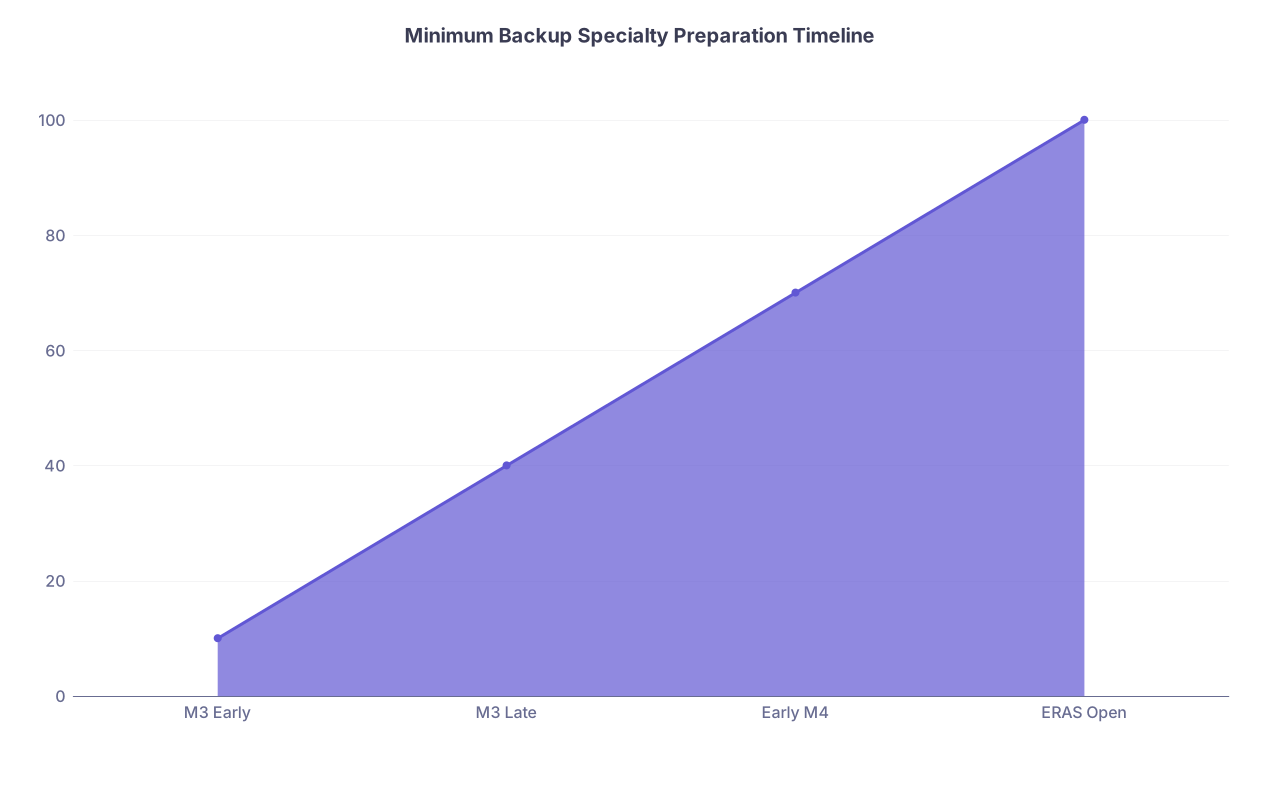
| Category | Value |
|---|---|
| M3 Early | 10 |
| M3 Late | 40 |
| Early M4 | 70 |
| ERAS Open | 100 |
Interpret that as percent of “backup readiness” (letters, exposure, narrative) you should ideally reach. Waiting until ERAS opens and starting from zero is how you end up with a laughably weak Plan B that doesn’t work.
3. Own your narrative – without self‑sabotage
You don’t need a tortured speech about your backup on every interview.
If someone asks, “What other specialties did you consider?” you can say, calmly:
- “I was strongly considering ENT and general surgery. I loved the OR and procedural work in both. Over time, I realized I wanted the broader case mix and more emergent cases, so I committed to general surgery as my primary path.”
Or for a derm applicant with IM backup:
- “I explored both dermatology and internal medicine. I loved the diagnostic side and pathophysiology. Ultimately I saw myself long‑term in a field with more inpatient complexity and broader systemic disease, so IM felt right.”
Notice what you don’t say: “Derm didn’t work out so I’m here.” That’s how you light yourself on fire in front of an IM program director who wants people who actually want their field.
You frame it as genuine exploration, then a decision. Not failure.
Parallel Planning: The Grown‑Up Strategy
The smartest applicants I’ve seen in competitive fields do something most classmates don’t see: they run two quiet tracks in parallel.
Not equal weight. But not zero either.
They:
- Target 1–2 rotations or electives in a plausible backup field
- Cultivate at least one letter writer outside their dream field
- Keep notes on what they actually like/dislike about each specialty so they aren’t reinventing their story in October
- Make an honest, numbers‑based decision by late summer: “Do I stay single‑track, or do I formally incorporate a backup?”
Parallel planning is annoying. It takes more email, more scheduling, more mental effort. But it gives you optionality without broadcasting “I’m not serious” to anyone.

The “all‑or‑nothing” applicants feel more pure. More heroic. They also have a much higher chance of spending a year doing research they didn’t really want because they went unmatched.
You’re not less committed because you planned for multiple outcomes. You’re more mature.
When You Might Not Need a Backup Specialty
Let me be fair. There are situations where a true backup specialty isn’t necessary and might just dilute effort.
You probably don’t need a backup specialty if:
- You’re applying to a relatively less competitive field (FM, psych, many IM programs)
- You have strong, consistent metrics for that field (good Step 2 CK, no major red flags, solid clinical evals)
- You’re geographically flexible and willing to rank a wide range of programs
In that case, your “backup” is not a different specialty. It’s a longer rank list, including community programs, new programs, and less desirable locations.
But that situation is not most people aiming for derm, plastics, ortho, ENT, neurosurg, or even EM in the current job climate.
Confusing those two categories—treating derm like family med—is how people get burned.
The Real Failure Isn’t Having a Backup. It’s Magical Thinking.
The cult of “no backup” flatters your ego. It sounds decisive and bold.
But stripped of the bravado, it’s this belief:
“If I want it enough, I’ll be the exception to the statistics.”
Sometimes you will be. Many people are. But betting your entire professional trajectory on “I’ll be the lucky one” with no safety net isn’t romantic. It’s reckless.
You’re allowed to be ambitious and pragmatic. You can rank your dream specialty #1–15 and still have #16–25 as a field you’d actually be okay doing. That’s not giving up.
That’s refusing to let a broken, zero‑sum system have the last word on whether you get to practice medicine.

Key Takeaways
- Backup specialties do not reduce your chance of matching into your dream field; the algorithm always tries your top choices first.
- In highly competitive fields, not having a backup isn’t “commitment”—it’s ignoring supply‑demand reality and increasing your chance of going unmatched.
- Smart applicants do parallel planning: they build a credible, values‑aligned backup option while still going all‑in on their primary specialty at the top of the rank list.