
The myth that you can “just pick a backup specialty” without running the numbers is wrong. Backup planning is a data problem before it is a feelings problem.
If you are deciding on backup fields, you are really asking two questions:
- Where does my Step/Level score sit in each specialty’s distribution?
- How far down the prestige and competitiveness ladder am I willing to move?
Let’s quantify that.
1. The Score Bands Reality: Where You Actually Sit
Most applicants think in single numbers: “I have a 233” or “I got a 245.” Programs do not. They think in bands and cutoffs.
For USMLE Step 2 (now the main screening tool) and COMLEX Level 2, most specialties operate in rough bands:
- Below ~215–220: high risk in competitive fields, need strong story + institutional ties
- 220–235: solid for many core fields, marginal for competitive ones without something extra
- 235–250: competitive for most non-derm/ortho/PR/ENT/neurosurg programs
- 250+: strong anywhere, assuming the rest of the file is not a disaster
Those bands are not arbitrary. They roughly track NRMP “Charting Outcomes” data on matched vs unmatched medians.
Let me make this more concrete with a heavily simplified table. Numbers vary by year and source, but the pattern holds.
| Specialty Tier | Typical Matched Median Step 2 | Risk Zone (US MD) |
|---|---|---|
| Ultra-competitive (Derm, PRS, ENT, NS) | 255–260+ | <245 often high risk |
| Competitive (Ortho, Rad Onc, IR, Ortho Spine) | 250–255 | <240 significant risk |
| Upper-mid (EM, Anes, Rads, Gas, Neuro) | 245–252 | <235–240 more limited |
| Core (IM, Peds, FM, Psych, OB/GYN) | 235–245 | <225 more limited |
| Less competitive (Path, PM&R, Neuro, prelim-only) | 230–240 | <220 more limited |
You should mentally place yourself relative to these bands, not obsess over a single cutoff you see on Reddit.
Two key points:
- Cutoffs are usually set around the 25th–40th percentile of a program’s own applicant pool, not around national averages.
- Within any specialty, program tiers have very different bands. A community FM program may happily interview at 215; a top IM program may effectively cut at 245+.
So when you pick a backup specialty, you are not just changing field. You are shifting to a different score distribution—and you must see how your score percentile changes with that shift.
2. How Program Cutoffs Actually Work (Not How People Pretend They Do)
Program directors rarely articulate this clearly, but their screening logic is surprisingly consistent.
At a high level, many programs use something like:
- Hard screen: Below X → auto-reject
- Soft screen: X–Y → reviewed if something else is strong
- Comfortable: ≥Y → normal review
Where X and Y are different for every specialty and every tier of program.
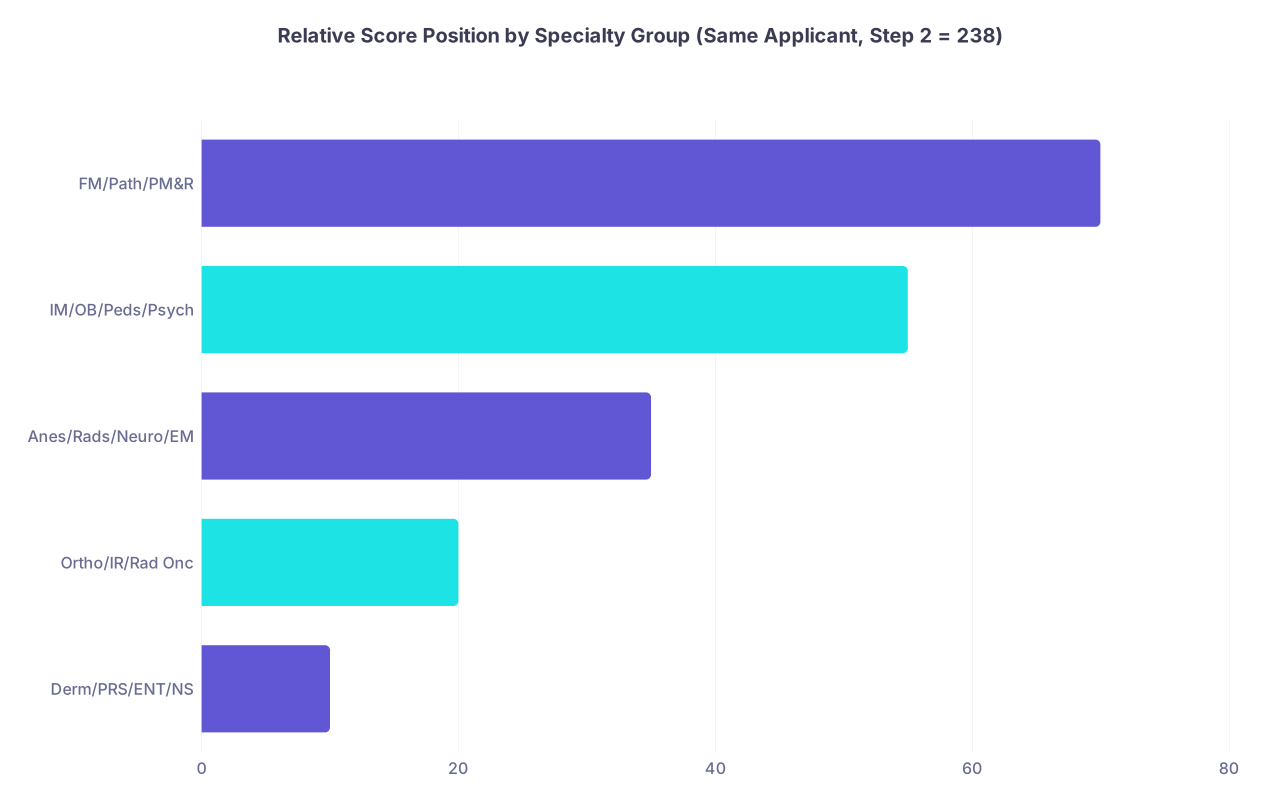
Let’s visualize how that feels as an applicant moving across specialties with the exact same score. Assume you are a US MD with a Step 2 of 238.
| Category | Value |
|---|---|
| Derm/PRS/ENT/NS | 10 |
| Ortho/IR/Rad Onc | 20 |
| Anes/Rads/Neuro/EM | 35 |
| IM/OB/Peds/Psych | 55 |
| FM/Path/PM&R | 70 |
Interpretation (approximate):
- In ultra-competitive fields, 238 might sit around the 10th percentile of interviewees. You are fighting uphill.
- In core fields, you jump to the mid-range (40–60th percentile).
- In less competitive fields, you are comfortably above the middle.
Same human. Same brain. Same transcript. The only thing that changed is the comparison group.
That is the entire logic behind sane backup planning: use specialty switching to move yourself up the percentile ladder.
3. Specialty Clusters: What Backs Up To What (Statistically, Not Emotionally)
Programs do not care about your feelings about “fit” as much as they care about risk. Risk of you not matching. Risk of you not passing boards. Risk of you not finishing.
When PDs look at backup applicants, they think in adjacency:
- Training overlap
- Clinical skill overlap
- Patient population overlap
- Historical applicant flow (who actually backs up into us)
Let’s group specialties into realistic “backup clusters” based on score expectations and training similarity, then talk cutoffs inside those clusters.
A. Ultra-Competitive Surgical / Lifestyle Cluster
Derm, Plastic Surgery, ENT, Neurosurgery
If you are primarily aiming here, you already know the bar:
- Typical matched US MD Step 2: often 255–260+
- Research volume: high; multiple pubs, often in-field
- Backup logic: You must assume that scores under ~245–248 put you in significant risk territory, even with great research.
Common backup fields people consider:
- Diagnostic Radiology
- Anesthesiology
- Radiation Oncology
- Internal Medicine (aiming for cards/GI)
- Sometimes Pathology (for research-rich applicants)
Reality: with a 245 in this cluster, you move from “borderline/weak” to “comfortably competitive” for many DR/Anes programs, and “solid” for good IM programs.
B. Competitive Ortho/Procedural Cluster
Orthopedic Surgery, Interventional Radiology (integrated), sometimes Urology
Score profile:
- Step 2 matched median: ~250–255 for US MDs at many programs
- Heavy emphasis on letters, ortho/IR away rotations, research
Common backups:
- Diagnostic Radiology
- Anesthesiology
- PM&R (especially for musculoskeletal interest)
- General Surgery (but this is increasingly competitive at strong programs)
With a score of, say, 242–248:
- Ortho: you are on the lower half of the successful pool, highly dependent on away rotations and letters.
- DR/Anes: you usually become mid-to-upper range.
- PM&R: often upper range, especially outside top-name programs.
That is what “backup” looks like on paper: using the same number to jump percentiles by switching comparison groups.
4. The Big Four Backup Magnets: IM, FM, Psych, PM&R
There are four specialties that frequently serve as backup destinations because their score distributions and seat volumes can absorb risk:
- Internal Medicine
- Family Medicine
- Psychiatry
- PM&R (to a lesser extent, but enough to matter)
I am going to be blunt. Many applicants misuse these fields as “dumping grounds” when they fail at something more competitive. Programs know this. They have seen the late “I love primary care now” personal statements.
If you want to use these as backups, you must understand their score bands and where you fit.
Internal Medicine: The Pressure Valve With a Hidden Cliff
IM has massive volume. It is the catch-all backup for:
- Failed derm/ENT/PRS/NS attempts
- Failed ortho/IR/rads/anesthesia attempts
- Late specialty changers who woke up in October
But IM is bimodal:
- Top academic IM (big university hospitals) – effectively competitive
- Community and smaller university IM – more forgiving
Approximate Step 2 cutoffs:
- Prestigious academic IM: soft screens around 240–245, real comfort closer to 248–250
- Solid university/community IM: soft screens 230–240
- Safety IM (lower-tier community): consider applicants in the 220s, sometimes below with good narrative
So if you have a 232:
- As a derm applicant: you are not in the game at nearly all programs.
- As an IM applicant: you can still match decently, but you must target programs realistically and apply broadly.
Family Medicine: Absorbs Volume, But Not Indiscriminately
FM appears to have “no cutoffs,” but data shows there are still patterns:
- Matched US MD Step 2 median often high 220s–230s
- Matched US DO Level 2 often mid- to high-500s
Risk zones:
- Below ~215 on Step 2: FM will want a clear explanation, strong clinical performance, and clean professional history.
- Above ~225: statistically safe for US MD/DO if you apply appropriately and do not sabotage yourself.
FM is a classic backup for:
- Lower Step scores
- Geographic flexibility
- Applicants switching late from more competitive fields
But if you are a late switcher from a surgical field with a thin primary care story, you must fix the narrative. FM PDs can tell when someone suddenly “discovers” they love continuity of care in November.
Psychiatry: The New Semi-Competitive, Data-Driven Reality
Psych exploded in popularity. That changed the backup math.
Data trends over the last decade:
- Filled positions by US MD/DO increased.
- Mean matched Step scores climbed significantly.
Where this leaves you:
- Step 2 in low 230s: no longer a slam dunk at popular urban academic psych programs.
- Step 2 sub-220: risk increases even at smaller programs, you need strong letters and a clean history.
Psych can still function as a backup, but it is not the “easy” field people used to claim. If your primary target was derm/ENT with a 260, then yes, psych is more forgiving. If you are sitting at 215, do not treat psych as a guaranteed parachute.
PM&R: The Musculoskeletal Backup With Quiet Competition
PM&R attracts:
- Ortho near-misses
- Sports medicine hopefuls
- Neuro and MSK-interested applicants who want better lifestyle
Score reality:
- Step 2 medians commonly in the low-to-mid 230s for US MDs
- Many programs soft-screen around 225–230
The danger zone is assuming PM&R is wide open. In certain regions (especially big academic rehab centers) it is quietly very competitive, because the applicant pool is self-selected and often strong.
5. How Cutoffs Shift When You Change Backup Direction
The critical question is not “What is the cutoff?” It is “How does my risk profile change when I pivot fields?”
Let me walk through three realistic archetypes.
Case 1: Mid-240s, Aiming High Surgical, Needs Rational Backup
- Step 2: 246
- Primary target: ENT
- Research: multiple projects, 1–2 pubs, mostly ENT
- School: mid-tier US MD
ENT world:
- 246 is below the mean of matched applicants at most academic ENT programs.
- With strong letters and away rotations, you have a shot, but risk is real.
Backup logic:
- Diagnostic Radiology and Anesthesia both have matched medians around 245–250.
- In many DR/Anes applicant pools, 246 puts you roughly at or slightly below the median but well out of the danger zone.
So your “backup shift” is something like:
- ENT: 30–40% match probability (made-up number, but directionally right)
- DR/Anes: 70–80%+ if you apply broadly and realistically
- IM: 90%+ at non-elite programs
This is rational. You move from sub-median to near-median and above-median pools.
Case 2: Low 230s, Competitive But Not Elite, Wants Procedure
- Step 2: 231
- Primary target: Anesthesiology
- Research: decent but not heavy, mixed topics
- School: US DO
Anesthesia world:
- 231 for DO is below the mean for matched DO applicants at many university Anes programs.
- Some community Anes programs still interested, but screens around 230–235 are common.
Backup options people whisper about:
- PM&R
- Psych
- IM
- FM
Score re-framing:
- In PM&R: 231 is mid-range or slightly above mid-range in many places.
- In Psych: 231 is competitive, but not “guaranteed.” You need strong psych interest.
- In IM: 231 is comfortable for community programs; borderline for big-name academic IM.
- In FM: 231 is above the mean in many programs.
Here, a dual-application strategy Anes + PM&R or Anes + IM/FM makes statistical sense. Anes + Psych might also work, but only if your psych story is credible.
Case 3: Below 220, Need High-Probability Backup
- Step 2: 218
- Primary target: initially EM, realized late that EM became brutally competitive
- Research: minimal, some QI
- School: US DO
EM world:
- Recent data: EM saw a big squeeze. Even US MDs in the low 220s had trouble at popular programs.
- DO with 218 is high-risk in EM if applied as sole specialty.
Backup logic:
- FM and some community IM programs still have generous score windows and care more about clinical performance and fit.
- Psych and PM&R are no longer reliable parachutes at this score; some will screen you out.
If you want to play the numbers, EM cannot be your only field. You probably need:
- EM + FM, or
- EM + IM (broad, realistic list), or
- EM as a “reach field” with primary focus on FM
That is how you let the score data drive the choice, instead of ego.
6. Dual-Apply Strategy: How Many Programs Per Field?
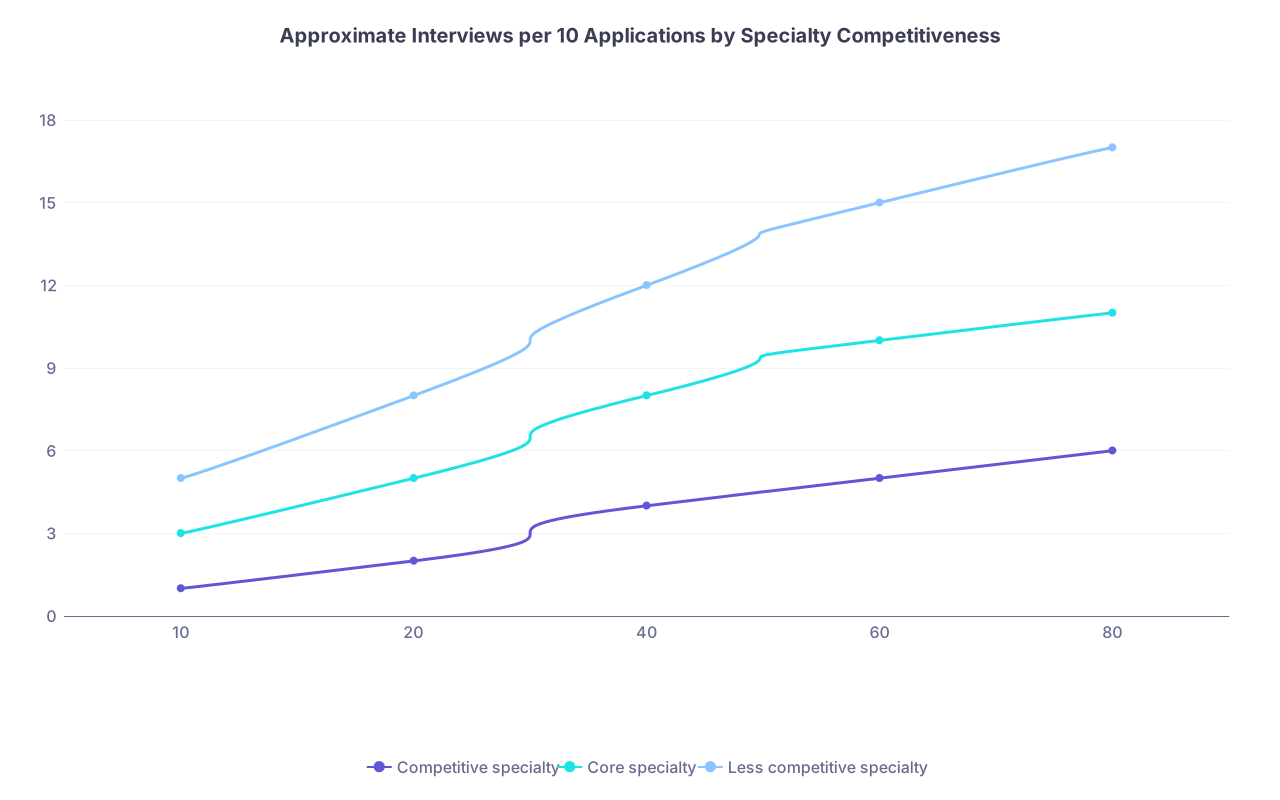
Another place people ignore data: program counts. If you shift to a backup field but apply to only 5–10 programs in that field “just in case,” your odds barely move.
Look at the rough relationship between program count and interview yield by competitiveness. These are directional, not exact.
| Category | Competitive specialty | Core specialty | Less competitive specialty |
|---|---|---|---|
| 10 | 1 | 3 | 5 |
| 20 | 2 | 5 | 8 |
| 40 | 4 | 8 | 12 |
| 60 | 5 | 10 | 15 |
| 80 | 6 | 11 | 17 |
If you are building a true backup plan:
- Competitive primary + core backup → 30–60 programs in primary, 20–40 in backup
- Competitive primary + FM/Path backup → 30–60 in primary, 20–30 in backup
- Core primary with modest risk + no backup → 40–60 programs total, unless you are extremely strong
Applying to 5–8 “safety” programs is theater. The math does not move.
7. Timing: When You Must Commit To a Backup Field
Score bands are one axis. Time is the other.
There is a very predictable timeline meltdown I see every year:
- June–July: “I will see how away rotations go, then decide if I need a backup.”
- September: ERAS opens, letters are late, personal statement is half-finished.
- October: Panic: “Should I add 10 IM programs now, just in case?”
By that point, you have already made your choice. Half-hearted backup applications launched in October with:
- No specialty-specific letters
- Generic, obviously recycled personal statements
- No evidence of longitudinal interest
perform poorly, even if your scores are good enough.
If your Step/Level score is below your primary specialty’s matched mean by more than ~10–15 points (or equivalent for COMLEX), you should at least model a backup plan by July:
- Does your score put you above the median in a backup field?
- Do you have any history (electives, research, volunteering) that matches that backup?
- Can you secure 1–2 letters in that field by early September?
If yes, seriously consider dual-applying. Not in October. In August.
Here is an underused tool: a simple decision flow.

| Step | Description |
|---|---|
| Step 1 | Get Step 2 score |
| Step 2 | Identify potential backup field |
| Step 3 | Primary only or limited dual apply |
| Step 4 | Plan dual-apply, secure backup letters |
| Step 5 | Consider less competitive backup or broaden geography |
| Step 6 | Prepare field specific PS for both |
| Step 7 | Score within 10 pts of primary specialty mean? |
| Step 8 | Have strong letters and research in field? |
| Step 9 | Score above median in backup field? |
Cold, but effective.
8. COMLEX-Only and IMG Realities: Different Baselines, Same Logic
If you are COMLEX-only or an IMG, the same score-band logic applies, but your baseline shifts downward for many specialties due to program bias.
Patterns I have seen repeatedly:
- Some competitive specialties effectively ignore COMLEX-only applicants unless they also have USMLE.
- Many core fields (FM, IM, Psych, Peds) have wide doors for DO/IMGs if scores are clean and there are no red flags.
- For IMGs, the relative position in the pool matters more than the absolute score: a 245 USMLE from an IMG may still be treated like a lower-percentile candidate in derm or ortho, but becomes very strong in FM or community IM.
The backup principle is unchanged:
- Identify fields where your score percentile is high relative to their typical matched pool.
- Ensure your application content is coherent with that choice (letters, PS, experiences).
Do not decide on backup solely based on anecdotes from one senior from your school who broke into ortho from nowhere. Outliers make good stories and terrible strategy.
9. Pulling It Together: How To Actually Choose a Backup Field
Strip the emotion out for an hour and run a simple three-step process.
Quantify your position.
- Compare your Step/Level score to the latest matched medians for your primary specialty.
- Calculate your “gap”: are you above, at, or 5–10–15 points below?
List 2–3 plausible backups.
Criteria:- Your score would be at or above the median in that field.
- You can tell a semi-plausible story of interest by September.
- You can get at least 1 specialty-appropriate letter.
Decide on one of three strategies by August:
- Primary only: you are at/above mean with strong application → accept risk.
- True dual apply: primary + one backup with 20–40 programs each.
- Backup-dominant: you push most applications to the safer field, keep primary as a reach.
Then commit. Do not half-apply everywhere and hope the numbers bail you out.



Bottom Line
Three points, no fluff:
- Step scores function in bands and percentiles, not as magic single numbers. A 238 can be weak in ENT and strong in FM at the same time.
- Backup specialties only work if your score moves you into a higher percentile bracket in that new field and your application narrative actually matches that choice.
- Dual-apply decisions should be made early, with real program volume and field-specific letters, not as a last-minute October panic after the data has already made the decision for you.