The fantasy that “a strong applicant will just get enough interviews” is wrong. Interview yield by specialty is wildly uneven, and if you ignore that data when picking backups, you are gambling, not planning.
You are not applying to “residency in general.” You are entering multiple, parallel markets that behave very differently. The same application can generate 20+ interview invites in one specialty and 3 in another. I have seen it happen—same person, same year, different tabs in ERAS.
This article is about treating interview yield as a quantitative problem, not a vibe check. Once you understand how invite patterns differ by specialty, you can design backup plans that actually protect you instead of just making you feel better.
1. What “Interview Yield” Really Means (And Why You Are Misjudging It)
Most applicants talk about “how competitive” a specialty is using Match rate or Step scores. That is incomplete. The operational metric that matters during application season is:
Interview Yield = Invites Received / Programs Applied To
This is where people get burned. They pick a “backup” specialty that is numerically easier to match, but with:
- lower yield per application
- heavier geographic bias
- stronger preference for home/affiliated students
Result: they spray 60–80 applications for 5–7 interviews and think “backup” means “apply more.” It does not.
You should be thinking in three linked variables:
- Applications submitted (N)
- Interview yield (invites per 10 apps)
- Expected total interviews (invites)
Then mapping that to: “What number of interviews gives me a >90% chance to match in this specialty?”
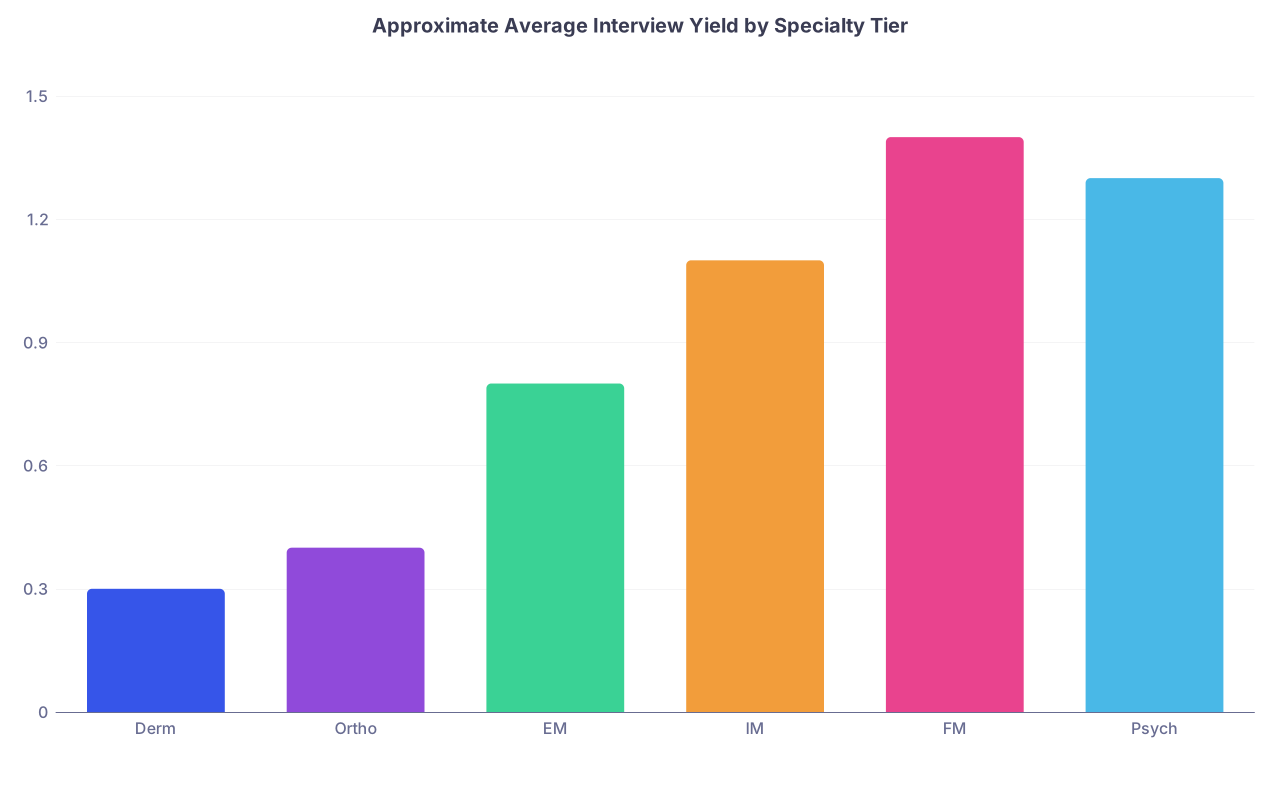
Let us ground this with some realistic, synthetic but representative numbers.
| Category | Value |
|---|---|
| Derm | 0.3 |
| Ortho | 0.4 |
| EM | 0.8 |
| IM | 1.1 |
| FM | 1.4 |
| Psych | 1.3 |
Interpretation: for every 10 applications, the average applicant might get:
- Dermatology: ~3 invites per 100 apps → 0.3 per 10
- Orthopedics: ~4 per 100 apps → 0.4 per 10
- Emergency Med: ~8 per 100 apps → 0.8 per 10
- Internal Med: ~11 per 100 apps → 1.1 per 10
- Family Med: ~14 per 100 apps → 1.4 per 10
- Psychiatry: ~13 per 100 apps → 1.3 per 10
The exact values vary by year and applicant profile, but the relative story is consistent: your “backup” often sits in the 1.0–1.4 range, not 3–4. That means you cannot brute-force your way out of a bad plan.
2. Competitiveness ≠ Backup Viability: Reading the Data Correctly
The data on Match rates misleads applicants constantly. Consider a simplified snapshot:
| Specialty | Overall Match Rate | Avg Interview Yield (invites per 10 apps) |
|---|---|---|
| Dermatology | ~65% | ~0.3 |
| Orthopedic Surg | ~70% | ~0.4 |
| Emergency Med | ~80% | ~0.8 |
| Internal Med | ~95% | ~1.1 |
| Family Med | ~96% | ~1.4 |
| Psychiatry | ~93% | ~1.3 |
Two key points:
- Match rate is conditional on actually being ranked by some programs. That requires interviews.
- Interview yield by specialty is shaped by structural factors:
- emphasis on away rotations (ortho, ENT, some EM)
- strong home-program preference (surgical fields, some IM academic programs)
- program density (FM vs Derm)
- screening thresholds (Step, research, AOA, etc.)
So planning backups is not: “I want Derm, so I will back up with EM because EM is less competitive than Derm.” That is the wrong conceptual level. You should ask:
- Given my profile, what is my plausible yield in each specialty?
- How many interviews am I likely to get if I apply broadly?
- Does that number cross the safety threshold (roughly 10–12 interviews for most categorical specialties, more for ultra-competitive, fewer for FM)?
Example: The Overconfident Derm + EM Applicant
Profile:
- Step 2: 247
- Top-quartile class rank
- 1 derm publication, 1 poster
- No home derm program, strong EM SLOEs
Plan: 80 Derm applications, 60 EM applications.
If they are an average-ish derm applicant:
- Derm yield: 0.3 invites per 10 → 80 apps ≈ 2–3 invites
- EM yield: 0.8 per 10 → 60 apps ≈ 4–5 invites
Total: maybe 6–8 interviews across two specialties. Risky. That is not a secure backup plan. The EM component is not generous enough to rescue a mediocre Derm cycle.
You fix that not by panicking but by doing the math before ERAS submission.
3. High-Risk vs High-Yield Specialties: How the Markets Behave
You can roughly group specialties into three buckets in terms of interview yield and structure.
A. Ultra-Competitive, Low-Yield (Terrible For Backup)
Think: Dermatology, Plastic Surgery, Neurosurgery, ENT, Ortho, Integrated Vascular, some Radiology and IR profiles.
Common traits:
- Extremely low interview yield per application
- Programs heavily weight:
- school pedigree
- research depth
- away rotation performance
- letters from known faculty
- Strong clustering of interviews: applicants either get many or almost none
From a backup perspective, these specialties are binary: either your profile is aligned and they are your primary target, or they are not strategic at all. They are almost never rational backups.
If your “backup” is just another ultra-competitive field with slightly different letters (e.g., “I’ll back up Ortho with Neurosurg”), you are not backing up. You are doubling down on the same risk profile.
B. Moderately Competitive, Medium-Yield (Conditional Backups)
Think: Emergency Medicine (with recent volatility), OB/GYN, Anesthesiology, general Radiology, some stronger IM and Pediatrics positions.
Traits:
- Yield more sensitive to:
- Step 2 and class rank
- SLOEs / strong specialty-specific letters
- geographic or institutional ties
- Some programs screen ruthlessly; others are more flexible
- Away rotations matter but are not everything
These can be effective backups only if:
- You have actually built a parallel profile (rotations, letters, personal statement)
- You accept that you may still need 15–25 applications per 3–4 expected interviews
They are not “easy.” They are simply more forgiving if you check the basic boxes.
C. Broad-Base, Higher-Yield (Real Backup Terrain)
Think: Internal Medicine (non-elite), Family Medicine, Psychiatry, Pediatrics (outside ultra-competitive regions), some Pathology.
Traits:
- Higher program density across many regions
- More linear relationship between number of applications and number of interviews
- More tolerance for:
- IMG status (depending on field and region)
- Step failures (if later scores are solid)
- Non-traditional backgrounds
This is where most true safety net strategies live. If your backup specialty is in this bucket and your yield per 10 applications is <1.0, that is a signal: your application has global weaknesses, not just specialty mismatch.
4. Using Interview Yield to Decide How Many Programs to Apply To
Planning without numbers is guesswork. You need to define:
- Target minimum interviews in primary specialty
- Target minimum interviews in backup specialty
- Realistic yield ranges for your profile in each field
Then back-calculate applications.
Rough Interview Targets
These are not rigid, but they are reality-based:
- Ultra-competitive fields (Derm, Plastics, etc.):
- 14–18+ interviews → reasonably safe
- 8–12 → high risk, possible SOAP
- Standard categorical fields (IM, Peds, Psych, OB, Anes):
- 10–12+ interviews → good safety margin
- 7–9 → moderate risk
- FM, community-heavy programs:
- 8–10+ interviews → usually safe
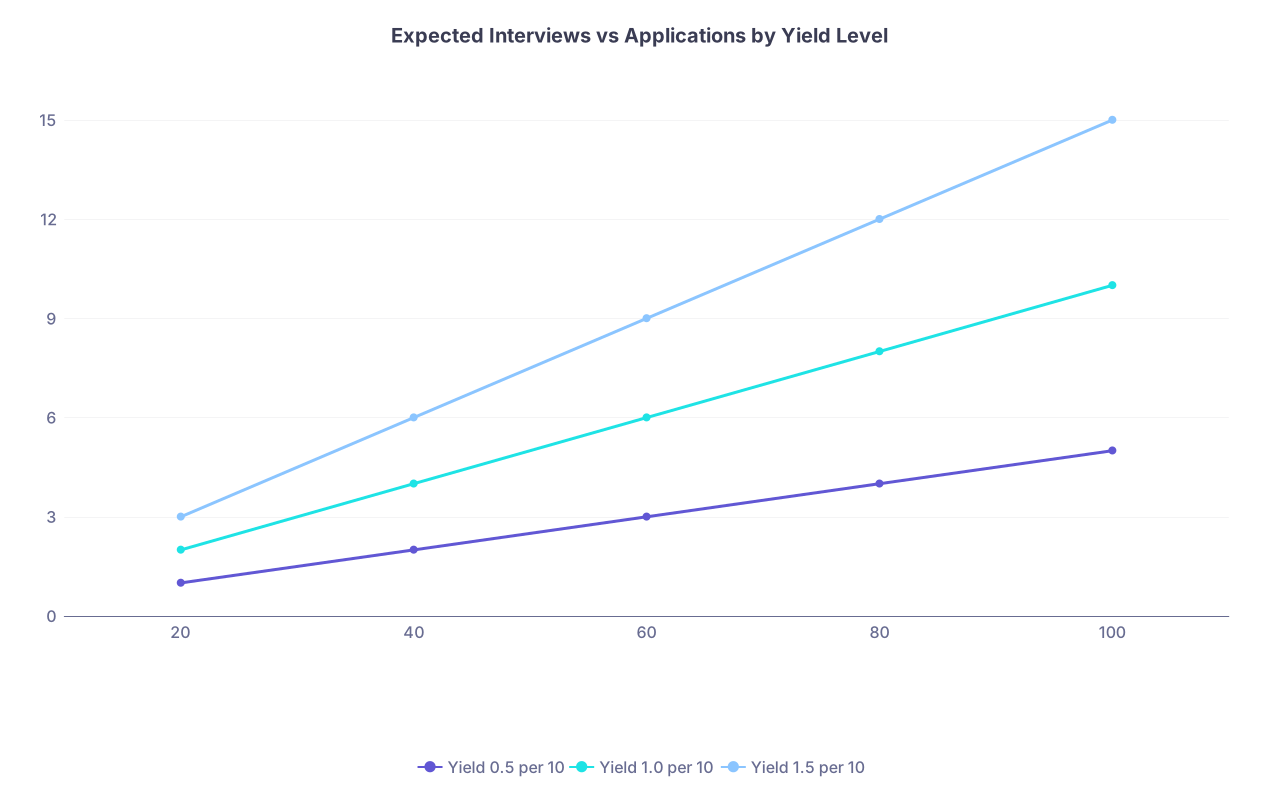
Now connect that to yield.
| Category | Yield 0.5 per 10 | Yield 1.0 per 10 | Yield 1.5 per 10 |
|---|---|---|---|
| 20 | 1 | 2 | 3 |
| 40 | 2 | 4 | 6 |
| 60 | 3 | 6 | 9 |
| 80 | 4 | 8 | 12 |
| 100 | 5 | 10 | 15 |
If your realistic yield in a backup specialty is ~1.2 per 10 applications and you want 10 interviews:
- 10 / 1.2 ≈ 8.3 → ~83 applications
That is the math people do after interview season, when they are already stuck. You should be doing it in August.
Concrete Example: IM Primary, Psych Backup
Applicant profile:
- Step 2: 232
- No failures
- Mid-tier US MD, middle of class
- Decent but not stellar research
- No geographic constraints, wants Northeast or Midwest ideally
Assumptions (these are typical, not guaranteed):
- IM yield: ~1.0 per 10 apps
- Psych yield: ~1.2 per 10 apps
Targets:
- IM: goal 12 interviews
- Psych: goal 8 interviews
Back-calculation:
- IM: 12 / 1.0 = ~120 IM apps
- Psych: 8 / 1.2 ≈ ~67 Psych apps
Is that overkill? For some applicants, yes. For this specific profile applying heavily in competitive regions, those numbers are entirely reasonable.
If they decide “I only want to apply to 80 IM and 30 Psych because fees are expensive,” the expected yield drops:
- IM: 80 * (1.0 / 10) = 8 interviews
- Psych: 30 * (1.2 / 10) ≈ 3–4 interviews
Total across both: perhaps 11–12 interviews. That is borderline as a combined plan.
You do not have to like these numbers. You just have to understand them if you want to manage risk.
5. Specialty-Specific Invite Patterns You Ignore At Your Peril
The raw yield numbers do not tell the full story. The shape of invite distribution also matters.
A. Home vs Away vs No Connection
In several specialties (ortho, neurosurg, ENT, many surgical fields), a huge fraction of interviews go to:
- home students
- students from “feeder” schools
- applicants who rotated there
If you are an outsider with no away rotation and no institutional ties, your effective yield may be half the average. That is why chasing those fields as backups is so dangerous.
By contrast, in FM, broad IM, and many Psych programs, connectivity still helps, but the baseline openness to unfamiliar schools is much higher. Yield is less sensitive to school pedigree.
B. Step Scores as a Step Function, Not a Gradient
Programs do not “gently” rate you lower as your Step 2 drops from 255 to 230. Many simply cut you off below a threshold. That produces stepwise yield patterns:
- Above a certain score → you get a consistent trickle of invites
- Below it → you get almost nothing, regardless of how many applications you send
So if your Step 2 is 216 and you are “backing up” Ortho with Radiology and Anesthesia without adjusting for this, you are ignoring the screening data. You need fields where thresholds are lower or more flexible—often FM, Psych, some IM and Pathology.
C. Volatile Fields (Looking at You, EM)
Emergency Medicine has been a textbook case of how macro shifts break naive planning. In recent years:
- Application numbers dropped
- Some programs underfilled
- Others still had strong demand
The result is inconsistent yield patterns, with some candidates getting far more invites than expected, others still facing steep screening.
If you are using 2018–2019 “EM is the perfect backup” mentality in a post-EM-oversupply/undersupply whiplash market, you are planning on outdated data. For volatile fields, you must look at the last 1–2 NRMP and specialty reports, not just what residents three years ahead of you said.
6. Multi-Specialty Strategies: When and How They Actually Work
A multi-specialty plan is not “apply to more things and see what sticks.” It needs internal logic.
At minimum, you need:
- Distinct personal statements (not lightly edited versions)
- Letters that actually match the specialty
- A rank list you can live with in every field you apply to
Here are three models that the data tends to reward.
Model 1: High-Risk + True Safety Net
Example: Primary Derm, backup Internal Medicine or Family Medicine.
This works if you are honest that:
- Derm is high risk even with a strong application
- IM/FM has much higher and more predictable yield
- You are genuinely willing to train in the backup specialty if you match there
The numbers often look like:
- 60–80 Derm applications → realistic expectation: 2–8 interviews depending on profile
- 40–80 IM or FM applications → realistic expectation: 6–14 interviews
In aggregate, your odds of matching somewhere are high, even if Derm collapses.
Model 2: Adjacent Fields With Different Structural Risk
Example: Primary Ortho, backup FM or IM, not Neurosurgery.
People get this wrong constantly. They back up:
- Ortho with Neurosurg
- ENT with Plastics
- IR with Diagnostic Rads only (both still score-sensitive)
That simply replicates the same profile risk. A more rational structure:
- Primary: Ortho
- Secondary: Anesthesiology if you have the letters and rotations
- True backup: IM or FM in regions you would accept
Then calculate yield separately for each layer.
Model 3: Geographic and Tier Diversification Within a Single Field
Sometimes the smartest “backup” is not a second specialty but:
- community-heavy vs academic-heavy programs
- broader geography vs one major city
- mid-tier programs vs top-20 only
For IM, Psych, Peds, FM, a big portion of your safety comes from where and how broadly you apply, not adding a second field. In those cases, your “backup” is structured as a different program tier, not a new specialty.
7. Practical Workflow: Designing Your Backup Around Invite Data
Here is how I would walk you through this, step by step.

| Step | Description |
|---|---|
| Step 1 | Choose Primary Specialty |
| Step 2 | Assess Competitiveness Data |
| Step 3 | Select Backup Specialty Bucket |
| Step 4 | Plan Within Specialty Backups |
| Step 5 | Estimate Yield for Each Specialty |
| Step 6 | Set Target Interview Numbers |
| Step 7 | Back Calculate Applications per Specialty |
| Step 8 | Secure Letters and Rotations |
| Step 9 | Submit ERAS with Quantified Plan |
| Step 10 | Is Primary High Risk? |
Concretely, your process should look like this:
Get field-specific data
- Latest NRMP Program Director Survey
- Specialty-specific application/match reports
- Your school’s internal match statistics by specialty (often very revealing)
Classify your primary specialty into:
- Ultra-competitive
- Moderately competitive
- Broad-base / higher-yield
Estimate your personal yield band (conservative, average, optimistic) using:
- Step 2 score relative to field norms
- School type and region
- Research and specialty exposure
- Presence/absence of home program
Pick backup specialty or structure that:
- Lives in a clearly higher-yield bucket
- Matches at least some of your prior experiences and letters
- You can commit to ranking programs in
Quantify applications:
- Assign target interview counts by field
- Divide by conservative yield to get application numbers
- Reality check: budget, time, and burnout vs risk reduction
Revisit once early invites come in
Early invite pattern is data, not noise. If your first 3–4 weeks show:- Primary specialty underperforming expectations and
- Backup specialty also underperforming
you should immediately consider:
- expanding application lists (late adds)
- targeting more community or less competitive regions
- preparing mentally for SOAP scenarios
8. The Brutal but Useful Parts of the Data
Let me be blunt about what the numbers say, year after year.
If your Step 2 is <220 and you have no major redeeming factors, trying to “back up” an ultra-competitive surgical field with another moderately competitive specialty is usually wishful thinking. You need at least one backup in a clearly higher-yield bucket.
If you are an AMG with Step 2 in the high 240s, solid letters, and coherent story, your real risk is not total non-match—it is mismatched expectations regarding geography and program prestige. For you, diversifying within a single field is often more powerful than adding a second specialty.
If you are an IMG, the concept of “backup” is even more about yield than prestige. A family medicine program in a less desirable location that has historically taken several IMGs per year is mathematically more protective than a shiny but IMG-rare IM program in a coastal city.
If you rely on anecdote—“my friend matched EM as a backup from Derm with only 20 applications”—you are ignoring survivor bias. The ones who got crushed by that plan are not on social media giving you their strategy.
Key Takeaways
Interview yield—not just Match rate—should drive how you pick and size your backup specialties. Compute expected invites, not just “number of programs.”
True backups live in higher-yield, structurally different specialties or program tiers, not just “slightly less competitive” versions of your dream field.
Design your plan with explicit numbers (target interviews, estimated yield, required applications) and be ready to adjust when early invite data tells you the market’s verdict on your application.