
The idea that “a backup specialty is the same everywhere” is flatly wrong. The data show that geography can make the difference between a realistic backup plan and a fantasy.
If you are treating backup specialties as purely categorical (e.g., “IM vs FM vs Psych”) and ignoring regional supply–demand, you are missing half the equation. Programs do not recruit into a vacuum. They recruit into specific labor markets with wildly different applicant pressures.
This is about where the backup specialty is relatively easier to match. Not “easy” in some absolute sense—there is no truly easy match anymore—but where the odds tilt in your favor given how the national numbers shake out.
1. The Core Reality: Match Difficulty Is Regional, Not Just Specialty-Based
Start with the national spine of the story: NRMP data. Then layer regional patterns on top.
The NRMP’s Program Director Survey and Results and Data reports make three things clear:
- Less competitive specialties (FM, IM categorical, Psych, Peds, Path, some IM subspecialty prelims/transitional) are not uniformly “less competitive” everywhere.
- Applicant behavior is geographically biased. People over-apply to coasts and under-apply to interior regions, especially rural-heavy states.
- Hospitals in certain regions are structurally understaffed and depend heavily on IMGs and less geographically restricted applicants just to function.
So you cannot just say “I will use Internal Medicine as a backup” and stop there. You must ask: Internal Medicine where?
To make this concrete, think in terms of three axes:
- Regional desirability to applicants (coastal urban vs interior / rural)
- Local physician supply (states with shortages vs glutted markets)
- IMG penetration (a proxy for how broad the applicant pool has to be to fill spots)
When you map those axes, some patterns pop out fast.
2. Broad Regional Patterns: Where Backup Specialties Match More Easily
I will simplify the country into a few functional regions for match purposes. This is not about census regions; it is about application behavior.
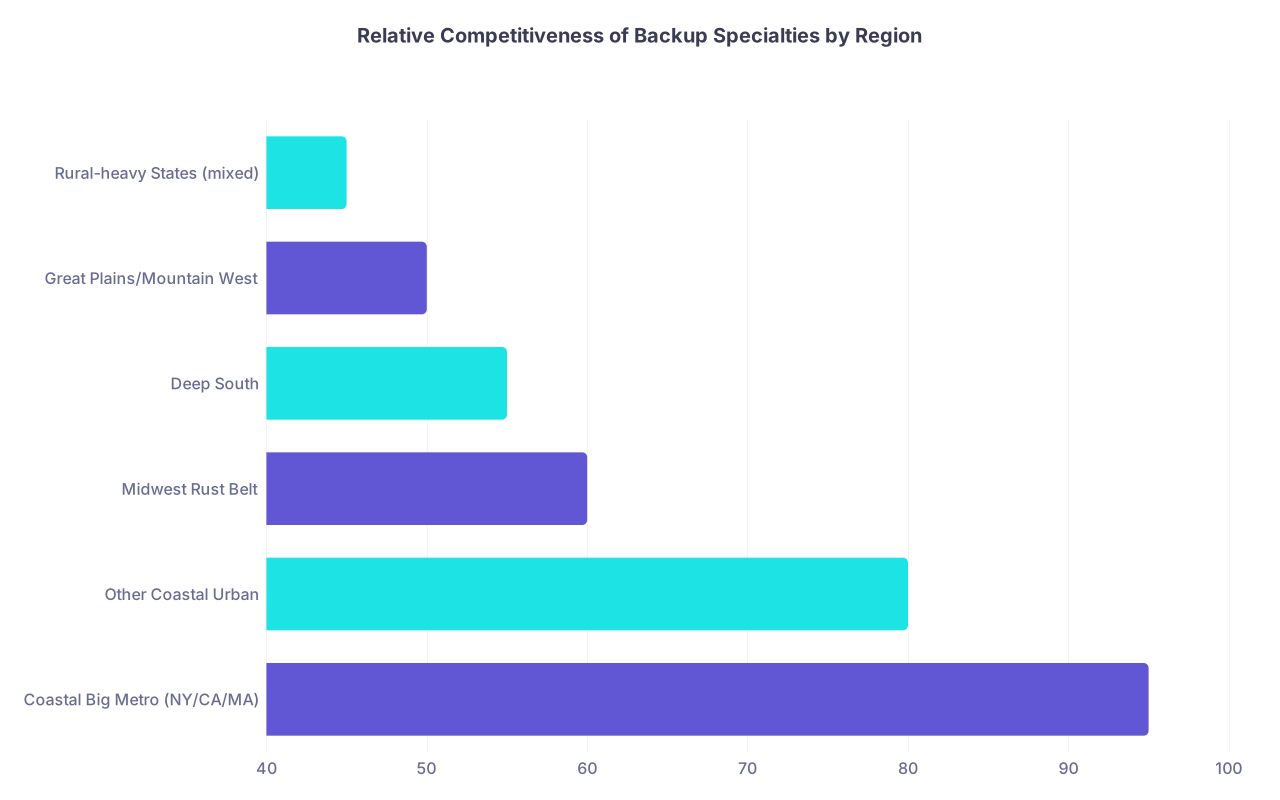
| Category | Value |
|---|---|
| Coastal Big Metro (NY/CA/MA) | 95 |
| Other Coastal Urban | 80 |
| Midwest Rust Belt | 60 |
| Deep South | 55 |
| Great Plains/Mountain West | 50 |
| Rural-heavy States (mixed) | 45 |
Scale here: 100 = very competitive for backup specialties (few “easy” matches), 40–60 = relatively easier.
2.1 Regions that generally match backup specialties more easily
These are the zones where Internal Medicine, Family Medicine, Pediatrics, Psychiatry, and Pathology are more forgiving relative to big coastal metros.
- Great Plains / Upper Midwest: Kansas, Nebraska, Iowa, Dakotas, parts of Minnesota, Missouri (outside St. Louis/Kansas City)
- Mountain West (excluding Denver/SLC metro pressure zones): Wyoming, Montana, Idaho, New Mexico, parts of Nevada (non-Vegas), Utah outside SLC
- Deep South and lower-resourced states: Mississippi, Alabama, Arkansas, Louisiana, parts of Georgia and South Carolina, West Virginia
- Rust Belt interior: Ohio (outside Cincy/Cleveland/Columbus), Indiana, Michigan away from Ann Arbor/Detroit, Western Pennsylvania, upstate New York
Common traits:
- Higher proportion of IMGs in core fields (often >40–50% of IM/FM positions)
- Persistent physician shortages per AAMC and HRSA data
- Higher number of community and safety-net hospitals using residency programs to meet workforce needs rather than prestige branding
2.2 Regions where backup specialties are not good backups
- Manhattan / Brooklyn / Queens heavy NY programs
- Boston / Cambridge
- San Francisco Bay Area / LA / San Diego
- Seattle, Portland, Chicago core, DC, Miami
In those hubs, even “backup” specialties like Psych and FM become effectively competitive because everyone wants to live there. The fill-rate for categorical IM with US grads is extremely high; IMGs and off-cycle applicants get squeezed.
Simple rule: If the city’s name regularly shows up on “Best Places for Young Professionals” lists, your backup specialty will be harder there than the national average.
3. How Different Backup Specialties Behave by Region
Let us separate major “backup” options and look at how geography modulates their competitiveness.
3.1 Internal Medicine (Categorical) as backup
Nationally, IM is broad, but regionally it is bimodal.
- Coastal academic centers: IM behaves like a mid-tier competitive specialty. High Step 2 medians, strong research expectations, and major preference for US MDs at established schools.
- Interior community programs: IM is the workhorse. Many positions stay IMG-heavy and less Step-obsessed.
| Region Type | IMG % in IM | Typical Step 2 Median* | Holistic Flexibility |
|---|---|---|---|
| NYC/Boston academic | 15–25% | High 240s–250s | Low |
| CA coastal university | 10–20% | High 240s–250s | Low |
| Midwest community | 40–60% | Low 230s–mid 230s | Medium–High |
| Deep South community | 50–70% | High 220s–low 230s | High |
| Great Plains / Mountain W | 50–80% | High 220s–low 230s | High |
*Step 2 medians are rough band estimates from PD interviews + anecdotal data; exact values vary per program.
Implication: If you are using IM as a backup from a mid-range US MD or DO program with Step 2 in the low 230s, your odds are dramatically different in:
- Boston vs Birmingham
- San Francisco vs Sioux Falls
I have seen applicants go 0/20 in IM applications all clustered in NY/NJ/CA, then match easily the next year after flipping their list toward Ohio/Indiana/Arkansas with essentially the same application.
3.2 Family Medicine
Family Medicine is the canonical “geographically sensitive” specialty.
Where FM is tougher:
- Urban coastal areas with lifestyle draw (Seattle, Portland, Bay Area, Boston)
- Prestigious academic FM programs with research/public health focus
Where FM is significantly easier:
- Rural-heavy states (KS, NE, ND, SD, MT, WY, ID, NM)
- Deep South and parts of Appalachia (MS, AL, AR, WV, KY outside Louisville/Lexington)
- Midwest small cities (Toledo, Fort Wayne, Peoria, Davenport, Sioux City)
The AAFP and NRMP data show that FM fill rates vary, but a constant: programs in rural-serving regions frequently scramble or fill late.
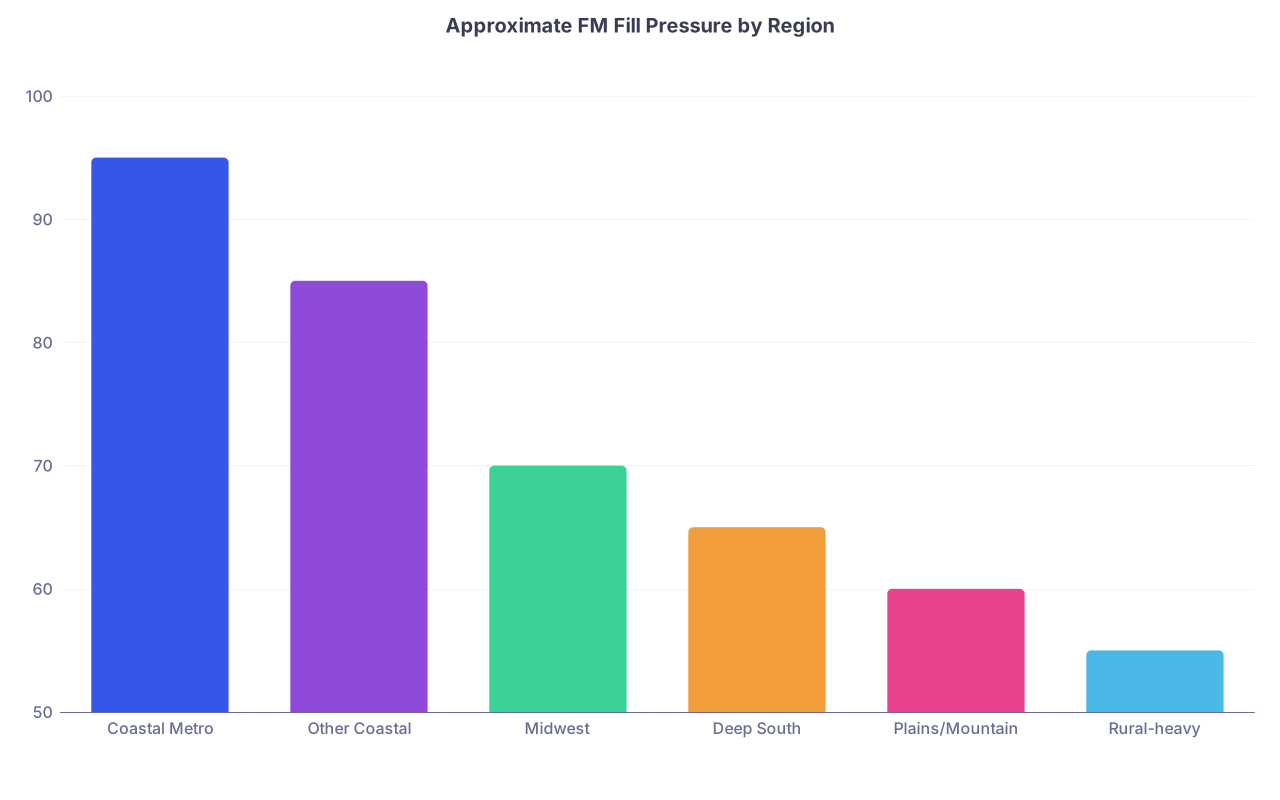
| Category | Value |
|---|---|
| Coastal Metro | 95 |
| Other Coastal | 85 |
| Midwest | 70 |
| Deep South | 65 |
| Plains/Mountain | 60 |
| Rural-heavy | 55 |
Again, 100 = very tight fill, lower = more open.
3.3 Psychiatry
Psych has gotten more competitive, but geography still matters.
- Big-name coastal academics (Columbia, MGH, UCSF, UCLA): Psych is no longer a backup. It is a target.
- Interior/rural-heavy states: community psych and smaller university-affiliated programs still have meaningful flexibility.
Expect higher acceptance of:
- Non-traditional applicants
- DOs and IMGs
- Those with later interest shifts, as long as they show some coherent story and minimal psych-relevant exposure
Watch particularly:
- Midwest: Missouri, Indiana, Ohio outside top-tier hubs
- South: Arkansas, Mississippi, Louisiana, parts of Georgia and South Carolina
- Plains/Mountain: Nebraska, Kansas, New Mexico, Utah/Wyoming/Idaho programs
3.4 Pediatrics
Peds sits between IM and FM.
Demand patterns:
- Nicely resourced children’s hospitals in big cities are competitive.
- Smaller children’s hospitals and community peds-heavy institutions in interior states have more leeway.
Regions where Peds is more forgiving:
- Midwest community programs and second-tier university affiliates
- South and lower-population states with pediatrician shortages (e.g., Mississippi, Arkansas, New Mexico)
I see US MD/DO applicants with mid-220s Step 2, modest research, and average MSPEs routinely match Peds in those regions even when similar profiles struggle to land Psych/IM in coastal cities.
3.5 Pathology and other less location-sensitive fields
Pathology is niche but behaves similarly:
- Academic pathology in coastal hubs is research-heavy and not a casual backup.
- Community and smaller university pathology programs in interior regions often advertise broadly and are more open to a range of backgrounds.
Other backup-ish tracks (prelim IM, transitional years) are more idiosyncratic, but the same regional gradient applies: coastal TYs at big-name hospitals are extremely competitive; interior community prelims are much more attainable.
4. Concrete Regional “Buckets” That Help or Hurt Backup Plans
Let me make this more operational. If you are structuring a backup specialty plan, you want to deliberately overweight certain geographies.
4.1 Regions that statistically amplify your backup odds
You should actively add these to your list if you are serious about matching a backup specialty.
Great Plains / Upper Midwest corridors
- Example states: Nebraska, Kansas, Iowa, North Dakota, South Dakota, parts of Minnesota and Missouri
- Common scenario: Large community hospitals with 8–20 IM/FM residents per year, many IMGs, high service needs.
- Data hint: Frequently >50% IMG in IM/FM; repeated references in PD survey to “difficulty filling unfilled positions.”
Deep South and lower-resource states
- Example states: Mississippi, Alabama, Arkansas, Louisiana, West Virginia
- Physician workforce data: among the lowest per capita physician counts in the country.
- Result: Programs more inclined to prioritize “will come here and actually stay” over “has perfect metrics.”
Mountain West / Rural-interior states
- Example states: Montana, Wyoming, Idaho, New Mexico, inland Nevada
- Demographic reality: Low population density, limited medical school seats, long-standing shortages.
- Psych, FM, and IM all often have a softer floor for standardized scores and research, especially at community sites.

4.2 Regions that quietly sabotage backup strategies
These regions inflate the apparent competitiveness of backup specialties:
Prestige-dense Northeast corridor
- Manhattan, Brooklyn, Queens, Boston, New Haven, Providence, Philadelphia core.
- Oversupply of applicants, especially couples matches and academic-track candidates.
- Even FM and Psych programs here often get flooded with strong US MD applicants who would be mid-tier elsewhere.
West Coast coastal strip
- Bay Area, LA, San Diego, Seattle, Portland.
- Lifestyle and geographic draw leads to high application volume across all specialties.
- Many FM and Psych applicants who say “I will stay West Coast only” are essentially opting into a much more competitive market.
Destination sun metros
- Miami, parts of coastal Florida, Phoenix, Austin/central Texas.
- Mixed picture: some hospitals still IMG-heavy, but others act like mini-coastal hubs because of lifestyle and migration patterns.
A US MD or DO with mid-range stats restricting a backup specialty to these locations is statistically handicapping themselves.
5. Putting It Together: How to Use Geography in Your Backup Plan
Now to the practical “how”.
5.1 Step 1: Quantify the regional risk
Look at your own profile honestly:
- School: US MD vs DO vs IMG
- Step 2: below 225, 225–235, 236–245, >245
- Red flags: Leaves, failures, professionalism notes
- Research: Strong (multiple pubs), moderate, minimal
Then assign yourself to a risk band for your primary specialty. If you are in the lower half of competitiveness, you must treat geography as a primary lever in your backup.
5.2 Step 2: For each backup specialty, map your geographic tiers
For example, say you are a US DO with Step 2 at 230, applying EM as primary, IM/Psych as backup.
Your geographic tiers might look like this:
- Tier A (High chance backup success):
- IM + Psych in Great Plains, Deep South, interior Midwest, Mountain West community programs.
- Tier B (Moderate chance):
- IM + Psych in non-major metros in the South and Midwest (e.g., Cincinnati suburbs, smaller Texas cities).
- Tier C (“stretch” for you):
- Psych in coastal urban centers, IM in top academic centers in big cities.
You deliberately overweight A and B, then sprinkle C. Not the other way around.

| Step | Description |
|---|---|
| Step 1 | Assess Competitiveness |
| Step 2 | Prioritize Interior Regions |
| Step 3 | Mixed Coastal and Interior |
| Step 4 | Focus on Plains, South, Midwest |
| Step 5 | Add Rural and Community Programs |
| Step 6 | Apply Broadly in Backup Specialty |
| Step 7 | Primary Risk High |
5.3 Step 3: Use program-level signals that correlate with “easier” matches
There are recurring markers:
- High IMG percentage historically (check program rosters and alumni lists).
- Location in smaller cities (<250k metro population) or obvious rural catchment.
- Explicit mention of “service to underserved” and strong community health focus.
- Fewer total applications reported in PD survey than coastal peers.
| Indicator | Better for Backup? |
|---|---|
| IMG proportion > 40% | Yes |
| Metro population < 250,000 | Yes |
| Community hospital core site | Yes |
| University flagships in big city | No |
| Highly ranked research institution | No |
You do not need to overcomplicate this. If the hospital is the only major medical center within 100+ miles, it is almost always more open for IM/FM/Psych/Peds backups than a downtown Boston or LA program.
6. Example Scenarios: How Geography Changes the Math
Concrete examples based on real patterns I have seen (details altered, but the structure stands).
Scenario 1: US MD, Step 2 = 228, aiming for Surgery, backup IM
Year 1:
- Applies GS mostly in big cities, backup IM only in NYC, Boston, Chicago, and SF Bay.
- Outcome: 0 GS interviews; 2 IM interviews (both strongly prefer research-heavy candidates); no match.
Year 2 (re-application with similar metrics):
- Keeps GS attempts modest but now adds 40 IM programs:
- 15 in Midwest community programs (IN, OH, MI, MO)
- 10 in Great Plains (NE, KS, IA, SD, ND)
- 10 in Deep South (MS, AL, AR, LA)
- 5 in Mountain West rural areas
- Outcome: ~8–12 IM interviews, 1–2 GS prelim/interview; matches categorical IM in Midwest.
Key difference was not a radically different CV. It was an intentional regional shift to where IM faces less applicant pressure.
Scenario 2: US DO, Step 2 = 234, primary EM, backup FM/Psych, wants West Coast
Initial instinct:
- Apply EM broadly, FM and Psych only in CA, OR, WA to “stay near family.”
- Data reality: West Coast FM and Psych PGY‑1 positions are flooded with US grads aiming to stay local; IMG penetration is low.
Better move:
- Keep a handful of West Coast FM/Psych programs for hope.
- Add:
- 15–20 FM in Plains/Mountain/South
- 10–15 Psych in Midwest and South
- Result: Significantly more backup interviews and a vastly higher probability of matching somewhere.
7. How Many “Easier Geography” Programs Do You Actually Need?
You do not need 100. You do need enough to convert statistical advantage into actual options.
For most US MD/DO applicants using a less-competitive specialty as backup:
- 15–25 programs in high-yield geographies (Plains, Midwest, Deep South, Mountain West) is usually a solid baseline if that’s your only backup specialty.
- If you are backing up with two specialties (IM + FM, IM + Psych, FM + Peds), you might split that: 10–15 in each, skewed toward easier geographies.
For IMGs:
- The bar is higher. I routinely see successful matches with 40–60 backup applications, heavy in IMG-friendly and rural/interior regions.
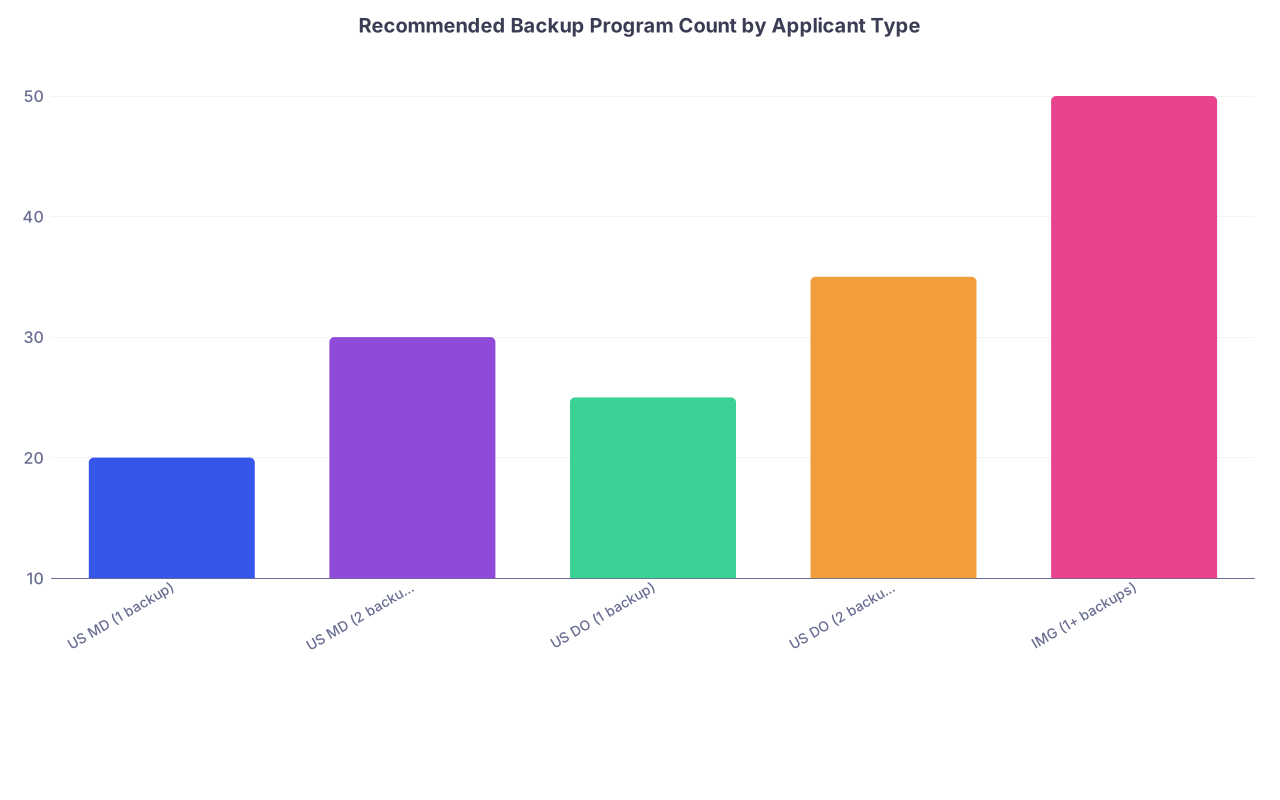
| Category | Value |
|---|---|
| US MD (1 backup) | 20 |
| US MD (2 backups) | 30 |
| US DO (1 backup) | 25 |
| US DO (2 backups) | 35 |
| IMG (1+ backups) | 50 |
These are not exact prescriptions, but they show the scale. And every one of those counts assumes you are leaning into friendlier regions, not just filling 30 slots with NYC and LA programs.
8. How to Research the Geography Efficiently
You do not have to reinvent the wheel.
Practical workflow:
- Pull a list of all programs in your backup specialty from FREIDA / ACGME / specialty society sites.
- Mark:
- State
- City population (rough lookup)
- Academic vs community
- Apparent IMG percentage (from resident bios)
- Tag each program as:
- Coastal metro
- Large non-coastal city
- Interior mid-size
- Rural/small city

- Prioritize applications in:
- Interior mid-size
- Rural/small city
- States with known physician shortages (AAMC and HRSA maps show this very clearly)
This does not take long. I have watched applicants do a rough version of this in an afternoon, and the difference in their final interview counts is substantial.
9. Non-Negotiable Reality: Geography Can Matter More Than a 5‑Point Step Difference
People obsess over whether a 234 vs 239 will sink their backup plan. Then they apply exclusively to saturated coastal urban markets. That is backwards.
The magnitude of regional effect is large:
- Moving your backup programs from coastal metros to interior shortage regions often has the effect of “raising” your application one tier in competitiveness.
- For many applicants, that geographic shift is worth far more than a marginal Step improvement.
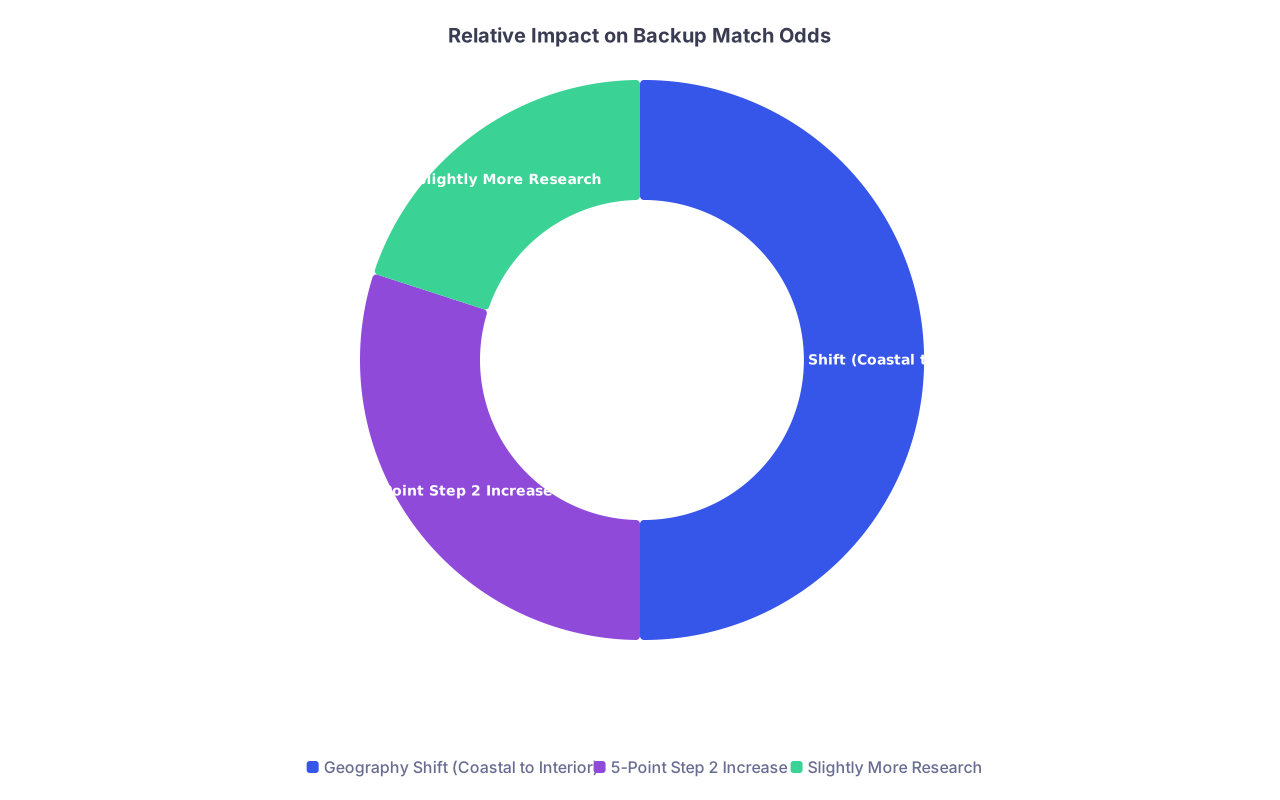
| Category | Value |
|---|---|
| Geography Shift (Coastal to Interior) | 50 |
| 5-Point Step 2 Increase | 30 |
| Slightly More Research | 20 |
Rough conceptual breakdown, but it captures the reality: geography is a heavy lever when you are near the margins.
Final Takeaways
- Backup specialties are not universally easy; they are easier in specific regions with applicant shortages and higher IMG penetration—mainly the Great Plains, Deep South, interior Midwest, and rural Mountain West.
- If you limit your backup applications to coastal metros and prestige hubs, you erase much of the statistical safety that those specialties offer.
- A deliberate geographic strategy—favoring interior, rural, and community-based programs—often shifts your match odds more than small improvements in scores or CV padding.